Daycare Dryer Vent Safety: A Guide for NY, NJ and CT
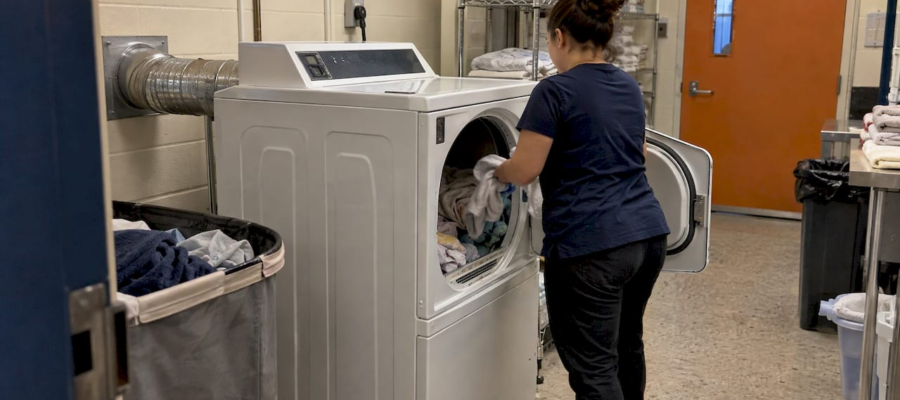
A daycare dryer vent is safe when it is rigid metal, short and straight, exhausts outdoors through a damper with no screen, and is cleaned on a schedule that matches how hard the dryer works. Daycares run more laundry than a family home: bibs, blankets, nap sheets, spare clothes. That means more lint in the vent and less time between loads. If you run a center in New York, New Jersey or Connecticut, the practical answer is a professional vent cleaning at least once a year, more often for heavy use, plus a weekly staff routine. Our dryer vent cleaning service covers that work for residential and commercial properties across the three states.
TL;DR
- Lint is the fuel. The U.S. Fire Administration lists failure to clean as the leading factor in clothes dryer fires.
- Use rigid or semi-rigid metal duct, 4 inches wide, no longer than 35 feet once bends are counted, venting outside with a backdraft damper and no screen.
- Clean lint screens every day of use and have the full exhaust duct cleaned at least yearly. Busy laundry rooms need it more often.
- Slow drying, a hot dryer top or laundry that stays damp are the warning signs. Act on them the same week.
- Check your state licensing rules and local fire code. Keep the service record where an inspector can find it.
Table of Contents
- Why a daycare dryer vent deserves more attention than a home one
- What a safe daycare dryer vent looks like
- How long can the vent be?
- Which rules apply to a daycare
- Warning signs your daycare dryer vent needs attention
- How often to clean
- A weekly and daily routine for staff
- What a professional vent cleaning covers
- Our view: treat lint as a schedule, not an emergency
- Book a daycare dryer vent cleaning
- FAQ
- Sources
Why a daycare dryer vent deserves more attention than a home one
A dryer pushes heat, air and lint through one duct. When the duct clogs, heat has nowhere to go. The U.S. Fire Administration explains that lint buildup reduces airflow and becomes a highly flammable fuel source, and that overheating can ignite the lint or materials nearby. The same report names failure to clean as the number-one factor in clothes dryer fires.
The national numbers show the scale. The National Park Service, citing the Consumer Product Safety Commission, reports about 15,500 clothes dryer fires a year in the U.S., averaging 10 deaths, 310 injuries and more than $84 million in property damage. New Jersey’s Division of Fire Safety says more than 13,000 fires a year start in laundry areas, and nearly 4,000 are caused directly by lint in the dryer or vent pipe.
In a daycare, three things raise the stakes:
- Volume. Several loads a day mean lint accumulates in weeks, not months.
- Occupants. Young children cannot evacuate on their own. Staff have to move them, so early warning and a lower fire risk matter more.
- Moisture. A full wet load can hold up to 1.5 gallons of water, according to the same fire administration report. If the vent is crushed or exhausts into a wall, attic or crawl space, that moisture can drive mold and poor indoor air.
The New York State Department of Health puts maintenance in simple terms: dryers combine heat, air and fuel, and the job is controlling the fuel. Its 2025 campus bulletin recommends cleaning dryers, lint traps and vents yearly, and more often in busy laundry rooms. A daycare laundry area is a busy laundry room.
What a safe daycare dryer vent looks like
Dryer venting is mostly about resistance. The Building America Solution Center at Pacific Northwest National Laboratory explains that when length, upward angles, kinks or narrow transitions add resistance, some dryers shut down while others keep heating and can ignite lint stuck in the vent. Short, straight, horizontal, smooth metal ducts work best.
Use this as a checklist when you look at your own setup:
| Part of the system | What it should be |
|---|---|
| Duct material | Rigid or semi-rigid galvanized steel or aluminum with a smooth interior. Vinyl, nylon and foil ducts are not recommended. |
| Diameter | 4 inches |
| Length | No more than 35 feet including the equivalent length of fittings |
| Transition duct (dryer to wall) | UL 2158A listed, no longer than 8 feet |
| Support | Supported along its run, at least every 12 feet under the model code |
| Joints | Clamps or foil tape. No screws that poke into the duct. |
| Exhaust | Outdoors only, never into an attic, crawl space, chimney or wall |
| Termination | Backdraft damper, no screen, at least 3 feet from building openings and 10 feet from an AC or heat pump condenser |
These specifications come from the PNNL guide to proper clothes dryer venting, which cites the International Residential Code. The U.S. Department of Energy’s Vent a Clothes Dryer guide agrees on rigid or semi-rigid sheet metal, exterior termination, a damper and no grille or screen, and adds insulation for ducts running through unconditioned space.
Why spiral and foil ducts fail
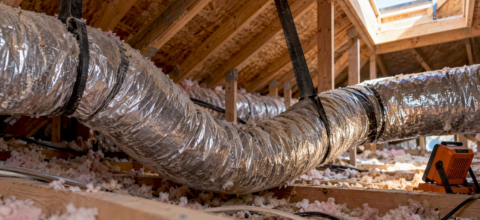
PNNL notes that spiral duct designs trap lint, and that vinyl, nylon and foil ducts are not recommended and void most dryer warranties. Accordion-style duct is easy to crush behind a dryer pushed against a wall. It is one of the first things to look for in a vent that dries slowly.
What about tape and wood?
For joints, the Department of Energy specifies sealing with material listed to UL 181B or 181B-M. Standard cloth duct tape is not that. The adhesive breaks down with heat, so use listed foil tape or clamps, and never screws that protrude into the duct.
For questions about how close a vent may run to framing or other combustibles, the answer depends on the dryer’s installation instructions and the local code your building inspector enforces. Ask your local code office, and have the installer confirm clearances when the vent is serviced or replaced.
How long can the vent be?
The model code sets the limit at 35 feet from the dryer connection to the outside, reduced for every bend. Under the 2024 International Residential Code, a 4-inch-radius mitered 45° elbow takes off 2 feet 6 inches and a 90° elbow takes off 5 feet. If the equivalent length ends up above 35 feet, the code requires a permanent label within 6 feet of the connection showing the length.
A worked example: a laundry room with a dryer 20 feet from the exterior wall and two 90° bends in the route. Two bends cost 10 feet, so the effective length is 30 feet. That is inside the limit, but only 5 feet of margin remains. Add a third bend and you are at 35 feet. A longer, bendier run collects lint faster, which is why those vents need more frequent cleaning. The U.S. Fire Administration advises more frequent cleaning for vents longer than 6 feet or dryers without moisture sensors or high-temperature limit controls.

We explain the rule in more detail on our page about the 35-foot code rule for dryer vent length.
Which rules apply to a daycare
Two sets of rules sit on top of each other. The building and fire code covers the vent itself. Your state child care licensing agency covers how the center operates. A home-based family daycare and a licensed center in a commercial building can fall under different building classifications, so confirm which applies to you.
A few points to keep in mind:
- The model code is a baseline. Most of the vent specifications above come from the International Residential Code. Commercial and multi-unit buildings may be reviewed under the International Mechanical Code. Our page for property managers covers IMC 504.11 for multi-unit dryer vents.
- Local fire officials can add requirements. The Town of Nyack, New York, for example, has a fire inspector directive requiring commercial dryer vent pipes to be taken apart, cleaned and re-secured at least four times a year. It also requires lint screens to be checked at least weekly and a certification form filed after each service. That is one town’s rule, not a statewide one, so ask your own fire marshal what applies.
- Keep paperwork. A dated service record helps at a fire inspection, at a licensing visit and when an insurer asks.
For the exact licensing and inspection requirements in your state, speak to your state child care licensing office and your local fire marshal. They decide what your center must show.
Warning signs your daycare dryer vent needs attention
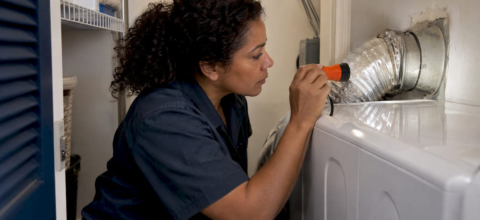
The vent hides behind the wall, so you notice it through the dryer’s behavior. Whirlpool’s venting specifications say long drying times or a hot dryer top indicate that the exhaust system needs inspection. The U.S. Fire Administration adds that heavy clothes taking a long time to dry, or clothes that feel unusually hot, are warning signs.
Watch for these in your laundry area:
- Towels and blankets need a second cycle.
- The laundry room feels humid or warm, or smells of hot lint.
- The outside hood flap does not open when the dryer runs, or lint is visible around it.
- Lint collects behind or under the dryer.
- The dryer shuts off mid-cycle.
- Birds or animals have nested in the vent. The fire administration notes nests obstruct airflow.
Whirlpool also notes that lint can collect in the exhaust hood so flaps or louvers will not open or close fully. After any cleaning, the flap should move freely and exhaust should leave without leaks.
Our pages on dryer vent blockage signs and 5 warning signs your dryer vent is a fire hazard go through them in more detail.
How often to clean
There is no single number that fits every daycare. Here is how the guidance fits together:
- The U.S. Fire Administration recommends cleaning the vent every couple of years for ordinary household use, and more often in the situations described above.
- Whirlpool recommends annual inspection for single-family use, and more frequent inspection for commercial use or systems with several dryers.
- New York State’s Department of Health advises yearly cleaning of dryers, traps and vents, more often in busy laundry rooms.
- A town like Nyack requires quarterly vent service for commercial dryers.
A home-based daycare that does a load or two a day can reasonably sit at the annual end. A center washing for 40 children, or one with a long vent run or several dryers, should plan on every three to six months and follow any local rule that is stricter. We cover the household version in how often to clean a dryer vent.
A weekly and daily routine for staff
Professional cleaning handles the duct. Staff handle everything between visits. PNNL’s guidance and the Nyack directive point to the same habits:
- Clean the lint screen before or after every load. Nyack requires at least a weekly check.
- Never run the dryer unattended, and turn it off when the room is empty at the end of the day.
- Keep flammable soiled items out of the dryer. Items with cooking oil, cleaning solvents or similar substances should not go in.
- Pull the dryer forward only when needed and look for a crushed or kinked transition duct.
- Check the outside hood each month while the dryer runs. Air should be pushing the flap open.
- Keep the area clear of boxes, paper and supplies.
- Install and test smoke and carbon monoxide alarms in the laundry area and keep a fire extinguisher there. Staff should know where it is.
A short log on the laundry room wall, with a line for each check and each professional service, makes the routine easy to prove.
What a professional vent cleaning covers
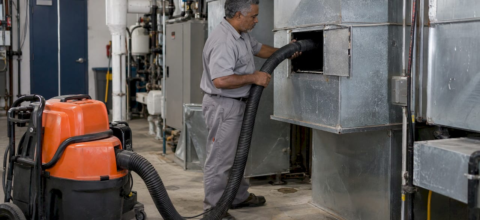
A proper job cleans the whole duct from the dryer connection to the exterior hood, not just the part you can reach. It also checks that the exhaust leaves freely, the damper works, the joints are secure and the transition duct is intact. This is where a trained technician saves staff from guessing: you leave knowing the exhaust path is open and the hood moves.
After our service, the points worth confirming are the same ones listed above: clear airflow outside, a free-moving flap, secure connections and a dated record for your files. Our technicians are certified, and we serve both residential and commercial properties, so we can work with a home daycare or a larger center.
If the vent is the wrong material, too long or routed into a wall or attic, cleaning alone is not the fix. It needs to be brought up to standard, and that conversation should happen before the next heavy laundry season.
Our view: treat lint as a schedule, not an emergency
Most dryer fires are not surprises. They follow months of slowly shrinking airflow that nobody sees because the vent is behind a wall.
We have been cleaning air ducts, dryer vents and chimneys for more than 10 years across New York, New Jersey and Connecticut, for homes and for commercial clients. For a daycare, our advice is to take the guesswork out. Put the vent on a calendar, give staff a short weekly routine and keep a written record of every service.
A child care center is the kind of place where a calm, scheduled approach beats a rushed one. Cleaning on a set schedule lets you plan around nap time and closures, rather than reacting to a dryer that has stopped drying. Our dryer vent cleaning is built for that: a complete duct clean, a check of the exhaust and a clear result you can file.
Victor
Book a daycare dryer vent cleaning
If your dryer is slow, your vent run is long or you cannot remember the last cleaning, start with a professional visit. Amazon Air Duct Cleaning provides dryer vent cleaning for residential and commercial properties in New York, New Jersey and Connecticut. Property managers with several dryers can ask about commercial dryer lint hazards and schedules, and you can request service through our NJ and NY dryer vent page.

FAQ
How long can a dryer vent safely be?
The model building code sets 35 feet as the maximum, counted from the dryer connection to the outside. Each bend reduces that figure: 2.5 feet for a 45° elbow and 5 feet for a 90° elbow. A long run needs cleaning more often.
Can duct tape be used on dryer vent joints?
No. The Department of Energy calls for connections sealed with material listed to UL 181B or 181B-M. Use listed foil tape or clamps, and avoid screws that protrude into the duct, because they catch lint.
How often should a daycare clean its dryer vent?
At least once a year, based on New York State’s guidance for dryers, traps and vents. Busy laundry rooms, long runs or several dryers call for more frequent service. Some local fire officials set their own schedule, so ask yours.
What is the average cost to clean a dryer vent?
Price depends on vent length, access and the number of dryers. We do not publish a flat price, so ask for a quote for your property. Give the technician the vent run length and the number of dryers.
Sources
- U.S. Fire Administration, Topical Fire Research Series Vol. 7, Issue 1: Clothes Dryer Fires
- National Park Service, Fire Prevention 52: Dryer Fires
- New Jersey Division of Fire Safety, Fire Safety Facts: Dryer Safety
- New York State, A Campus Fire Safety Message on dryer vents (2025)
- PNNL Building America Solution Center, Proper Clothes Dryer Venting
- U.S. Department of Energy, Vent a Clothes Dryer
- 2024 International Residential Code, Chapter 15 Exhaust Systems
- Whirlpool, Dryer Venting Specifications
- Town of Nyack, Dryer Vent Maintenance and Cleaning directive
Recommended
- Apartment Dryer Vent Maintenance: A Guide for NY, NJ and CT
- Dryer vent safety procedure: 5 essential steps
- New York Dryer Vent Code: What NYC and NYS Require
- Stop Lint Fires: 35 Foot Limit and Key NJ Dryer Vent Rules