Hospital Dryer Vent Safety: What Facilities Must Know
Hospital dryer vent safety comes down to three things: keeping lint out of the exhaust path, keeping the duct built to code, and keeping a written record that both are being done. Lint is the fuel, restricted airflow is the trigger, and a documented, regular professional cleaning is what breaks the chain. If you manage a hospital, clinic, nursing facility or any property with an on-site laundry in New York, New Jersey or Connecticut, our dryer vent cleaning team cleans these exhaust systems for residential and commercial clients.
TL;DR
- Lint buildup in the dryer and vent reduces airflow, which can make a dryer overheat and start a fire.
- Vent systems should be cleaned at least once a year; a busy hospital laundry usually needs a tighter schedule set by load volume and duct layout.
- Dryer exhaust must be independent, metal, short, smooth inside and terminate outdoors with a backdraft damper and no screen.
- Healthcare laundries are also expected to keep maintenance schedules and records, so cleaning reports matter as much as the cleaning.
- Slow drying, heat in the laundry room and visible lint at the outlet are the first signs to act on.
Table of Contents
- Why a hospital dryer vent is a bigger risk than a home vent
- The code basics every facility manager should know
- How often should hospital dryer vents be cleaned?
- Warning signs your hospital dryer vent needs attention now
- A hospital dryer vent safety routine that works
- What professional cleaning does that staff cannot
- Our perspective
- Book your hospital dryer vent cleaning
- Documentation: the part inspectors ask about
- Frequently asked questions
- Sources
Why a hospital dryer vent is a bigger risk than a home vent
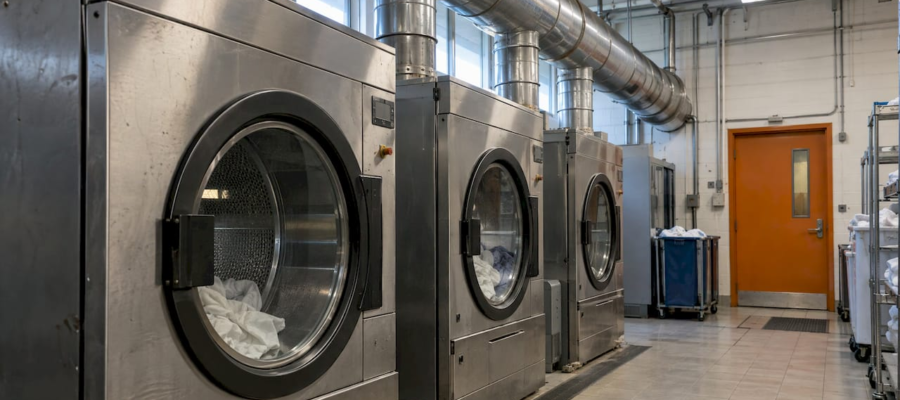
A household dryer runs a few loads a week. A hospital laundry, or a nursing wing with its own machines, can run for hours every day, drying towels, gowns, scrubs and bedding that shed a great deal of lint. The physics are the same as at home, only the volume is larger.
The National Park Service explains the mechanism plainly: lint buildup in the dryer and vent reduces airflow, causing dryers to overheat and start fires. It names lack of maintenance, lint buildup, inappropriate items in the dryer and inadequate venting as the contributing factors. The U.S. Department of Energy adds that about 15,000 fires start in dryers each year in the United States, with 10 to 20 deaths, and that lint inside the dryer can ignite at the drum, the motor or the electrical connections.
The New York State Division of Homeland Security and Emergency Services frames it as fire science: dryers combine heat, air and fuel, and the fuel is lint. Its July 2025 bulletin says failure to clean is the leading contributing factor in dryer fires in residential buildings, and recommends yearly cleaning, more often in busy laundry rooms. A hospital laundry is about as busy as a laundry room gets.
Fire is not the only hazard
A blocked vent also traps moisture. According to Cleaning & Maintenance Management, a commercial machine can emit up to a gallon of moisture per load, and a blocked vent can hold that moisture in the room, where it feeds mold and bacteria. In gas dryers, restricted exhaust can also allow carbon monoxide to build up. In a healthcare setting, where patients and staff are already more vulnerable, a damp, poorly exhausting laundry is a problem on top of the fire risk.
The CDC’s infection-control guidance for healthcare laundry points to a related issue. It says areas that receive contaminated textiles should be at negative air pressure relative to clean areas, to reduce recontamination by aerosolized contaminated lint. It also says laundry equipment should be used and maintained according to manufacturer instructions, and that damp textiles should not be left in machines overnight. Lint control, airflow and infection control are connected.
The code basics every facility manager should know
Hospitals answer to several layers of rules: model mechanical codes adopted by each state or city, the manufacturer’s installation instructions, the fire code and the facility’s accreditation or insurer. You do not need to memorize all of them. You do need to know what a compliant dryer exhaust looks like, because that is what an inspector, or a cleaning technician, will check.
The 2021 International Mechanical Code, Section 504 is the model language many jurisdictions build on. Your local adopted edition governs, so confirm it with your building or fire official. In summary, it requires:
- Dryers exhausted according to the manufacturer’s instructions, with moisture and combustion products carried outside.
- No fire dampers and no flow-obstructing devices in the dryer exhaust duct.
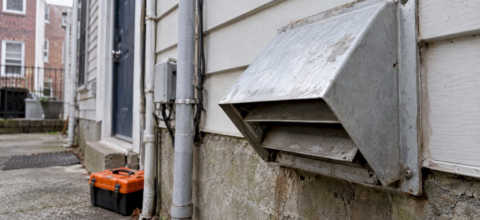
- Termination outdoors with a backdraft damper and no screen at the outlet.
- A minimum open termination area of 12.5 square inches.
- Makeup air where the installation exhausts more than 200 cubic feet per minute (cfm).
A model code adopted in another state shows the same pattern. The Georgia Mechanical Code 2024, which is based on the IMC, requires dryer exhaust to be independent of other exhaust systems and discharged where it cannot be drawn back in, never into an attic or crawl space. The point for you is that these are common model-code requirements, not a quirk of one place.
Duct material, length and support
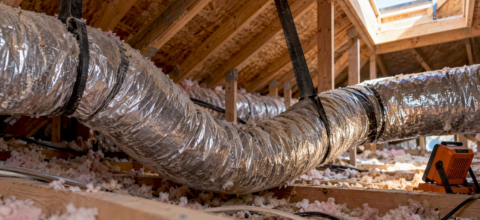
For domestic-type dryers, the same IMC section calls for a smooth interior, metal at least 0.016 inch thick, a 4-inch nominal diameter, support at 4-foot intervals and a maximum length of 35 feet, reduced for each fitting. Transition ducts must be listed to UL 2158A and be no longer than 8 feet. The Department of Energy warns separately that white vinyl flexible hose does not meet the UL standard for dryer venting, and that clogged vent caps and bird or rodent nests restrict airflow.

Commercial and multi-dryer installations are different. An industry guide to laundry exhaust notes that manufacturers often specify individual exhaust runs no longer than 15 equivalent feet, and that where several dryers share a header, the connector ducts should have a smooth interior, join the header at no more than 45 degrees and include lint cleanouts. Always follow the specification printed for your exact dryer model. One major manufacturer’s venting specification, for example, says systems must handle up to 230 CFM per dryer and keep duct air velocity at 1,200 FPM or more, and tells installers to review the IMC, the National Fuel Gas Code, UL 2158 and ANSI Z21.5.1.
Accreditation expectations
If your hospital runs its own laundry, or contracts one that seeks accreditation, the standards are explicit about upkeep. The Healthcare Laundry Accreditation Council standards call for documented compliance with local, state and federal rules, equipment that conforms to manufacturer recommendations and applicable codes, a written routine and preventive maintenance schedule, and periodic blow-down of environmental surfaces, including vents, to limit dust and lint. A vent cleaning report fits directly into that paper trail.
How often should hospital dryer vents be cleaned?
The floor is once a year. Both the Department of Energy and the National Park Service direct facility managers to clean vent systems at least annually and inspect them regularly. That is a minimum for a modest installation, not a target for a hospital.
The right interval depends on what your laundry actually does:
| Factor | Why it shortens the interval |
|---|---|
| Daily load volume | More loads put more lint into the duct every day. |
| Hours of operation | Machines running long shifts leave less time for the system to cool and clear. |
| Duct length and bends | Longer runs, many elbows and vertical sections collect lint faster than short, straight ones. |
| Textile type | Towels, bedding and cotton linens shed more lint than lightweight synthetics. |
| Shared headers | Several dryers feeding one duct make a blockage affect every machine. |
A practical way to set your own schedule is to inspect the duct at short intervals after startup, note how much lint has built up, and adjust the cleaning frequency to what you find. Many facilities end up with quarterly or more frequent professional cleaning for the busiest systems. Keep daily habits in place in between: clean lint screens every load, as the NPS advises, and keep the area around the dryers clear.
Warning signs your hospital dryer vent needs attention now
Staff on the laundry floor notice these before any inspector does. Cleaning & Maintenance Management lists longer drying times or damp laundry, heat in the laundry room, a fresh-laundry smell with the dryer door closed, and unusual noises as signs of a restricted vent. Add to that a burning smell during operation and visible lint at the exterior outlet.
If you see them, this is the sequence we recommend:
- Stop using the affected dryer. A dryer that runs hot with restricted exhaust is the exact scenario that leads to fires. If you smell burning or see smoke, follow your facility’s fire emergency procedure and call 911.
- Check the outside termination. Look for a clogged hood, a stuck damper, a screen someone added or a nest.
- Log the problem. Note the date, the machine, the symptom and who reported it.
- Book a professional inspection and cleaning. Do not run the machine again until the exhaust path has been cleared.
- Keep the service report. It supports your maintenance schedule and any later inspection.
Our article on the warning signs your dryer vent is a fire hazard goes through the early signals in more detail, and commercial dryer lint hazards covers risks and schedules for larger operations.
A hospital dryer vent safety routine that works
Safety in a laundry is mostly routine. The following split keeps responsibilities clear.
Every shift
- Clean lint screens or traps before or after every load.
- Do not overload the dryer.
- Keep the area around the dryer free of lint, linens and supplies.
- Do not dry foam, rubber, plastic or items soiled with flammable substances. These NPS cautions apply in a hospital as much as at home, and it is worth remembering that cleaning products, oils and solvents turn up in healthcare linens.
- Do not leave a running dryer unattended for long periods.
Weekly and monthly
- Walk the exterior terminations and confirm the damper opens freely and there is no screen or blockage.
- Check that duct joints are tight, supports are in place and no flexible vinyl or foil has crept into the run.
- Compare drying times against what is normal for the machine.
Scheduled professional service
- Full cleaning of the duct from the dryer to the outlet, plus the dryer cavity where the manufacturer allows it. The New York State bulletin notes that many manufacturers recommend that a qualified person clean lint from inside the dryer.
- An airflow and termination check.
- A written report you can file with your maintenance records.
What professional cleaning does that staff cannot
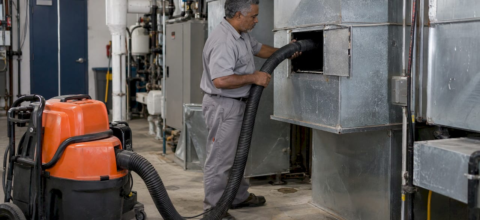
Maintenance teams can handle lint screens and visual checks. Cleaning a long, bent commercial duct is another job. Cleaning & Maintenance Management advises that the most important fire-prevention step is scheduling regular vent maintenance and inspections by a certified technician, who can find buildup before it becomes an issue and verify the system meets updated codes.

There is also a scheduling reason. A hospital laundry cannot stop for long, and cleaning has to be planned around linen turnover. A provider that works with commercial and residential properties, as we do, can plan the visit around your laundry’s schedule so the dryers are back in service quickly.
For the building as a whole, laundry exhaust is only one of several air pathways. Facilities that also want attention on supply and return ducts can look at our commercial air duct cleaning service. The two are separate systems and are cleaned separately.
Our perspective
We have spent more than 10 years cleaning ductwork and vents for homes and commercial properties in New York, New Jersey and Connecticut, and the pattern is consistent: dryer vents get attention only after something goes wrong.
In a hospital, that is the wrong order. The laundry is a quiet, essential part of patient care, and its exhaust system is a fire path hiding in the walls. The fix is not complicated. Set a cleaning interval that matches your real load, have the work done by a certified technician, and keep the report.
Our technicians are strictly certified, and we publish what we do on our service pages so facility managers know what to expect before they book. If your records show the last vent cleaning was a year or more ago, that is the date to act on.
Victor
Book your hospital dryer vent cleaning
We clean dryer vents for commercial and residential clients across New York, New Jersey and Connecticut. For a hospital, clinic or care facility, the visit covers the exhaust duct and the outside termination, and leaves you with the service record your maintenance file needs. Start with our hospital dryer vent cleaning guide for facilities, then request a dryer vent cleaning for your location.

If you are a property manager or real estate agent preparing a building for sale or inspection, the same service and the same report apply.
Documentation: the part inspectors ask about
Fire marshals, insurers and accreditation surveyors look for proof. Keep a simple file for each laundry:
- Dryer make, model and the manufacturer’s venting specification.
- A diagram or description of the duct run, with length and number of bends.
- Dates of every professional cleaning, with the service report.
- Daily and weekly check logs signed by staff.
- Repairs, such as replaced duct sections or new terminations.
One trade guide suggests keeping cleaning records for at least three years for code and insurance purposes. Ask your insurer and local fire official what they require, since retention and frequency rules vary by jurisdiction and policy.
Frequently asked questions
Is there one national rule for hospital dryer vent cleaning?
No single federal rule sets a cleaning date for every hospital dryer. Your requirements come from the model mechanical code your state or city has adopted, the fire code, the manufacturer’s instructions and any accreditation standard you follow. Government fire-safety guidance consistently points to cleaning at least once a year. Confirm the specifics with your local fire official.
Can we use flexible foil or vinyl duct to connect the dryer?
The Department of Energy states that white vinyl flexible hose does not meet the UL standard for dryer venting. The IMC allows only listed transition ducts, no longer than 8 feet and not concealed, between the dryer and the exhaust duct. Rigid smooth metal is the right choice for the rest of the run.
Do we need to clean the dryer itself, or only the vent?
Both matter. Lint inside the dryer can ignite at the drum, motor or electrical connections, as the Department of Energy notes. The New York State bulletin says many manufacturers recommend that a qualified person clean lint from inside the dryer, so include the machine cavity in your service plan.
What is the first thing to check if drying times get longer?
Check the lint screen and the outside vent hood for blockage, then stop using the dryer if the problem continues and schedule a professional cleaning. Longer drying times and heat in the laundry room are classic signs of restricted airflow.
Sources
- Fire Prevention 52: Dryer Fires, U.S. National Park Service
- Dryer Venting, U.S. Department of Energy
- A Campus Fire Safety Message, New York State DHSES, July 2025
- Laundry and Bedding, Infection Control, CDC
- 2021 International Mechanical Code, Section 504
- Georgia Mechanical Code 2024, Chapter 5 Exhaust Systems
- HLAC Accreditation Standards, 2023
- Dryer Venting Specifications, Whirlpool, November 2023
- Venting Laundry Exhaust in Commercial and Multi-Family Buildings
- How to Implement Dryer Vent Maintenance to Prevent a Fire, Cleaning & Maintenance Management
Recommended
- Hospital Dryer Vent Cleaning: What Facilities Need to Know
- Dryer vent safety procedure: 5 essential steps
- Commercial Dryer Lint Hazards: Risks, Warning Signs, Schedules
- Why Maintain Vents? Health, Safety, and Efficiency Insights