Connecticut Dryer Vent Code: What the State Requires
Connecticut regulates dryer vents through the 2022 Connecticut State Building Code, which is built on the 2021 International Codes. For a typical home, the rules come down to a smooth metal duct 4 inches wide, a maximum run of 35 feet minus allowances for elbows, an exterior outlet with a backdraft damper and no screen, and upkeep that keeps lint from building up. This guide explains each rule in plain terms for homeowners, buyers, agents, property managers and facility managers, and shows where a professional dryer vent cleaning visit fits in.
TL;DR
- The 2022 Connecticut State Building Code applies to permit applications filed from October 1, 2022. A 2026 code is in the adoption process, so check the state page for its effective date.
- Residential ducts must be smooth-walled metal, 4 inches in diameter, no longer than 35 feet before fitting deductions, with sealed joints and no protruding screws.
- The outlet must be outdoors, at least 3 feet from building openings unless the dryer’s instructions say otherwise, with a backdraft damper and no screen.
- The fire code requires the lint trap and duct to be maintained so lint does not accumulate. Multifamily and commercial buildings have extra rules.
- Your town’s building official issues permits and inspects new or altered vents.
Table of Contents
- Which code applies in Connecticut right now
- Residential dryer duct rules: material, size and joints
- The 35-foot maximum length and how elbows reduce it
- Where the vent must end: termination rules
- Fire code: keeping the vent clean
- Concealed ducts, booster fans and fire-rated walls
- Commercial, health-care and education buildings
- Permits and inspections
- A practical checklist for buyers, agents and landlords
- Perspective
- Dryer vent cleaning in Connecticut
- FAQ
- Sources
Which code applies in Connecticut right now
The 2022 Connecticut State Building Code took effect on October 1, 2022. It is based on the 2021 International Building, Residential, Mechanical and other model codes, with Connecticut’s own amendments. The state’s regulations page lists the code along with its published errata, which are corrections to the text.
Three separate parts of the code touch a dryer vent:
- The residential code (IRC), Chapter 15: governs one- and two-family homes and townhouses.
- The mechanical code (IMC), Chapter 5: governs commercial and multifamily dryer exhaust.
- The fire safety code (IFC), Section 610: governs maintenance after installation.
A newer set of codes is on the way. The state says the 2026 building, fire safety and fire prevention codes were expected to take effect July 1, 2026, but the effective date was delayed while the legislature’s regulation review committee had not yet approved them. Separately, Public Act 26-58, effective October 1, 2026, changes how often the state must adopt new model-code revisions. Because the schedule can shift, confirm the code in force on the state’s page before you design or permit a project. The dryer venting rules below have stayed stable across recent model-code editions, so they are a sound guide either way.
Residential dryer duct rules: material, size and joints
The residential rules sit in sections M1502.4.1 through M1502.4.6.1 of the 2021 IRC as adopted in Connecticut. In plain terms:
| Item | What the code says |
|---|---|
| Material | Metal duct with a smooth interior, at least 0.0157 inch (No. 28 gage) thick |
| Size | 4 inches nominal diameter; an oval duct with a 4-inch equivalent is allowed |
| Support | Supported at intervals of no more than 12 feet |
| Joints | Sealed and mechanically fastened, with no fasteners protruding more than 1/8 inch into the duct |
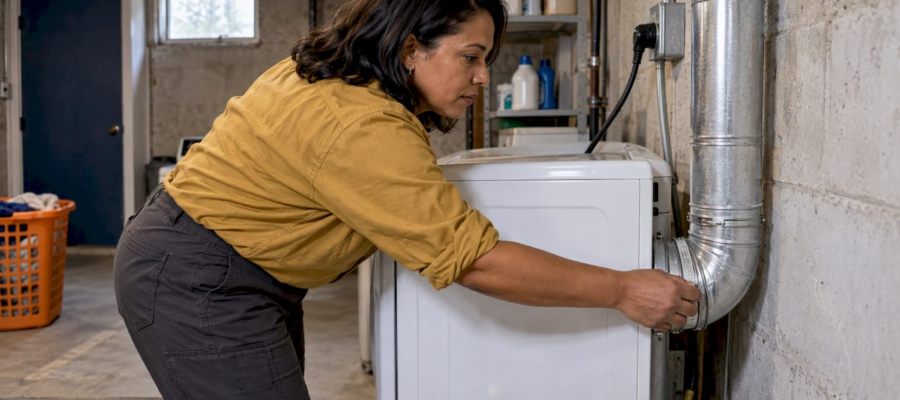
| Transition duct | The short connector between the dryer and the wall duct: a single length, listed and labeled to UL 2158A, no longer than 8 feet, and not concealed inside walls |
These details matter for a reason that has nothing to do with paperwork. Lint catches on anything that sticks into the airflow, so a screw that pokes through a joint or a ribbed interior collects debris. The Department of Energy’s Pacific Northwest National Laboratory notes in its Building America guide that short, straight, horizontal runs work best, and that long runs, bends, upward angles, kinks, narrow ducts and rough surfaces add resistance and can contribute to lint buildup.
That guide also lists good practice beyond the minimum: rigid or semi-rigid galvanized steel or aluminum, a slight downward slope toward the outlet so condensation can drain, joints sealed with foil tape or clamps rather than screws, and insulation for ducts that pass through unconditioned spaces.
What about flexible foil or vinyl duct?
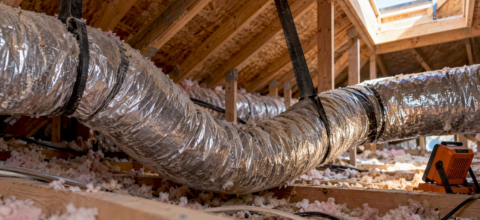
The code language calls for a smooth interior and a transition duct listed to UL 2158A, and it does not allow the transition duct to be hidden in construction. If your dryer is connected with a long accordion-style duct running through a wall or ceiling, it does not match what the code describes for the main run. This is one of the most common findings when a vent is inspected, and replacing it with rigid metal is a straightforward fix.
The 35-foot maximum length and how elbows reduce it
Under IRC M1502.4.6.1, the maximum exhaust duct length is 35 feet, measured from the transition-duct connection to the outlet terminal. The transition duct itself is not counted. That 35 feet is a ceiling, not an allowance you always get, because each fitting subtracts length. Examples from Table M1502.4.1.6.1 of the code:
- A 4-inch radius mitered 90-degree elbow counts as 5 feet.
- A 6-inch radius smooth 90-degree elbow counts as 1 foot 9 inches.
- A 10-inch radius smooth 90-degree elbow counts as 1 foot 6 inches.
The code also lets the length be set by the dryer manufacturer’s instructions, which is why the dryer’s installation manual is the first document to read.
A worked example. Say your laundry room is in the center of the house and the run to the exterior wall is 20 feet with two 4-inch radius mitered elbows. Those elbows cost 10 feet, so the effective length is 30 feet. That is inside the limit. Add a third elbow and a longer run to a different wall and you can cross it quickly. For a deeper walk-through, see our guide to the maximum dryer vent length.

Where the vent must end: termination rules
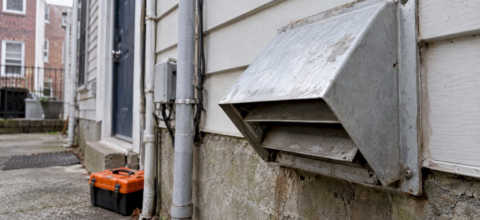
Section M1502.3 of the IRC says the duct must end outdoors. It must follow the dryer manufacturer’s instructions for location, and if those instructions are silent, the outlet must be at least 3 feet in any direction from openings into the building, including ventilated soffits. That includes windows, doors and crawlspace vents. The terminal must also:
- Have a backdraft damper, a flap that opens with airflow and closes when the dryer stops, keeping out cold air and animals.
- Have no screen at the termination.
- Keep an undiminished passageway with at least 12.5 square inches of open area.
The mechanical code repeats the same logic for commercial and multifamily buildings in IMC 504.4: outdoor termination, a backdraft damper, no screens, and no fasteners that obstruct flow. It also bars connecting the duct to a vent connector, vent or chimney, or extending it into other ducts or plenums.
The PNNL guide adds a best practice: keep the outlet 10 feet from an air conditioner or heat pump condenser, so lint and moist air are not pulled into the equipment.
Bird guards, cages and screens
The screen rule is the one homeowners trip over most. A mesh screen or small-hole cover on the outlet catches lint, clogs, and cuts the open area below the 12.5 square inch minimum. Connecticut fire officials have paid attention: a 2024 legal update reports that town fire safety officials began enforcing IMC Section 504 in October 2023, citing outside termination, backdraft dampers and the screen prohibition, and that some municipal fire prevention officers read Section 504.4 as prohibiting cages over dryer vents. If your outlet has a screen or cage, plan to replace it with a damper-style hood.

Fire code: keeping the vent clean
Installation is only half the story. The 2022 Connecticut State Fire Safety Code, Section 610.1.2, requires the lint trap, the heating and mechanical components, and the exhaust duct system to be maintained according to the manufacturer’s operating instructions so lint and debris do not accumulate. Section 610.1.1 requires the duct system to be installed per the IMC or the fuel gas code and the manufacturer’s instructions.
The code does not give a single cleaning interval. In practice, the practical test is airflow: if clothes take more than one cycle to dry, the laundry room feels unusually hot, or the outlet flap barely moves, the duct is restricted. Our page on how often to clean a dryer vent covers the usual schedule by household size and dryer type.
Concealed ducts, booster fans and fire-rated walls
Some situations come up often in renovations and multi-unit buildings. The mechanical code, as adopted in Connecticut, handles them this way:
- Concealed transition ducts: not allowed inside construction.
- Fire-resistance-rated walls and floors: a duct may pass through only if it is galvanized steel or aluminum under Section 603.4 and the rating is maintained. Fire dampers are prohibited in dryer exhaust ducts.
- Booster fans: domestic dryer exhaust duct power ventilators must be listed and labeled to UL 705 and installed per the manufacturer’s instructions.
- Future dryer spaces in multifamily buildings: where space for a dryer is provided, an exhaust duct system must be installed and capped at the future dryer location if no dryer is there yet.
If you are adding a booster fan to rescue a long run, remember that the same 2024 enforcement update notes that fire officials in some towns have addressed booster fan prohibitions under Section 504.6. Ask your town’s building official before installing one.
Commercial, health-care and education buildings
Facility managers in schools, clinics and care facilities fall under IMC 504.9 for commercial dryers. The mechanical code requires:
- Exhaust ducts installed per the appliance manufacturer’s instructions.
- Exhaust fan motors located outside the airstream.
- Fans running continuously, or interlocked with each other in multiple-dryer installations.
- A minimum 6-inch clearance to combustible materials.
- Transition ducts limited to single lengths not exceeding 8 feet, listed, labeled and not concealed.
Property managers with multiple laundry rooms should also see our guide to passing IMC 504.11 for multi-unit dryer vents and our notes on apartment dryer vent maintenance in NY, NJ and CT.
Permits and inspections
Every Connecticut town appoints a building official to administer the state code, and construction generally requires that official’s permit, as the General Assembly’s research office explains. For a new or altered vent, the inspections work like this under the IMC administration chapter:
- Rough-in inspection: after the ducting is complete but before wall or ceiling finishes cover it.
- Final inspection: when the mechanical system is complete.
- Scheduling: the permit holder is responsible for requesting each inspection.
The permit and inspection steps belong to the town, not to a contractor. Plain cleaning of an existing vent generally does not change the installation, but if a cleaning technician finds a duct that does not match the rules above, the repair or replacement is where a permit conversation with your town begins.
A practical checklist for buyers, agents and landlords
Use this list before a closing, a tenant turnover or an annual building walk-through:
- Find the dryer’s installation manual and note the maximum duct length it specifies.
- Trace the duct from the dryer to the outside. Note length, elbows and any flexible sections in walls or ceilings.
- Look at the outdoor hood. It should open freely, have a damper, and carry no screen or cage.
- Check the termination distance: 3 feet from windows, doors, soffit vents and similar openings unless the manual says otherwise.
- Look for screws protruding into the duct at joints.
- Check airflow with the dryer running. A weak flow at the outlet signals a blockage or restriction.
- Have the whole run cleaned and inspected, and keep the record.
Perspective
Most dryer vent problems we see in this work come down to two things: a run that is longer or twistier than the code and the manual allow, and lint that has been building for years. The code is clear about both. What the code cannot do is clean the duct for you.
Our technicians are certified, and we have more than 10 years of experience serving homes and commercial properties across New York, New Jersey and Connecticut. We believe the right approach is to treat the vent as a system: the dryer connection, the duct, the joints and the outlet hood all get attention, because a clean duct behind a screened or crushed outlet still restricts airflow.
If you manage several units, put the vents on a schedule rather than waiting for a complaint. A regular, documented routine is simpler to defend at an inspection than a one-off scramble.
Victor
Dryer vent cleaning in Connecticut
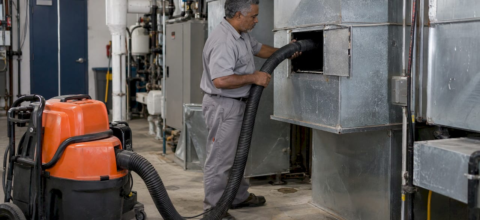
If you want the whole run cleaned, we provide professional dryer vent cleaning for homes and commercial properties in Connecticut, New Jersey and New York. We also serve Stamford and Norwalk with dedicated local pages. Our team of certified technicians can clean the duct end to end and tell you what they find at the outlet.

For a quote or to schedule a visit, start from our dryer vent cleaning page or the Amazon Air Duct Cleaning home page.
FAQ
Does Connecticut require a permit to clean a dryer vent?
Cleaning an existing vent does not by itself involve new construction. The permit requirement applies to constructing or altering a system: the town’s building official issues permits for that work. If you plan to reroute, extend or replace the duct, contact your town’s building official first.
What is the maximum dryer vent length in Connecticut?
The residential limit under IRC M1502.4.6.1 is 35 feet from the transition duct to the outlet, reduced for each elbow or fitting. The dryer manufacturer’s instructions can set a different limit, so check the manual.
Can I put a screen or bird guard on my dryer vent outlet?
The code calls for a backdraft damper and no screen at the termination, and some Connecticut fire officials have read the rules as also prohibiting cages. Use a damper-style hood instead, which keeps out animals and lets lint pass.
Which code edition applies if I am building or renovating?
The 2022 Connecticut State Building Code applies to permit applications filed from October 1, 2022. A 2026 code is in the adoption process, so check the state’s code page or ask your building official which edition your permit falls under.
How far must the outlet be from windows and doors?
If the dryer’s instructions give no distance, at least 3 feet in any direction from openings into the building, including ventilated soffits. Following the manual comes first.
Sources
- Connecticut State Building Code: Regulations
- History of the Connecticut State Building Code
- Building and Fire Code Adoption Process
- Public Act 26-58, An Act Concerning Revisions to the State Building Code
- Chapter 15 Exhaust Systems, 2021 IRC portion of the 2022 CT code
- Chapter 5 Exhaust Systems, 2021 IMC portion of the 2022 CT code
- Chapter 1 Scope and Administration, 2021 IMC portion of the 2022 CT code
- Chapter 6 Building Services and Systems, 2022 CT State Fire Safety Code
- Proper Clothes Dryer Venting, Building America Solution Center
- Building Code, Connecticut General Assembly Office of Legislative Research
- Update: Dryer Vent Regulations Are Being Enforced by the Local Fire Safety Officials
Recommended
- New York Dryer Vent Code: What NYC and NYS Require
- Stop Lint Fires: 35 Foot Limit and Key NJ Dryer Vent Rules
- NY/NJ/CT Property Managers: Pass IMC 504.11 for Multi Unit Dryer Vents
- Landlord Dryer Vent Responsibilities in NY, NJ and CT