Duct Fogging Safety: What Homeowners and Managers Should Know
Duct fogging is safe when four things line up: the product is EPA-registered and labeled for use in HVAC ducts, the label allows fogging as an application method, the ducts are cleaned first, and the people in the building follow the label’s ventilation and re-entry directions. Get those right and fogging is a controlled step in a duct cleaning job. Get them wrong and a product made for countertops ends up circulating through every room. Our team handles antimicrobial and deodorizing duct treatments for homes and commercial buildings in New York, New Jersey and Connecticut, and this guide explains what a safe job looks like so you know what to expect.
TL;DR
- Safe fogging starts with the label: the product must be EPA-registered, labeled for HVAC use, and list fogging as an allowed method.
- Antimicrobials belong after cleaning, never instead of it, because soil on duct surfaces interferes with the product.
- Re-entry and ventilation times come from the label. For one phenol duct product, EPA modeling put residential re-entry at 16 to 24 hours.
- Children, people with asthma and anyone with a medical condition should be mentioned to your contractor before the job.
- Property managers and facility managers should plan treatment for unoccupied hours and keep the product’s safety data sheet on site.
Table of Contents
- What duct fogging actually is
- The label is the safety rule
- Clean first, treat second
- Health effects that safe practice is designed to prevent
- Re-entry and ventilation: why the clock matters
- Before and after: a homeowner’s checklist
- For property managers, facility managers and agents
- Fogging vs. mechanical cleaning: which one does what
- Our antimicrobial and deodorizing service
- Our perspective
- FAQ
- Sources
What duct fogging actually is
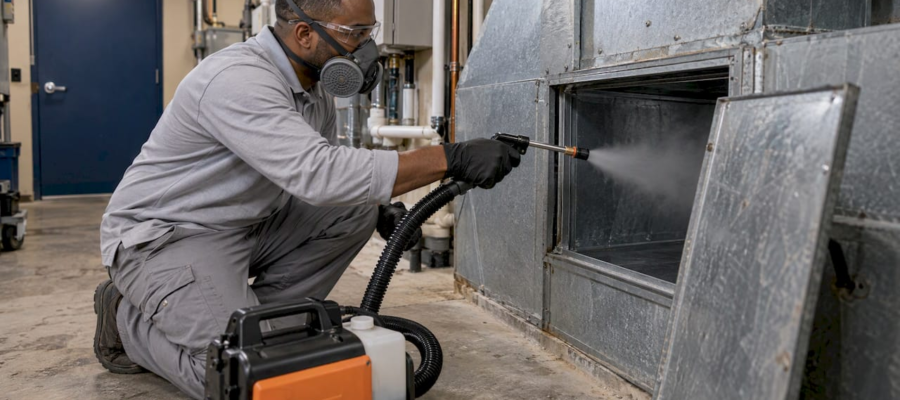
Fogging means turning a liquid antimicrobial or deodorizer into a fine mist and carrying it through the duct system. The goal is coverage: the mist reaches interior surfaces you cannot get to with a hand tool. Contractors use it to inhibit odors and slow future microbial growth after the ducts have been cleaned.
The same mist that reaches every corner of a duct is the reason safety matters. Once your furnace or air handler runs again, whatever is on the duct surfaces or hanging in the air can move to every room that has a register. EPA’s pesticide office describes HVAC systems as a different exposure setting from hard surfaces like countertops, where most antimicrobials were first registered. Ducts are usually hard to reach, which creates unique exposure for the applicator, and once the system runs, the product can be distributed throughout the building to occupants, including infants and children.
That is not a reason to avoid treatment. It is the reason the rules around treatment are specific, and the reason the details below are worth knowing.
The label is the safety rule
Every antimicrobial pesticide carries a label, and under federal law the label is the instruction manual. The NADCA white paper on chemical products in HVAC systems (NADCA is the National Air Duct Cleaners Association, the trade body for the industry) explains that every label carries the statement that using a product inconsistently with its labeling violates federal law, and that products are evaluated only for the use patterns and application methods the label lists.
For you, that turns into three practical questions about any duct treatment:
- Is the product EPA-registered? NADCA states that antimicrobial pesticides used in HVAC systems must be EPA-registered and used according to their labels.
- Does the label name HVAC ducts as a use site? EPA’s 2010 guidance says HVAC&R use must be specifically included on a product label, and that EPA needs to conduct a risk assessment before a product can carry that use. Products with no HVAC directions must not be used on those surfaces.
- Does the label allow fogging? NADCA notes that spraying, wiping or fogging is acceptable only when that method is listed on the label.
A product sold as a general disinfectant is not automatically a duct product. EPA’s 2006 notice said sanitizers and disinfectants registered for hard surfaces were not intended for air ducts, and that efficacy data for duct use had not been submitted. According to NADCA, EPA has accepted claims such as fungistatic, bacteriostatic, odor-inhibiting, deodorizing and cleaning claims for ductwork, which is the territory a properly labeled duct antimicrobial or deodorizer works in. If you read a contractor’s quote and see language about “disinfecting your ducts,” the label is the thing that tells you what the product is actually approved to do.
New Jersey’s Department of Health gives the same checklist in its guidance on disinfectant use in indoor spaces: confirm the product is approved for the planned application method, check the listed use sites and surface types, read the precautionary statements, follow the re-entry timing, and make sure applicators are trained and wearing protective equipment chosen from the product’s Safety Data Sheet.
Clean first, treat second
Sequence is a safety and performance issue at once. NADCA’s guidance says antimicrobials should be applied only after surfaces have been cleaned, because soil interferes with how the product works. A mist put into a dirty duct has to fight through dust and debris and leaves a layer of product sitting on top of it.
NADCA’s president has also criticized contractors who use a fogger at a return grille and then claim they have treated the whole system. A legitimate treatment follows cleaning and is applied according to the label, not as a shortcut. If a quote lists fogging by itself at a low price, with no cleaning step, that is a red flag worth sitting with for a moment.
Our air duct cleaning comes first, and antimicrobial and deodorizing treatment is its own listed service on top of it. You can read more on our antimicrobial fogging explainer and the duct sanitization process for homeowners.
Health effects that safe practice is designed to prevent
The reason for label rules, ventilation and protective equipment is to keep exposure low. NADCA’s white paper lists the effects that misapplied or unlabeled chemicals can cause: allergic reactions, chemical burns, respiratory irritation, eye injuries, toxic fumes and poisoning. EPA’s indoor air guide for health professionals adds that misuse of household foggers can cause headache, dizziness, muscular weakness and nausea, and that children are at extra risk from inhaling vapors and contaminated dust after a product is used.
Two groups deserve a direct mention to your contractor before the job:
- Children and infants. A presentation from EPA’s Region 9 experts series emphasizes that children are more sensitive than adults to toxic chemicals, and that some effects, such as asthma attacks, are immediate while others may take years to appear.
- People with asthma or other respiratory or medical conditions. The NIH’s Division of Occupational Health and Safety advises consulting occupants with medical conditions before duct work. If someone in your home has asthma, a chronic lung condition, or is pregnant, ask their doctor whether they should be away during and after treatment.
The NIH fact sheet also notes that no biocides are EPA-registered for use on fiberglass duct board or fiberglass-lined ducts. So tell your technician what your ducts are made of, or let them inspect first, so the treatment matches the system.
Re-entry and ventilation: why the clock matters
The label tells you when it is safe to go back in and when to open windows. EPA’s safety tips for foggers and misters say to follow label directions for ventilation and re-entry, because some products applied as a fog or mist can react with chemicals in the air and irritate the eyes, nose and lungs. The same page says products labeled for professional use should be applied only by a trained and licensed professional.

How long that wait is depends on the product and the building. An EPA risk assessment of a phenol-based product used in air-duct cleaning found that residential re-entry needed a delay of 16 or 24 hours depending on the model used, while commercial buildings, which have higher air exchange rates, could re-enter after 0 or 3 hours. That is one product, not a rule for all products. The lesson is that a house, with less air exchange than an office, can need a much longer wait than a commercial space, and the label for the specific product is the authority.
In practice:
- Plan to be out of the building for the time the label specifies, with children and pets arranged ahead.
- Open windows and doors when the label says to, not before and not on your own schedule.
- Ask your technician for the product name and the re-entry time before the day of service, so you can plan childcare, work-from-home days or tenant notices.
Before and after: a homeowner’s checklist
What makes a fogging job go smoothly is mostly preparation. Our guide to preparing for air duct cleaning covers the cleaning side; these are the points specific to treatment.
Before
- Tell the technician about every occupant: infants, children, anyone with asthma or allergies, pregnant family members and pets.
- Arrange where everyone will be during the service and during the re-entry period.
- Know the product name and its label directions for re-entry and ventilation.
- Move food, dishes and pet items out of the way of registers if the technician asks.
During
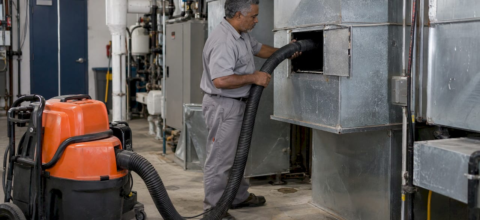
- The HVAC system is switched off for the work. NIH advises doing duct work when the building is unoccupied and using containment and negative-air machines with high-efficiency filters.
- Applicators wear the protective equipment the label and safety data sheet call for. NADCA notes OSHA requires that a safety data sheet be available at any US job site where chemical products are in use, that application containers carry use labels, and that workers be trained and wear appropriate PPE including respiratory protection when required.
After
- Stay out for the label’s re-entry time and ventilate as directed.
- NIH recommends placing filters over supply and return grills when the system restarts.
- Restart the system only when the technician confirms it is time.
- If anyone develops eye, nose or throat irritation, headache, dizziness or nausea, move to fresh air. For serious symptoms, call 911 or Poison Help at 1-800-222-1222, and talk to the person’s doctor.
For property managers, facility managers and agents
If you manage a school, clinic, office or apartment building, the same label rules apply, with extra logistics.
- Schedule for off-hours. EPA’s mold guidance says HVAC remediation is best done when the building is not in use, with containment, negative air pressure and HEPA vacuuming of cleanable materials. A treated system should not run for occupied spaces until the label’s re-entry time passes.
- Notify occupants. Tell tenants, staff and parents what is being applied, when, and for how long areas will be closed. In schools and health facilities, include nurses and anyone responsible for students or patients with respiratory conditions.
- Keep the paperwork. Product label, safety data sheet and your contractor’s training records belong in your building file. Our guide to training staff on duct hygiene is written for facility teams.
- Zone the work. Commercial buildings often have multiple air handlers. Treating one zone at a time lets you keep other areas open, and our commercial air duct cleaning service is set up for both residential and commercial properties.
Real estate agents and new home buyers have a simpler version. If a seller mentions that the ducts were recently fogged, ask for the date, the product name and the label. A properly treated home has documentation, and a buyer with an infant or an asthmatic family member should know the re-entry period has passed before moving belongings in.
Fogging vs. mechanical cleaning: which one does what
These are two different steps, and neither replaces the other.
| Mechanical duct cleaning | Antimicrobial or deodorizing fogging | |
|---|---|---|
| What it does | Removes dust, debris and contaminants from duct surfaces | Applies a labeled product to cleaned surfaces to inhibit odors and future microbial growth |
| When | First | Only after cleaning |
| Safety focus | Containment, negative air, filtration | Label, EPA registration, PPE, re-entry, ventilation |
| Occupant impact | Low, with containment | Follow the label’s re-entry timing |
NADCA’s position is that source removal is the foundation of a duct cleaning, and that chemical applications come afterward, strictly within what the label states. Treatment makes the most sense where musty odors, a past moisture event or visible microbial growth are a concern. Our pages on signs your ducts need cleaning and why duct sanitizing matters for indoor air quality help you decide whether treatment fits your situation. For a fuller picture of what can go wrong with any duct job, see our list of duct cleaning risks for homeowners.
Our antimicrobial and deodorizing service
We provide antimicrobial and deodorizing duct system cleaning for homes and commercial properties across New York, New Jersey and Connecticut, with more than 10 years of experience and certified technicians. If you want to schedule a service or have questions about a specific property, our air duct cleaning page is the place to start.

If you are adding air treatment on top of a cleaning, our UV light installation is another option we offer for HVAC systems.
Our perspective
Most of the duct treatment questions we hear come down to one thing: people want to know that what goes into their ducts is meant to be there. That is the right instinct. A duct is not a countertop, and a product used there should be one that the label says belongs in a duct.
Our view is simple. Clean the system first, treat it second, and let the label set the rules for application, ventilation and re-entry. That order protects the people who live and work in the building, and it gives the treatment a clean surface to work on.
We serve homeowners, property managers, facility managers and agents across New York, New Jersey and Connecticut, and each of them needs the same clear plan: what is being done, when to leave, and when to come back. A trained, certified technician who explains those three things is what a safe job looks like.
Victor
FAQ
Is duct fogging safe?
It is safe when the product is EPA-registered, labeled for HVAC ducts and allows fogging, and when the applicator follows the label’s directions for protective equipment, ventilation and re-entry. The risks come from using a product that is not labeled for ducts or ignoring the waiting period.
Can I stay in the house during duct fogging?
Plan to be out. Re-entry times are set by each product’s label, and EPA’s risk assessment of one duct product found that residential re-entry needed 16 to 24 hours. Arrange for children, pets and anyone with respiratory conditions to be elsewhere, and ask your technician for the label’s exact timing.
Does the EPA recommend fogging ducts?
EPA does not treat duct use as automatic. Its 2010 guidance says HVAC use must be specifically included on a product label after EPA completes a risk assessment. The practical rule is to use only products carrying that labeling and follow it as written.
Do ducts need to be cleaned before fogging?
Yes. NADCA’s guidance says antimicrobials go on only after surfaces are cleaned, because soil interferes with how the product performs. Fogging is a follow-up step, not a substitute for removing debris.
Who should talk to a doctor first?
Anyone with asthma, a chronic respiratory condition, a pregnancy or another medical condition in the household should ask their doctor before the service. Tell your technician about children and pets too, so the schedule accounts for them.
Sources
- NADCA: Using Chemical Products in HVAC Systems
- NADCA: The Truth About Disinfection
- EPA: Use of Disinfectants and Sanitizers in HVAC&R Systems (2010)
- EPA: Draft PRN 2006-A, Antimicrobial Pesticide Products in HVAC&R Systems
- Federal Register, December 29, 2006: Pesticide Registration Notice
- EPA: Indoor Air Pollution, An Introduction for Health Professionals
- EPA: Safety Tips for Using Foggers and Misters (2022)
- EPA: Safer Cleaning, Sanitizing and Disinfecting (Region 9 presentation)
- EPA risk assessment for phenol-based air-duct product (2008)
- NIH DOHS: Fact Sheet on HVAC Duct Cleaning
- New Jersey Department of Health: Disinfectant Use in Indoor Spaces
- EPA: Mold Course Chapter 5
Recommended
- Antimicrobial Fogging: What It Does and When a Homes Need It
- Educational List of Duct Cleaning Risks for Homeowners
- OSHA Air Duct Guidelines: Your Homeowner Compliance Guide
- Safe vent cleaning practices to protect your home’s air