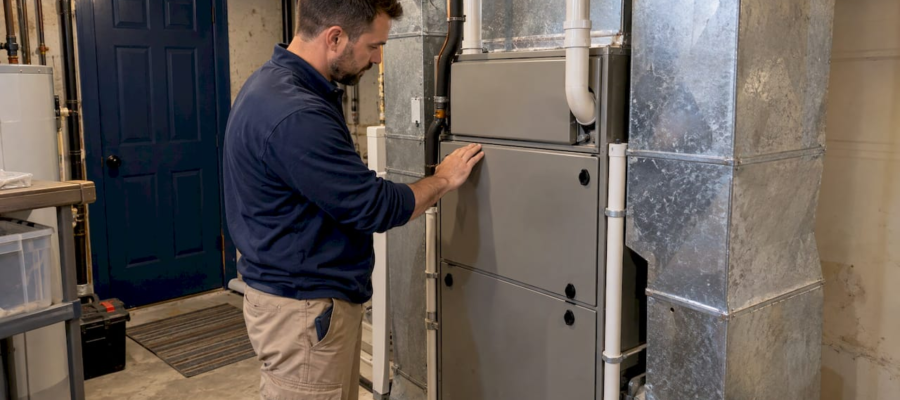
HVAC UV Light Safety: What Homeowners and Managers Should Know
HVAC UV lights are safe for people and pets when a trained professional installs them inside the air handler or ductwork, shields the lamp, and fits the access panels with warnings and power cutoffs. The risk comes from direct UV-C exposure to eyes and skin, and a correctly installed system is built so nobody in the building ever sees the lamp. If you own, buy, manage or sell a property in New York, New Jersey or Connecticut, the safety question is really an installation question. This guide explains why, what the exposure limits mean, and what to check before and after a system goes in. Our UV light installation service is the natural next step once you are ready to act.
TL;DR
- In-duct UV-C lamps sit inside the air handler or ductwork, so building occupants are not expected to be exposed when the system is installed to current guidance.
- The hazard is direct viewing of a lit lamp: it can cause a painful, temporary eye and skin burn, which is why panels need warnings and a power cutoff.
- Properly coated HVAC lamps do not produce ozone, and lamps should be replaced about once a year even if they still glow.
- Placement and shielding protect filters, gaskets and wiring from UV wear, so installer training matters more than the lamp brand.
- Always switch the power off before opening a unit with a UV lamp in it.
Table of Contents
- Why UV-C needs respect, and why it is contained
- What the safety standards say about enclosed systems
- How much exposure is too much
- The safeguards a safe installation includes
- Does HVAC UV light make ozone?
- Should the lamp stay on all the time, and when to replace it
- Can UV-C damage filters, gaskets or wiring?
- What has changed in U.S. rules and standards
- A safety checklist for your property
- Safe habits for owners, tenants and staff
- Our perspective on UV light safety
- Book UV light installation with Amazon Air Duct Cleaning
- FAQ
- Sources
Why UV-C needs respect, and why it is contained
UV-C is the short-wavelength band of ultraviolet light, around 254 nanometers, that damages the genetic material of microbes. HVAC lamps use it to treat the cooling coil and sometimes the passing air. The same property is why it should never reach a person.
A peer-reviewed history of ultraviolet germicidal irradiation explains that in-duct systems irradiate the whole duct cross-section at intensities room occupants cannot reach. It also notes that UV-C is absorbed by the outer layer of dead skin, so long-term health risks are considered negligible compared with ordinary sun exposure. Overexposure at this wavelength can still cause sunburn-like redness of the skin and “welder’s flash,” a temporary painful inflammation of the eye surface.
That is the whole safety picture in two lines: the lamp is strong, and it is enclosed. Everything an installer does is about keeping those two facts true.
What the safety standards say about enclosed systems
ASHRAE, the professional society that writes U.S. heating and cooling standards, covers this in its chapter on ultraviolet air and surface treatment. Because in-duct systems live inside air-handling units or ductwork, typical building occupants are not expected to be exposed. With careful adherence to safety guidelines, these enclosed systems should not result in UV exposure.
The same chapter cites the Tuberculosis Ultraviolet Shelter Study, a double-blind field trial at 14 U.S. shelters covering 3,611 staff and residents. It found no statistically significant difference in eye or skin irritation reports between periods with the lights on and placebo periods. The one UV-related eye case was resolved by repositioning a fixture. Those lights were in occupied rooms, which is a harder setting than a sealed duct.
The U.S. Department of Energy’s January 2025 germicidal UV fact sheet says the same thing in plain terms: germicidal UV can be safe when it is designed, installed and maintained by a trained professional to the latest industry standards. It also treats UV as one layer alongside ventilation and filtration to minimum ASHRAE standards.

How much exposure is too much
Homeowners and property managers do not need to calculate doses, but the numbers show why enclosure matters. A study published through the CDC library reports that the ACGIH threshold limit value for 254 nm UV is a dose of 6.0 millijoules per square centimeter over eight hours. That is the same as about 0.2 microwatts per square centimeter held for a full workday. Overexposure at this wavelength causes temporary eye inflammation and skin redness but, unlike longer UV wavelengths, does not cause skin cancer or permanent eye damage.

ASHRAE adds a timing detail that surprises people. Eye symptoms from UV-C appear roughly 6 to 12 hours after exposure and usually resolve within 24 to 48 hours. There is no warning sensation while it happens, so a technician or homeowner who peeks at a lit lamp will not know until later. Thus the rule is simple: never look at a lit UV-C lamp, and never open a unit while the lamp has power.
If you or someone in your home or building has a burning, gritty eye feeling hours after contact with a UV lamp, see a doctor or an eye care professional.
The safeguards a safe installation includes
Here is what a correctly built in-duct system looks like, based on ASHRAE’s design guidance.
- Full enclosure of the lamp. It sits inside the air handler or duct, aimed at the coil or air stream, never into a room.
- Interlocks or power cutoffs on access panels. Opening the panel should de-energize the lamp, or the lamp should be disconnected before anyone works inside.
- Warning labels. ASHRAE guidance calls for labels on UV fixtures alerting personnel to eye and skin hazards.
- An on/off switch and electrical disconnect. These make servicing safe.
- Control of reflective surfaces. Highly UV-reflective materials near the lamp are removed or covered if measured stray radiation exceeds the recommended limit.
- Commissioning measurements. ASHRAE describes using a hand-held radiometer tuned to 254 nm to check for stray UV-C when the system is started up.
Equipment safety has a standard behind it too. An ASHRAE journal article on UV-C fixtures summarizes the UL 1995 limits for HVAC equipment: leakage from any opening of no more than 0.1 microwatts per square centimeter, and the same limit for the occupied space around the equipment. That is a fraction of the threshold limit value above. The engineering-first approach also reflects international guidance, which favors built-in controls such as interlocks and lockout/tagout over relying on goggles or procedures alone.
This list is a good reason to hire a certified technician rather than treat a UV lamp as a plug-in accessory. Our technicians are strictly certified and we have more than 10 years of experience serving homes and businesses in New York, New Jersey and Connecticut.
Does HVAC UV light make ozone?
Ozone is a lung irritant, so this is a fair question. Low-pressure mercury lamps emit mostly at 253.7 nm. Some bulbs also emit a shorter wavelength near 185 nm, which can turn oxygen into ozone. ASHRAE’s 2020 chapter on ultraviolet lamps and fixtures explains that most HVAC UV-C lamps have an interior coating that blocks emission at 200 nm and below, so ozone production is not an issue.
So the lamp type matters. Lamps for HVAC use should be ozone-free by design, and replacement lamps should match the original size and wattage, which leads to the next point.
Should the lamp stay on all the time, and when to replace it
Coil-treatment lamps are generally run continuously, because the goal is to keep the coil surface irradiated around the clock rather than to switch the light on for a few minutes. ASHRAE’s 2020 chapter says the typical useful life of a UV-C lamp is about 9,000 hours of continuous operation. It adds that changing lamps annually (8,760 hours in a year) is a prudent way to make sure enough UV energy is delivered, since lamps can keep glowing long after their output has dropped.
The visible blue glow is therefore not a sign that the lamp is working. In practice, put the replacement on the calendar:
- Replace the lamp about once a year for continuous operation.
- Use a lamp that matches the original size and wattage.
- Keep the air filter in place. ASHRAE notes that in-duct UV works best combined with filtration, which also keeps dust off the lamp so its output does not drop.
- Turn off power before opening the cabinet.
In the Northeast, the cooling season is shorter than in the South, but a lamp that runs year-round should still follow the annual schedule. Many property managers tie the change to the spring cooling-season service visit so it never gets forgotten.
Can UV-C damage filters, gaskets or wiring?
Yes, if the lamp is placed carelessly, and this is the second big reason placement is a professional job. The National Air Duct Cleaners Association’s white paper on UV lighting applications warns that UV can degrade organic materials, including filters, sealants, gaskets and wiring insulation. Left unmanaged, that can cause air leaks or loss of performance, so vulnerable materials should be shielded or substituted.
An Oak Ridge National Laboratory literature review of UVGI for HVAC adds that coil-surface systems typically use lower-output lamps and long run times to reduce this wear. The practical takeaway is that lamp position, shielding and output are design decisions, not afterthoughts. See our guide to placement of HVAC UV lights for how location affects coil results.
What has changed in U.S. rules and standards
Three developments are worth knowing about if you manage a building or are buying one.
- NFPA 90A, 2024 edition. The standard for air-conditioning and ventilating systems added technical requirements for UV-C germicidal lamp systems. Local code officials decide what applies where you are, so ask your municipality’s building department about permits.
- ASHRAE Standard 185.1 addendum, June 2025. It adds an optional test using a harmless virus stand-in (bacteriophage MS2) for single-pass UV-C lights in air handlers or ducts, so test results can feed into Standard 241.
- ASHRAE Standard 241-2023. It sets minimum requirements for controlling infectious aerosols in new and existing buildings, covering design, installation, commissioning, operation and maintenance of air-cleaning systems, as listed in the ASHRAE standards summary.
For schools, clinics and offices, the direction is consistent: UV works as part of a ventilation and filtration plan, and commissioning and maintenance records matter as much as the hardware.
A safety checklist for your property
Use this before approving an installation or accepting a building with UV already in the ducts.
| Check | What you want to see |
|---|---|
| Lamp location | Inside the air handler or duct, aimed at the coil or air stream, with no light path into a room |
| Access panels | Warning labels on the unit, and power off before the panel is opened |
| Disconnect | A switch or disconnect near the unit for servicing |
| Lamp type | Ozone-free HVAC lamp, matching the original size and wattage |
| Materials | Filter, gaskets and wiring shielded or kept out of the UV path |
| Schedule | A yearly lamp replacement noted on your maintenance calendar |
| Installer | A certified technician who can explain the placement |
For a home sale, agents and buyers can use the same table. A UV light in the furnace or air handler is an HVAC accessory that should come with a service date for the lamp.
Safe habits for owners, tenants and staff
Most UV-C problems come from maintenance, not from normal operation. A few habits cover nearly all of them.
- Do not remove panels or filters while a UV lamp has power. If a filter change requires opening the cabinet, switch off the system and the lamp circuit first.
- Brief maintenance staff, especially in schools, clinics and multi-tenant buildings, so no one opens an air handler with the lamp lit.
- Never aim a spare lamp at a room or test it on a bench in the open.
- Keep service records: lamp install date, last replacement and who did the work.
When a lamp is being swapped, the technician is the one working near the fixture, and that is where certification training counts. If your equipment room is shared, mark the unit so other trades know UV-C is inside.
Our perspective on UV light safety
We install UV lights in homes and commercial buildings across New York, New Jersey and Connecticut, and the question we hear most is whether the light is safe to have in the house. Our answer is yes, when it is installed as the standards describe: enclosed, aimed at the coil, labeled and serviced on schedule.
What we like about the guidance from ASHRAE, NADCA and the Department of Energy is that it puts the safety in the installation. That fits how we work. Our technicians are strictly certified, we have served residential and commercial customers for over 10 years, and we treat the coil, the blower and the lamp as one system rather than as separate products.
If your system also has a dirty coil or blower, clean it before or along with the UV installation. Our evaporator coil and blower cleaning service pairs naturally with UV treatment, and our guidance on safe HVAC UV light installations goes into the standards in more detail.
Victor
Book UV light installation with Amazon Air Duct Cleaning
We install UV lights for residential and commercial properties in New York, New Jersey and Connecticut, and we also offer evaporator coil and blower cleaning, air duct cleaning and antimicrobial duct system cleaning. If you want a UV light fitted by a certified technician, start with our UV light installation page.

Local pages are available if you want to see who covers your area: White Plains, NY, Stamford, CT, or the New York and New Jersey page.
FAQ
Are HVAC UV lights safe for kids and pets?
Yes, when the lamp is installed inside the air handler or duct, shielded and aimed at the coil or air stream. ASHRAE says typical building occupants are not expected to be exposed to in-duct UV energy when safety guidelines are followed. The lamp should never shine into a living space.
Should an HVAC UV light stay on all the time?
For coil treatment, lamps are typically run continuously, and ASHRAE puts useful lamp life at about 9,000 hours, so an annual change is prudent. Always cut power before opening the unit, even if the lamp is meant to stay on during normal operation.
How much UV exposure is harmful?
The ACGIH limit for 254 nm UV is 6.0 mJ/cm² over eight hours. Higher exposure can cause temporary eye and skin burns, with eye symptoms showing up 6 to 12 hours later. Enclosed systems are designed so occupants stay far below that level.
Does HVAC UV light produce ozone?
Properly coated HVAC lamps do not. ASHRAE says most have a coating that blocks the short wavelengths that make ozone, so ozone is not an issue. Use replacement lamps that match the original specification.
Do I need a UV light in my air conditioner?
It is an option, not a requirement, and it works best on a wet cooling coil as part of good filtration and regular cleaning. If you are weighing it for your home or building, see our page on HVAC UV light types and talk to us about your system.
Sources
- ASHRAE: Ultraviolet Air and Surface Treatment
- ASHRAE: Ultraviolet Lamps and Fixtures (2020 chapter)
- The History of Ultraviolet Germicidal Irradiation for Air Disinfection (PMC)
- Journal of Photochemistry & Photobiology B, CDC library
- NADCA White Paper on Ultraviolet Lighting Applications
- ORNL: Ultraviolet Germicidal Irradiation for Heating, Ventilating and Air Conditioning
- U.S. Department of Energy: GUV Air Treatment Overview
- NFPA 90A, 2024 edition
- ASHRAE Addendum a to Standard 185.1-2020
- ASHRAE Standards Summary
Recommended
- Homeowners: ASHRAE Guidance for Safe HVAC UV Light Installations
- Homeowners: 55% Fewer Coil Microbes When HVAC UV Is Placed Right
- Myth vs. Fact: Do HVAC UV Lights Actually Work for Coastal Homes?
- Cut Coil Pressure Loss 22% with HVAC UV Light in NY, NJ, CT Homes