Laundromat Dryer Vent Maintenance: Schedules and Safety
A laundromat dryer vent system needs a daily lint routine run by staff and a professional duct cleaning about every three to six months. Busy stores should stay at the short end of that range. Dryer makers and fire-safety groups point the same way: Whirlpool’s venting specifications recommend an annual exhaust inspection for single-family use and more frequent inspections for commercial use or multiple-dryer systems. A laundromat is the second case, and then some.
This guide is written for owners, managers and landlords of coin-op and wash-dry-fold stores in New York, New Jersey and Connecticut. It covers the schedule, the daily and weekly tasks, the warning signs, the code language behind all of it, and what to expect when you hire a professional.
TL;DR
- Staff clean lint screens daily or more often, and vacuum around and behind machines weekly. A professional cleans the duct and vent system every three to six months, according to American Coin-Op.
- Longer drying times, hot machines and a stiff or stuck outside hood flap are the signs that a vent is restricted and should be checked now.
- Fire codes require the lint trap and exhaust duct to be maintained per the manufacturer’s instructions so lint cannot block airflow.
- Some local fire officials set their own schedule. Nyack, NY asks for servicing at least four times a year, with certification paperwork. Ask your own fire marshal what applies to your town.
- Keep a written log of every task. It helps with inspections, insurers and your own accountability.
Table of Contents
- Why a laundromat vent is a different job from a home vent
- How often to clean: a practical schedule
- What your staff should do every day
- Warning signs that a vent needs attention now
- The fire numbers behind the schedule
- What the codes require
- What professional cleaning involves
- Our perspective
- Book commercial dryer vent cleaning
- Extra fire-protection steps for the laundry floor
- FAQ
- Sources
Why a laundromat vent is a different job from a home vent
A home dryer might run a few loads a week. A laundromat dryer bank can run from opening to closing, load after load, with many users who have different fabrics, different habits and no stake in how the equipment is kept. Lint builds up faster, and it builds up in more places: the screens, the cabinets, the transitions to the main duct, the shared duct runs and the exterior hoods.
The U.S. National Park Service’s Fire Prevention 52 page says vent systems should be cleaned at least annually and inspected regularly, and notes that lint fires are much more common in group living settings such as dormitories. The same logic applies to a shared laundry room open to the public. Annual is the floor for a household. It was never meant as the schedule for a store.
There is also a design difference. Many laundromats use several dryers feeding one central exhaust. Whirlpool’s commercial dryer venting specification states that central exhaust systems must provide for periodic inspection and clean-out of lint accumulated in the central duct. If your system was built without access points, cleaning it properly is harder, and that is worth raising with a contractor early.

How often to clean: a practical schedule
The sources do not all say the same thing, and your store’s volume decides where you land. Here is how the guidance lines up.
| Task | Who does it | How often |
|---|---|---|
| Clean lint screens | Staff | Daily or more often; between loads in busy periods |
| Check exterior hoods and flaps | Staff | At opening, and after storms or heavy use |
| Vacuum around and behind machines | Staff | Weekly |
| Inspect belts, heat, airflow | Staff or technician | Regularly, per the manufacturer |
| Duct and vent cleaning | Professional | Every three to six months |
| Smoke detector testing | Staff | Monthly |
| Fire equipment inspection | Licensed professional | Annually |
The daily, weekly and three-to-six-month figures come from American Coin-Op’s Fire Prevention Primer, published in June 2025. The same article calls lint the number one fire hazard in laundromats and recommends putting cleaning protocols on the daily opening and closing checklist and documenting each task.
Which end of the range fits your store?
A simple way to decide:
- Every three months: your dryers run most of the day, you have a long shared duct, you have a long run to the roof or the exterior wall, or you have noticed lint at the hood.
- Every four to six months: moderate hours, a short and straight duct, and a clean inspection record at the last two visits.
- Sooner than scheduled: drying times have grown, machines run hot, or you see lint where it should not be.
If you manage a multi-family building with a shared laundry room, our guide to how often to clean a dryer vent walks through the same decision for lower-volume setups.
What your staff should do every day
Professional cleaning handles the ductwork you cannot reach. The daily routine keeps the part you can reach from feeding it.
- Clean every lint screen at opening, and again during busy periods. The U.S. Fire Administration’s Clothes Dryer Fire Safety flyer advises cleaning the lint filter before and after each cycle in a home. In a store, the daily-or-more-often rule is the practical version of that advice.
- Never run a dryer without its lint filter. Replace any torn or missing screen before the machine goes back in service.
- Walk the dryer bank and look for lint on the floor, on the tops of machines and in the gaps behind them.
- Check the exterior hood during a cycle. The same flyer advises making sure the outdoor vent covering opens when the dryer is operating.
- Look at the flexible connectors behind the machines for crushing, kinks or damage. The flyer says the venting behind the dryer should not be damaged, crushed or restricted.
- Log it. A one-line entry with the date, initials and anything unusual is enough.
A short note on what customers put in your dryers: the USFA’s clothes dryer fire report points to foam-backed rugs and athletic shoes as improper items that can cause problems. A clear sign above the machines, listing what may not go in, is cheap protection.
Warning signs that a vent needs attention now
Don’t wait for the calendar if you see any of these:
- Loads take noticeably longer to dry. Reduced airflow from lint buildup makes a dryer less efficient and can lead to overheating, according to the U.S. Fire Administration.
- The cabinet or the room feels unusually hot, or the machine shuts off on its limit thermostat.
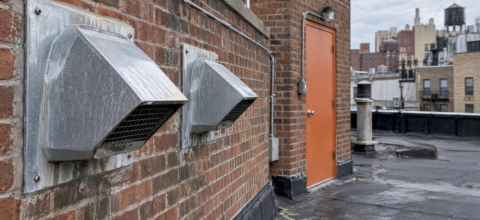
- Lint around the exterior hood, or a hood flap that does not open fully or stays stuck.
- A burning smell or a musty, humid smell near the dryers.
- Excess humidity in the laundry area. Whirlpool’s specification lists moisture removal, lint control and heat removal among the reasons to vent outdoors, so a damp, hot room suggests the exhaust path is not doing its job.
- Visible lint on the back of machines, on the floor behind them or on duct joints.
- Plastic or vinyl duct anywhere in the system. The USFA notes that plastic or vinyl exhaust materials can create problems.
Our article on commercial dryer lint hazards covers risks, warning signs and schedules in more detail, and what lint buildup is and how it forms explains where it collects.
The fire numbers behind the schedule
Failure to clean is the most common factor in dryer fires. The NFPA’s research on home fires involving clothes dryers and washing machines (2010 to 2014 annual averages) found that failure to clean accounted for 33% of clothes dryer fires, 50% of civilian fatalities and 34% of civilian injuries. Dust, fiber or lint was the item first ignited in 27% of cases, and clothing in 26%.

The USFA’s report covering 2008 to 2010 reached a similar conclusion: failure to clean was the leading factor, at 34 percent, in residential dryer fires. UL Solutions, citing NFPA statistics, put it at 33%, and noted that spontaneous combustion of the clothing load during dryer use contributed to 26%.
These are home statistics. They are the best public data on the cause, and a store runs far more cycles than a home. That is why the commercial schedule is tighter.
What the codes require
Codes do not give one national cleaning interval. They set a standard of maintenance, and the details come from the manufacturer and your local fire official.
- The International Fire Code, in its clothes dryer exhaust duct provisions, states that the lint trap, mechanical and heating components and the exhaust duct system must be maintained according to the manufacturer’s operating instructions to prevent lint or debris from blocking the exhaust of air and products of combustion.
- The Town of Nyack, NY Fire Inspector’s dryer vent maintenance notice points to the IFC and NFPA 1 for that duty. It also asks that dryer vent pipes be serviced at least four times a year, that lint screens be checked and cleaned at least weekly, and that a certification form go to the fire inspector after each servicing.
- The same notice says commercial and residential dryers must be listed and labeled and installed according to the manufacturer’s instructions.
What this means in practice: the manufacturer’s manual for your dryer model is part of your legal obligation. Keep it on file. Then call your local fire marshal or code office in your New York, New Jersey or Connecticut municipality and ask whether they have a specific schedule or certification requirement. Nyack shows that some towns do, and your insurer may ask for the same paperwork.
What professional cleaning involves
A professional visit goes well beyond what staff can do with a vacuum. Whirlpool’s venting specification describes the basic sequence, and a commercial job follows the same logic at larger scale:
- Disconnect the exhaust duct from the dryer and from the outside exhaust hood.
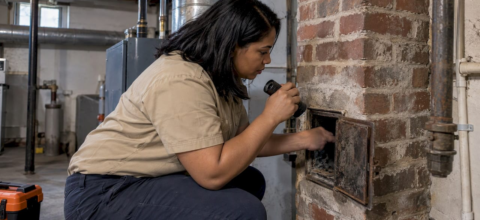
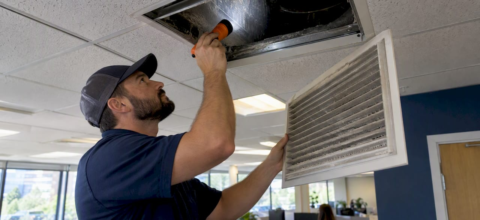
- Inspect the inside of the duct and remove the lint.
- Clear the hood so its flappers or louvers open and close freely.
- Reassemble and secure the joints.
- Run the dryer to confirm the airflow is unobstructed and there are no leaks.
For a store, add these: all dryers in a bank, the shared duct runs, any rooftop terminations, and a written record of what was done for your files or the fire inspector.
Cost and time
Commercial dryer vent pricing depends on the number of dryers, the length and layout of the duct, roof or wall access, and whether the work has to happen after hours. A fair quote comes after someone looks at your system or reviews photos and a count of machines. A flat number given without any of that information is a red flag. Time on site follows the same factors: a small store with a short duct can be quick, while a large store with a long shared run takes longer and is often scheduled when you are closed so dryers are not out of service during peak hours.
Questions to ask any contractor
- Will you clean the full length of the duct, including shared runs and the exterior hood?
- Can you give me a written report or certificate I can file or send to the fire inspector?
- Do you have experience with commercial laundry systems, not only houses?
- Are your technicians certified, and are you insured?
- Can you work outside my business hours?
Our perspective
We see the same pattern in the stores we visit across New York, New Jersey and Connecticut. A dryer bank that is cleaned on a schedule stays quiet: dryers heat well, the hoods open, and the owner is never surprised. A store that waits for a problem usually discovers it as long dry times and angry customers, long before it is anything worse.
Our view is simple. Treat the vent as equipment, not as a one-off chore. Put the daily lint routine on the opening checklist, book professional cleaning on a recurring calendar, and keep the paperwork. We bring more than 10 years of experience and certified technicians to residential and commercial properties, and we would rather help you set a schedule than wait for an emergency call.
If you are unsure where your store sits between three and six months, tell us your hours and your machine count and we will tell you what we would do.
Victor
Book commercial dryer vent cleaning
We clean dryer vents for laundromats, multi-family buildings and other commercial properties across New York, New Jersey and Connecticut. See our dryer vent cleaning service for what a visit includes and to request an appointment.

If your property also has a central air system, our commercial air duct cleaning service can be scheduled in the same visit. For a view of how similar schedules work in another high-volume business, read our hotel dryer vent maintenance guide. Prefer to compare options for a smaller property? Our article on cleaning the vent yourself or hiring a pro explains the trade-offs.
Extra fire-protection steps for the laundry floor
Vent cleaning is one layer. American Coin-Op’s primer suggests several others:
- Install smoke detectors in dryer areas, storage rooms and mechanical spaces, test them monthly and change batteries regularly.
- Mount ABC-rated fire extinguishers on the wall where they are visible and within reach.
- Consider sprinkler systems, which can dramatically reduce damage.
- Keep emergency exit lighting and signage compliant with local codes and check them monthly.
- Have fire equipment inspected annually by a licensed professional.
Also vacuum around and behind machines weekly. Lint that escapes the screen settles there, and it is easy to miss.
FAQ
How often should a laundromat dryer vent be cleaned?
Professional duct and vent cleaning every three to six months is the schedule recommended by American Coin-Op, with lint screens cleaned daily or more often. High-volume stores belong at the short end. Check your local fire official, since some towns set their own interval.
Are laundromats legally required to clean dryer vents?
The IFC and NFPA 1 require the lint trap, heating components and exhaust duct to be maintained per the manufacturer’s instructions so lint does not block exhaust. Specific intervals and paperwork vary by municipality, so ask your local fire marshal.
Can my staff clean the dryer vents themselves?
Staff should handle lint screens, floor and rear-of-machine cleaning, and hood checks every day. The duct itself, especially shared runs and rooftop terminations, is a job for a trained technician with the right equipment, and the visit gives you a written record.
What are the signs my dryer vent is clogged?
Longer drying times, unusually hot machines or rooms, lint at the exterior hood, a hood flap that sticks, and burning or musty smells are the main signs. Call for service as soon as you notice one.
How much does commercial dryer vent cleaning cost?
It depends on the number of dryers, duct length, access and timing. We quote after reviewing your system, so you know what is included before work starts.
Sources
- Whirlpool Venting Specifications
- Whirlpool commercial dryer venting specification
- American Coin-Op: A Fire Prevention Primer (Part 1)
- U.S. National Park Service: Fire Prevention 52, Dryer Fires
- U.S. Fire Administration: Clothes Dryer Fire Safety
- U.S. Fire Administration: Topical Fire Report, Clothes Dryer Fires
- NFPA: Home Fires Involving Clothes Dryers and Washing Machines
- UL Solutions: Mitigating Clothes Dryer Fires
- UpCodes: Clothes Dryer Exhaust Duct Systems
- Town of Nyack Fire Inspector: Dryer Vent Maintenance/Cleaning
Recommended
- Dryer vent safety procedure: 5 essential steps
- Safety First: 5 Reasons to Get Your Dryer Vent Cleaned
- How Often Should You Clean Your Dryer Vent
- Commercial Dryer Lint Hazards: Risks, Warning Signs, Schedules