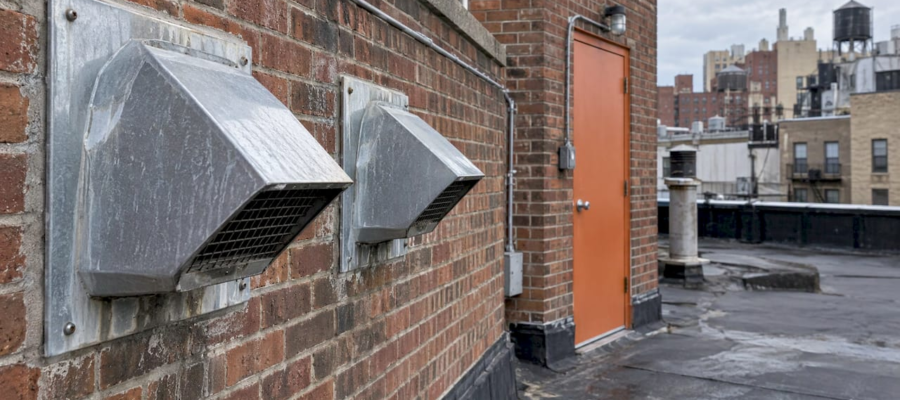
Laundry Room Dryer Vent Code in NYC: What You Need to Know
In New York City, every clothes dryer must exhaust to the outside through a smooth metal duct, with a few narrow exceptions. The main exception is a listed and labeled condensing (ductless) electric dryer. The duct generally can’t run longer than 35 feet once you subtract for elbows. It also needs the right termination fitting and, in a closet, enough air to breathe. Gas dryers in houses have an additional permit step. This guide walks through each rule so you can check a laundry room, prepare for an inspection or know what to ask a contractor.
TL;DR
- Dryers must vent outdoors under the NYC Mechanical Code, Section 504. Only listed and labeled condensing (ductless) electric dryers are exempt.
- Domestic duct: smooth metal, 4 inches nominal, maximum 35 feet of developed length, reduced by 5 feet per 90-degree elbow and 2.5 feet per 45-degree elbow.
- Single-dryer terminations take a backdraft damper. Multiple-dryer systems must not have one. Screens are prohibited at the outlet.
- A dryer closet needs an opening of at least 100 square inches, or makeup air by other approved means.
- Gas dryers vented through an exterior wall in a one- or two-family home need a Licensed Master Plumber and a DOB filing.
Table of Contents
- Which code applies to a laundry room in NYC
- The basic rule: exhaust to the outside
- Where the vent must end
- Duct material, size and support
- How long can the duct be
- Dryer closets and makeup air
- Gas dryers, permits and inspections
- Shared and commercial laundry rooms
- Our perspective
- A quick laundry room checklist
- When a professional cleaning makes sense
- FAQ
- Sources
Which code applies to a laundry room in NYC
New York City writes its own mechanical code rather than adopting the national model code unchanged. The NYC Mechanical Code was comprehensively amended by Local Law 126 of 2021, issued November 7, 2021 and effective November 7, 2022. Section 504, Clothes Dryer Exhaust, is the part that matters for laundry rooms. Gas piping and fuel-gas appliances also fall under the Fuel Gas Code and DOB rules, which we cover in the permit section below.
If you manage property in New Jersey or Connecticut, the rules differ by state. Our guides cover New York dryer vent code and New Jersey dryer vent code separately. This article stays with the five boroughs.
The basic rule: exhaust to the outside
Section 504.1 says clothes dryers must be exhausted in accordance with the manufacturer’s instructions. The dryer exhaust system must be independent of all other systems and must carry moisture and any products of combustion outside the building. That means you cannot tie a dryer duct into a bathroom fan, a kitchen hood or a ventilation shaft.
The NYC Department of Buildings made the exception explicit in Buildings Bulletin 2009-005. Only electric dryers listed and labeled as condensing (ductless) may skip outdoor exhaust. A gas dryer, or a standard electric one, always needs a duct to the outside. A ventless dryer is a legitimate option for a small apartment, but it must carry that listing and label.

Where the vent must end
Dryer exhaust ducts must terminate on the outside of the building. Not in an attic, crawl space, soffit cavity or basement ceiling. Three details at the outlet trip people up:
- Backdraft damper: required for a single-dryer installation, and not allowed on multiple-dryer installations.
- No screens: screens are prohibited at terminations because lint clogs them quickly.
- Location: environmental air exhaust outlets are required to sit at least 3 feet from property lines, 3 feet from operable openings into buildings, and 10 feet from mechanical air intakes, according to the 2014 edition of the code. Check the current edition with your architect or engineer before relying on those distances for a new design.
Bird guards are a common question here. Our page on the dryer vent bird guard code in NYC explains what is and isn’t allowed at the outlet.
Duct material, size and support
For domestic (home-type) dryers, Section 504.8 sets these requirements:
| Item | Requirement |
|---|---|
| Interior finish | Smooth |
| Material | Metal, minimum 0.016 inch (0.4 mm) thick |
| Diameter | 4 inches nominal, unless the manufacturer requires larger |
| Support | At 4-foot intervals |
| Transition duct (dryer to wall duct) | Listed to UL 2158A, no longer than 8 feet, not concealed |
| Fire dampers | Prohibited in dryer exhaust ducts |
The smooth interior matters because lint catches on ridges. That is why a flexible foil or vinyl accordion duct running through a wall is a red flag during an inspection or a cleaning visit. Short, listed transition ducts are the only flexible piece the code accepts, and only in the visible space between the dryer and the wall.
Where a duct passes through a wall or ceiling membrane, the gap around it has to be sealed with noncombustible material, approved fire caulking or a noncombustible duct wall receptacle. A duct may not pass through a fire-resistance-rated assembly unless it is galvanized steel or aluminum of the thickness specified in Section 603.4. Do not install a fire damper to get around that: dampers are prohibited in these ducts because they catch lint.
How long can the duct be
The maximum length of a domestic dryer exhaust duct is 35 feet, measured from the transition duct connection to the outlet terminal. Each fitting uses up part of that allowance:
| Fitting | Equivalent length deducted |
|---|---|
| 4-inch radius mitered 90-degree elbow | 5 feet |
| 4-inch radius mitered 45-degree elbow | 2 feet 6 inches |
A worked example: a run with two 90-degree elbows and one 45-degree elbow uses 12.5 feet of the allowance (5 + 5 + 2.5). That leaves 22.5 feet of straight duct. The ICC commentary explains that 35 feet reflects the worst case, a dryer rated for a maximum of 35 feet, so the least capable dryer on the market still works with the duct. The goal is to avoid a mismatch that lets lint build up and creates a fire hazard.
Also read the dryer’s installation manual. The code points to the manufacturer’s instructions, and some dryers are rated for shorter runs. Our explainer on the 35-foot maximum dryer vent length goes deeper on measuring.
One more number applies to a specific case. For a domestic gas dryer vented directly through an exterior wall under DOB’s Rule 101-02, the duct may not exceed 25 feet from the dryer to the outlet terminal, with deductions for bends. The wall penetration is limited to one 4-inch-diameter opening, or one opening up to 4 inches square.
Dryer closets and makeup air
A dryer pushes air out of the room, and it needs air to replace it. Under Section 504.6, installations exhausting more than 200 cfm need makeup air. A closet designed for a clothes dryer must have an opening of at least 100 square inches, or makeup air provided by other approved means.
In practice, a louvered closet door or a ducted air supply handles this. Without it, the dryer starves for air, runs longer, and pushes lint back into the room. If your laundry closet has a solid door and a tight frame, that’s worth sitting with for a moment before you assume the dryer is fine just because it works.

Gas dryers, permits and inspections
Electric dryers swapped like-for-like don’t usually draw DOB attention. Gas dryers are different. Under Rule 101-02:
- A domestic gas dryer vented directly through an exterior wall is limited to one- or two-family residences (R-3) three stories or fewer in height.
- A Licensed Master Plumber files a Limited Alteration Application (LAA1).
- New installations need a gas roughing-in, a gas test and a gas finish inspection by DOB or self-certification.
- An existing dryer venting through an outer wall needs only a finish inspection when filed on an LAA1.
DOB’s project requirements for 1- and 2-family alterations also state that a new single domestic direct-vent gas dryer in a one- or two-family home four stories or less can be done without a Registered Design Professional under Category 2 work. Rules and filing procedures change, so confirm the current process with your plumber or on the DOB site before you start.
Cleaning an existing vent is not an alteration. It doesn’t need a filing, but it is the maintenance that keeps an approved installation safe.
Shared and commercial laundry rooms
Buildings with several dryers, and commercial or retail laundries, face a stricter set of rules.
- Commercial dryers (Section 504.9): installation must follow the manufacturer’s instructions and NFPA 54. Exhaust fan motors sit outside the airstream. In multiple installations the fan runs continuously or is interlocked to run whenever any unit operates. Ducts need 6 inches of clearance to combustible materials, and transition ducts are limited to single lengths of 8 feet and may not be concealed. Details are in the 2022 code.
- Ventilation rates: the 2022 ventilation table lists 25 cfm per person for commercial laundries, and 7.5 cfm per person plus 0.06 cfm per square foot for coin-operated laundries.
- Retail laundry openings: DOB’s retail laundry code notes say intake openings must be at least 10 feet from lot lines and buildings and 20 feet from contaminant sources. Exhaust openings must be at least 10 feet from lot lines, buildings and windows, and 10 feet above the sidewalk.
Equipment makers add their own limits. One commercial laundry supplier notes that commercial dryers often specify individual exhaust with runs of no more than 15 equivalent feet, and that mechanical exhaust is the practical answer for most multi-dryer jobs. Always design to the model’s own specification.
For property managers, shared ducts and rooftop terminations create recurring lint problems. See our guides on multi-unit dryer vents, roof dryer vent problems, high-rise dryer vent issues and apartment dryer vent maintenance.
Our perspective
Code tells you how a vent should be built. It says little about what the vent looks like five years later. In the homes and buildings we service across New York, New Jersey and Connecticut, the common problem isn’t a missing permit. It’s a duct that was compliant on day one and is now packed with lint, crushed behind the dryer, or capped with a screen someone added later.
Our approach is to treat the code as a checklist for the visit. We look at the duct material, the number of elbows, the total run, the termination and the airflow at the outlet. Then we clean the full run, not just the part you can reach from the dryer. For property managers, we recommend a recurring schedule so the whole building is covered in one round.
Our team has over 10 years of experience with residential and commercial properties, and we aim to be straightforward about what we find: what meets code, what needs a licensed trade, and what simply needs cleaning.
Victor
A quick laundry room checklist
Use this before an inspection, a sale or a lease turnover:
- Confirm the dryer vents outside, unless it’s a listed and labeled condensing electric model.
- Measure the run from the transition duct to the outlet, then subtract 5 feet per 90-degree elbow and 2.5 feet per 45-degree elbow.
- Check that the duct is smooth rigid metal and the transition piece is short, listed and visible.
- Look at the outside termination: damper present for a single dryer, no screen, clear of lint.
- Check the closet opening (at least 100 square inches) or another makeup air path.
- For a gas dryer, check whether your plumber filed the LAA1 and the finish inspection.
- Schedule a cleaning. Our page on how often to clean a dryer vent helps you set an interval.
When a professional cleaning makes sense
Code compliance and cleanliness are separate questions. A duct that meets every measurement above still collects lint. If your dryer takes more than one cycle to dry a load, the laundry room feels humid, or the outside flap barely opens, the vent needs attention.
Our dryer vent cleaning service covers homes and commercial buildings in New York, New Jersey and Connecticut. We clean the full duct run through to the termination and can tell you what we see about the duct’s material, length and outlet while we are there. For White Plains and the surrounding area, see our local service page, or browse dryer vent and air duct services in NJ and NY.

If you’re not sure whether your laundry room meets the rules above, book a visit through our site and tell us the building type and dryer fuel. We’ll plan the visit around it.
FAQ
Does a dryer in an NYC apartment have to vent outside?
Yes, in nearly every case. The only exemption in the Mechanical Code is for electric dryers listed and labeled as condensing (ductless). A gas dryer or a standard electric dryer has to exhaust through a duct to the outside of the building. The DOB’s Buildings Bulletin 2009-005 confirms this reading.
What is the maximum dryer vent length in NYC?
The Mechanical Code sets 35 feet for a domestic dryer, measured from the transition duct to the outlet, minus 5 feet for each 4-inch radius 90-degree elbow and 2.5 feet for each 45-degree elbow. For a gas dryer vented through an exterior wall under DOB Rule 101-02, the limit is 25 feet with bend deductions. Your dryer’s manual may set a shorter limit.
Can I put a screen or bird guard on my dryer vent?
Screens are prohibited at dryer exhaust terminations under the Mechanical Code because lint clogs them. A single-dryer vent needs a backdraft damper. See our page on the dryer vent bird guard code in NYC for what is permitted at the outlet.
Does a dryer closet need ventilation?
Yes. A closet designed for a clothes dryer needs an opening of at least 100 square inches, or makeup air provided by other approved means. Installations exhausting more than 200 cfm also require makeup air. A louvered door is a common solution.
Do I need a permit to install a gas dryer in my NYC home?
For a domestic gas dryer vented directly through an exterior wall in a one- or two-family home, DOB Rule 101-02 requires a Licensed Master Plumber to file an LAA1 and arrange inspections. Confirm current filing steps with your plumber or DOB before work begins.
Sources
- NYC Mechanical Code, Chapter 8 and Local Law 126 of 2021
- NYC Mechanical Code, Section 504: Clothes Dryer Exhaust
- NYC Buildings Bulletin 2009-005
- NYC Mechanical Code 2014, Chapter 5 Exhaust Systems
- ICC IMC commentary on Table 504.8.4.1
- 1 RCNY §101-02: Dryer-Boiler Installation
- DOB project requirements for 1- and 2-family alterations
- NYC Mechanical Code 2022, Chapter 5 Exhaust Systems
- NYC Mechanical Code 2022, Chapter 4 Ventilation
- NYC DOB retail laundry code notes
- Venting laundry exhaust in commercial and multi-family buildings
Recommended
- New York Dryer Vent Code: What NYC and NYS Require
- Dryer Vent Bird Guard Code in NYC: What Is Allowed
- Apartment Dryer Vent Maintenance: A Guide for NY, NJ and CT
- Maximum Dryer Vent Length: The 35-Foot Code Rule Explained