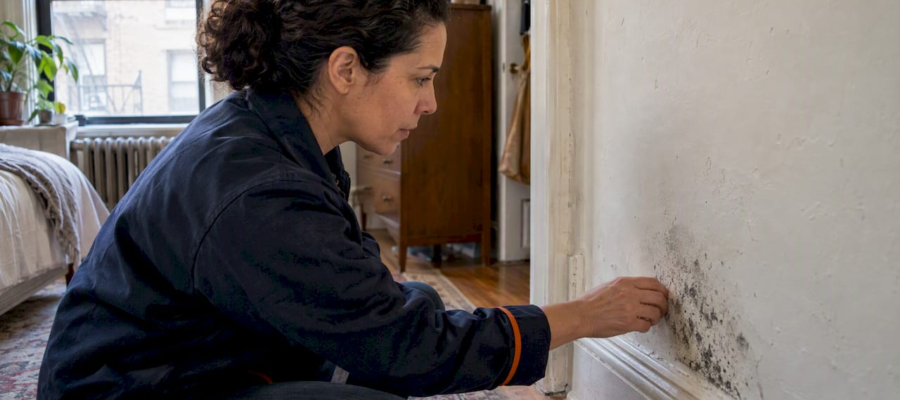
Local Law 55 and Mold: What NYC Owners Must Do
Local Law 55 of 2018, the Asthma-Free Housing Act, requires owners of New York City buildings with three or more apartments to keep tenants’ homes free of mold and pests, and to fix the conditions that cause them. It applies to housing units of any size when a tenant has been diagnosed with moderate or severe persistent asthma. If you own, manage or rent in one of those buildings, this guide covers what the law requires, how mold violations are classified, who is allowed to remove mold, and where your HVAC system fits in.
We clean air ducts, coils and vents in New York, New Jersey and Connecticut. We are not lawyers, and the law itself is the final word. We’ve pulled the details from the city’s own pages so you can check each one.
TL;DR
- Local Law 55 covers private buildings with three or more apartments in NYC. Owners must inspect for mold, mice, rats and cockroaches every year and fix the conditions behind them.
- Mold violations are Class A (90 days to correct), Class B (30 days) or Class C (21 days), depending on the size of the affected area.
- For larger jobs in bigger buildings, state rules require a licensed mold assessor and a separate licensed remediator. Check licenses before you hire.
- Cleaning mold without fixing the moisture source only buys you time. Ducts, coils, drain pans and dryer vents are part of that moisture picture.
- Tenants should put mold complaints in writing. Owners should document every inspection and repair.
Table of Contents
- What Local Law 55 actually requires
- Mold violation classes and deadlines
- Who is allowed to remove mold
- Moisture comes first, always
- Where HVAC systems fit in
- A practical plan for owners and property managers
- If you’re a tenant
- Our perspective
- How we can help with the HVAC side
- FAQ
- Sources
What Local Law 55 actually requires
The city’s housing agency explains that Local Law 55 of 2018 requires owners of buildings with three or more apartments to keep apartments free of mold and pests, including safely fixing the conditions that cause these problems. You can read the full text in the law itself.
In practice, owners have these duties:
- Inspect each apartment for mold, mice, rats and cockroaches at least once a year.
- Inspect vacant apartments for mold and pests before a new tenant moves in.
- Fix the underlying conditions, such as leaks, not only the visible growth.
- Give tenants an official fact sheet and notice about these responsibilities.
- Keep records of inspections and repairs.
The agency, HPD, has its own obligations. It must ask about mold and pests during every apartment inspection and issue violations when it finds them. Property managers should read that as a signal: an inspection for any reason can turn into a mold violation.
Who is covered
The law reaches private owners of buildings with three or more units. It also applies to a home of any size where a tenant has been diagnosed with moderate or severe persistent asthma. A one- or two-family house with no such tenant is generally outside it, though other habitability rules can still apply.
Mold violation classes and deadlines
HPD sorts mold violations by the size of the affected area. This is the part most owners want to see in a table, so here it is, based on the HPD indoor allergen page:
| Class | Mold in a room of a dwelling unit | Time to correct |
|---|---|---|
| A | Less than 10 sq. ft. (or less than 30 or 50 sq. ft. in aggregate on a level, hallway or common area) | 90 days |
| B | 10 to 29 sq. ft. (or at or above those aggregate figures) | 30 days |
| C | 30 sq. ft. or more | 21 days |
A violation that isn’t certified as corrected in time can be upgraded to a higher class, which brings potential penalties. Open violations are public records. Buyers and prospective tenants can look up a building’s history on HPDOnline, and a string of open mold violations shows up in due diligence.
What certification means for owners
Once the work is done, the owner certifies the correction through HPD’s system. Tenants can dispute that certification. If a tenant disputes it, a reinspection is required, and if it fails the violation stays open. That is why the paper trail matters: dated photos, invoices, the scope of work and the moisture fix all belong in your file.

Who is allowed to remove mold
This is where well-meaning owners get into trouble. New York City’s health department explains that when the mold area is more than 10 square feet in buildings with 10 or more units, owners must use New York State Department of Labor-licensed mold assessment and remediation professionals. The same page covers nonresidential buildings of 25,000 square feet or more of floor area.
Two points that are easy to miss:
- The assessor and the remediator must be separate companies. The assessor writes the plan and clears the job. The remediator does the work. The split exists to prevent a conflict of interest, so hiring one firm to do both is a red flag.
- Verify the license yourself. Use the New York State Department of Labor’s licensed mold contractor search before you sign anything.
For small areas, the city’s guidance allows owners to handle them using safe work practices. Even then, anyone disturbing mold should follow containment and protection steps rather than wiping and hoping. The EPA’s mold remediation guidance for schools and commercial buildings is a useful reference, and it notes that EPA itself does not regulate mold or mold spores in indoor air. The binding rules here are city and state ones.
Moisture comes first, always
The same EPA document makes the point every honest remediator repeats: controlling moisture is the most effective way to control indoor mold growth. If you scrub the wall and leave the leak, the mold returns, and under Local Law 55 you’ve now got a repeat problem on your records.
Typical sources in NYC apartment buildings include:
- Roof, window and façade leaks that travel down walls
- Plumbing leaks inside walls, under sinks and above ceilings
- Poor bathroom and kitchen ventilation
- Condensation on cold surfaces and uninsulated ducts
- Clogged condensate drains on HVAC equipment
If you want a plain-language explanation of why high indoor humidity and leaks go together, this guide to indoor humidity above 60% and stopping leaks early covers the warning signs well. Our own tips to prevent mold growth cover the day-to-day habits that help.
Where HVAC systems fit in
Mold in a heating and cooling system is a special case, because the system spreads whatever is inside it to every room it serves. Many Local Law 55 conversations stop at walls and ceilings and skip the air handler. They shouldn’t.
Guidance in the EPA document is direct on three points:
- Don’t run a system you suspect is contaminated with mold. Running it can distribute spores through the building.
- Fix the moisture first. Cleaning ducts will not stop regrowth if a leak, poor drainage or high humidity persists.
- Consider better filtration afterward. Standard filters often miss mold spores, so a filter rated MERV 8 or higher is a reasonable upgrade once the system is clean.
Places mold hides in a system
When we look at a system with a moisture complaint, these are the usual suspects:
- Evaporator coil and blower. They stay damp in cooling season. Our evaporator coil and blower cleaning addresses this area directly.
- Drain pan and condensate line. Standing water here feeds growth.
- Plenum. Moisture collecting at the plenum is a common starting point, which we cover in plenum cleaning and why to fix moisture first.
- Supply ducts and vents. Condensation on uninsulated ducts can cause growth. See what homeowners need to know about mold on air vents and how to detect and remove black mold around air vents.
- Dryer vents. Trapped moisture is a hazard on its own. Our page on stopping dryer vent moisture before mold or fire explains it.
For more on this topic, read our guide on HVAC mold removal and restoring air quality and how to prevent mold in ducts.
Duct cleaning is not a substitute for licensed mold work
This is worth sitting with for a moment. If visible mold on building surfaces exceeds the thresholds above, the licensed assessor and remediator rules govern that work. Duct and coil cleaning is a different job: it removes dust, debris and contamination from the HVAC system, and it can be part of a sensible plan alongside moisture repairs. If a company tells you duct cleaning alone satisfies a Class C violation, that is a red flag.
A practical plan for owners and property managers
- Inspect on a schedule. Walk every unit annually and every vacant unit before move-in. Look under sinks, around windows, behind toilets, at ceilings below bathrooms, and at HVAC registers.
- Record everything. Date, unit, findings, photos, who did the inspection.
- Find the water. Hire a plumber, roofer or HVAC technician as the source requires.
- Size the problem. Measure affected area per room. That determines the violation class if HPD ever cites you, and whether licensed professionals are required.
- Use the right professionals. Licensed, separate assessor and remediator where the thresholds apply. Verify on the state database.
- Clean the HVAC system when it’s part of the picture. Coils, drain pan, blower and ducts, after the moisture is fixed.
- Certify and keep the file. If HPD cited you, certify correction within the window and keep proof in case a tenant disputes it.
For turnovers, our tenant move-in duct prep guide pairs well with the vacant-unit inspection the law requires.
If you’re a tenant
Your landlord’s duty is not optional. The New York Attorney General’s tenants’ rights guide explains that the warranty of habitability under Real Property Law §235-b guarantees a safe and livable home, and it cannot be waived by a lease clause.
What that means in practice:
- Complain in writing. Email or certified mail creates a timeline. A verbal complaint is hard to prove later.
- Report to the city. HPD takes mold complaints, and its report a quality or safety issue page explains that violations lead to a notice to the owner to repair within a set time.
- Know the repair route. A repair petition in housing court is one option, described by LawHelpNY.
- Don’t stop paying rent or leave on your own. Doing so can expose you to a nonpayment case. Talk to a tenant attorney or legal aid organization first.
While you wait for repairs, our tenant ventilation care guide and tenant air quality action guide cover what you can do without touching the owner’s equipment.
Our perspective
We see the HVAC side of mold complaints often, and the pattern is consistent: the visible patch gets attention, and the system that moves air past it does not. When a building has a recurring moisture problem, the coils, drain pans and ducts deserve a look.

We also think the licensing rules are a good thing. A reputable HVAC cleaner should tell you where its work ends and where a licensed mold assessor or remediator has to take over. Our team has over 10 years of experience with residential and commercial properties across New York, New Jersey and Connecticut, and we would rather scope a job honestly than oversell it. If the real fix is a plumber, we’ll say so.
One more point for managers: ask any contractor to put the scope in writing, including what areas will be cleaned and what moisture cause they believe is behind the problem. A vague scope is hard to defend if a tenant disputes your certification.
— Victor
How we can help with the HVAC side
Once the moisture source is dealt with, we clean the parts of the system that carry the contamination. Depending on what the inspection shows, that can include air duct cleaning, antimicrobial and deodorizing duct system cleaning, coil and blower work, and UV light installation. For multi-unit and institutional properties we offer commercial air duct cleaning. Prices are quoted per job, so contact us through our site at amazonairpro.com for an estimate.
FAQ
Does Local Law 55 apply outside New York City?
No. It is a New York City law, enforced by HPD. Properties elsewhere in New York, New Jersey and Connecticut are governed by their own state and local rules. Tenants elsewhere in New York State still have the warranty of habitability under state law.
Are NYC landlords responsible for mold?
Yes, in buildings with three or more apartments they are required to keep units free of mold and fix the conditions that cause it. HPD can issue violations when it finds mold. The exception is when the condition was caused by the tenant or their guests.
Can I break a lease because of mold?
Not safely on your own. The state’s tenants’ rights guide describes rent reduction suits and repair petitions as the usual routes, and unilateral action can invite a nonpayment case. If a home becomes uninhabitable through no fault of yours, Real Property Law §227 may let you vacate and cancel the lease, so speak with a tenant attorney first.
Does cleaning my air ducts fix a mold violation?
Not by itself. A violation is about mold in the dwelling and the moisture behind it. Duct cleaning can be one part of the fix when mold or contamination has reached the HVAC system, but the leak must be repaired and any required licensed remediation completed.
Sources
- Indoor Allergen Hazards (Mold and Pests), NYC HPD
- Local Law 55 of 2018, NYC
- Mold, NYC Health
- Report a Quality or Safety Issue, HPD
- Mold Remediation in Schools and Commercial Buildings, EPA
- Tenants’ Rights Guide, New York Attorney General
- Filing a Petition for Repairs, LawHelpNY
Recommended
- Tenant Air Quality Concerns: NY, NJ & CT Action Guide
- Mold on Air Vents: What NY, NJ, CT Homeowners Must Know
- HVAC mold removal: Restore air quality in NY, NJ, CT
- Clean vents, safe tenants: essential guide for property managers