Myth vs. Fact: Do HVAC UV Lights Actually Work for Coastal Homes?
You’ve heard about UV lights for HVAC systems. Maybe a technician mentioned them, or you saw an ad online. And if you’re like most homeowners along the Connecticut coast, your first reaction was probably skepticism. Fair enough. The internet is full of products that overpromise, and it’s hard to tell what’s real from what’s marketing.
But UV-C technology has a longer track record than most people realize, and it’s worth separating the science from the sales pitch. Especially in places like Stamford, Greenwich, and Norwalk, where the humidity rolling off Long Island Sound makes mold and air quality problems more persistent than in drier parts of the state. Here’s what the research says about the most common claims.
Myth #1: “UV Lights Don’t Do Anything. It’s All a Scam.”
The Science Behind UV-C Goes Back Over 70 Years
This one is easy to understand but hard to support with evidence. UV-C light at the 254-nanometer wavelength has been used in hospitals, water treatment facilities, and laboratories for decades to neutralize bacteria, viruses, and mold spores. It works by disrupting the DNA of microorganisms so they can’t reproduce.
The same principle applies inside your HVAC system. A UV-C lamp positioned near key components targets the biological contaminants that thrive in dark, damp spaces. The National Air Duct Cleaners Association recognizes UV-C as a legitimate method for reducing microbial buildup in ductwork and air handling units. So no, HVAC UV lights are not a gimmick. They’re applied science with a well-documented history.
Myth #2: “UV Lights Can’t Handle Mold in a Humid Place Like Stamford”
High-Humidity Homes Are Exactly Where UV-C Makes the Biggest Difference
This is the myth that gets things backwards. Your evaporator coil is constantly damp during the cooling season because it pulls moisture out of the air. In a town like Stamford, where coastal humidity from the Sound keeps moisture levels high for months, that coil becomes one of the most mold-prone surfaces in your home.
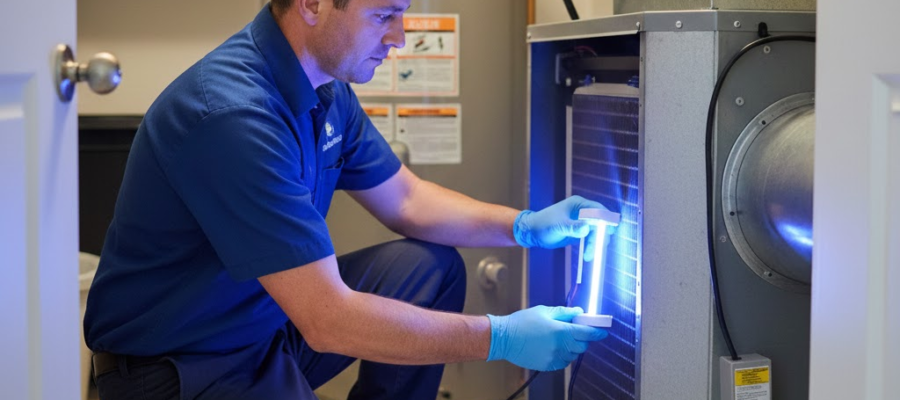
A coil-mounted UV-C lamp runs around the clock, preventing new biological growth before it starts. Think of it like sunscreen for your coils. It won’t scrub away existing buildup, but it stops mold from gaining a foothold. For homeowners who keep noticing musty smells every time the AC runs, this is often the fix. And if you want to understand how Stamford’s salty air affects other parts of your system, that’s a separate but related concern worth looking into.
How UV Light Systems Are Set Up Inside Your HVAC
Coil Sterilization Units
The most common residential setup. A UV-C lamp sits near the evaporator coil, condensation pan, and filter area, running continuously to keep mold, bacteria, and biofilm from forming on those surfaces. If you’re trying to prevent mold in your HVAC system in a humid climate, this is the place to start.
In-Duct Air Sterilization Units
These mount inside the return duct and treat the air as it passes through. The interior of that duct section is usually lined with reflective material to increase UV-C coverage. In-duct units focus more on neutralizing airborne pathogens and tend to be a good addition for households dealing with allergy or respiratory issues.
Myth #3: “My Filter Already Handles Air Quality. A UV Light Would Be Redundant.”
Filters Catch Dust. UV Lights Neutralize Living Organisms. Two Different Jobs.
A lot of homeowners assume their air filter covers everything, but filters only trap non-living particles like dust, pet dander, and pollen. They physically catch debris in a mesh. They can’t do anything about living organisms like mold spores, bacteria, or viruses that pass through or settle inside the system.
UV-C light fills that gap. It disrupts the DNA of biological contaminants so they can’t grow or reproduce. The CDC recognizes UV germicidal irradiation as a complementary measure alongside filtration, not a substitute. Your filter handles dust. The UV light handles biology. For homeowners in Stamford CT looking for the best UV light for HVAC allergies, using both layers together is the most effective approach.
Myth #4: “It’s Too Expensive to Be Worth It.”
Compare the Cost to What You’d Spend on Mold Remediation
A UV-C installation is a one-time investment with low ongoing costs. Bulb replacement runs about once a year, and the electricity draw is minimal. Now compare that to professional mold remediation, which can easily run into the thousands. Or to repeat service calls for musty odors and coil cleaning year after year.
There’s also an efficiency benefit. A coil free of biofilm transfers heat better, so your system doesn’t work as hard and uses less energy. If you’re weighing the pros and cons of UV light for your coastal home, the long-term numbers tend to support installation, especially if you’re already spending money chasing mold-related symptoms.
What to Know About UV-C Safety
Direct exposure to UV-C light can harm skin and eyes. That’s exactly why these lamps belong inside the HVAC system, installed by a trained technician. Once mounted and enclosed, no UV-C reaches your living space during normal operation. Bulb swaps should also be left to a professional. This isn’t a weekend DIY project.
Should You Add UV-C to Your Coastal Connecticut HVAC System?
For most homeowners in Stamford, Greenwich, Norwalk, and the surrounding Fairfield County area, the answer leans toward yes. The combination of Long Island Sound humidity, seasonal pollen, and the way HVAC systems naturally collect biological growth creates conditions where UV-C provides real, measurable value. If you’ve been dealing with allergies or recurring musty odors, a UV light installation addresses the problem at the source.
Talk to a Local IAQ Team That Knows the Coast
Amazon Air Pro installs and services UV-C systems for homeowners across Stamford and surrounding coastal Connecticut communities. Our technicians understand the specific air quality challenges that come with living near the water, and they can walk you through what makes sense for your home. Give us a call and we’ll answer your questions.