Solving the Split-Level Problem: How Paramus Homeowners Can Finally Balance Their Home’s Temperature
Is your upstairs bedroom unbearably hot while your downstairs family room feels like an icebox? If you live in a split-level home in Paramus, this probably sounds familiar. These temperature swings aren’t just uncomfortable, they’re built into how split-level homes work. But you don’t have to live with it. HVAC zoning technology fixes the temperature imbalance that’s frustrated homeowners for decades.
Why Split-Levels Have Uneven Heating and Cooling
Split-level homes became popular across Bergen County in the 1960s and 1970s, and Paramus has plenty of them. These homes made creative use of space with staggered floors and semi-open layouts. But that same design creates problems when you’re trying to keep every room comfortable.
The main issue is simple physics. Warm air rises while cool air sinks. In split-level houses with short, open stairways connecting different floors, those stairways move hot air upward and cold air downward like highways. During summer, upper-level bedrooms become sweltering while the lower family room stays comfortable. In winter, it flips—your furnace struggles to warm the lower levels while the upper floors overheat.
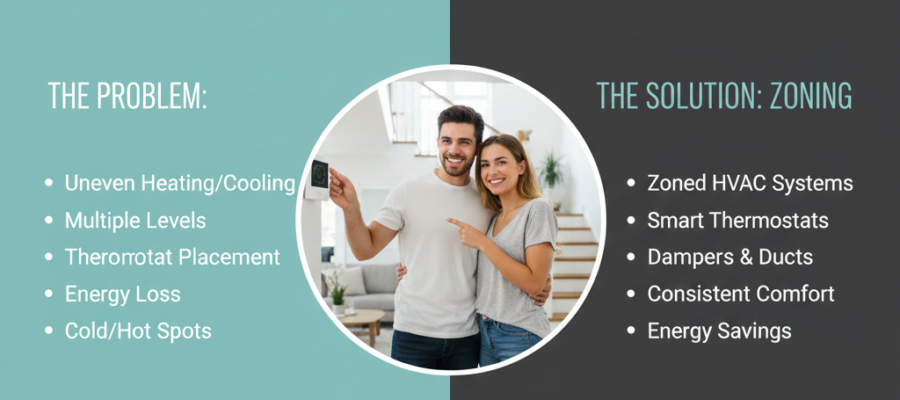
Most split-level homes have just one thermostat, usually on the main level. This single control tries to manage the temperature for three or four different floors. The thermostat only measures one spot, so it gets a misleading reading. When your system cools down the hot upstairs, it over-cools the already cold basement. When it heats the chilly lower level, it turns the upper bedrooms into saunas. This single-thermostat setup is the root of how to fix hot upstairs cold downstairs split-level issues.
How HVAC Zoning Fixes Split-Level Temperature Problems
HVAC zoning systems divide your home into separate temperature zones, each with its own thermostat. Think of it like having individual light switches for each room instead of one switch for the entire house.
The system uses motorized dampers installed in your ductwork. These dampers open and close based on what each zone’s thermostat is calling for. When your upstairs bedroom needs cooling, the dampers send cold air there. When your lower-level den needs heat, the system sends warm air to that zone.
Three main parts make this work: the zone control panel coordinates signals from all thermostats, the dampers control airflow to each zone, and individual thermostats give you control over each area. HVAC zoning for tri-level homes in NJ delivers targeted climate control that single-system setups can’t match. You might set your upstairs to 68°F while keeping your downstairs at 72°F.
Benefits: Comfort, Energy Savings, and Equipment Life
Balanced comfort is what you notice first. Every room reaches and stays at the temperature you want. No more hot spots in summer or cold zones in winter.
Energy savings follow from this targeted approach. When you’re cooling a hot upstairs, your existing system also cools the already comfortable main level and the cold basement. You’re paying to over-cool two-thirds of your home. The best way to cool a split-level house in Paramus isn’t running your air conditioner harder, it’s directing that cooling power where it’s needed.
Your HVAC equipment also benefits. When your system doesn’t have to work as hard fighting against your home’s design, it experiences less wear and tear. This means fewer repairs and longer equipment life.
Cost of HVAC Zoning for Split-Level Homes
The cost of HVAC zoning for a split-level home depends on your home’s size, how many zones you want, and your existing ductwork condition. Most split-level homes work well with three to four zones—one for the upper level, one for the main level, one for the lower level, and sometimes a separate zone for a finished basement.
You can often retrofit your current HVAC system for zoning without replacing everything. A professional assessment determines if your existing equipment can handle zoning. In many cases, adding motorized dampers and zone thermostats to your current ductwork is all you need.
The initial investment pays back through reduced energy bills. When you’re not heating or cooling your entire home to fix problems in just one zone, monthly utility costs drop noticeably. Making sure your system has clean ducts helps maximize these efficiency gains.
Balancing Temperature in 1960s Split-Level Homes
Older Paramus homes face specific challenges. These homes often have outdated insulation, original single-pane windows, and ductwork that may have developed leaks over the years. But these factors make zoning more valuable, not less.
When you can’t easily upgrade every part of your home’s structure, directing your heating and cooling strategically becomes essential. Balancing temperature in a 1960s split-level works best when zoning compensates for the inefficiencies common in older construction.
Smart thermostats in each zone let you program different temperatures for different times of day. If your bedrooms are upstairs, you can reduce cooling there during the day when no one uses those rooms. At night, you shift priorities—cooling the bedrooms while reducing air conditioning to the main floor.
How Zoning Installation Works
Installing HVAC zoning in an existing home starts with an evaluation. An HVAC professional examines your current system, inspects your ductwork, and discusses your comfort concerns. They map out which zones make sense for your home’s layout.
The installation centers on adding motorized dampers to your existing ductwork. The process is typically simple and doesn’t require major construction. Most installations finish in one to two days. New thermostats go into each zone, and the zone control panel connects everything.
Setting Up Temperature Zones in Bergen County Homes
Temperature zones Bergen County homeowners create typically align with how they use their homes. Upper-level bedrooms form one natural zone since they’re usually used only at night and tend to be warmer. The main living level becomes another zone. Lower levels or basements make up a third zone, particularly if they’re finished and used regularly.
Some homeowners create a fourth zone for spaces with unique needs: a home office, a master bedroom separate from other bedrooms, or a finished basement recreation room. Understanding the character of Paramus split-level homes helps explain why certain zoning configurations work better than others.
Fixing Uneven Heating in Paramus Split-Levels
Uneven heating Paramus homeowners experience in their split-level homes isn’t something you need to accept. HVAC zoning transforms how your home’s heating and cooling works, shifting from a one-size-fits-all approach to targeted climate control.
The combination of improved comfort, energy savings, and extended equipment life makes zoning a practical investment for split-level homeowners. You’ll stop fighting over the thermostat. Your family members can each have the temperature they prefer in their own spaces. Your energy bills will reflect the efficiency gains from conditioning only the areas that need it.
If temperature imbalances have frustrated you for years, a zoning assessment can show you exactly how to achieve balanced comfort throughout your home.