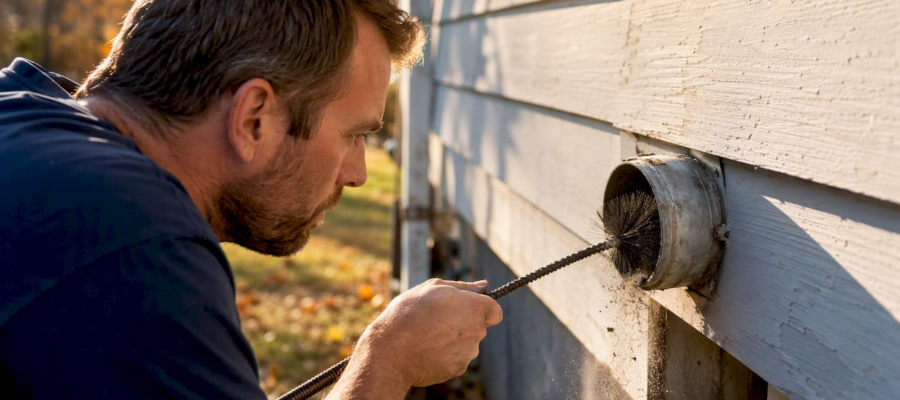
Dryer Vent Blockage Removal: Safety-First Steps for Homeowners
Stop using your dryer the moment you notice warning signs of a blocked vent. Unplug it, shut off the gas supply if it’s a gas unit, and ventilate the laundry area before doing anything else. The NFPA recommends cleaning dryer vents at least once a year, and for good reason: CPSC laboratory testing confirmed that internal dryer temperatures rise sharply when exhaust blockage reaches significant levels, creating real ignition risk. If you’re in New York, New Jersey, or Connecticut and the vent is severely blocked, Amazonairpro offers same-day dryer vent cleaning service so you’re not left waiting.
Immediate safety steps:
- Unplug the dryer or switch off the circuit breaker (gas dryers: also close the gas shutoff valve)
- Do not run the dryer again until the vent is cleared
- Open a window or door to ventilate the room if you smell burning
Key Takeaways
A blocked dryer vent is a fire hazard that requires immediate action: stop using the dryer, run a quick airflow check, and clear the blockage or call a professional fireplace fabricator before the next cycle.
| Point | Details |
|---|---|
| Stop at warning signs | Damp clothes, burning smell, or weak exterior airflow mean stop using the dryer immediately. |
| CPSC temperature threshold | Blockages at significant blockage cause significant internal temperature spikes that increase ignition risk. |
| NFPA annual minimum | Clean dryer vents at least once a year; heavy-use households or long runs need cleaning every 6 months. |
| DIY scope limit | DIY removal works for short, straight runs under 10 feet; long, concealed, or nest-blocked ducts need a professional. |
| Amazonairpro local service | Same-day dryer vent cleaning with video inspection and airflow testing is available across NY, NJ, and CT. |
Table of Contents
- How to tell your dryer vent is blocked
- Can you confirm a dryer vent blockage in 10 minutes?
- Step-by-step DIY dryer vent blockage removal
- When should you call a professional instead?
- What does professional dryer vent cleaning include?
- Safety standards and codes every homeowner should know
- A simple maintenance schedule to prevent future blockages
- A note from 10 years of local dryer vent work
- Amazonairpro serves NY, NJ, and CT homeowners with same-day dryer vent cleaning
- Sources
- FAQ
How to tell your dryer vent is blocked
Clothes still damp after a full cycle is the most common complaint, but it’s rarely the first sign. Whirlpool’s product guidance lists the key indicators: long dry times, little or no airflow at the exterior hood, visible lint accumulating near the vent connection, and a lint screen that stays unusually clean because restricted airflow isn’t pulling lint through properly.
Signs your dryer vent needs attention:
- Clothes are still damp or hot after one full cycle
- The dryer cabinet feels excessively hot to the touch
- A burning smell during operation (lint scorching near the heating element)
- Weak or no warm air at the exterior vent hood
- Visible lint buildup around the back of the dryer or at the outdoor flap
- The laundry room feels more humid than usual
The fire risk is what makes these symptoms urgent, not just inconvenient. USFA/FEMA analysis identified failure to clean as the leading contributing factor in clothes dryer fires, with animal nests, improper duct materials, and faulty installations also documented as common blockage causes.
The NFPA and Chimney Safety Institute of America (CSIA) are clear: a dryer vent that isn’t cleaned regularly is one of the most preventable fire hazards in a home. The risk isn’t theoretical — it’s documented in thousands of residential fire reports annually.
InspectApedia’s summary of CPSC test data adds useful nuance: partial restrictions below roughly 50% typically don’t produce dramatic temperature spikes, but blockages at significant blockage alter thermostat behavior and push internal temperatures into dangerous territory. That threshold is closer than most homeowners realize.
Can you confirm a dryer vent blockage in 10 minutes?
Yes, and you should run these checks before pulling the dryer away from the wall. This self-assessment approach helps you triage severity and decide whether a DIY clean or a professional call is the right next move.
- Check the lint screen. Remove it and hold it up to light. A film of fabric softener residue can restrict airflow even when lint is cleared. Wash it with warm soapy water if it doesn’t pass light through easily.
- Run the Air Fluff cycle with the lint screen removed. Go outside and hold your hand near the exterior vent hood. Weak or no airflow almost always points to a duct restriction rather than a failed heating element — a diagnostic tip confirmed by Whirlpool’s product help.
- Check the exterior flap. It should swing open freely when the dryer runs. A flap stuck shut means blockage, a broken hinge, or a nest.
- Inspect the transition hose. The flexible section connecting the dryer to the wall duct should have no kinks, crushing, or visible lint buildup.
- Sniff for a burning odor. Even faint scorching during operation is a reason to stop immediately.
- Look for nests or debris at the exterior hood. Birds and small animals commonly nest in vent terminations, causing total blockages.
Rule out false positives first: an overloaded drum, very cold ambient temperatures, or inadequate makeup air in a tight laundry room can all mimic vent restriction symptoms. Eliminate those before assuming the duct is blocked.
Safety note for gas dryers: shut off the gas supply before moving or disconnecting the dryer. If you smell gas at any point, leave the home immediately and call your gas utility’s emergency line.
Step-by-step DIY dryer vent blockage removal
DIY removal works well for short, straight runs, typically under 10 feet, with minimal bends and no suspected animal nests. Anything more complex than that calls for professional equipment.
Tools you’ll need:
- Vacuum with a long hose attachment
- Flexible rotary dryer vent brush kit with extension rods
- UL-listed metal transition duct (if replacing the existing one)
- Foil-backed metal tape (not standard duct tape)
- Hose clamps
- Flashlight, work gloves, safety glasses
Step-by-step process:
- Cut power at the breaker (and close the gas valve for gas dryers). Never skip this.
- Pull the dryer away from the wall far enough to access the transition hose.
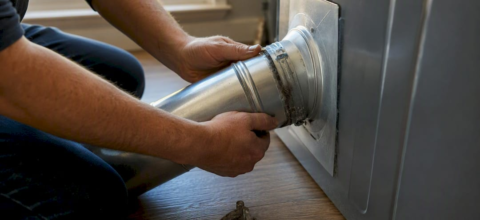
- Disconnect the transition hose from both the dryer exhaust port and the wall duct collar.
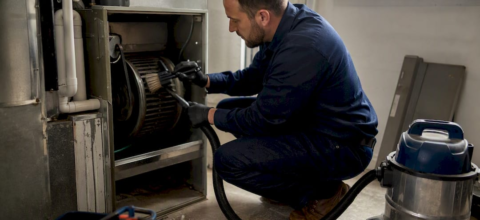
- Clean the lint trap housing inside the dryer with your vacuum hose.
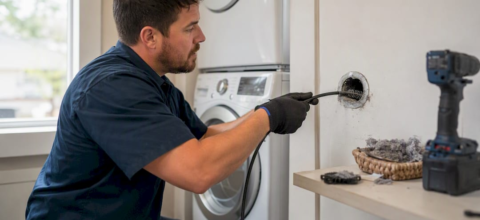
- Feed the rotary brush from the dryer end of the wall duct, extending rods as you go, while a second person vacuums lint at the opening. Then repeat from the exterior end.
- Inspect the removed transition hose. Home Depot’s how-to guide recommends replacing any plastic or foil duct with a UL-listed metal flexible transition duct no longer than 8 feet.
- Reinstall the transition duct, seal joints with UL-rated metal foil tape, and secure with clamps.
- Restore power and run a timed test cycle. Go outside and confirm strong, warm airflow at the exterior hood.
Pro Tip: Feed the brush from the dryer end first, not the exterior. Pushing from outside risks compacting lint deeper into bends. Vacuum continuously as you retract the brush to capture loosened debris rather than letting it settle.
NADCA industry guidance notes that DIY brush kits cannot reliably clear compacted lint in long runs, vertical sections, or multiple elbows. If the brush meets significant resistance or the airflow test still fails after cleaning, stop and call a professional.

When should you call a professional instead?
Some situations are genuinely beyond what a DIY kit can handle safely. Stop using the dryer and book professional service if any of these apply:
- You find a visible animal nest at the exterior hood or inside the duct
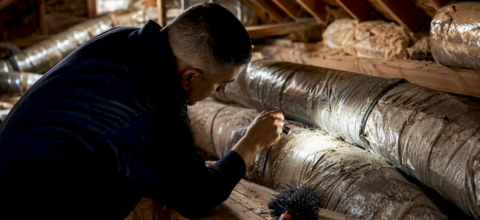
- The duct run is long, concealed in a wall or ceiling, or has multiple bends
- The existing duct is plastic or flexible foil (it needs replacement, not just cleaning)
- A burning smell persists after a DIY clean
- You have a gas dryer and suspect a venting problem
- The dryer keeps overheating or tripping its thermal limiter repeatedly
- Airflow at the exterior hood is still weak after a full DIY attempt
Pro Tip: While you wait for service, use a laundromat rather than running a dryer you know is restricted. A single cycle on a partially blocked vent can push internal temperatures into the danger zone documented in CPSC testing.
If the exterior flap is completely blocked by a nest, don’t attempt to clear it from inside. A technician with a camera and high-powered vacuum can remove the nest without pushing debris further into the duct.
What does professional dryer vent cleaning include?
A professional service covers more ground than a brush kit can reach. Here’s what a thorough job looks like:
- Full duct access cleaning using a rotary brush system paired with a high-capacity vacuum, clearing compacted lint from the entire run
- Video inspection to identify damaged sections, disconnected joints, or hidden nests
- Nest and debris removal from the duct and exterior termination
- Transition duct repair or replacement with a UL-listed metal unit when the existing one is damaged or non-compliant
- Airflow testing before and after to measure restored performance — ask for this specifically when booking
What affects the price: duct run length, number of bends, whether the duct passes through a wall cavity or attic, pest removal, replacement parts, and gas-dryer inspection all add to the scope. Longer and more complex runs cost more, and that’s reasonable given the equipment required.
Pro Tip: Ask any service provider whether airflow testing is included. A technician who measures airflow before and after cleaning gives you proof the job was done properly, not just an assurance.
When booking, confirm the provider carries liability insurance, uses rotary brush and vacuum equipment (not just a shop vac), and will document the condition of the duct before and after service.
Safety standards and codes every homeowner should know
These rules aren’t suggestions. They’re the baseline that keeps your home code-compliant and your family safe.
- Vent to the outdoors only. Never terminate a dryer duct into an attic, soffit, crawlspace, or wall cavity.
- Use rigid or smooth-wall metal duct for the permanent run. Flexible foil and plastic ducts are code-prohibited as permanent installations because they sag and trap lint.
- Maximum run length is 35 feet under IRC baseline guidance, reduced by approximately 5 feet for each 90° elbow. A run with two 90° bends has an effective maximum of about 25 feet.
- Transition ducts must be UL 2158A-listed and no longer than 8 feet for the appliance-to-wall connection.
- No screens on the exterior hood. Screens trap lint and accelerate blockages. Use a louvered or flap-style termination instead.
NFPA recommends cleaning dryer vents at least once a year. If your household does more than average laundry, has pets, or has a duct run longer than 15 feet, twice-yearly cleaning is worth considering.
CPSC and InspectApedia test data make the case for these standards clearly: the materials and run lengths that code restricts are precisely the conditions that produce the worst blockages and the highest internal temperatures. Inspect the exterior vent monthly and keep a record of professional cleanings — some home insurance policies ask for documentation.
A simple maintenance schedule to prevent future blockages
Consistent habits cut blockage risk dramatically. Here’s a practical schedule:
Every load:
- Clean the lint screen before or after each cycle
Monthly:
- Check that the exterior flap opens freely during operation
- Look for visible lint accumulation at the hood or around the dryer back
- Run a quick airflow check (hand near the exterior vent during Air Fluff)
Every 6–12 months:
- Inspect the full transition hose for kinks, crushing, or lint buildup
- Schedule a professional cleaning if you have heavy use, pets, or a long duct run
Annually (minimum):
- Full professional inspection and cleaning per NFPA guidance via CSIA
- Document the service date for your records
Pro Tip: Households with pets shed significantly more fiber into laundry loads. If you have dogs or cats, plan on professional cleaning every 6 months rather than annually.
Preventive upgrades worth making now:
- Replace any plastic or flexible foil duct with rigid or semi-rigid metal duct
- Keep the exterior hood at least 12 inches above ground level to reduce debris entry
- Trim landscaping or remove debris that could block the exterior termination
- Check that the exterior hood has no screen — replace it with a louvered flap if it does
Regular maintenance also restores the designed airflow your dryer needs to run efficiently. A restricted vent forces the dryer to run longer, wearing out components faster and raising your energy bill.
A note from 10 years of local dryer vent work
After more than a decade of dryer vent cleaning across New York, New Jersey, and Connecticut, the same issues come up repeatedly. Plastic transition hoses are still common in older homes throughout the region, and they’re almost always partially collapsed by the time we see them. Long runs that pass through finished walls or attic spaces are another frequent finding, especially in multi-story homes in NYC and the suburbs of NJ and CT. Bird nests in exterior terminations are a seasonal problem, particularly in spring.
The decision framework for DIY versus professional service is straightforward: if you can see the full duct run, it’s under 10 feet, and the brush moves freely, DIY is reasonable. If there’s any doubt about what’s inside the duct, where it goes, or whether the existing materials are safe, a professional inspection protects you from a much more expensive problem later.
Amazonairpro serves NY, NJ, and CT homeowners with same-day dryer vent cleaning
If the checks above revealed a serious blockage, a suspected nest, or a duct that needs replacement, Amazonairpro’s team is ready to handle it the same day in New York, New Jersey, and Connecticut. Every job includes rotary brush cleaning with high-capacity vacuum extraction, a video inspection of the duct run, airflow testing before and after, and transition duct replacement when needed. Gas dryer venting is inspected as part of the service.

Booking is straightforward. Visit the dryer vent cleaning service page to check same-day availability in your area, or go directly to the NY and NJ service page to schedule. For homeowners planning a broader HVAC clean, Amazonairpro also offers air duct and dryer vent bundles that cover the full system in one visit.
Sources
The following authoritative sources informed this guide. Each covers a distinct aspect of dryer vent safety and maintenance.
- Dryer Vent may be Blocked or Restricted – Product Help | Whirlpool
- USFA/FEMA report on clothes dryer fires and contributing factors
- CPSC final report on electric clothes dryers and lint ignition characteristics
- How to clean a dryer vent – Home Depot
- How to Tell If Your Dryer Vent Needs Cleaning (Self-Assessment Checklist) – Lint Dragon
FAQ
How do you clear a clogged dryer vent yourself?
Disconnect the transition hose, then feed a flexible rotary brush kit from the dryer end of the wall duct while vacuuming loosened lint. Repeat from the exterior end, then reinstall a UL-listed metal transition duct and confirm strong airflow at the exterior hood before running the dryer again.
How often do dryer vents get clogged?
Most vents accumulate enough lint to restrict airflow within 12 months of regular use, which is why the NFPA recommends at least annual cleaning. Households with heavy laundry loads, pets, or long duct runs often see significant buildup in 6 months or less.
What happens if a dryer vent is blocked?
A blocked vent traps heat inside the dryer. CPSC testing shows internal temperatures rise sharply at significant blockage blockage, increasing the risk of lint ignition. Beyond fire risk, a blocked vent causes longer dry times, higher energy use, and accelerated wear on dryer components.
How long does it take to clean a dryer vent pipe?
A straightforward DIY clean on a short, accessible run typically takes some time, depending on duct length and complexity. A professional service, which includes video inspection, rotary brush cleaning, and airflow testing, generally takes longer and varies with the duct’s condition.
Recommended
- Dryer Vent Blockage: Spot Signs and Prevent Risks – Amazon Air Duct Cleaning
- Dryer vent safety procedure: 5 essential steps – Amazon Air Duct Cleaning
- 5 Warning Signs Your Dryer Vent Is a Fire Hazard (And What to Do)
- Safety First: 5 Reasons to Get Your Dryer Vent Cleaned – Amazon Air Duct Cleaning