HVAC mold removal: Restore air quality in NY, NJ, CT
Most mold growing inside an HVAC system stays completely out of sight. It hides behind panels, inside ductwork, and around coils, quietly releasing spores into the air you breathe every day. By the time symptoms appear, such as persistent sneezing, musty odors, or worsening allergies, contamination may have been spreading for months. EPA mold guidance confirms that professional HVAC mold removal, conducted under EPA and NADCA (National Air Duct Cleaners Association) standards, is one of the most effective ways to restore safe indoor air quality. This guide walks you through exactly what that process looks like and why it matters for homes and businesses across New York, New Jersey, and Connecticut.
Table of Contents
- How mold contaminates HVAC systems
- What is HVAC mold removal?
- Step-by-step HVAC mold removal process
- Regulations in New York, New Jersey, and Connecticut
- DIY vs. professional HVAC mold removal
- Maintaining HVAC systems to prevent mold
- Get professional HVAC mold removal in NY, NJ, and CT
- Frequently asked questions
Key Takeaways
| Point | Details |
|---|---|
| Hidden hazards | Mold in HVAC systems can stay out of sight but drastically impact air quality and health. |
| Professional process | Effective removal follows strict standards with thorough cleaning, containment, and system upgrades. |
| Legal compliance | NY, NJ, and CT homeowners and businesses must follow regional licensing rules for safe mold remediation. |
| DIY limitations | Home cleaning only handles minor issues—deep mold removal needs specialized equipment and expertise. |
| Prevention | Routine maintenance and moisture control stop mold before it becomes a costly problem. |
How mold contaminates HVAC systems
Mold needs three things to grow: moisture, a food source, and warmth. Your HVAC system provides all three. Condensation builds up around cooling coils, dust and organic debris collect inside ducts, and the system’s warmth creates ideal conditions for mold colonies to form and spread.
Once mold takes hold, your HVAC system becomes a distribution network. Every time the system runs, mold spreads spores throughout the building’s air, reaching every room connected to the ductwork. That’s what makes HVAC mold different from a patch of mold on a bathroom wall. It’s not contained.
Early warning signs are worth paying attention to:
- A persistent musty or earthy odor when the system runs
- Increased allergy or asthma symptoms among occupants
- Visible dark spots or discoloration around vent covers
- Unexplained respiratory irritation that improves when you leave the building
The tricky part is that most HVAC mold is hidden. It grows inside air handlers, behind insulation, and deep within duct runs where no one looks. You can have a serious contamination problem without seeing a single visible sign.
If you notice any of these signals, detecting mold in air ducts early is critical. The longer mold goes unaddressed, the more it spreads and the more costly the remediation becomes. Learning about removing mold in ducts before the problem escalates gives you a real advantage.
What is HVAC mold removal?
HVAC mold removal is not the same as a standard duct cleaning. Basic cleaning removes dust, debris, and buildup from duct surfaces. Mold removal is a specialized remediation process that addresses active biological contamination using containment, antimicrobial treatments, and verified clearance testing.
According to EPA and IICRC standards, a proper HVAC mold removal process includes shutting down the system, inspecting all components, containing the work area, HEPA vacuuming (using filters that capture 99.97% of airborne particles), replacing porous materials, treating coils and surfaces with antimicrobials, and verifying results through air sampling before the system is restarted. The full HVAC mold removal protocol makes clear that skipping any of these steps risks incomplete remediation.

Here’s a quick comparison to clarify the difference:
| Feature | Basic HVAC cleaning | HVAC mold removal |
|---|---|---|
| Target | Dust and debris | Active mold contamination |
| Equipment | Standard vacuums and brushes | HEPA vacuums, negative air machines |
| Antimicrobial treatment | Rarely included | Always included |
| Clearance testing | Not required | Required before restart |
| Regulatory compliance | General best practices | EPA/IICRC/NADCA standards |
The core goal of mold removal is twofold: eliminate the existing contamination and prevent it from coming back. That second part is what separates a thorough job from a temporary fix. Our air duct cleaning services are built around this standard, and the equipment used for cleaning air ducts reflects that commitment.

Step-by-step HVAC mold removal process
Knowing what professionals actually do during a mold removal job helps you ask the right questions and recognize quality work. Here is the standard process:
- Shut down the HVAC system. Running the system during remediation spreads spores. Everything stops before work begins.
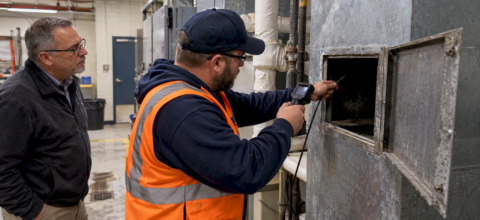
- Inspect all components. Technicians use cameras and borescopes (small inspection cameras inserted into ductwork) to map the full extent of contamination.
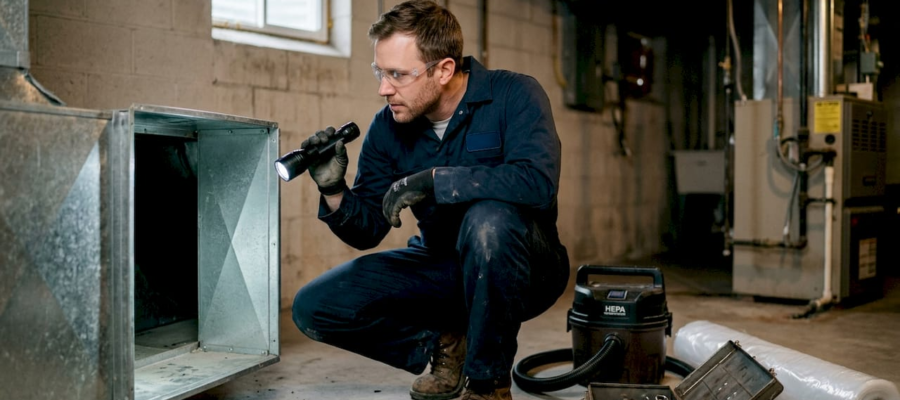
- Contain the work area. Plastic sheeting seals off vents and registers. Negative air machines create lower air pressure inside the work zone so spores cannot escape into occupied spaces.
- HEPA vacuum all surfaces. HEPA filters capture 99.97% of particles, including mold spores, making this step non-negotiable for safe removal.
- Mechanical brushing. Rotating brushes dislodge mold from duct walls while the HEPA vacuum captures what’s released.
- Apply antimicrobial treatments. EPA-registered antimicrobial agents are applied to all affected surfaces, including coils, drain pans, and duct interiors. Our antimicrobial duct cleaning process follows this protocol precisely.
- Replace porous materials. Flexible ducts, duct liner insulation, and other porous components that cannot be cleaned are removed and replaced.
- Repair the moisture source. Leaks, condensation issues, and drainage problems are fixed. Without this step, mold returns.
- Upgrade filtration and add UV lights. MERV-13 filters (rated to capture smaller particles than standard filters) and UV germicidal lights provide ongoing protection.
- Air sampling verification. Post-remediation air samples confirm spore counts are within safe levels before the system is restarted.
Pro Tip: Moisture repair is the step most often skipped by low-quality contractors. If the underlying moisture problem isn’t fixed, mold will grow back within weeks, no matter how thorough the cleaning was.
| Step | Purpose | Tools used |
|---|---|---|
| Containment | Prevent spore spread | Plastic sheeting, negative air machines |
| HEPA vacuuming | Remove spores safely | HEPA vacuum systems |
| Antimicrobial treatment | Kill remaining mold | EPA-registered agents |
| Air sampling | Verify safe clearance | Spore trap cassettes, lab analysis |
For larger commercial properties, commercial duct cleaning follows the same rigorous steps but is scaled to handle complex multi-zone systems.
Regulations in New York, New Jersey, and Connecticut
Local rules matter when you’re booking mold removal. Getting this wrong can create liability issues for business owners and leave homeowners with incomplete work that doesn’t meet legal standards.
New York City has some of the most specific requirements in the region. The NYC Department of Health and Mental Hygiene (DOHMH) mandates that contamination larger than 10 square feet requires a licensed mold assessor to evaluate the problem before remediation begins. HVAC-wide contamination falls under Level V, the most serious classification, which requires full system shutdown and professional remediation by a licensed contractor. The NY mold remediation rules outline these requirements in detail.
New Jersey and Connecticut do not have the same state-specific mandates, but both states follow EPA and IICRC S520 standards (the industry’s primary mold remediation standard). Contractors working in these states are expected to follow those protocols.
Key points for property owners across the region:
- In NYC, always confirm your contractor holds a valid mold remediation contractor license
- For contamination over 10 sq ft in NYC, a separate licensed assessor must document the problem first
- Business owners should request written documentation of the remediation process for compliance records
- In NJ and CT, ask contractors to confirm they follow IICRC S520 and EPA guidelines
Pro Tip: Licensing verification is not optional. Ask to see credentials before any work begins. A legitimate contractor will have no hesitation showing you their license and certifications.
Our commercial air duct cleaning services are fully compliant with regional requirements, and our team can walk business owners through documentation needs. If you’re unsure whether your situation requires a licensed assessor, our mold detection resources can help you assess the situation.
DIY vs. professional HVAC mold removal
This is a fair question, and the honest answer is: it depends on the scope. For very minor surface mold on a vent cover or a filter that needs replacing, you can handle that yourself. But anything inside the ductwork or around HVAC components is a different situation entirely.
| Task | DIY possible? | Why |
|---|---|---|
| Replace air filters | Yes | Simple, no special tools needed |
| Clean surface vent covers | Yes | Accessible and low-risk |
| Clean inside ductwork | No | Requires HEPA equipment and training |
| Treat coils and air handlers | No | Risk of spreading spores without containment |
| Verify air quality post-cleaning | No | Requires lab-analyzed air sampling |
The core risk with DIY mold removal inside ducts is spore dispersal. Without proper containment and HEPA equipment, cleaning attempts can actually make contamination worse by releasing spores into the air. DIY is limited to filters and vents; full HVAC mold removal requires professionals with the right tools and safety protocols.
Additional risks of DIY approaches:
- No way to verify the system is safe before restarting it
- Exposure to mold spores without proper respiratory protection
- Missing hidden contamination in areas you can’t see or reach
- No compliance with NYC licensing requirements if applicable
If you want to take a proactive role, focus on preventing mold in ducts through regular filter changes and moisture control. Leave the remediation to certified professionals.
Maintaining HVAC systems to prevent mold
Once remediation is complete, your goal shifts to keeping mold from coming back. The good news is that consistent maintenance is far less expensive than repeated remediation.
Moisture control, upgraded filters, UV lights, and routine checks are the four pillars of effective HVAC mold prevention. Here’s what that looks like in practice:
- Fix leaks immediately. Any water intrusion near ductwork or air handlers creates mold conditions within 24 to 48 hours
- Insulate ducts properly. Condensation on uninsulated ducts is a common and overlooked moisture source
- Check drain pans regularly. Clogged condensate drain pans are one of the most frequent causes of HVAC mold
- Use MERV-13 filters or better. These capture smaller particles and reduce the organic debris that feeds mold
- Install UV germicidal lights. These lights continuously disinfect air passing through the system, reducing mold and bacteria growth
- Schedule annual professional inspections. A trained technician can catch early signs of moisture or mold before they become serious problems
Pro Tip: Annual maintenance costs a fraction of what full mold remediation runs. Treating it as optional is one of the more expensive decisions a property owner can make.
For seasonal guidance, our HVAC summer maintenance resource covers timing and priorities. And for a focused look at long-term strategies, preventing HVAC mold walks through the full approach. The EPA’s mold prevention guidance also reinforces that moisture control is the single most important factor.
Get professional HVAC mold removal in NY, NJ, and CT
If you’ve read this far, you already know that HVAC mold removal is not a job for guesswork or shortcuts. It requires the right equipment, trained technicians, and a process that meets EPA, IICRC, and NADCA standards from start to finish.

At Amazon Air Duct Cleaning, we’ve spent over 10 years helping homeowners and business owners across New York, New Jersey, and Connecticut restore safe, clean indoor air. Our certified team handles everything from initial inspection to post-remediation air sampling, following every step of the professional process outlined in this guide. Whether you need air duct cleaning services for a residential property or commercial duct cleaning for a larger facility, we’re equipped to handle it. Not sure if your system needs attention? Check the signs your air ducts need cleaning and reach out to our team for an honest assessment.
Frequently asked questions
How do I know if I have mold in my HVAC system?
Musty odors when the system runs, increased allergy symptoms, and visible discoloration near vents are the most common signals. A professional inspection with camera equipment can confirm hidden mold in ductwork that you can’t see from the outside.
Is HVAC mold removal safe for my family or business?
Yes, when performed by certified professionals using proper containment and HEPA equipment. Professionally contained removal prevents spore distribution and leaves the system verified safe before it’s restarted.
Can I remove mold from air ducts myself?
DIY is reasonable for filter replacements and cleaning surface vent covers, but full HVAC mold removal needs specialized equipment, containment, and post-remediation air testing that only professionals can provide.
What are NY, NJ, and CT mold removal regulations?
NYC requires licensed assessors for contamination over 10 square feet and applies Level V rules to HVAC systems. New Jersey and Connecticut follow EPA and IICRC S520 guidelines without additional state-specific mandates.
How can I prevent mold from returning to my HVAC system?
Fix moisture sources, upgrade to MERV-13 filters, install UV germicidal lights, and schedule annual professional inspections. Maintenance and upgrades are consistently more cost-effective than repeated remediation.
Recommended
- How to prevent mold in ducts for healthier indoor air – Amazon Air Duct Cleaning
- How to Detect and Remove Black Mold from Air Vents
- Signs of Black Mold in Air Vents & How to Remove It
- Mold in Your Ducts? Here’s How to Get Rid of It | PRO Tips