Improve indoor air quality: steps for healthier spaces
TL;DR:
- Indoor air pollution includes invisible threats like PM2.5, VOCs, radon, CO, and mold spores.
- Source control, ventilation, and high-quality filtration are essential for effective indoor air quality.
- Regular maintenance, radon testing, and professional duct cleaning support ongoing healthy indoor environments.
Americans spend about 90% of their time indoors, yet most people never think twice about the air they’re breathing at home or at the office. If you’ve been dealing with persistent coughs, unexplained fatigue, or seasonal-style allergies that never quite go away, the culprit may not be outside at all. Indoor air pollution is a real, measurable problem, particularly in densely built environments like New York City, northern New Jersey, and Connecticut’s older housing stock. This article walks you through practical, research-backed strategies to understand, reduce, and monitor indoor air quality, whether you own a home, manage a retail space, or run a commercial office.
Table of Contents
- Understanding the main indoor air quality threats
- Step 1: Source control, the foundation of good air quality
- Step 2: Ventilation, dilute pollutants safely
- Step 3: Air cleaners and HVAC filters, capture what you can’t avoid
- Managing humidity, monitoring, and ongoing maintenance
- Our perspective: Why most guides oversimplify indoor air quality
- Professional support for clean indoor air
- Frequently asked questions
Key Takeaways
| Point | Details |
|---|---|
| Start with source control | Eliminate pollution sources first for the most effective and affordable air quality improvements. |
| Ventilate with caution | Bring in outdoor air strategically to dilute pollutants, avoiding times of high outdoor pollution. |
| Use proper filtration | Install high-efficiency HVAC filters and air cleaners, especially in high-occupancy or urban areas. |
| Maintain humidity and monitor | Keep humidity between 30-50% and regularly test for radon and carbon monoxide. |
| Routine cleaning matters | Schedule professional duct and vent cleaning to support all your air quality goals. |
Understanding the main indoor air quality threats
To solve air quality problems, you first need to know what’s actually polluting your indoor spaces. The list of common indoor pollutants is longer than most people expect, and several of them are invisible, odorless, and genuinely dangerous at elevated levels.
The primary threats include:
- Particulate matter (PM2.5): Tiny particles from cooking, candles, traffic exhaust, and construction that penetrate deep into the lungs.
- Volatile organic compounds (VOCs): Gases emitted from paints, cleaning products, furniture, and adhesives. Common indoors year-round.
- Radon: A naturally occurring radioactive gas that seeps up from soil and rock. Radon is a high risk in NY, NJ, and CT and is the second-leading cause of lung cancer in the U.S.
- Carbon monoxide (CO): Produced by gas appliances, fireplaces, and attached garages. Odorless and potentially fatal.
- Mold spores: Common in humid basements, bathrooms, and anywhere water damage has occurred, especially in older Northeast homes.
Here’s something worth knowing: PM2.5 levels indoors are often 2 to 5 times higher than outdoors. That’s not a typo. Cooking a meal on a gas stove without ventilation, or running a scented candle, can push your indoor particle levels well above what you’d encounter standing on a busy street.
The EPA’s current annual National Ambient Air Quality Standard (NAAQS) for PM2.5 is 9 micrograms per cubic meter. Many homes in the tri-state area routinely exceed that during ordinary activities. For humidity, the recommended range is 30 to 50 percent. Going above that encourages mold and dust mites; going below it dries out mucous membranes and increases vulnerability to airborne viruses.
For residents of Connecticut and northern New Jersey in particular, radon testing is not optional. These areas include geology that releases radon naturally, and older construction often lacks the sealing that would slow its entry.
Step 1: Source control, the foundation of good air quality
Now that you know the main threats, focus on stopping them at their origin before trying to dilute or filter them. This approach is called source control, and it is the most effective and cost-efficient indoor air quality improvement available.
Adding ventilation and filtration without fixing the source of pollution is like bailing water from a boat with the plug still out. You’ll work hard for limited results.
Here are six source control actions worth prioritizing:
- Identify and repair leaks. Water intrusion leads to mold. Check basements, under sinks, and around windows regularly.
- Switch to low-VOC products. Look for paints, adhesives, and cleaning supplies labeled low-VOC or zero-VOC. The difference in air quality is noticeable within days.
- Eliminate indoor smoking. Tobacco smoke contains hundreds of toxic compounds, and no ventilation system fully removes them from carpets and walls.
- Maintain gas appliances. Have your furnace, water heater, and stove serviced annually. Poorly tuned burners produce excess CO and nitrogen dioxide.
- Test for radon. Short-term radon tests are inexpensive and widely available. If levels exceed 4 picocuries per liter (pCi/L), mitigation is strongly recommended.
- Install and maintain CO alarms. Place them near sleeping areas and on every level of the home or business. Test monthly.
For details about pollutant sources and which rooms tend to harbor them, it helps to review the most common culprits by room type. And if you want to get more simple maintenance tips that pair with source control, those small habits compound quickly.
Pro Tip: Start your source control audit in the kitchen, basement, and any utility rooms. These spaces generate the highest pollutant loads and often get the least attention.

Step 2: Ventilation, dilute pollutants safely
Once you’ve addressed sources, it’s time to bring in clean air and move stale air out, but with strategy and care. Natural ventilation like opening windows and running fans dilutes indoor pollutants effectively, but only when outdoor air is actually cleaner than what’s inside.
Here’s a quick comparison of ventilation options:
| Ventilation type | Approximate airflow | Best use case | Limitation |
|---|---|---|---|
| Natural (windows/doors) | Variable | Mild weather, low outdoor pollution | Seasonal, weather-dependent |
| Mechanical (HVAC fresh air) | 15 to 60 CFM typical | Year-round baseline ventilation | Requires compatible system |
| Spot (kitchen/bath fans) | 50 to 300 CFM | Cooking, bathing, high-moisture tasks | Localized only |
ASHRAE standards 62.1 and 62.2 define minimum ventilation rates for commercial and residential spaces respectively. For most homes, the goal is roughly 0.35 air changes per hour. Businesses have stricter requirements based on occupancy and space type.
For kitchens specifically, a vented range hood rated between 100 and 300 CFM makes a significant difference. Run it during cooking and for at least 10 to 20 minutes after you’re done. Many people turn it off too soon, letting residual particles settle back into the space.
For business ventilation tips tailored to retail and office settings, the considerations around occupancy and code compliance add another layer. And if smoke from wildfires or nearby construction is a factor, knowing how to purify air from smoke indoors is a practical skill worth having.
Pro Tip: Don’t open windows during outdoor pollution spikes like wildfire smoke events, high pollen days, or active construction nearby. On those days, keep the building sealed and rely on filtration instead.
Step 3: Air cleaners and HVAC filters, capture what you can’t avoid
Even strong source control and ventilation can’t remove every contaminant. That’s where filtration and air cleaning pick up. High-efficiency HVAC filters (MERV 13 or higher) and portable air cleaners with solid CADR (Clean Air Delivery Rate) ratings help capture fine particles without producing ozone, which is a key consideration when choosing a device.

Here’s how common filter options compare:
| Filter type | Particles captured | Approximate cost | Change frequency |
|---|---|---|---|
| MERV 8 | Dust, pollen, mold spores | $10 to $20 | Every 3 months |
| MERV 11 | Above + fine dust, pet dander | $15 to $30 | Every 3 months |
| MERV 13 | Above + PM2.5, smoke, bacteria | $20 to $40 | Every 2 to 3 months |
| HEPA portable unit | 99.97% of particles 0.3 microns+ | $80 to $300+ | Filter: 6 to 12 months |
For guidance on choosing the right air filter for your specific system, check compatibility with your HVAC unit first. Jumping to a MERV 13 on an older system with a weak blower can restrict airflow and reduce efficiency. And if you want to fully understand MERV ratings before buying, that context makes the decision much easier.
For portable air cleaners, placement matters:
- Bedrooms: Place near the bed where you spend the most breathing hours.
- Family rooms and living areas: Central placement works best for larger spaces.
- Office areas: Position near workstations, not tucked in a corner.
- Near pollutant sources: A unit near a litter box, printer, or hobby workspace reduces localized exposure.
Always choose ozone-free devices. Some ionizers and UV systems generate ozone as a byproduct, which is itself a lung irritant.
Managing humidity, monitoring, and ongoing maintenance
With the major systems in place, maintaining good air quality comes down to consistent upkeep and staying alert to risks that develop slowly. Maintaining indoor humidity at 30 to 50 percent, fixing leaks promptly, and testing for radon and CO are all part of a sustainable routine.
Key ongoing maintenance tasks:
- Fix leaks within 24 to 48 hours to prevent mold colonization, especially in basements and crawl spaces.
- Use a dehumidifier in humid months. The Northeast gets genuinely muggy summers, and without control, indoor humidity can climb above 60 percent.
- Test radon annually or after any major renovation that disturbs soil or foundation sealing.
- Test CO detectors monthly and replace units older than 5 to 7 years.
- Clean or replace HVAC filters on schedule. A clogged filter doesn’t just reduce air quality, it strains the system and raises energy costs.
- Schedule professional duct and vent cleaning when needed, particularly after water damage, pest activity, or renovations.
For more detail on humidity and mold prevention, the relationship between moisture and spore growth is worth understanding. And knowing how to prevent mold in ducts specifically is relevant for any home with central air.
Pro Tip: Buy a $20 to $30 digital hygrometer (humidity monitor) and place it in your main living area. Set a calendar reminder every 90 days for filter replacement and appliance checks. Small habits like these prevent big problems.
Our perspective: Why most guides oversimplify indoor air quality
After more than 10 years of working in homes and businesses across New York, New Jersey, and Connecticut, we’ve seen a pattern: people buy an air purifier, feel better about it, and stop there. That’s understandable, but it misses the point.
A standalone air cleaner without source control and adequate ventilation barely moves the needle on real indoor air quality. It’s treating a symptom, not the problem. We’ve walked into homes where the owner had a high-end purifier running in the living room while a gas range was venting into the kitchen, radon had never been tested, and the HVAC filter hadn’t been changed in over a year. The purifier was doing some good, but not nearly enough.
The uncomfortable truth is that prioritizing source control and MERV 13+ filtration alongside consistent ventilation gives the best balance of cost, effectiveness, and health outcomes. Spending $400 on an air purifier feels proactive. Spending $30 on a MERV 13 filter and actually changing it on schedule is more effective.
Every small improvement in filter selection, source reduction, and ventilation timing adds up. The cumulative effect is what matters.
Healthy indoor air is never one-and-done. It’s a lifestyle of prevention, monitoring, and collaboration between homeowner, business manager, and pro.
Professional support for clean indoor air
Sometimes, an expert’s eye and a thorough cleaning make all the difference in keeping indoor air quality where it needs to be.

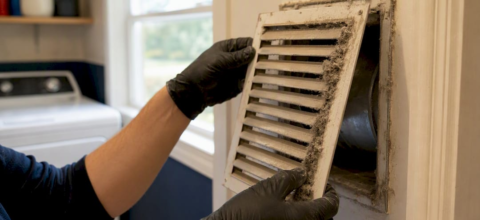
Even the most diligent homeowner or facilities manager can’t clean inside ductwork, clear a clogged dryer vent, or assess chimney buildup without professional tools. Regular air duct cleaning services support all three pillars we’ve covered: they reduce the buildup of particulate matter circulating through your system, improve airflow for better ventilation efficiency, and remove conditions where mold can grow. If you’ve recently dealt with water damage, completed a renovation, or noticed persistent odors or allergy symptoms, that’s a clear signal to call a professional. For commercial duct cleaning in New York and New Jersey, we work with offices, retail spaces, and multi-unit properties. Start with easy maintenance for air quality and let us handle the rest.
Frequently asked questions
What is the fastest way to improve indoor air quality in my home?
Natural ventilation quickly dilutes airborne indoor pollutants, so opening windows and running exhaust fans while removing immediate sources like aerosols or smoke is the fastest first step. For same-day impact, combine this with turning on a CADR-rated air cleaner.
How often should I change my HVAC air filter?
Change HVAC filters every 3 months as a baseline, or every 1 to 2 months if you have pets, allergies, or anyone with respiratory conditions in the home. High-efficiency filters lose effectiveness quickly when clogged, so consistency matters more than the filter brand.
Is a portable air cleaner enough for my office?
Portable air cleaners help, but they work best when combined with source control and adequate ventilation. Combining filtration, source control, and ventilation gives far better results than any single device alone, especially in shared office environments with multiple occupants.
Should I monitor CO2 or pollutants to check air quality?
CO2 is a ventilation proxy, not a full measure of indoor air quality, so use a CO2 monitor alongside dedicated pollutant sensors and a humidity monitor for a complete picture. Relying on CO2 alone can give you false confidence about air that still contains PM2.5, VOCs, or mold spores.
Recommended
- Improve Indoor Air Quality with Easy Home Maintenance Tips
- Plants to improve indoor air quality – Amazon Air Duct Cleaning
- Why is air quality inside important? – Amazon Air Duct Cleaning
- Improving Air Quality in Your Business (11% Productivity Boost?)
- Hygienic Ceiling Panels: Benefits & Options