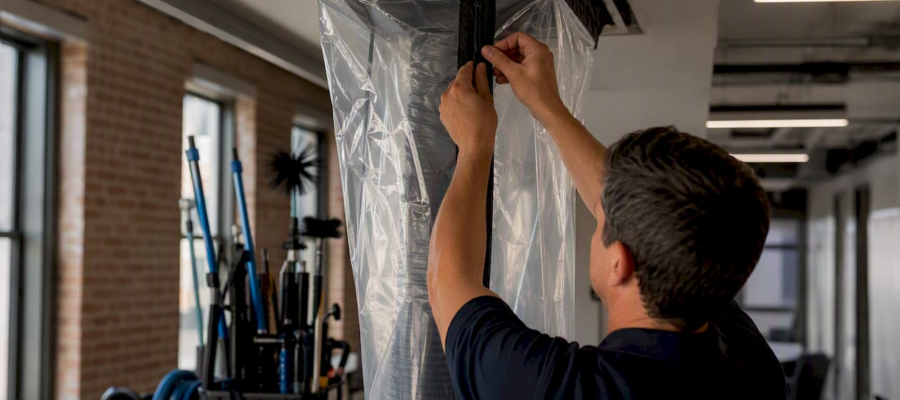
Office Duct Hygiene Workflow for Facility Managers
The correct office duct hygiene workflow follows five phases, in order: assessment, negative-pressure containment, mechanical agitation and source removal, biological control when the assessment calls for it, and documented verification. This sequence comes from the 2025 edition of ACR, The NADCA Standard, and it’s the framework you should require from any contractor bidding on your office HVAC system, full stop.
Verification isn’t optional and it isn’t a formality. A contractor who can’t hand you continuous manometer logs, before-and-after photos, and results from a NADCA Vacuum Test or Surface Comparison Test hasn’t finished the job, no matter what the invoice says.
Before you sign anything, confirm the proposal includes these five items:
- A written work plan covering scope, sequence, schedule, and safety procedures
- Continuous differential-pressure monitoring during all cleaning phases
- HEPA-filtered negative air machines sized for your system
- Source-removal cleaning methods (agitation plus vacuum capture, not suction alone)
- A final cleanliness test with documented, objective acceptance criteria
If a bid is missing any of these, you’re not looking at a NADCA-aligned proposal. You’re looking at a quote.
Key Takeaways
A defensible office duct hygiene workflow requires five gated phases, continuous negative-pressure logging, and objective cleanliness testing before any invoice gets paid.
| Point | Details |
|---|---|
| Require the five-phase model | Insist on assessment, containment, source removal, biological control if needed, and documented verification, in that order. |
| Demand continuous logging | A manometer log covering the entire cleaning window, not spot checks, is non-negotiable. |
| Verify objectively | Accept only NADCA Vacuum Test or Surface Comparison Test results as proof of cleanliness, not visual sign-off. |
| Hold back final payment | Tie 10 to 20% of payment to passing verification, with re-clean and retest at no extra cost on failure. |
| Work with a NADCA-aligned provider | Amazonairpro structures New York, New Jersey, and Connecticut office jobs around this same five-phase, fully documented workflow. |
Table of Contents
- How Does the Five-Phase Duct Cleaning Workflow Work in Practice?
- What Should a Pre-Job Work Plan Include?
- How Do You Set Up Containment and Negative Pressure?
- What Equipment and Methods Belong in a Duct Cleaning Job?
- How Do You Verify a Duct Cleaning Job Actually Worked?
- What Does a Day-of Office Duct Cleaning Actually Look Like?
- How Long Does Office Duct Cleaning Take, and What Drives the Cost?
- How Often Should You Actually Clean Office Ducts?
- What Should You Require When Selecting a Contractor?
- What Do the 2025 NADCA Updates Change for Facility Teams?
- What I’ve Learned Running Office Duct Jobs Across NY, NJ, and CT
- Get a NADCA-Aligned Duct Cleaning Proposal for Your Office
- Standards and Guidance Worth Keeping on File
- Sources
- FAQ
How Does the Five-Phase Duct Cleaning Workflow Work in Practice?
Each phase has a trigger, a set of typical tasks, and a deliverable that has to exist before the crew moves to the next step. Skipping the paperwork isn’t a shortcut, it’s a break in the chain of accountability that leaves you with no way to prove the job was done right.
Here’s how the phases translate to an actual office jobsite:
- Assessment. The contractor surveys the system, reviews as-built drawings if available, and photographs baseline contamination. This is where they identify service opening locations, note AHU condition, and flag any asbestos or mold concerns that would change the scope.
- Containment setup. Crews isolate the work zone, seal supply and return openings outside the active area, and establish negative pressure using HEPA-filtered negative air machines. Nothing gets cleaned until containment is verified and logging begins.
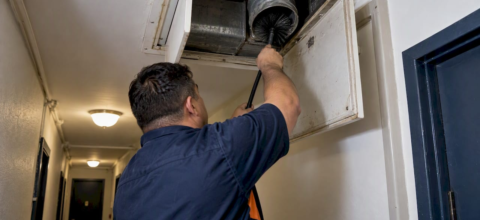
- Mechanical agitation and source removal. Rotary brushes, air whips, or contact vacuums dislodge debris while continuous vacuum collection captures it. This is the labor-intensive core of the job and the phase most vulnerable to shortcuts.
- Biological control, if the assessment calls for it. Antimicrobial or EPA-registered treatments get applied only when microbial growth was documented in phase one, not as a routine upsell.
- Documented verification. Post-cleaning photos, vacuum test or surface comparison results, and a signed certificate of completion close out the job.
| Phase | Entry Criteria | Exit Deliverable |
|---|---|---|
| Assessment | Signed work plan received | Baseline photos, system diagram, scope confirmation |
| Containment | Assessment complete | Manometer log showing stable negative pressure |
| Agitation/source removal | Containment verified | Visual clearance of debris, vacuum log |
| Biological control | Assessment flagged microbial growth | SDS on file, application log |
| Verification | Cleaning complete | Vacuum/Surface Comparison Test results, before/after photos, certificate |
Your quick-reference deliverables list for the entire job:
- Written work plan (pre-mobilization)
- Continuous manometer log (during cleaning)
- Vacuum test or surface comparison report (post-cleaning)
- Before/after photo documentation
- Signed certificate of completion
Pro Tip: Gate every phase transition on documented proof, not on the clock. A crew that says “we’re on schedule” hasn’t answered the only question that matters: can they show you the manometer reading from an hour ago?
What Should a Pre-Job Work Plan Include?
A written work plan is where most disputes get prevented or created. If the contractor hands you a one-page quote with a price and a start date, you don’t have a work plan. You have an invoice waiting to happen.

Require the plan to spell out scope, sequence, schedule, a written safety plan, and Safety Data Sheets for any chemicals proposed for biological control. NADCA’s commercial cleaning checklist covers the minimum project requirements you should expect to see referenced, including HVAC component inspections and containment protocols.
Before the crew mobilizes, walk the system with the contractor’s lead technician and confirm:
- Current system diagrams match what’s actually installed (offices renovated over the years often have undocumented duct runs)
- Existing service openings are adequate, or new ones are scoped with SMACNA-compliant closure methods
- Air handling unit condition, coil access, and blower compartment access are documented with photos
- Occupied zones adjacent to the work area are identified for containment planning
- A named point of contact exists on both sides for the duration of the job
Your contract should include specific clauses, not general language. Ask for:
- Explicit confirmation of ACR compliance, referencing the NADCA five-phase model by name
- A stated requirement for continuous manometer logging with log samples provided at handover
- A defined verification test (NADCA Vacuum Test or Surface Comparison Test) named as the acceptance method
- A holdback clause tied to passing that test
When interviewing contractors, ask directly whether their lead technician holds a Certified Ventilation Inspector credential or equivalent, whether the company carries NADCA membership, and what the static lift specification is on their negative air equipment. Vague answers to any of these three questions are worth noting.
How Do You Set Up Containment and Negative Pressure?
Negative pressure keeps dislodged contaminants from migrating into occupied space instead of into the vacuum system. Without it, agitation just redistributes dust through the building rather than removing it, which is the exact opposite of what you’re paying for.
AIHA’s overview of duct cleaning describes the standard process as washing, brushing or vibrating, and vacuum collection, all performed under negative pressure to control migration. NADCA’s standard goes further, requiring continuous negative pressure throughout mechanical cleaning, not just during active agitation.
Require this equipment on any office job:
- HEPA-filtered negative air machines, sized to the system’s cubic footage
- Flexible ducting rated for continuous negative air machine operation
- Exhaust routing that vents away from building intakes and operable windows
A continuous manometer log should record differential pressure at regular intervals, not just a start and end reading. Fields to require in the log:
- Time stamp
- Zone or duct segment location
- Differential pressure reading
- Operator initials
- Notes on any deviation and corrective action taken
Pro Tip: If the negative air machine isn’t HEPA-equipped for a particular application, the exhaust still has to be routed outdoors and away from intakes. Ask the contractor to show you the routing plan on the building’s own floor plan, not just describe it verbally.
What Equipment and Methods Belong in a Duct Cleaning Job?
Source removal, meaning mechanical agitation paired with continuous vacuum capture, is the only method NADCA recognizes as acceptable for cleaning air distribution components. Anything that relies on suction alone, without physically dislodging debris first, doesn’t meet the standard, regardless of what the marketing language says.
Common agitation tools include rotary brushes sized to duct diameter, air whip devices for flexible ductwork, and contact vacuums for direct debris extraction at service openings. The right tool depends on duct material, accessibility, and the type of contamination found during assessment.
Specifications worth requiring in writing:
- HEPA filtration on all vacuum collection equipment
- A stated minimum static lift specification for negative air machines appropriate to system size
- Service openings sized and closed per SMACNA and UL 181 standards, protecting both structural and thermal integrity
Some methods should be off the table entirely for office systems. Do not accept:
- Wet power-washing of components not rated for moisture exposure, which risks corrosion and microbial growth
- Suction-only approaches with no mechanical agitation, which leave adhered debris in place
- Chemical fogging used as a substitute for physical source removal rather than a supplement to it
Pro Tip: Ask how the contractor plans to size and place service openings before they cut into anything. Undersized openings force technicians to work blind, and improperly closed openings can compromise duct integrity for years after the crew leaves.
How Do You Verify a Duct Cleaning Job Actually Worked?
Visual inspection alone isn’t proof. It’s an opinion. The NADCA General Specification lays out two objective tests that remove the guesswork: the NADCA Vacuum Test and the Surface Comparison Test.
The Vacuum Test uses a calibrated sampling pump and cassette to collect debris from a defined surface area, which is then weighed against a documented threshold. The General Specification cites an example acceptance criterion for non-porous surfaces where debris below 0.75 mg per 100 square centimeters is considered acceptably clean under the specified sampling protocol. The Surface Comparison Test uses reference cleanliness standards to visually benchmark cleaned surfaces against documented acceptable conditions, useful on surfaces where vacuum sampling isn’t practical.
Both tests have limitations. Vacuum testing requires calibrated equipment and a defensible sampling protocol, specified in advance in the contract, or results become difficult to defend if a dispute arises later.
At handover, you should receive:
- Before and after photo documentation for every accessed zone
- Completed vacuum test or surface comparison report, tied to specific locations
- The full continuous manometer log from the job
- A signed certificate of completion
If verification fails, the contract should specify a re-clean and retest at no additional cost, with a fresh signoff before final payment releases. Documenting the process properly from the start makes this dispute path far shorter if it ever comes up.
One tight declarative sentence anchors this whole section: objective testing, not visual approval, is what makes a cleanliness claim defensible.
| Point | Details |
|---|---|
| Verification method | Require either the NADCA Vacuum Test or Surface Comparison Test, not visual sign-off alone. |
| Acceptance threshold | NADCA’s General Specification cites debris below 0.75 mg per 100 cm² on non-porous surfaces as one benchmark. |
| Failed test protocol | Contract should mandate re-clean and retest at no cost before final payment. |
What Does a Day-of Office Duct Cleaning Actually Look Like?
A well-run job moves in a predictable sequence, and knowing that sequence lets your facility team catch problems before they become disputes. Here’s the operational flow for a typical multi-zone office system.
- Mobilization (hour 0). Crew arrives, confirms access with building security, and reviews the work plan with the facility rep on site.
- Containment setup (hours 0 to 1). Negative air machines get positioned, ducting connected, and openings sealed. Manometer logging starts before any tool touches a duct.
- AHU isolation and zone entry (hour 1 onward). The system is isolated per zone rather than shut down building-wide when the layout allows, which limits disruption to unaffected floors.
- Mechanical cleaning (bulk of the day). Agitation and vacuum work proceeds zone by zone, with the facility rep able to check manometer readings at any point.
- Verification testing (final hours). Vacuum or surface comparison sampling happens as each zone finishes, not all at once at the end.
- Demobilization and handover. Equipment is removed, openings closed to spec, and documentation packaged for signoff.
Facility reps should confirm these items at scheduled checkpoints:
- Manometer readings match the logged targets at each hourly check
- No visible dust migration into occupied space adjacent to the containment zone
- Service openings are closed and sealed before the crew moves to the next zone
- Photos are being taken at each stage, not reconstructed afterward
Occupant communication matters more than most facility teams plan for. A short notice sent 48 to 72 hours ahead, covering which zones will be affected and whether HVAC service will be interrupted, prevents most complaints before they start. Scheduling the noisiest work for off-hours, when the floor plan allows it, is worth the added coordination.
If the pressure differential drops outside the logged range or the crew finds unexpected conditions like suspected mold or damaged insulation, work should pause immediately for reassessment. That’s not a delay to fight. That’s the system working as designed.
How Long Does Office Duct Cleaning Take, and What Drives the Cost?
A single small AHU serving one zone typically wraps in a single day. A multi-AHU office system spanning several floors can run three to five days or longer, depending on how many zones need isolation and how much access work the building requires.
Cost and schedule both move on the same handful of factors:
- System complexity, meaning the number of AHUs, duct runs, and zones requiring separate containment
- Accessibility, since a system with few existing service openings needs new ones cut and closed, adding both time and cost
- Contaminant load found during assessment, particularly if biological control gets triggered
- Which verification tests are specified, since vacuum testing with calibrated sampling adds time versus surface comparison alone
- Whether the work has to happen entirely off-hours, which compresses the schedule and often raises labor cost
Systems with decades of undocumented renovations almost always reveal something the initial assessment couldn’t see from the outside.*
How Often Should You Actually Clean Office Ducts?
Fixed calendar intervals, like “clean every three years no matter what,” don’t hold up against how NADCA’s current guidance frames the decision. The 2025 ACR release pushes toward a risk-based approach: inspect the system, measure what you find, score the risk, and trigger cleaning only when the numbers justify it.
That decision flow looks like this in practice:
- Inspect on a regular schedule, typically annually for office systems, using a camera and visual assessment at accessible points.
- Measure debris accumulation, note any odor complaints, and check whether HVAC performance has measurably dropped.
- Score the findings against a simple threshold: visible debris depth, occupant complaint volume, and airflow reduction.
- Trigger cleaning when any two of those three factors cross your threshold, rather than waiting for all three or acting on just one.
A workable policy might trigger action when occupancy type changes significantly (a renovation adding dozens of workstations to a previously light-use floor), when visible debris is confirmed during a routine inspection, when measured airflow drops below expected specification, or when odor complaints from multiple occupants point to the HVAC system rather than an isolated source.
Pro Tip: Align duct inspections with your existing filter-change and coil-cleaning schedule. You’re already sending a technician into the mechanical room. Adding a five-minute duct camera check to that visit costs almost nothing and gives you the inspection data the risk-based model actually needs.
What Should You Require When Selecting a Contractor?
The selection checklist matters as much as the cleaning itself, because a contractor who can’t meet these baseline requirements won’t suddenly produce NADCA-aligned documentation once the job starts.
Before you shortlist a bidder, confirm:
- ACR conformity, stated explicitly in their proposal, not just “NADCA certified” as a vague claim
- A Certified Ventilation Inspector or equivalent credential on the technical lead
- Equipment specifications in writing, including HEPA filtration and negative air machine capacity
- References from comparable commercial office jobs, not residential work alone
- Current insurance certificates naming your building as an additional insured where required
- A written safety plan covering PPE requirements and site access protocols
Contract clauses to insist on, in order of priority:
- Explicit scope of work tied to the five-phase NADCA model
- Named verification test with a stated acceptance threshold
- Continuous manometer logging requirement with log samples delivered at handover
- Access and closure standards referencing SMACNA and UL 181 where new service openings are cut
- A holdback percentage, typically 10 to 20%, released only after passing verification
Red flags that should end a bid before you get to pricing: no mention of a manometer plan anywhere in the proposal, deliverables described only as “photos on request” rather than a defined package, and any hesitation when you ask which verification test they intend to use.
What Do the 2025 NADCA Updates Change for Facility Teams?
The 2025 ACR edition sharpened three things that matter directly to how you write contracts: it leaned harder into source removal as the only acceptable cleaning method, it formalized containment and continuous verification as baseline requirements rather than best practice, and it pushed the industry toward risk-based scheduling instead of fixed intervals.
Guidance from EPA’s indoor air quality resources reinforces why this matters beyond the duct system itself. Ventilation and pollutant control sit at the center of healthy building performance, which is why evaluating HVAC airflow and system efficiency after cleaning belongs in your scope, not as an afterthought. ASHRAE’s ventilation guidance similarly supports treating duct hygiene as one input into a building’s broader IAQ picture rather than an isolated maintenance task.
| Update Area | Previous Practice | 2025 ACR Direction |
|---|---|---|
| Scheduling | Calendar-based intervals | Risk-based, triggered by inspection findings |
| Verification | Visual inspection often sufficient | Objective testing (Vacuum Test/Surface Comparison) expected |
| Cleaning method | Suction-only accepted by some contractors | Source removal (agitation plus vacuum) required |
The practical implication for your contracts: reference the ACR five-phase model by name, require the documented deliverables at each phase, and keep the full paper trail. That’s not bureaucratic overhead. It’s what protects you if an occupant later raises an air quality complaint and you need to show exactly what was done, when, and how it was verified.
Pro Tip: Retain the complete documentation package, logs, photos, and test reports, for at least as long as your building’s typical lease or tenant turnover cycle. It’s the fastest way to answer a facilities audit or a tenant IAQ inquiry without scrambling.
What I’ve Learned Running Office Duct Jobs Across NY, NJ, and CT
A typical office job for us starts the same way every time: a walkthrough with the facility rep before a single tool comes out of the truck, confirming access points, occupied zones, and where containment needs to go. We run continuous manometer logging from the moment containment goes up until the last zone is verified, because a spot check tells you nothing about what happened in the hour nobody was watching.
The part most facility teams underestimate is how much zone-by-zone gating saves them. Isolating and clearing one AHU or floor at a time, rather than shutting the whole building’s air handling down, means fewer occupant complaints and a verification trail that’s actually useful if a question comes up six months later…
We work across New York, New Jersey, and Connecticut, and building occupancy patterns vary enough between a Midtown high-rise and a suburban Connecticut office park that scheduling has to be localized, not copied from a template. What works for a 24-hour building doesn’t work for a nine-to-five suburban tenant, and a contractor who doesn’t ask about your building’s actual occupancy rhythm before proposing a schedule hasn’t done the homework.
Get a NADCA-Aligned Duct Cleaning Proposal for Your Office
If you’ve read this far, you already know what separates a real proposal from a quote with a price on it. Amazonairpro builds every commercial office job around the same five-phase structure this article just walked through, so what you’re evaluating on paper is what actually happens on-site.

Here’s what that looks like in practice: continuous manometer logging on every job, before-and-after photo documentation, objective verification testing rather than a visual sign-off, and a written work plan before anyone mobilizes. Facility managers who want a third-party inspection option can request one as part of the proposal, and every job closes with a signed certificate of completion plus the full documentation package for your files.
We cover commercial office duct cleaning throughout New York and New Jersey, with scheduling built around your building’s actual occupancy patterns rather than a generic off-hours template. If your last cleaning report was just a one-line invoice, request a detailed assessment and proposal and see the difference a documented workflow makes at handover.
Standards and Guidance Worth Keeping on File
For specification writing and contract language, these five sources cover the ground this article draws from:
- ACR, The NADCA Standard: 2025 Edition — the primary standard defining the five-phase workflow and verification requirements
- NADCA’s Commercial Cleaning Checklist — a practical minimum-requirements checklist for scoping commercial jobs
- EPA’s indoor air quality guidance — context for tying duct cleaning to broader building IAQ performance
- ASHRAE ventilation guidance — supporting framework for evaluating post-cleaning airflow and system efficiency
- AIHA’s overview of duct cleaning practices — background on containment risk and standard mechanical steps
For property managers coordinating cleaning across multiple building systems, this property manager cleaning workflow guide offers a useful complement on scheduling and cross-team coordination.
Sources
FAQ
How often should air ducts be cleaned in an office building?
There’s no fixed interval that fits every building. NADCA’s current guidance favors a risk-based approach: inspect annually, and trigger cleaning when debris accumulation, occupant complaints, or measured airflow loss cross your threshold.
What is the 2-foot rule for ducts?
This isn’t a standard NADCA defines, and no authoritative source in the duct cleaning standards ties a specific “2-foot rule” to service openings or access requirements. Service opening sizing and placement should instead follow the SMACNA and UL 181 closure specifications referenced in NADCA’s General Specification.
What are the steps involved in duct cleaning?
The process follows five phases: assessment, negative-pressure containment setup, mechanical agitation with source removal, biological control if the assessment calls for it, and documented verification through testing and photo evidence.
How long does a typical duct cleaning take?
A single small AHU serving one zone often finishes in a day. A multi-AHU office system spanning several floors typically takes three to five days, depending on the number of zones and how much access work the building needs.
Who verifies that duct cleaning actually worked?
The contractor should provide objective test results, either a NADCA Vacuum Test or Surface Comparison Test, along with before-and-after photos and a signed certificate of completion. A provider like Amazonairpro documents each of these at handover so the facility team has a defensible record, not just a verbal assurance.
Recommended
- Why Duct Cleaning Is Important for Business Success
- Office Dust Reduction Tips for NY, NJ, and CT Offices – Amazon Air Duct Cleaning
- How to Reduce Workplace Dust: A Facility Manager’s Guide – Amazon Air Duct Cleaning
- How to Document Duct Cleaning: A Property Owner’s Guide – Amazon Air Duct Cleaning