Pet Dander in Ducts: How It Gets There and What to Do
Yes, pet dander gets into your ductwork, and your system can carry it back into the rooms you live in. Dander is made of tiny proteins from shed skin, and it travels on the same air your furnace and air conditioner move all day. The practical answer has three parts: keep dander from building up at the source, use the right filter, and have the duct system professionally cleaned when your home’s situation calls for it. This guide walks through each part for homes and buildings in New York, New Jersey and Connecticut.
TL;DR
- Dander is a fine, lightweight particle. It drifts through rooms, is pulled into return vents and can settle inside ducts.
- NADCA says HVAC systems typically circulate household air 5 to 7 times per day, so what is in the ducts can reach every room.
- A MERV 11 to 13 filter, changed on schedule, is the first line of defense. Pet households often need to change it more often than the label suggests.
- Consider a professional duct inspection or cleaning if you have shedding pets, allergic or asthmatic residents, or you are moving into a home where pets lived.
Table of Contents
- How pet dander gets into your ducts
- Signs dander may be building up in your system
- Can dander in ducts affect health?
- Cut dander at the source first
- Choose the right filter
- When to have your ducts inspected or cleaned
- What proper duct cleaning involves
- Can animals get into your ductwork?
- Our perspective
- Book a cleaning for a pet household
- A simple year-round routine for pet owners
- FAQ
- Sources
How pet dander gets into your ducts
Dander is not the same as fur. It is the microscopic flakes of skin that every cat, dog, rabbit and bird sheds. The National Institute of Environmental Health Sciences describes pet dander as tiny proteins from shed skin that can trigger sneezing and red or itchy eyes, and can make asthma harder to control.
Because the particles are so light, they stay in the air for a long time and settle on upholstery, carpets and clothing. Your return vents pull air from those rooms back toward the furnace or air handler. Anything the filter does not catch continues into the ducts, and some of it lands on the interior surfaces.
That is why NADCA notes that dander can make its way into air ducts and circulate through the home whenever the furnace or air conditioner is running. It is a loop: the pet sheds, the air carries dander to a return, the system redistributes what is left.

Why older Northeast homes can be harder
Many homes in our area, from prewar houses in Westchester and Bergen County to split-levels on Long Island and colonials in Fairfield County, have long duct runs, finished basements with carpet and heating systems that run for months each winter. Windows stay shut from late fall through spring, so there is less fresh air to dilute what the pets shed. We see the heaviest dander and hair buildup in homes with several pets, multiple returns near floor level and filters that have not been changed in a while.
Signs dander may be building up in your system
No single sign proves it, but these are worth noticing, especially in combination:
- Allergy-like symptoms, such as sneezing or itchy eyes, that seem worse indoors or when the heat or AC kicks on.
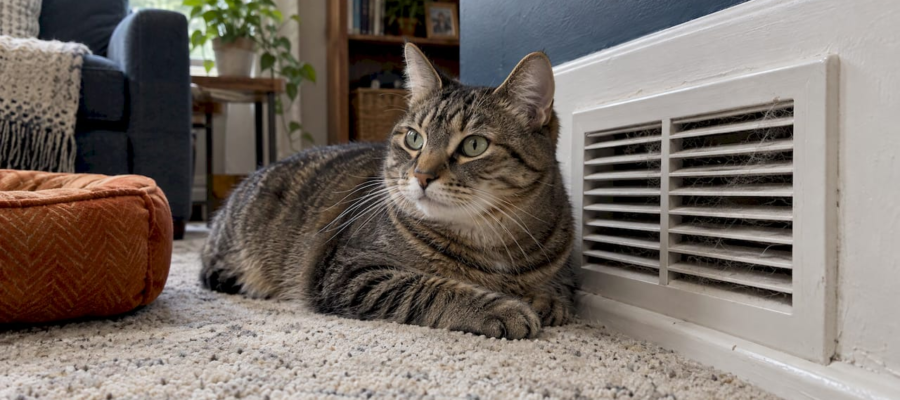
- Visible dust, fur or debris around supply registers, or a gray film on vent covers.
- A musty or “pet” smell that returns soon after you clean.
- Furniture that needs dusting again within days.
- Filters that look clogged long before their replacement date.
For a longer checklist, see our guide on 5 signs your air ducts need cleaning, or read how to know you need your air ducts cleaned.
Can dander in ducts affect health?
For people who are sensitive to it, yes. The American Lung Association lists pet dander among indoor air pollutants and recommends steps such as keeping pets off furniture and out of the bedroom of anyone with an allergy. If someone in your home has asthma, talk with their physician or allergist about their specific triggers and treatment plan. Cleaning is a home-maintenance step, not medical care.
It is also worth sitting with a fair point for a moment. The U.S. EPA states that duct cleaning has not been conclusively shown to prevent health problems, and it does not recommend routine cleaning for the average home. It recommends cleaning when there is a clear reason, such as substantial visible mold, vermin, or excessive dust and debris clogging the system. A home with several shedding pets can reasonably fall into that last category, which is why we look at the actual condition of the system rather than a calendar alone.
Cut dander at the source first
Duct work and household habits do the best job together. The NIEHS guidance on pet allergens gives a practical list for homeowners:
- Keep pets out of the bedroom of an allergic person, and off furniture.
- Encase mattresses and pillows.
- Remove or replace carpets where possible.
- Vacuum with a HEPA-filter cleaner or a double-layered microfilter bag when the allergic person is away.
- Run a HEPA air cleaner in the bedroom.
- Bathe dogs at least twice a week.
- Dust with a damp cloth so particles are trapped instead of re-released.
The American Lung Association adds that you should brush your pet in a closed-off area away from the person with asthma, and clean furniture, carpets and clothing promptly after contact.
Washing pet bedding and brushing regularly round out the routine. A home furnace maintenance guide covers complementary measures such as vacuuming and pet bedding care alongside keeping the furnace itself clean.
Choose the right filter
Your filter is the checkpoint that keeps dander out of the ducts in the first place. MERV ratings describe how well a filter captures particles of different sizes. According to the EPA’s Indoor airPLUS bulletin on filtration, MERV 8 filters can generally capture contaminants such as animal dander, mold spores and most larger particles of 3 to 10 microns. MERV 11 filters remove roughly 20% of particles between 0.3 and 1 micron, and MERV 13 filters typically show at least 50% removal efficiency for the smallest particles tested.
For whole-house filtration, the American College of Allergy, Asthma & Immunology calls a disposable filter rated MERV 11 to 13 the most cost-efficient choice, one that catches pollen, pet allergens and mold without impeding airflow. The EPA’s guide to air cleaners advises choosing at least a MERV 13 if you upgrade, or as high as your system fan and filter slot can handle.
| Filter rating | What it does for pet households | Notes |
|---|---|---|
| MERV 8 | Captures animal dander and most larger particles (3 to 10 microns) | A common baseline for many systems |
| MERV 11 | Removes roughly 20% of particles between 0.3 and 1 micron | Within the 11 to 13 range ACAAI favors |
| MERV 13 | At least 50% removal of the smallest particles tested | EPA suggests this level if your system can accommodate it |
We cover the details in our guide to what MERV rating to use.
Fit and change schedule matter as much as the rating
The EPA bulletin warns that higher-MERV filters tend to restrict airflow, so the filter box and ducts must be sized for them, and that dirty, clogged filters can raise furnace run time, motor wear and energy use. It also says to seal the filter slot so air cannot bypass the filter. Before you move up a rating, confirm your system can handle it.
The EPA says to replace filters per the manufacturer’s recommendations, typically every 60 to 90 days, and sooner if they look heavily soiled. In a pet household, plan on the short end. One home-maintenance resource suggests changing a pet household’s furnace filter every 30 to 60 days in winter, closer to 30 for multiple pets or a heavy shedder. A good habit: check the filter monthly and replace it when you can no longer see the pleats clearly.
A portable HEPA purifier in the bedroom can complement furnace filtration for someone with allergies. ACAAI notes, citing the EPA, that HEPA filters can remove up to 99.97% of airborne particles of 0.3 microns.

When to have your ducts inspected or cleaned
NADCA recommends that HVAC systems be inspected yearly and that a complete system cleaning be performed every 4 to 5 years. It adds that frequency can vary, and that homeowners should weigh pets in the home, occupants with asthma or allergies, and indoor smoking.
The Breathing Clean FAQ from NADCA lists factors that lead to considering more frequent cleaning:
- Pets that shed high amounts of hair and dander
- Residents with allergies or asthma
- Smokers in the household
- Water contamination or damage
- Home renovations
- Prior to occupancy of a new home
Consider cleaning if… / You can wait if…
| Consider duct cleaning if… | You can probably wait if… |
|---|---|
| You have one or more heavy-shedding pets | Your pets are low-shedding and the system is inspected yearly |
| Anyone at home has allergies or asthma | No one reports symptoms and registers are clean |
| You are buying or renting a home where pets lived | The home has been pet-free and recently cleaned |
| You see dust, fur or debris at registers | Filters stay fairly clean between changes |
| You finished a renovation or had water damage | Your last full cleaning was within the 4 to 5 year window and nothing has changed |
Moving into a home where pets lived
This is one of the most common calls we get from new buyers and from real estate agents preparing a listing. Previous owners with several cats or dogs leave dander in carpet, vents and the duct system. Having the ducts inspected before you move in is easier than doing it after the furniture is placed, because you can also replace carpet, wash walls and change filters while the rooms are empty. Property managers turning over rentals with pets face the same situation between tenants. For turnover context, this property management and pets guide covers when ducts may need cleaning and what duct cleaning can and cannot do about allergens.
What proper duct cleaning involves
How the cleaning is done matters more than whether it is done. NADCA explains that the most effective approach is source removal: the contractor places the system under negative pressure with a powerful vacuum while devices inserted into the ducts dislodge debris stuck to interior surfaces. Antimicrobial chemicals, per NADCA, should only be applied after the system has been thoroughly cleaned.
That gives you a few reasonable things to look for in any contractor:
- A clear explanation of the method, including negative pressure and agitation tools.
- Technicians who are trained and certified.
- A written scope covering supply and return runs, registers and the air handler.
- No pressure to add treatments before the system is actually clean.
Our own equipment is covered in what equipment we use to clean air ducts, and you can read how to prepare for air duct cleaning so the visit goes smoothly. If you want to know more about the broader picture, our complete HVAC cleaning guide explains the parts of the system that collect buildup.
Can animals get into your ductwork?
They can, and it is a separate source of allergens from your own pets. The EPA’s pest entry prevention bulletin says birds, rodents and bats can enter homes, attics, basements or ducts, and can carry bacteria, viruses, parasites, fungi and allergens. If they reach the HVAC system, allergens and contaminants can spread quickly through the home. The EPA recommends sealing any hole larger than 1/4 inch by 1/4 inch with corrosion-resistant copper or stainless steel wire mesh.
In the Northeast, unsealed attic and basement penetrations, crawl spaces and disconnected duct sections are the usual entry points. If you hear scratching in a vent, see droppings at a register or notice a sudden odor, have the system inspected promptly, since cleaning is warranted when vermin are present.
Our perspective
We have cleaned ducts in homes across New York, New Jersey and Connecticut for over 10 years, and pet households are among the ones we see most. The pattern is consistent: dander and fur collect at return vents and in the first sections of duct near the air handler, and they build faster when filters are changed late.
Our view is that dander control works best as a system. Filters, vacuuming, grooming and bedding care reduce what enters the air. A thorough source-removal cleaning resets the duct system so those habits start from a clean baseline, which matters most when you move into a home where pets lived, after a renovation, or when someone at home has allergies.
We hold our technicians to strict certification standards, and we explain the scope of each job before we start. For pet owners, we recommend pairing cleaning with a filter schedule that fits your pets, and we are glad to walk you through it. Where antimicrobial treatment or UV light makes sense, we apply it only after the system has been cleaned.
Victor
Wait
Book a cleaning for a pet household
If your home has pets and you want the duct system looked at, our air duct cleaning service covers residential and commercial properties in New York, New Jersey and Connecticut. We can also handle evaporator coil and blower cleaning, where dander and dust can collect inside the air handler, and antimicrobial and deodorizing duct system cleaning for pet odors once the system is clean.

For facility managers in schools and health settings, our commercial air duct cleaning follows the same source-removal approach. To request a visit, start from Amazon Air Duct Cleaning.
A simple year-round routine for pet owners
- Monthly: check the filter and replace it when it is soiled; in winter plan on 30 to 60 days.
- Weekly: vacuum carpets and upholstery with a HEPA-sealed vacuum, wash pet bedding and dust with a damp cloth.
- Every season: follow our seasonal indoor air maintenance tasks, and wipe registers and returns.
- Yearly: schedule an HVAC inspection, in line with NADCA’s yearly recommendation.
- Every 4 to 5 years, or sooner for shedding pets or allergies: a full duct system cleaning.
For more on the pet hair side of the problem, see how to manage pet hair in vents, the pet owner’s guide to cleaner indoor air, and our overview of allergen buildup in ducts. A regular HVAC maintenance routine keeps the blower, coils and filter slot in shape as well.
FAQ
How do I get rid of dander in the air?
Start at the source: brush pets away from living areas, bathe dogs regularly, wash bedding and vacuum with a HEPA-sealed vacuum. Add a HEPA air cleaner in the bedroom and change your furnace filter on schedule. The American Lung Association recommends HEPA air cleaners to decrease airborne allergens.
Can pet dander cause breathing problems?
It can for sensitive people. The NIEHS says dander proteins can trigger sneezing and itchy eyes and make asthma harder to control. If someone in your home has asthma, ask their doctor how to manage pet exposure.
How often should ducts be cleaned in a home with pets?
NADCA suggests a yearly inspection and a full cleaning every 4 to 5 years, and says pets that shed heavily, allergies and asthma can justify more frequent cleaning. A technician can look at your registers and returns and tell you what the system actually needs.
Should I have the ducts cleaned before moving into a home where pets lived?
It is a sensible time to do it. NADCA lists prior to occupancy of a new home among the reasons to consider cleaning, and the rooms are easiest to access while empty. Pair it with new filters and a deep clean of carpets and vents.
Sources
- Pet Allergens, NIEHS
- Pet Dander Can Make Matters Worse, NADCA
- Prepare HVAC Systems for Fall Season, NADCA
- FAQs, Breathing Clean by NADCA
- Pet Dander, American Lung Association
- Should You Have the Air Ducts in Your Home Cleaned?, US EPA
- Indoor airPLUS Technical Bulletin: Filtration, US EPA
- Guide to Air Cleaners in the Home, US EPA
- Indoor airPLUS Technical Bulletin: Pest Entry Prevention, US EPA
- Air Filter, ACAAI
- How Pets Affect Indoor Air Quality
- Indoor Air for Pets in Winter
Recommended
- How Can I Remove Pet Odors From My Ducts?
- Allergen removal in ducts: improve indoor air quality
- How to Manage Pet Hair in Vents: 2026 Guide
- The Pet Owner’s Guide to Cleaner Indoor Air | Dander, Fur & Air Quality