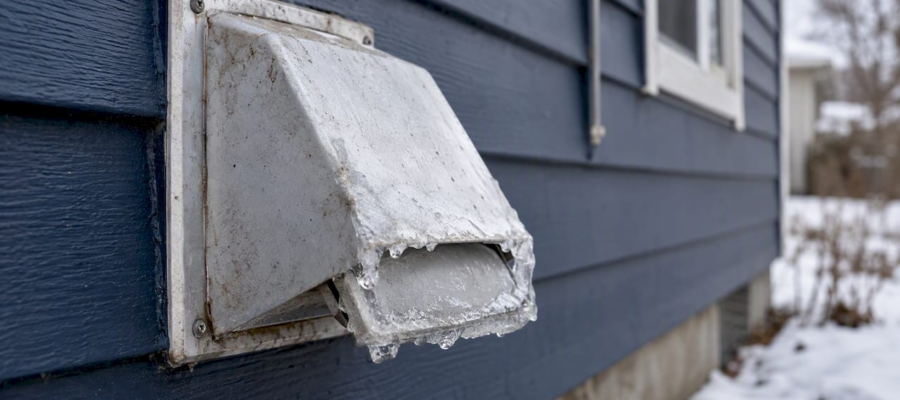
Frozen Dryer Vent Flap: What to Do and How to Prevent It
If the flap on your outdoor dryer vent is frozen shut or stuck open with ice, stop using the dryer until the exhaust has a clear path outside. A blocked vent traps hot, humid air and lint in the machine and the duct, and that is a fire and performance problem, not just a winter annoyance. In New York, New Jersey and Connecticut, where freezing nights are routine from late fall into early spring, this is one of the most common seasonal vent problems we see. This guide explains why the flap freezes, how to check it safely, what a thaw does and does not fix, and how to keep it from happening again.
TL;DR
- A flap freezes when warm, damp dryer exhaust meets a surface at or below 32°F (0°C) and enough ice builds up to restrict the opening or damper.
- Do not run the dryer while the flap is frozen or blocked. Turn it off, check the outside hood, and clear only loose snow or ice you can remove safely.
- Melted ice does not mean the vent is fine. Lint, a damaged damper or a poorly routed duct are often the real cause, so the dryer should not simply be restarted.
- Repeated freezing points to a vent problem: a long run through unheated space, a crushed or sagging duct, or heavy lint. That is when a professional inspection makes sense.
- Keep the flap clear of snow, clean the lint filter, and have the vent cleaned at least yearly.
Table of Contents
- Why a dryer vent flap freezes
- Signs the flap is frozen or restricting airflow
- What to do right now, step by step
- Can you run the dryer with a frozen flap?
- Thawed does not mean fixed
- When a frozen flap means you need a professional
- How to keep the flap from freezing again
- Choosing an exterior vent cover that lets the flap move
- Our perspective: treat the flap as a warning light
- How we can help
- FAQ
- Sources
Why a dryer vent flap freezes
A dryer does not just blow hot air outside. It blows hot, wet air. Every load sends moisture out through the duct and past the flap (also called the damper) on your exterior wall. When that moist air touches something cold, some of it condenses, and if the surface is at or below freezing, the condensation turns to ice.
There is no single outdoor temperature at which this happens. According to Dundas Jafine, a vent products manufacturer, moisture has to collect on a surface at or below 32°F (0°C), and enough ice has to form to restrict the opening or damper. A short, straight, well-sealed vent on a mild day may never ice up. A long run through a cold crawl space on a 20-degree night very well might.
Three conditions tend to combine:
- Cold hood or damper. The metal or plastic hood is the coldest part of the system. Moisture condenses there first, and the flap can stick to its frame.
- An unconditioned duct section. Ductwork through an unheated garage, crawl space, or exterior-wall cavity chills the exhaust before it exits, so condensation forms inside the pipe.
- Extra moisture and lint. Lint is sticky when damp. The U.S. Fire Administration notes that moisture in warm dryer air can condense in ducts that are too long or have many bends, attracting lint and creating resistance. More resistance means slower airflow, which means more time for moisture to cool and condense.
This is why a frozen flap is often a symptom rather than the whole problem. The ice is what you can see. What is happening inside the duct is what decides whether it comes back.
Signs the flap is frozen or restricting airflow
Sometimes you spot the ice. More often you notice the dryer behaving strangely first. Watch for these:
- Clothes take much longer to dry. The USFA says heavy items like jeans or towels taking unusually long to dry, or clothes feeling hotter than usual at the end of a cycle, point to a likely clogged exhaust. If you are suddenly running two cycles for a normal load, check the vent.
- The flap does not move. Stand outside while the dryer runs. A healthy flap lifts or opens when the dryer is on and settles closed when it stops. If it stays shut, or barely twitches, air is not getting out.
- Ice or frost around the hood. Icicles, a crust of ice on the louvers, or frost on the hood after a cycle mean moisture is condensing there.
- Little or no air at the outlet. Hold your hand near the hood during a cycle. Weak or absent airflow means something is restricting it.
- A hot laundry room. A dryer that cannot exhaust heat warms up the room and the cabinet of the machine itself.
If you see more than one of these, treat it as a blocked vent, not just a cold-weather quirk. Our guide to warning signs your dryer vent is a fire hazard covers the full list.
What to do right now, step by step
The goal is to get to a safe, clear exhaust path without hurting yourself or damaging the vent. Dundas Jafine’s guidance is to stop the dryer, inspect the accessible exterior hood, clear only loose material that can be removed safely, and not use the dryer until a clear exhaust route is established. Here is how that looks in practice:
- Turn the dryer off. Do not finish the cycle hoping it will clear. Unplug the machine if you plan to pull it from the wall.
- Look at the exterior hood. Check for snow drifted against it, ice on the louvers, a flap frozen shut, or a flap wedged open with debris.
- Clear loose snow. Brush away snow from around the hood with a gloved hand or soft brush. Stay off ladders on icy ground, and do not climb to a second-story vent in winter conditions. That is a job for a professional.
- Remove only what comes away easily. Loose ice and lint can be lifted off. Do not chip at frozen ice with a screwdriver or hammer, and do not pry the flap. Plastic hoods crack in the cold, and a bent damper will not seal or open correctly afterward.
- Leave open flames and heat guns out of it. Never aim a torch or other open flame at a vent hood. Lint is flammable, and so is the dust around it.
- Let it clear naturally if needed. If the ice will not budge safely, wait for a warmer part of the day rather than forcing it, and leave the dryer off. Hang laundry inside or use a laundromat in the meantime.
- Check from the inside, too. With the dryer off and unplugged, look at the duct behind it. The USFA advises checking for damage, crushing or restriction in the venting behind the dryer.
If you want a fuller walkthrough of safe blockage handling, see our article on dryer vent blockage removal and safety-first steps.
Can you run the dryer with a frozen flap?
No. This is the part worth sitting with for a moment, because the dryer will still turn on and still make heat. It just has nowhere to put it.
The Consumer Product Safety Commission tested electric dryers with the exhaust partly or fully blocked and found that temperatures in some dryer areas rose, with significant increases at 75% or 100% blockage. A flap frozen shut is a blockage, and it can be a near-total one. Lint inside the machine and duct then sits in hotter conditions than it was ever meant to.
The scale of the wider problem is also real. The CPSC reported in 2023 that clothes dryers average 6,400 fires, about 180 injuries and nearly $105 million in property damage each year. Not every one of those starts with a frozen vent, but restricted exhaust is a well-documented contributor. You can read more in our explainer on dryer vent fire hazards for homeowners.
A gas dryer adds another reason to be careful. Combustion gases are meant to leave the house through the exhaust. The CPSC says fuel-burning appliances should be installed and operated according to manufacturer instructions and local codes, and that people should not service them without the knowledge, skill and tools. If you have a gas dryer and a blocked vent, do not experiment. Call a qualified technician, and if anyone feels dizzy, nauseous or has headaches while the dryer is running, get everyone outside and call 911.
Thawed does not mean fixed
Here is where many homeowners get caught. The ice melts by afternoon, the flap swings freely, and the dryer goes back into use. The problem seems solved.
But as Dundas Jafine points out, visible thawing does not remove lint or repair a damaged damper, so the dryer should not be restarted just because the ice is gone. Ask yourself:
- Was the dryer already slow before the cold snap? If so, lint was probably restricting airflow, and the ice was an added problem on top.
- Does the flap close fully, and open fully when you gently lift it? A bent or cracked damper will let cold air in and moisture collect.
- Is the duct behind the dryer crushed, kinked or sagging? Low spots hold condensation that freezes in a cold run.
- Has this happened before? Once may be weather. Twice is a pattern.
A useful rule of thumb comes from the same source: ice on the exterior hood calls for checking the hood and damper, while recurring internal icing calls for evaluating the duct route, cold sections, joints and insulation. If the ice keeps coming back, the fix is in the duct, not in chipping the hood.
When a frozen flap means you need a professional
Some situations are fine to handle yourself: brushing snow off a ground-level hood, wiping a little lint off the louvers, replacing a cracked cover. Others are not. Consider calling a professional if:
- The dryer is still slow after the flap is clear. That suggests lint inside the duct. Our post on how often to clean your dryer vent explains typical timelines.
- The vent exits high on the house or from a roof, where ladders and ice are a real hazard.
- The flap or hood is damaged or will not open and close on its own.
- The duct runs through unheated space, or the freezing keeps recurring.
- You find animal nests. The USFA lists lint, animal nests and damaged venting as causes of blockage that can prevent proper exhaust and cause overheating.
- You have a gas dryer and any doubt about the exhaust.
The USFA recommends professional dryer installation and service, along with checking the venting behind the dryer. A technician can look at the whole route from the machine to the outside wall, not just the part you can see from the yard. If you are weighing the cost of a call against doing it yourself, our comparison of DIY versus professional dryer vent cleaning lays out the tradeoffs honestly.
Installation problems that cause repeat freezing
The USFA reports that dryer exhaust should terminate outdoors, not in an attic, soffit, ridge vent, crawl space, chimney or interior wall, and that venting should use smooth metal ducting with sealed, supported joints. Older homes across the tri-state area sometimes have vents that were rerouted over the years, with long runs, extra elbows or flexible foil sections that sag. Those are exactly the setups where moisture lingers and freezes. A technician can tell you whether the route needs to be shortened, straightened or replaced, which is a different job from cleaning.

How to keep the flap from freezing again
No prevention step is a guarantee in a hard freeze, but these habits cut the odds a lot.
Keep the outside clear
The National Fire Protection Association says the outdoor dryer vent flap should not be covered by snow, the exhaust pipe should not be restricted, and the flap should open while the dryer operates. After any snowfall, walk out and look at the hood. Drifts pile up against exterior walls, and a hood near the ground can be buried without you noticing.
Clean the lint filter every load
The NFPA advises cleaning the lint filter before or after each load, and cleaning lint from the vent pipe yearly or more often if clothes take longer to dry. The USFA gives the same guidance: clean the filter every time and clean dryer vent ductwork every year. Less lint means freer airflow and less sticky buildup at the damper.
Use the right duct
The NFPA recommends rigid or flexible metal venting. Thin plastic or foil-style duct is easier to crush and tends to sag, which creates low spots where water collects.
Keep the run short and straight
Every elbow and extra foot adds resistance and cooling surface. If your dryer sits far from an exterior wall, ask a professional whether a different route is possible.
Get a yearly cleaning
The CPSC advises cleaning the vent at least yearly, keeping the exhaust unrestricted and confirming the outdoor flap opens. Many households need it more often: big families, pet owners, and anyone doing several loads a week. Doing the cleaning in early fall, before the first hard freeze, means you go into winter with the vent clear.
Choosing an exterior vent cover that lets the flap move
If your hood is cracked, rattles in the wind, or the flap does not seat properly, a replacement may help. A few points matter more than brand names:
- The flap must open easily under dryer airflow. Anything that makes it stiff, spring-loaded too tightly or partly blocked is a problem. The NFPA wants the flap to open while the dryer operates.
- No screens. The USFA says outside dampers should keep out rain, snow and dirt, but should not use wire screen or cloth because those materials can collect lint and clog the vent. Skip any cover with a mesh insert, even if it promises to keep out birds.
- Sturdy material. Cheap plastic can go brittle in cold weather and crack at the hinge. Metal hoods tend to hold their shape better, though they can also chill faster, so the fit and seal matter.
- A proper seal against the wall. Gaps let cold air and moisture into the wall cavity and the duct end.
- A size that matches your duct. Most residential vents use 4-inch duct, but check yours before you buy.
Replacing a cover is only part of the answer. If the duct behind it is clogged, a new hood will not restore airflow. For a ground-level hood, swapping it may be a simple job. For anything high up or built into siding or brick, it is worth having a technician do it while checking the duct.
Our perspective: treat the flap as a warning light
In our work across New York, New Jersey and Connecticut, we see the frozen flap as an early signal more than a stand-alone problem. A lot of homeowners call us after the third or fourth time they have chipped ice off the hood. By then the lint buildup is usually far enough along that the whole vent needs attention, and the dryer has been working too hard for months.

Our honest advice is simple. If the flap froze once during a severe cold snap, clear it safely, leave the dryer off until the outlet is clear, and then check how well the dryer performs afterward. If clothes still take longer than they used to, have the vent looked at. If it freezes repeatedly, do not keep fighting the symptom. Let someone inspect the full run, because the cause is usually inside the wall, the crawl space or the garage ceiling.
We also do not think everyone needs a service call every winter. A short, straight vent that is cleaned yearly and kept free of snow may never give you trouble. What we do recommend is not ignoring the signs: slow drying, a hot laundry room, a flap that does not move. They are cheap to act on and expensive to ignore.
— Victor
How we can help
If your dryer is slow, your flap keeps freezing, or you are not sure what is happening inside the duct, our technicians can inspect and clean the full vent from the machine to the exterior hood. We serve homeowners, landlords and property managers in New York, New Jersey and Connecticut. You can read about our dryer vent cleaning service or see our dryer vent and air duct services in NJ and NY to book.

We do not publish set prices, so the quickest route is to contact us with your address and a short description of what you are seeing. That helps us tell you what the visit is likely to involve.
FAQ
At what temperature does a dryer vent freeze?
There is no single number. Ice forms when moisture collects on a surface at or below 32°F (0°C) and builds up enough to restrict the opening or damper. A long or cold duct run can freeze at temperatures where a short, well-sealed one does not.
Is it safe to pour hot water on a frozen dryer vent?
We would not do it. Water can refreeze, soak the duct and lint, and crack a cold plastic hood. Stop the dryer, clear loose snow and ice by hand, and let the rest melt on its own or call a technician. Never use open flame near the vent.
Can a frozen vent flap cause a dryer fire?
It can contribute. When exhaust is blocked, heat and lint stay inside the machine and duct. CPSC testing found temperatures rose in parts of the dryer when exhaust was partly or fully blocked. That is why the dryer should stay off until the flap and duct are clear.
Why does my dryer vent flap rattle or stay open in winter?
Wind can catch a light flap, and ice or lint can wedge it open. An open flap lets cold air into the duct, which increases condensation. Check that the flap moves freely and seats closed, and replace a damaged hood with one that has no screen.
How often should I have my dryer vent cleaned?
At least once a year, according to the CPSC and USFA. Households with heavy laundry loads or pets may need it more often, and so should anyone who notices longer drying times. See our guide to dryer vent cleaning frequency for more detail.
Sources
- Dundas Jafine: how cold it has to be for a dryer vent to freeze shut
- USFA Topical Fire Report: Clothes Dryer Fires
- USFA: Clothes Dryer Fire Safety flyer
- CPSC: Final Report on Electric Clothes Dryers and Lint Ignition Characteristics
- CPSC: Save Daylight, Save Lives news release (2023)
- CPSC: Carbon Monoxide Questions and Answers
- NFPA: Clothes Dryer safety tips
- USFA: Basement and Garage Fire Safety
Recommended
- Dryer Vent Clogs: Why Roof Vents Need a Pro in NY, NJ & CT
- Stop Dryer Vent Moisture Before Mold or Fire, NY/NJ/CT Homeowners
- 5 Warning Signs Your Dryer Vent Is a Fire Hazard (And What to Do)