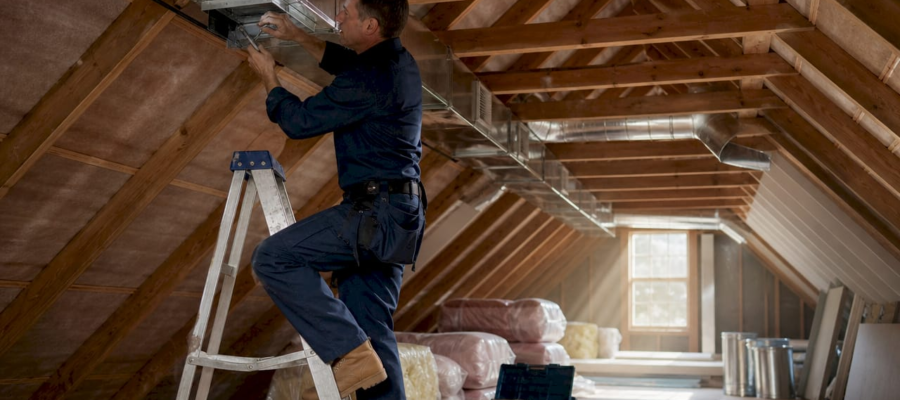
Building Ventilation Best Practices for Healthier Homes
TL;DR:
- Building ventilation best practices combine proper design, maintenance, and performance-based strategies to ensure healthy indoor air and energy efficiency. Proper system design relies on accurate load calculations, correct placement of intake and exhaust vents, and thorough testing and balancing, including sealing ducts during installation. Natural ventilation requires engineering and careful planning, using airflow modeling and effective opening sizing to avoid moisture issues and achieve energy savings.
Building ventilation best practices are defined as the set of design, maintenance, and operational strategies that deliver clean, fresh air to occupants while controlling energy use. Standards like ASHRAE 62.1 and CIBSE AM10 set the baseline for what effective ventilation looks like in both residential and commercial buildings. Poor airflow leads to moisture buildup, pollutant accumulation, and higher utility bills. Getting it right means understanding how air moves through a building, not just which equipment to install. This guide covers the full picture, from system design to filter selection, so you can make informed decisions for your home or property in New York, New Jersey, or Connecticut.
1. What are the best design strategies for building ventilation systems?
Good ventilation system design starts with accurate load calculations. ASHRAE 62.1 sets the minimum outdoor air requirements based on occupancy and floor area. Skipping this step leads to systems that are either undersized, leaving occupants in stale air, or oversized, wasting energy from day one.

Intake and exhaust placement matters more than most people realize. Fresh air intakes work best when positioned low, near eaves or soffits, while exhaust vents belong high, near the ridge. This arrangement uses natural buoyancy to push warm, stale air out and draw cooler, fresh air in. Reversing this placement, or placing both at the same height, kills the airflow path entirely.
Building pressurization is another critical design variable. Maintaining a slight positive pressure of 0.05–0.1 in.wg prevents unconditioned outside air from infiltrating through gaps in the building envelope. That infiltration brings humidity, dust, and pollutants that no filter can fully catch.
Mixed-mode ventilation combines mechanical and natural methods. On mild days, operable windows and louvres handle fresh air delivery. On extreme weather days, the mechanical system takes over. This approach cuts energy costs without sacrificing indoor air quality (IAQ).
- Duct sizing: Undersized ducts increase air velocity, which creates noise and pressure drops. Proper duct sizing keeps systems quiet and efficient.
- Testing and balancing: Every new or modified system needs airflow verification after installation. Assumptions made during design rarely survive contact with real construction.
- Lined ducts: Acoustic lining on supply ducts reduces fan noise transmission to occupied spaces.
- Commissioning: A formal commissioning process documents that the system performs as designed before occupants move in.
Pro Tip: Design for testing from the start. Install balancing dampers and test ports during construction. Retrofitting them later costs significantly more and often gets skipped entirely.
2. How do natural ventilation methods enhance indoor air quality and energy savings?
Natural ventilation uses wind pressure and thermal buoyancy to move air through a building without mechanical fans. The two primary strategies are cross-ventilation, where openings on opposite sides of a building create a pressure difference, and stack-driven ventilation, where warm air rises and exits through high openings as cooler air enters below.
Natural ventilation requires engineering, not assumption. The U.S. Department of Energy and CIBSE both emphasize that passive ventilation in humid climates carries real moisture and mold risk when openings are not sized and placed correctly. Treating it as a “set it and forget it” solution is one of the most common and costly mistakes property owners make.
CIBSE AM10 outlines a five-step process for natural ventilation design:
- Feasibility study: Assess climate, site, and building use to determine whether natural ventilation is viable.
- Strategy selection: Choose cross-ventilation, stack effect, or a hybrid approach based on the feasibility findings.
- Envelope design: Size and position openings, windows, louvres, and trickle vents to deliver the required airflow.
- Performance assessment: Model airflow under multiple weather conditions to verify the design works year-round.
- Commissioning: Test actual airflow rates after construction and adjust as needed.
A critical detail that most guides miss: effective opening area is always smaller than geometric opening area due to airflow contraction. A window that measures 4 square feet does not deliver 4 square feet of airflow. Ignoring this leads to undersized ventilation and unmet IAQ targets.
Pro Tip: Trickle vents installed in window frames provide controlled background ventilation year-round without the moisture risk of leaving windows fully open. They are inexpensive and highly effective in New York and New Jersey climates.
3. What are the most effective HVAC maintenance tips to sustain ventilation performance?
HVAC system maintenance is the single most controllable factor in long-term ventilation performance. Well-maintained systems operate 15–25% more efficiently and save homeowners $150–$450 annually on energy costs. That efficiency gap comes almost entirely from neglected filters, dirty coils, and leaking ducts.
Filter replacement is the highest-impact DIY task. Replace air filters every 30–90 days, with monthly checks recommended for homes with pets or allergy sufferers. A clogged filter does not just reduce airflow. It forces the blower motor to work harder, shortening its lifespan and increasing electricity use.
- Outdoor unit clearance: Keep at least 2 feet of clearance around the condenser unit. Debris and overgrown shrubs restrict airflow and reduce heat rejection efficiency.
- Duct sealing: Duct leakage wastes 20–30% of heated or cooled air before it reaches living spaces. Sealing ducts with mastic or foil tape is one of the highest-ROI upgrades available.
- Vent clearance: Supply and return vents blocked by furniture or rugs create pressure imbalances that reduce airflow to other rooms.
- Professional tune-ups: Schedule biannual HVAC tune-ups. Annual maintenance agreements typically cost $150–$300 and include two seasonal visits that protect manufacturer warranties.
- Smart thermostats: Devices like Ecobee or Nest track runtime and alert you to performance drops before they become expensive failures.
- Maintenance logs: Record every filter change, cleaning, and service visit. This documentation is required for most warranty claims and helps contractors diagnose problems faster.
Pro Tip: Check your HVAC air filter every month, even if you do not replace it. A visual check takes 30 seconds and tells you immediately whether your system is working harder than it should.
4. How to balance indoor air quality requirements with energy efficiency goals
Performance-based ventilation is the most effective way to meet IAQ standards without wasting energy. ASHRAE’s Indoor Air Quality Procedure (IAQP), part of ASHRAE 62.1, replaces fixed outdoor air rates with dynamic control based on real-time pollutant sensors. CO2 and VOC sensors measure actual occupancy and air quality, then signal the system to bring in more or less outdoor air as needed.
Traditional fixed-rate ventilation assumes a building is always at full occupancy. That assumption is wrong most of the time, especially in commercial buildings and multi-family properties. The result is over-ventilation during low-occupancy periods, which wastes conditioned air and drives up energy bills.
| Approach | IAQ Performance | Energy Use | Best For |
|---|---|---|---|
| Fixed ventilation rate | Consistent but often excessive | High | Simple residential systems |
| Demand-controlled ventilation (DCV) | Responsive to actual occupancy | Moderate | Offices, schools, retail |
| ASHRAE IAQP with sensors | Highest accuracy | Lowest | Commercial buildings, large properties |
| Energy recovery ventilators (ERV/HRV) | Good, with heat transfer | Low | Tight building envelopes |
Energy recovery ventilators (ERVs and HRVs) transfer heat and moisture between outgoing and incoming air streams. In New York and New Jersey winters, an ERV can recover a significant portion of the energy that would otherwise be lost through exhaust air. This makes fresh air delivery affordable even in extreme cold.
Balancing dampers and airflow measurement devices verify that conditioned air actually reaches occupants. A system that delivers the right total airflow but distributes it unevenly still leaves some rooms under-ventilated. Performance-based IAQ strategies address distribution, not just total volume.
5. What common ventilation mistakes should homeowners and property managers avoid?
Most ventilation failures trace back to a short list of avoidable errors. Recognizing them early saves money and protects occupant health.
- Wrong exhaust placement: Exhaust vents positioned too low reduce the stack effect and allow stale air to recirculate. Exhaust belongs at the highest point of the space.
- Skipping duct sealing: Leaking ducts waste 20–30% of conditioned air. This is not a minor inefficiency. It is equivalent to leaving a window open all winter.
- Using MERV 14+ filters in standard systems: High-MERV filters restrict airflow and can freeze evaporator coils. MERV 8–11 filters balance filtration and airflow for most residential HVAC systems.
- Sizing natural ventilation by geometric area: Actual airflow through an opening is always less than its physical size due to contraction effects. Use effective opening area in all calculations.
- Neglecting filter checks: A dirty filter is the most common cause of reduced airflow and system strain. Monthly visual checks take less than a minute.
- Skipping professional tune-ups: Proper maintenance prevents 75% of HVAC service calls. Skipping seasonal service leads to premature equipment failure and voided warranties.
- Ignoring occupant location in airflow planning: Fresh air that reaches the ceiling but not the breathing zone does not protect occupant health. Distribution matters as much as total volume.
- No post-installation testing: Systems that are never tested after installation often run out of balance for years. Commissioning is not optional. It is the only way to confirm the design actually works.
Key Takeaways
Effective building ventilation requires combining proper system design, regular maintenance, and performance-based IAQ strategies to protect occupant health and control energy costs.
| Point | Details |
|---|---|
| Design starts with load calculations | Use ASHRAE 62.1 baselines to size systems accurately before selecting equipment. |
| Duct sealing delivers the highest ROI | Leaking ducts waste 20–30% of conditioned air; sealing them outperforms most equipment upgrades. |
| Filter selection affects airflow | MERV 8–11 filters balance filtration and airflow; MERV 14+ risks coil freezing in standard systems. |
| Natural ventilation needs engineering | CIBSE AM10 requires feasibility studies and effective opening area calculations, not passive assumptions. |
| Performance-based ventilation saves energy | ASHRAE IAQP and demand-controlled ventilation reduce over-ventilation during low-occupancy periods. |
What I have learned from years of watching ventilation systems fail
After seeing hundreds of HVAC and ventilation setups across New York, New Jersey, and Connecticut, one pattern stands out clearly. Duct sealing is almost always the most overlooked and highest-return fix available. Property owners spend thousands on new equipment while losing 20–30% of their conditioned air through leaking duct joints. Seal the ducts first. Then evaluate the equipment.
The second thing I have learned is that natural ventilation gets oversold as a low-effort solution. It is not. It requires the same engineering discipline as a mechanical system. The CIBSE AM10 framework exists for a reason. Buildings that skip the feasibility and commissioning steps end up with moisture problems, uneven temperatures, and occupants who prop doors open because the space feels stuffy.
The shift toward performance-based IAQ ventilation is the most significant change in the field right now. Sensor-driven demand-controlled ventilation gives you real data on what your building actually needs, not what a design assumption says it needs. That is a meaningful improvement for both health and energy bills.
My practical advice: keep a written maintenance log, schedule biannual professional tune-ups, and do not wait for a comfort complaint to check your filters. The buildings that perform best over time are the ones where the basics are done consistently, not the ones with the most expensive equipment.
— Victor
How Amazonairpro supports your ventilation system’s long-term health
Clean ducts are the foundation of any effective ventilation strategy. Dust, debris, and contaminants that accumulate inside ductwork restrict airflow and reintroduce pollutants into the spaces you have worked to protect. Amazonairpro’s team of experienced technicians serves residential and commercial properties across New York, New Jersey, and Connecticut, with over 10 years of focused expertise in air duct and HVAC cleaning.

Whether you manage a commercial building or a single-family home, professional commercial duct cleaning removes the buildup that routine maintenance cannot reach. Amazonairpro uses professional-grade equipment to restore airflow, improve system efficiency, and support the IAQ goals you are working toward. If you want to know what signs point to dirty ducts, that is a good place to start before booking a service visit.
FAQ
What is ASHRAE 62.1 and why does it matter for ventilation?
ASHRAE 62.1 is the U.S. standard that sets minimum outdoor air ventilation rates for commercial and residential buildings. It defines how much fresh air a building must deliver based on occupancy and floor area to protect indoor air quality.
How often should air filters be replaced in a home HVAC system?
Replace air filters every 30–90 days, with monthly checks recommended for homes with pets or allergy sufferers. A clogged filter reduces airflow and forces the system to work harder, increasing energy use and wear.
What is demand-controlled ventilation (DCV)?
Demand-controlled ventilation uses CO2 or occupancy sensors to adjust outdoor air intake based on actual building use. It reduces over-ventilation during low-occupancy periods, cutting energy costs without sacrificing air quality.
Can natural ventilation replace a mechanical HVAC system?
Natural ventilation can supplement a mechanical system but rarely replaces it entirely in New York, New Jersey, or Connecticut climates. Extreme summer heat and winter cold require mechanical backup to maintain safe indoor temperatures and adequate fresh air delivery.
How do I know if my ducts are leaking?
Common signs include uneven room temperatures, higher-than-expected energy bills, and rooms that never seem to reach the set temperature. A professional airflow test or duct pressurization test confirms whether leakage is present and how severe it is.
Recommended
- Why Vent Hygiene Matters for Healthier Homes – Amazon Air Duct Cleaning
- Ventilation’s Role in Energy Efficiency for Your Home – Amazon Air Duct Cleaning
- Ventilation systems explained: a practical guide for healthier indoor air – Amazon Air Duct Cleaning
- Efficient Home Ventilation Upgrades: 2026 Guide – Amazon Air Duct Cleaning