Dryer vent safety procedure: 5 essential steps
TL;DR:
- Regular dryer vent cleaning reduces fire risk and improves drying efficiency.
- Use proper tools and follow safety steps carefully during cleaning.
- Professional help is recommended for complex or long vent systems.
Clogged dryer vents are among the top causes of preventable house fires in the Northeast, yet most homeowners in New York, New Jersey, and Connecticut rarely think about them until something goes wrong. A dryer vent packed with lint is not just an inconvenience. It is a genuine fire hazard sitting inside your wall. This guide walks you through a clear, expert-backed safety procedure so you can protect your home with confidence. We cover everything from gathering the right tools to verifying your work after cleaning, including the mistakes that trip up even careful homeowners.
Table of Contents
- Why dryer vent safety matters
- Essential tools and materials for safe dryer vent cleaning
- Step-by-step dryer vent safety procedure
- Common mistakes to avoid and troubleshooting tips
- How to verify dryer vent safety after cleaning
- A professional’s perspective: What most guides miss about dryer vent safety
- Get expert help with dryer vent safety in NY, NJ, and CT
- Frequently asked questions
Key Takeaways
| Point | Details |
|---|---|
| Annual cleaning is essential | A yearly dryer vent cleaning greatly reduces fire risk and keeps your appliance efficient. |
| Use the right tools | Proper brushes, vacuums, and safety gear make cleaning safer and more effective for homeowners. |
| Follow a step-by-step procedure | Careful preparation and systematic cleaning ensure no areas are missed and prevent damage. |
| Watch for warning signs | Long drying times and unusual heat are red flags your vent may need immediate attention. |
| Call in experts for tough jobs | Seek professional help for long vents, rooftop exhausts, or recurring issues to ensure complete safety. |
Why dryer vent safety matters
With safety top of mind, let’s look at why staying on top of dryer vent maintenance is non-negotiable.
Your dryer pushes hot, moist air out through a vent that runs from the back of the appliance to an exterior wall or rooftop. Every load of laundry deposits a thin layer of lint along that path. Over time, that buildup restricts airflow, forces your dryer to work harder, and creates the exact conditions needed for a fire to start. Lint buildup dramatically increases the risk of fire, and it happens faster than most people expect.
“Local fire marshals warn that regular vent checks could prevent most dryer-related fires. A few minutes of inspection each month can make a measurable difference.”
Homes in the tri-state area face some added challenges. Older construction in many New York City boroughs, New Jersey suburbs, and Connecticut towns often means longer vent runs, more elbows, and flexible foil ducts that were installed decades ago. These features trap lint more easily and are harder to clean thoroughly.
Watch for these warning signs that your vent may be dangerous:
- Clothes take more than one cycle to dry fully
- The laundry room feels unusually hot during a cycle
- You notice a burning smell when the dryer runs
- Lint appears around the dryer hose connection
- The exterior vent flap does not open during operation
The numbers behind this risk are worth knowing. Nearly 16,000 home fires start in the U.S. every year due to dryer vents. Beyond fire, a blocked vent can also cause moisture to back up into the duct, encouraging mold growth. In gas dryers, a restricted exhaust path can even contribute to carbon monoxide buildup. These are not remote possibilities. They are documented outcomes of routine neglect.
Understanding the dryer vent fire hazards specific to your home type is the first step toward fixing them. Whether you live in a single-family home in Westchester or a multi-unit building in Newark, the risks are real and the solutions are within reach.
Essential tools and materials for safe dryer vent cleaning
Knowing the risks, it’s crucial to gather the right tools before diving into the vent cleaning process.
The right equipment makes cleaning more thorough and safer. Trying to clean a vent with a broom handle or a makeshift brush often pushes lint deeper into the duct rather than removing it. Before you start, collect everything on this list.
Tools and materials checklist:
- Dryer vent brush kit with flexible rods (at least 12 feet total length)
- Vacuum cleaner with a hose attachment
- Flathead and Phillips screwdrivers
- Work gloves
- Safety glasses
- Dust mask or N95 respirator
- Flashlight or headlamp
- Foil tape (for resealing connections after cleaning)
If you have children or pets, move them to another room before starting. Lint and dust will become airborne during cleaning, and the process involves moving a heavy appliance.
Household tools vs. professional-grade equipment:
| Feature | Household DIY tools | Professional equipment |
|---|---|---|
| Brush reach | Up to 12 feet | 25+ feet with motorized rods |
| Suction power | Standard home vacuum | Industrial vacuum with HEPA filter |
| Inspection capability | Visual only | Camera inspection available |
| Lint removal rate | Good for short runs | Near-complete removal |
| Cost | Low upfront | Included in service fee |
For most homeowners with a standard vent run under 10 feet, a quality brush kit and a strong vacuum will get the job done. If your vent runs through multiple walls or exits through the roof, that is a different situation entirely, and one where DIY vs. professional vent cleaning becomes a more important question to answer honestly.

Pro Tip: Always wear a dust mask during cleaning. Lint is highly flammable and can carry bacteria, mold spores, and fine particulates that you do not want to breathe in.
Step-by-step dryer vent safety procedure
With your supplies ready, let’s walk through the safest, most effective cleaning process.

Following a safe procedure reduces fire hazards and improves dryer efficiency. Skipping steps or rushing through this process is how small problems become serious ones.
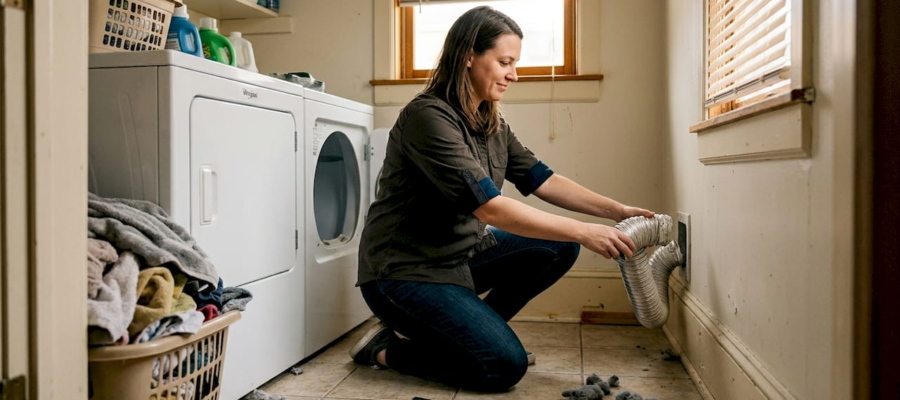
Step-by-step cleaning process:
- Unplug the dryer. For gas dryers, also turn off the gas supply valve before moving the appliance.
- Pull the dryer away from the wall. Give yourself at least two feet of working space.
- Disconnect the vent hose. Loosen the clamp with a screwdriver and gently pull the hose free from the dryer’s exhaust port.
- Insert the brush into the duct opening. Push it toward the exterior, rotating as you go to loosen lint from the walls of the duct.
- Vacuum as you go. Use the hose attachment to pull out loosened lint from both ends of the duct.
- Check the exterior vent flap. Go outside and confirm the flap opens freely and is clear of debris, bird nests, or ice buildup.
- Reattach the vent hose. Use foil tape to seal any gaps at the connection points.
- Restore power and run a test cycle. Run the dryer on air-only or a short cycle and confirm warm air exits the exterior vent.
Time and effort summary by task:
| Task | Estimated time | Difficulty |
|---|---|---|
| Preparation and unplugging | 5 minutes | Easy |
| Moving dryer and disconnecting vent | 10 minutes | Moderate |
| Brushing and vacuuming the duct | 15 to 25 minutes | Moderate |
| Exterior vent inspection | 5 minutes | Easy |
| Reassembly and testing | 10 minutes | Easy |
For reasons to clean vents safely, the test cycle at the end is not optional. It confirms airflow is restored and that no connections were left loose.
Pro Tip: Before reconnecting the vent hose, shine a flashlight into the duct from both ends. You should be able to see daylight from the exterior opening. If you cannot, there is still a blockage somewhere in the run.
Common mistakes to avoid and troubleshooting tips
Even with clear steps, there are common pitfalls. Here’s what to watch out for and solutions if problems arise.
Homeowners often miss hidden lint or damage connectors, leading to persistent hazards. Knowing what goes wrong most often helps you avoid the same traps.
Common mistakes during dryer vent cleaning:
- Forgetting to unplug the dryer before starting
- Skipping the exterior vent inspection entirely
- Using a leaf blower to push lint through instead of pulling it out
- Crushing or kinking the flexible duct when moving the dryer back
- Reattaching the hose without checking for tears or gaps
- Using duct tape instead of foil tape, which degrades under heat
If your dryer still takes a long time to dry clothes after cleaning, the problem may not be lint alone. A damaged duct, a partially blocked exterior flap, or a vent run with too many bends can all restrict airflow even after a thorough cleaning. In those cases, the importance of regular cleaning extends to inspecting the full duct path, not just the accessible section near the dryer.
Signs that something was missed or that a bigger issue exists:
- Burning smell persists after cleaning
- Drying times remain longer than 45 minutes for a normal load
- Lint continues to accumulate around the dryer connection
- The exterior flap still does not open fully during operation
If any of these signs remain after cleaning, stop using the dryer and contact a professional. Continuing to run a dryer with a compromised vent is not a calculated risk worth taking.
Pro Tip: If your home has flexible foil ductwork, consider replacing it with rigid metal duct. Rigid metal is smoother on the inside, traps less lint, and is far more resistant to crushing and heat damage.
How to verify dryer vent safety after cleaning
Once you finish cleaning and reassembly, it’s time to confirm your home’s vent is truly safe.
Properly checking airflow and lint-free exhaust reduces fire risk substantially. Verification is not a formality. It is the step that tells you whether the cleaning actually worked.
Post-cleaning safety checklist:
- Stand outside near the exterior vent during a test cycle and confirm strong, warm airflow
- Check that the exterior flap opens fully and closes when the dryer stops
- Inspect the hose connection at the back of the dryer for lint or gaps
- Confirm the laundry room temperature feels normal during the cycle
- Listen for any unusual sounds that might indicate a loose connection
Beyond the immediate check, build a simple maintenance habit. Write the cleaning date on a piece of tape and stick it to the back of the dryer or inside a cabinet door. Set a calendar reminder for 12 months out. For households that do laundry daily or run a home-based business, consider a quick visual check every month. Look at the exterior vent flap and the connection at the dryer. That takes about two minutes and can catch problems early.
A well-maintained vent can reduce dryer fire risk by over 30%, and the effort required to maintain it is genuinely modest. Reviewing the full duct maintenance checklist once a year is a smart way to keep your entire ventilation system in good shape, not just the dryer.
A professional’s perspective: What most guides miss about dryer vent safety
Most cleaning guides focus on the stretch of duct you can easily reach from behind the dryer. That is a reasonable starting point, but it misses where the real problems tend to hide. In our experience serving homes across New York, New Jersey, and Connecticut, the most serious blockages and code violations are almost always found in the sections homeowners never see: the duct run inside the wall, the rooftop exhaust, and the exterior termination cap.
High-use households, multi-family buildings, and rental properties often need cleaning twice a year, not once. Annual cleaning is a minimum baseline, not a guarantee of safety. The biggest long-term upgrade you can make is switching to rigid metal ductwork with fire-rated wall penetrations. It is a one-time investment that makes every future cleaning easier and every day between cleanings safer.
As we tell every client: ‘A clean dryer vent is only as safe as its weakest, least-visible connection.’ If you want full confidence in your vent system, working with regional dryer vent experts who know local building codes and construction styles is worth the call.
Get expert help with dryer vent safety in NY, NJ, and CT
If you want true peace of mind or run into issues you can’t fix, here’s how to get expert help fast.
Some dryer vent situations call for professional attention. If your vent run is longer than 6 feet, exits through the roof, or if you manage a multi-unit or rental property, a DIY cleaning may not be enough to meet local safety codes or fully clear the duct.

At Amazon Air Duct Cleaning, our team has over 10 years of experience serving residential and commercial clients across New York, New Jersey, and Connecticut. We use professional-grade equipment to book a dryer vent cleaning that goes well beyond what a brush kit can reach. For property managers and landlords, our NY and NJ vent cleaning services are built for multi-unit buildings. Not sure how often your property needs service? Our vent cleaning frequency advice can help you decide.
Frequently asked questions
How often should you clean your dryer vent for safety?
Vents need annual or semi-annual cleaning for safety. Clean more often if you do laundry daily, have a long vent run, or notice any of the warning signs described above.
What are the warning signs that a dryer vent is unsafe?
Hot laundry rooms, a burning smell, and persistent lint near the dryer connection are the clearest signals. Warning signs include heat, odor, and lint buildup, and any one of them warrants immediate attention.
Is it safe to clean a dryer vent without professional tools?
Yes, for short standard vent runs, a brush kit and vacuum work well. Using the right equipment is key for thorough cleaning, and professionals can reach deeper sections and spot hidden damage that DIY tools cannot.
When should a professional handle dryer vent cleaning?
Professionals can safely handle complex and long vent runs, roof exhausts, and situations where clogs persist after a DIY attempt. If performance does not improve after cleaning, call a pro.
Does cleaning the dryer vent really reduce fire risk?
Absolutely. Vent cleaning directly reduces fire risk and is one of the most cost-effective home safety steps you can take, especially in older homes with longer duct runs.
Recommended
- 5 Warning Signs Your Dryer Vent Is a Fire Hazard (And What to Do)
- Safety First: 5 Reasons to Get Your Dryer Vent Cleaned – Amazon Air Duct Cleaning
- Dryer Vent & Air Duct Services in NJ & NY | Book Today
- Dryer Vent Cleaning Jersey Shore: Safety & Efficiency by Amazon Air Pro