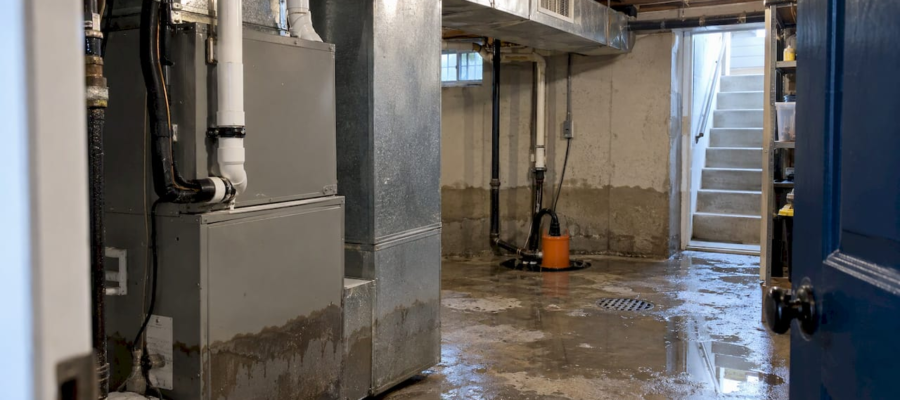
Duct Cleaning After a Flood: What to Do First
If floodwater reached your furnace, air handler or ductwork, leave the HVAC system off until a qualified professional has inspected and cleaned it. The EPA says to not use an HVAC system affected by the flood to dry out the house, because cleaning and drying it is complicated and best left to a professional. For homes in New York, New Jersey and Connecticut, our air duct cleaning team handles the cleaning side of that job once the structure is safe to work in.
TL;DR
- Do not turn on your furnace, air conditioner or fan if any part of the HVAC system was touched by floodwater. Running it can spread mold spores and debris through the whole house.
- Assume mold if the home stayed wet for more than 24 to 48 hours. Wet ducts, insulation and filters are the usual hiding places.
- Cleaning and disinfecting should be done by a professional experienced in mold cleanup. Some parts, such as flood-soaked insulation, are discarded rather than cleaned.
- After cleaning, the system is run continuously for 48 to 72 hours as a flush-out before people move back in.
- Standard homeowners policies generally exclude flood damage and mold from flooding. Photograph everything and call your insurer or flood policy provider early.
Table of Contents
- Why floodwater in the house means a problem in the ducts
- What to do in the first 48 hours
- How to tell whether water or contamination got into the system
- What a proper post-flood duct cleaning involves
- Clean it or replace it?
- Who this matters to, and what each reader should do
- Will insurance pay for it?
- Perspective
- How we can help after a flood
- Frequently asked questions
- Sources
Why floodwater in the house means a problem in the ducts
Ducts are a closed network that touches every room. Floodwater carries silt, sewage, bacteria and fungi. Once any of that gets into the system, the blower pushes it through every register the next time you switch it on.
The CDC’s flood reentry guidance says to have the HVAC system checked and cleaned by a service professional experienced in mold cleanup before turning it on, because a mold-contaminated system will spread mold throughout the house when restarted.
That matters in our area for a specific reason. Many homes in the New York metro region, northern and coastal New Jersey and Connecticut shoreline towns have furnaces, air handlers and trunk lines in basements or crawl spaces. Those are the first places water collects in a heavy storm, a burst main or a sewer backup.
The water does not have to reach the ducts to cause trouble. NIOSH, the CDC’s workplace health institute, explains that microorganisms can grow on every surface of submerged HVAC components, and that moisture can also collect in parts above the water line, such as supply ducts. For that reason the whole moisture-laden system needs inspection, not only the visibly wet parts.
What to do in the first 48 hours
The sequence matters more than speed in any single step. Here is the order we would follow if it were our own house.
- Make the building safe first. Do not enter a flooded basement with live electrical equipment. Wait for utility or electrician clearance. ACCA, the HVACR industry association, warns that waterlogged electrical components can short-circuit, burn out or create fire hazards.
- Leave the HVAC system off. That includes the thermostat, the air conditioner and any “fan only” setting. The EPA says not to use the system to dry the house until a professional says it is safe.
- Close off unaffected rooms. The EPA advises isolating clean areas with plastic sheeting, opening windows and covering vents, since debris and mold spores in the system could spread into dry areas.
- Throw away wet filters. The CDC’s hurricane HVAC flyer says water-damaged filters should be discarded and that repairs or cleaning of vents and ducts should be done before restart.
- Start drying the house. The EPA says to assume mold growth if the home and belongings could not be dried within 24 to 48 hours. Open doors and windows when weather allows, and use a wet/dry vacuum and dehumidifiers on the structure itself, not through the ducts.
- Document before you clean. Take dated photos and video of the equipment, ducts, insulation and water line. You will want them for any claim.
- Call a professional to inspect the system. Do this before anyone restarts the equipment, even if it seems to run fine.
One caution on fans. The EPA suggests waiting to run fans or dehumidifiers until visible mold has been gently cleaned, so the airflow does not spread it. If you see mold growth, that is a reason to get help sooner, not to push ahead alone.
How to tell whether water or contamination got into the system
You often cannot see it. Most of the duct network is behind walls, under floors and above ceilings. Signs that point to a problem include:
- A musty or earthy odor when any air moves through the house, or odors that linger after the structure dries.
- Visible water, silt or staining at the base of the furnace, air handler, plenum (the box that connects the unit to the main ducts), or at floor-level registers.
- Wet, discolored or sagging duct insulation, or lined duct board that feels damp.
- Rust on the cabinet, blower housing, drain pan or coil.
- Mold spots near registers, or a flood line on the equipment.
NIOSH advises that flood-related odors after cleaning mean the system should be reassessed for contaminated areas that were missed. A smell is information. It is not something to cover with air freshener.
The CDC’s guidance for asthma and mold allergy points out that identifying the type of mold is not the priority. Sampling is costly and there are no set standards for different kinds, so the best approach is to remove the mold safely and prevent regrowth. If someone in your home has asthma, allergies or a weakened immune system, keep them out of the house until cleanup is complete.
What a proper post-flood duct cleaning involves
This is not a standard routine duct cleaning. NIOSH’s flood recommendations describe the work a qualified professional should do:
- Remove contaminated insulation and filters. All flood-contaminated insulation around and inside HVAC components is removed and discarded.
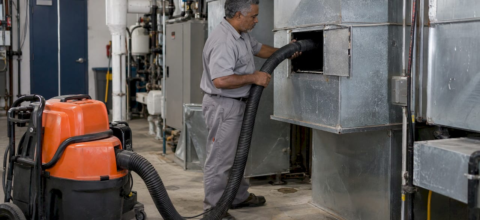
- HEPA-vacuum the contaminated surfaces. That covers filter racks, drain pans, bends and horizontal duct runs, where silt and debris settle.
- Disinfect with the system off. NIOSH describes a solution of 1 cup of household chlorine bleach per gallon of water, followed by a clean-water rinse. Never mix bleach with ammonia, which produces toxic fumes.
- Service the fan. The blower fan is removed, cleaned, disinfected, dried thoroughly and tested by a qualified professional before it goes back into the unit.
- Replace what cannot be cleaned. Components that cannot be effectively cleaned and disinfected are discarded and replaced. New insulation should preferably be external, smooth-surfaced and out of the air stream.
- Flush out. Before the building is reoccupied, the cleaned system runs continuously for 48 to 72 hours, with outdoor air dampers opened as far as temperatures allow, and the flush-out filters are replaced.
The CDC’s healthcare reopening guidance adds that ductwork that may not have been submerged still gets cleaned and disinfected, and that remediation work should be isolated from clean areas with barriers. It also says to check for asbestos before remediation. That last point is relevant in older Northeast housing stock, where some duct wrap and older insulation may contain it.
The cleaning steps above need trained hands and the right gear. Respiratory protection, HEPA filtration and containment are part of the job, and bleach solutions and wet electrical equipment are hazards in their own right.
Clean it or replace it?
Some parts of a flooded system should simply go in the dumpster. The decision comes down to whether the material can be thoroughly dried and disinfected.
| Component | Usual outcome | Why |
|---|---|---|
| Duct insulation (wrap or liner) that got wet | Discard and replace | Porous material that is submerged or cannot dry is not salvageable |
| Filters | Discard | Wet filters hold contaminants |
| Sheet metal ducts | Usually cleaned and disinfected | Smooth, non-porous surfaces can be cleaned |
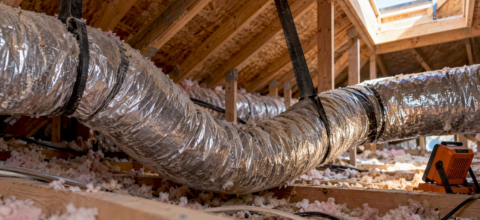
| Flexible or fiberglass duct board that stayed wet | Often replaced | Porous interior traps moisture and growth |
| Blower motor and fan | Cleaned, dried and tested, or replaced | Electrical parts need testing before reuse |
| Furnace, air handler, outdoor condenser | Evaluate for replacement | ACCA says flooded equipment faces high risk of rust, mold and premature electrical failure |
The CDC’s healthcare reopening guidance sets a useful benchmark: structural material that cannot be dried within 48 to 72 hours to below 20% moisture content should be removed and replaced. A moisture meter, and sometimes a borescope (a small camera on a flexible probe), are used to check what you cannot see.
The EPA’s own homeowner guidance uses a stricter number for finished building materials: moisture at 15% or less before refinishing. For ducts, the practical point is the same. Wet is not done until a meter says so.

ACCA also notes that flood-damaged water heaters should be replaced regardless of fuel type, and that older equipment may contain mercury, so do not dispose of unknown components yourself.
Who this matters to, and what each reader should do
Homeowners. Keep the system off, dry the structure, photograph everything and call for an inspection before restart. If you have a finished basement with ducts above a drop ceiling, tell the inspector so those runs get checked.
New home buyers and real estate agents. If a property has a flood history, ask for the date of the flood, what was repaired and whether the HVAC was inspected and cleaned afterward. Stains, a musty smell at registers or fresh paint on lower walls near the furnace are all reasons to ask questions before closing. For listings, a documented duct cleaning after a water event gives a buyer something concrete to rely on.
Property managers and facility managers. In multi-unit buildings, schools and clinics, one contaminated air handler can serve many occupants. Work in sequence: isolate, inspect, clean, flush, then reoccupy. Our commercial air duct cleaning covers business and institutional buildings.
Will insurance pay for it?
Usually not under a standard policy, and that surprises many people. The Insurance Information Institute states that flood damage is excluded under standard homeowners and renters policies. Separate flood coverage is available through the National Flood Insurance Program (NFIP) and a few private insurers. The same source notes that standard policies do not cover damage from lack of maintenance, mold or infestation.
For New Jersey readers, the state Department of Banking and Insurance’s homeowners summary says mold is not covered unless it results from a covered loss, and gives mold damage from flooding as an example that would not be covered.
If you do have flood coverage, documentation is everything. FEMA published an NFIP appeal decision in which a denial was upheld for vent cleaning and mold where the ducts were above the waterline and the cleaning, done more than two years after the flood, was not documented as required by the flood. The lesson is practical: clean promptly, and keep written records of the water line, the work performed and the dates.

Call your insurer or agent before major work begins, and ask what documentation they need. They decide coverage, not us.
Perspective
Most homeowners we talk to after water damage ask the same thing: the water is gone, the floors are drying, so why can’t we turn the heat back on? The answer is that the visible part of a flood is the smaller part of the problem.
A duct system is a long, enclosed surface that stays damp longer than the rooms around it. If silt, insulation or a drain pan has been wet, the first run of the blower moves whatever is growing there into your bedrooms. That is why we tell people to wait for the inspection, and why we treat the system as a whole instead of cleaning only the registers you can reach.
Our team has over 10 years of experience with residential and commercial properties across New York, New Jersey and Connecticut, and our technicians are certified. For flood and moisture work, our services include air duct cleaning, evaporator coil and blower cleaning, antimicrobial and deodorizing duct system cleaning, and UV light installation. Those cover the parts of the system the guidance says need attention: ducts, blower, coils and the air that passes through them afterward.
If the equipment itself is beyond saving, we would rather you hear that early and replace it than run a system that will fail or smell for months.
Victor
How we can help after a flood
Once the house is safe to work in and the structure is drying, the duct system is the next piece. Our air duct cleaning service covers residential and commercial properties in New York, New Jersey and Connecticut. If the blower and coils were exposed to moisture, our evaporator coil and blower cleaning addresses those components, and our antimicrobial and deodorizing duct system cleaning is available for ducts after moisture exposure.

Published pricing is not listed on our site for these services, so the quickest route is to book an inspection through our main site and tell us when the water came in and how long it took to dry.
If mold has already been found and remediated in the house, our guide to duct cleaning after mold remediation explains what to do next. Moisture near the air handler is covered in plenum cleaning for NY, NJ and CT homes. For longer-term protection once the system is clean, see how to prevent duct contamination.
Frequently asked questions
Can I run my HVAC to dry the house after a flood?
No, not if any part of the system was affected. The EPA says not to use a flood-affected HVAC system to dry the house until a professional says it is safe. Running it can carry mold spores and debris to rooms that were dry, and wet electrical parts can fail or become a fire hazard.
How long after a flood should ducts be cleaned?
Before the system is turned on again. The CDC says the HVAC system should be checked and cleaned by a professional experienced in mold cleanup before restart. Because mold can start growing if materials stay wet beyond 24 to 48 hours, sooner is better, once the building is electrically safe and the structure is being dried.
Does homeowners insurance cover mold in ductwork after a flood?
Generally no. Standard homeowners policies exclude flood damage, and mold that results from flooding is not covered either. A separate flood policy, such as one through the NFIP, may respond to some losses, but it has its own exclusions, so ask your carrier what documentation it needs before work starts.
Do all the ducts have to be replaced after a flood?
Not always. Smooth sheet metal ducts can often be cleaned and disinfected. Insulation, duct board and any component that was submerged or cannot dry within 48 to 72 hours are typically removed and replaced. An inspection with a moisture meter is what settles it for your system.
Is it safe to return home once the ducts are cleaned?
NIOSH recommends running the cleaned system continuously for 48 to 72 hours as a flush-out before reoccupancy, then replacing the flush-out filters. If flood-related odors remain, the system should be reassessed for missed areas. People with asthma or mold allergies should stay out until cleanup is complete.
Sources
- Flood Cleanup to Protect Indoor Air and Your Health, US EPA
- Text Version of the Flooded Home, US EPA
- Safety Guidelines: Reentering Your Flooded Home, CDC
- Heating, Ventilating & Air Conditioning (HVAC) System, CDC hurricane flyer
- Recommendations for the Cleaning and Remediation of Flood-Contaminated HVAC Systems, CDC/NIOSH
- Guidance for Reopening Healthcare Facilities After Water Damage, CDC
- Clinical Guidance for Asthma, Other Respiratory Conditions, and Mold Allergy, CDC
- Caution in hurricane flood zones, ACCA
- Which disasters are covered by homeowners insurance?, Insurance Information Institute
- Homeowners Insurance summary, New Jersey Department of Banking and Insurance
- No Direct Physical Loss: Air Vents, Mold, Mildew or Moisture, FEMA FloodSmart
Recommended
- Duct Cleaning After Mold Remediation: What to Do Next
- Fix Moisture First: Plenum Cleaning for NY/NJ/CT Homeowners
- Complete Duct Cleaning Checklist: Boost Air Quality 41%
- How to Prepare for Air Duct Cleaning