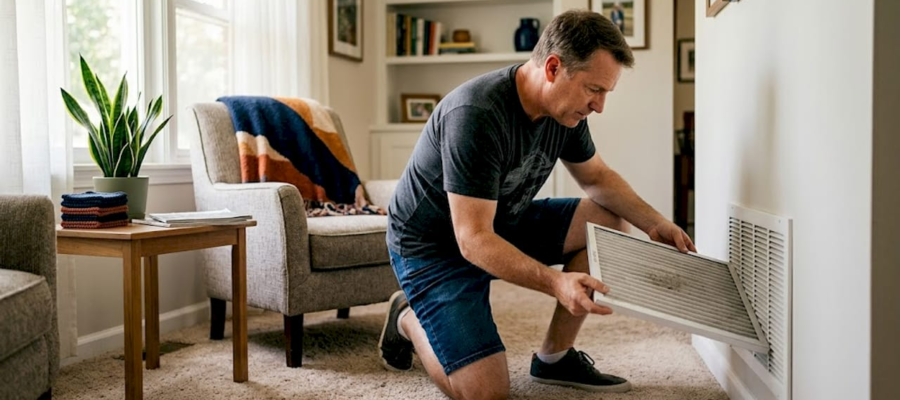
HVAC Air Filter Facts Every Homeowner Should Know
TL;DR:
- Choosing the right HVAC air filter involves balancing filtration efficiency with airflow, with MERV 8 to 13 being optimal for most homes. Proper installation, regular condition-based replacement, and cleaning of ductwork are essential for maintaining indoor air quality and system longevity. Oversized filters and neglecting installation details can cause system strain, leading to higher energy bills and costly repairs.
If your HVAC system is running but your home still feels stuffy, or your energy bills keep creeping up, your air filter is worth a serious look. Most homeowners treat filters as an afterthought, swapping them out on a vague schedule or buying whatever is cheapest at the hardware store. The truth is, knowing the right hvac air filter facts can mean the difference between a system that runs cleanly for years and one that racks up repair bills. This guide gives you the practical, evidence-based information you need, without the fluff.
Table of Contents
- Key takeaways
- 1. HVAC air filter facts start with the MERV rating
- 2. Filter types differ more than you might expect
- 3. Why airflow restriction is a silent efficiency killer
- 4. Installation quality is a fact most people overlook
- 5. Replacement intervals depend on your household, not just your calendar
- 6. Visual inspection beats a fixed schedule
- 7. Dirty filters damage more than just air quality
- 8. A filter comparison you can actually use
- My honest take on where most people go wrong
- Keep your air clean beyond the filter
- FAQ
Key takeaways
| Point | Details |
|---|---|
| MERV 8 to 13 hits the sweet spot | This range offers strong filtration for most homes without restricting airflow enough to harm your system. |
| Installation quality matters as much as filter choice | A poorly seated filter lets unfiltered air bypass it entirely, defeating the purpose of having one. |
| Replace by condition, not just calendar | Visual inspection beats a fixed schedule because loading rates vary by household, occupancy, and pet presence. |
| Thicker filters last longer but need compatible systems | A 4-inch deep-pleated filter can last up to six months, but only if your HVAC is designed to accommodate it. |
| Filters and duct cleaning work together | Even the best filter cannot clean what has already built up inside your ductwork over years of use. |
1. HVAC air filter facts start with the MERV rating
MERV stands for Minimum Efficiency Reporting Value. It measures how effectively a filter captures airborne particles on a scale from 1 to 20. The higher the number, the smaller the particles the filter can trap.
For most residential systems, MERV 13 is the EPA’s recommended target to balance capturing fine particles while keeping airflow manageable. That said, MERV 8 to 11 works well for most standard homes without pets or significant allergy concerns.
What you need to understand is that higher is not automatically better. A filter with too high a MERV rating can restrict airflow enough to stress your blower motor, reduce heating and cooling capacity, and increase your energy bill. Matching the filter to what your system can actually handle is the smarter move. Check your HVAC manual or ask your technician what pressure drop your system is rated for before upgrading.
Pro Tip: If you want to understand how specific ratings translate to real-world air quality, the MERV ratings guide from Amazonairpro breaks it down in plain terms.
2. Filter types differ more than you might expect
Not all filters are built the same, and the differences go beyond price. Here is a breakdown of what you will typically find on the market:
- Fiberglass filters: These are the thin, cheap filters you see priced at one to two dollars. They catch large debris like dust and lint, but they do little for smaller particles like pet dander or mold spores. They need replacing every 30 days.
- Pleated filters: Made from polyester or cotton paper folded accordion-style, these offer a much larger surface area and better particle capture than fiberglass. They typically last one to three months and hit the MERV 8 to 13 range comfortably.
- Washable or electrostatic filters: These use a static charge to attract particles and can be rinsed and reused. The catch is they tend to lose efficiency over time, and if you do not dry them completely before reinstalling, you risk mold growth inside your system.
- Deep-pleated or 4-inch thick filters: These have significantly more surface area and can last up to six months before needing replacement. The downside is that not every system has a filter slot wide enough to accommodate them.
For most households in New York, New Jersey, and Connecticut, a quality pleated filter in the MERV 10 to 13 range is the most practical starting point.
3. Why airflow restriction is a silent efficiency killer
Your HVAC system is designed to move a specific volume of air. When a filter becomes clogged, that movement gets harder, and the system has to work more to compensate. Dirty filters can increase energy consumption by 5% to 15%. Over a full heating and cooling season, that adds real money to your utility bills.

The consequences go beyond cost. When airflow drops low enough, the evaporator coil can freeze, the blower motor can overheat, and the system can start short cycling, where it turns on and off rapidly instead of running through full, efficient cycles. Clogged filters lead to coil freezing and blower motor stress, both of which mean expensive repairs.
Facility managers dealing with commercial systems face a compounded version of this problem. Upgrading to higher-efficiency filters without first verifying your system’s pressure drop limits can cause airflow penalties that hit your energy budget hard. The rule is simple: know your system’s specs before you change your filter spec.
4. Installation quality is a fact most people overlook
You can buy a MERV 13 pleated filter, slide it into the slot carelessly, and get almost none of the benefit you paid for. Air bypass from a poor filter seal means unfiltered air circulates right around the edges of the filter. The particles you were trying to catch go straight into your ductwork and eventually back into your breathing space.
This is one of the most underreported hvac air filter facts. People change their filter and still experience allergy symptoms or visible dust, and they assume the filter is not working. Often, the filter is fine. The installation is not.
When you install a filter, check that the arrow on the frame points toward the blower, not away from it. Press all four edges firmly to seat the filter flush against the frame. If there are gaps wider than the thickness of a credit card, the filter is not doing its job. Installation quality is as critical as the replacement frequency itself.
Pro Tip: After installing a new filter, run your hand along the edges of the slot while the system is running. If you feel suction pulling from outside the frame, air is bypassing the filter.
5. Replacement intervals depend on your household, not just your calendar
The standard advice to change your filter every 30, 60, or 90 days is a reasonable starting point but not the full picture. Replacement intervals should reflect loading rates, which vary based on occupancy, pets, local dust levels, and how many hours per day your system runs.
A single-person condo with no pets and a newer build might get away with replacing a 1-inch filter every 60 days. A home with two dogs, three kids, and an older build in a dusty area might need that same filter replaced every three to four weeks. The filter does not know what month it is. It only knows how much it has captured.
Thicker 4-inch filters can last up to six months, which makes them an attractive option for property managers overseeing multiple units. Fewer replacement cycles also means less time spent on maintenance visits. If your system can accommodate a 4-inch slot, the upgrade is worth considering. For a clear breakdown of timing by household type, the air filter replacement guide from Amazonairpro is a useful reference.
6. Visual inspection beats a fixed schedule
Pull your filter out and look at it. If the surface is uniformly gray and you can barely see the filter material underneath, it is past time for a replacement. If it still looks relatively clean, you have more time. Visual inspection and condition-based replacement is more reliable than a calendar reminder because it accounts for the actual conditions in your space.
There are a few other performance indicators worth watching:
- A noticeable drop in airflow from your vents, even with the system running at full capacity
- Visible dust accumulating on grilles, registers, or nearby furniture faster than usual
- Your system running longer cycles to reach the thermostat setpoint
- An uptick in allergy or respiratory symptoms among household members
Any one of these signals is a prompt to check your filter before your scheduled replacement date.
7. Dirty filters damage more than just air quality
People focus on indoor air quality when thinking about filters, which makes sense. But the system-level damage from neglect is just as consequential. Replacing filters regularly protects evaporator coils from dirt buildup, which directly maintains the system’s ability to absorb heat and run efficiently.
A dirty coil does not transfer heat well. Your system runs longer, consumes more energy, and wears out faster. Scheduling a coil inspection alongside your filter changes is a habit that pays off. It is a small thing that prevents a much larger repair bill down the road.
The connection between filter care and HVAC lifespan is not theoretical. It is mechanical. A system that breathes freely lasts longer, plain and simple. For a broader look at keeping your system in good shape year-round, the HVAC maintenance guide from Amazonairpro covers the full picture.
8. A filter comparison you can actually use
Here is a side-by-side look at common filter types to make selection clearer:
| Filter type | MERV range | Typical lifespan | Approx. cost | Airflow impact |
|---|---|---|---|---|
| Fiberglass | 1 to 4 | 30 days | $1 to $3 | Minimal |
| Basic pleated | 5 to 8 | 60 to 90 days | $5 to $15 | Low |
| Mid-grade pleated | 9 to 12 | 60 to 90 days | $15 to $30 | Moderate |
| High-efficiency pleated | 13+ | 60 to 90 days | $20 to $50 | Higher, verify system |
| Deep-pleated (4-inch) | 8 to 16 | Up to 6 months | $25 to $60 | Low (large surface area) |
| Washable electrostatic | 4 to 10 | Reusable (years) | $30 to $100 | Moderate, degrades over time |
Pro Tip: If you manage multiple units across a property, standardizing on one mid-grade pleated filter that fits all your HVAC slots simplifies procurement and reduces the chance of grabbing the wrong size during a busy maintenance cycle.
My honest take on where most people go wrong
I have talked with enough homeowners and facility managers to know that the mistake almost nobody talks about is installation carelessness. People spend time researching filter ratings, comparing brands, and following replacement reminders, and then they slide the filter in without checking the seal and undo most of that effort in about ten seconds.
The second thing I keep seeing is a reflexive reach for the highest MERV rating available. I understand the logic. Higher number, better filter. But I have seen systems with undersized blowers struggling against MERV 16 filters, running hotter, cycling faster, and costing more to operate than they would have with a MERV 11. The filter you choose has to match the system you have, not the system you wish you had.
What I think gets underestimated is the value of simply looking at your filter regularly. Not waiting for a calendar alert. Just pulling it out every few weeks and actually looking at it. That habit alone will tell you more about your system’s load and your indoor air conditions than any fixed schedule will. It also builds an intuition for your specific home over time.
In my experience, the homeowners and property managers who spend the least on HVAC repairs are not necessarily the ones buying the most expensive filters. They are the ones paying consistent attention to the basics. Right filter for the system, properly installed, changed when it is actually dirty, and backed up by occasional professional service when needed.
— Victor
Keep your air clean beyond the filter
Good filter maintenance is a strong foundation, but it is not the whole story. Professional duct cleaning improves indoor air quality by removing the built-up dust, debris, and allergens that your filter was never designed to reach. Ducts accumulate years of contaminants that circulate every time your system runs.

If you are in New York, New Jersey, or Connecticut and you have not had your ductwork inspected in the last few years, now is a reasonable time to consider it. Amazonairpro offers residential and commercial air duct and HVAC cleaning services for homes, apartment complexes, office buildings, and facilities of all sizes. Our team has over 10 years of experience, and we serve clients across NY, NJ, and CT. Cleaner ducts mean your filter does not have to work as hard, and your system runs closer to its design efficiency.
FAQ
What MERV rating is best for a home HVAC system?
For most homes, a MERV 8 to 13 filter offers the right balance of particle capture and airflow. The EPA recommends targeting MERV 13 when your system can support it.
How often should I replace my HVAC air filter?
Standard 1-inch filters typically need replacing every 30 to 60 days, while 4-inch deep-pleated filters can last up to six months. Households with pets, allergies, or heavy system use should replace filters more frequently.
Can a high-MERV filter damage my HVAC system?
Yes. A filter with a MERV rating that exceeds your system’s design limits can restrict airflow, cause coil freezing, and lead to blower motor overheating. Always verify your system’s pressure drop specs before upgrading.
Why is my air quality still poor after changing the filter?
Poor installation is often the cause. If the filter is not seated flush, unfiltered air bypasses it around the edges. Dust and allergens accumulated in your ductwork can also continue circulating regardless of filter condition.
Does professional duct cleaning replace the need for regular filter changes?
No. They serve different purposes. Filters capture particles in real time as air circulates. Duct cleaning removes the buildup inside your system that filters cannot reach. Both are part of a complete approach to indoor air quality.
Recommended
- What MERV Rating Should I Use? Air Filter Guide for Homeowners
- HVAC Maintenance Guide: Boost Air Quality & Efficiency – Amazon Air Duct Cleaning
- Improved HVAC Habits to Help Protect Your Home – Amazon Air Duct Cleaning
- Top HVAC upgrades for better efficiency and air quality – Amazon Air Duct Cleaning