The Role of Ventilation in Safety: A 2026 Guide
TL;DR:
- Proper ventilation supplies clean outdoor air and removes indoor pollutants to ensure occupant health and safety. CO₂ levels below 800 ppm indicate adequate airflow, while higher readings demand system evaluation and maintenance. Combining effective system design, real-time monitoring, and regular upkeep maintains safe indoor environments across various building types.
Ventilation is defined as the process of supplying fresh outdoor air and removing stale indoor air to protect occupants from airborne pollutants and maintain a safe, healthy indoor environment. The role of ventilation in safety goes far beyond comfort. According to the US EPA, inadequate air exchange raises indoor pollutant concentrations by failing to dilute and remove emissions from building materials, cleaning products, and occupants themselves. ASHRAE, the organization that sets ventilation standards for American buildings, defines acceptable indoor air quality through its Standard 62.1-2022, which specifies minimum outdoor air delivery rates for occupied spaces. CO₂ concentration is the most practical indicator of ventilation adequacy: readings below 800 ppm signal that fresh air exchange is sufficient for the number of occupants present.
How does ventilation improve indoor air quality and reduce health risks?
Ventilation improves indoor air quality by diluting airborne contaminants with outdoor air and physically exhausting pollutants before they accumulate to harmful levels. The US EPA identifies air exchange rate as a primary factor controlling indoor pollutant concentration. When that rate drops, everything from volatile organic compounds to respiratory aerosols builds up faster than occupants realize.
The list of contaminants that proper ventilation removes or reduces is longer than most homeowners expect:
- Carbon dioxide exhaled by occupants
- Volatile organic compounds (VOCs) from paints, adhesives, and furniture
- Airborne pathogens including influenza and SARS-CoV-2 aerosols
- Particulate matter (PM2.5) from cooking, candles, and cleaning products
- Formaldehyde from building materials and flooring
- Moisture that feeds mold growth
Research from GOV.UK confirms that good ventilation in schools lowers virus-containing air and reduces respiratory infection spread. The same principle applies directly to offices, retail spaces, and homes in New York, New Jersey, and Connecticut, where buildings are sealed tightly for much of the year to manage heating costs.
The US EPA also confirms that ventilating during cleaning reduces exposure to cleaning byproducts and airborne particles, including SARS-CoV-2. This means opening windows or running exhaust fans while using disinfectants is not optional hygiene theater. It is a documented safety measure that lowers your chemical exposure in real time.

Temperature and humidity control are secondary benefits that reinforce safety. High indoor humidity accelerates mold growth and increases the survival rate of some airborne pathogens. Proper ventilation keeps relative humidity in the 40 to 60 percent range that ASHRAE recommends for occupied buildings.
Pro Tip: Install a low-cost CO₂ monitor in your most occupied room. If readings consistently exceed 1,000 ppm during normal use, your ventilation rate is insufficient for the number of people in that space.
What are effective ventilation system designs and practices for safety?
Ventilation system design determines whether fresh air actually reaches occupants or simply circulates through empty corridors. Mechanical ventilation and natural ventilation each have a place in American buildings, but they perform very differently under real conditions.

| Feature | Mechanical ventilation | Natural ventilation |
|---|---|---|
| Consistency | Controlled and predictable | Depends on wind and temperature |
| Filtration | Can include HEPA or MERV-rated filters | No filtration capability |
| Energy use | Higher operating cost | Minimal energy cost |
| Best application | Commercial buildings, tight homes | Mild climates, supplemental use |
| CO₂ reduction | Effective when properly sized | Variable and unreliable |
For hazardous gases that are denser than air, such as propane or certain industrial solvents, low-level exhaust ventilation captures contaminants more effectively than mid or high-level exhaust placement. This is a detail that matters enormously in garages, basements, and commercial kitchens across the tri-state area, where dense gases settle near the floor and standard ceiling-mounted returns miss them entirely.
Occupancy density is another variable that most building owners underestimate. A published study in Nature Communications found that crowded spaces with low ventilation significantly increase respiratory infection risk, and that current ventilation standards may be inadequate for dense occupancy situations. Increasing space per person boosts effective clean airflow per occupant, which directly reduces aerosol exposure risk. If you run a retail store or restaurant in New Jersey or Connecticut, this finding has direct implications for how you configure your HVAC system during peak hours.
Air cleaning units, including portable HEPA filters and UV-C devices, are worth addressing here because they are widely misunderstood. GOV.UK research is clear that air cleaners reduce contaminants but do not lower CO₂ or replace ventilation for aerosol dilution. They are supplementary tools, not substitutes for fresh outdoor air exchange. Relying on a portable air purifier while keeping windows sealed does not address the core safety problem.
Pro Tip: For any space where you handle cleaning chemicals or store solvents, verify that your exhaust grille is positioned at or near floor level. A ceiling return will not capture gases that pool at ground level.
How to monitor and maintain ventilation for continuous safety and air quality?
Monitoring ventilation performance is not a one-time task. It requires a consistent schedule and the right tools to catch problems before they affect occupant health.
-
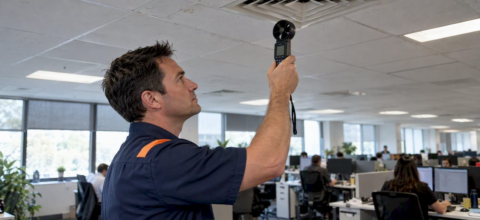
Install CO₂ monitors in occupied zones. The GOV.UK standard recommends readings below 800 ppm as a signal of good ventilation. Readings above 1,500 ppm indicate a serious deficiency that needs immediate attention. Place monitors at seated breathing height, not near windows or vents where readings will be artificially low.
-
Replace HVAC filters on schedule. A clogged filter restricts airflow and forces your system to work harder while delivering less fresh air. For most residential systems in New York and New Jersey, filter replacement every 60 to 90 days is appropriate. Commercial systems with higher occupancy loads may require monthly checks.
-
Schedule professional duct cleaning at regular intervals. Dust, debris, and microbial growth inside ductwork reduce airflow and reintroduce contaminants into the air stream. Following a vent cleaning schedule matched to your building type keeps the system performing as designed.
-
Ventilate strategically during and after cleaning. The US EPA recommends opening windows and doors during cleaning while avoiding periods of high outdoor air pollution or extreme weather. In New York City and northern New Jersey, check AirNow.gov before opening windows on high-ozone days in summer.
-
Conduct airflow checks after any renovation or system modification. Sealing gaps, adding rooms, or changing ductwork layouts can disrupt the original airflow balance. A qualified HVAC technician should verify that supply and return air volumes remain balanced after any significant change.
Pro Tip: Single-point CO₂ sensors can miss spatial variability in larger rooms. In spaces over 1,000 square feet, place sensors in at least two locations to get an accurate picture of ventilation distribution.
What is the role of ventilation in workplace and facility safety?
Ventilation in workplaces and large facilities carries regulatory weight that residential settings do not. OSHA requires employers to control employee exposure to airborne chemical contaminants, and ventilation is the primary engineering control for meeting those requirements. Facility managers who rely on personal protective equipment alone, without addressing ventilation, are not in compliance with OSHA’s hierarchy of controls.
The design details matter as much as the system capacity. Research confirms that ventilation system effectiveness depends on proper installation, testing, and alignment with the source location, especially for hazardous gas removal. A system that moves the right volume of air but exhausts it from the wrong location can leave a contaminated zone untouched while the rest of the building reads clean on sensors.
| Facility type | Primary ventilation concern | Recommended approach |
|---|---|---|
| Commercial kitchen | Grease, combustion gases, heat | Dedicated exhaust hood, makeup air unit |
| Warehouse or storage | Dense gas accumulation, fumes | Low-level exhaust, perimeter supply |
| Office building | CO₂, VOCs, biological aerosols | Demand-controlled ventilation with CO₂ sensors |
| Retail space | Occupancy spikes, cleaning chemicals | Increased outdoor air during peak hours |
| Medical or dental office | Pathogen aerosols | HEPA filtration plus enhanced air exchange |
Balancing ventilation rate with energy use is a genuine challenge for facility managers in New York, New Jersey, and Connecticut, where heating and cooling costs are significant. Demand-controlled ventilation systems, which modulate outdoor air intake based on real-time CO₂ readings, address this directly. They deliver more fresh air when occupancy is high and reduce it when the space is empty, cutting energy waste without compromising safety.
For facility managers overseeing multiple properties, the ventilation systems guide from Amazonairpro provides a practical framework for evaluating system performance across different building types. Verifying that each system’s exhaust placement, supply direction, and air exchange rate match the actual contaminants present in that space is the standard that separates compliant facilities from genuinely safe ones.
Pro Tip: Before signing off on any new ventilation installation in a commercial space, request a commissioning report that documents measured airflow rates at each supply and return grille. Specifications on paper do not guarantee performance in the actual building geometry.
Key takeaways
Proper ventilation is the single most effective engineering control for maintaining safe indoor air quality in homes, offices, and facilities across New York, New Jersey, and Connecticut.
| Point | Details |
|---|---|
| CO₂ is your benchmark | Readings below 800 ppm indicate adequate ventilation; above 1,500 ppm requires immediate action. |
| Exhaust placement determines effectiveness | Low-level exhaust captures dense gases that ceiling returns miss entirely in garages and basements. |
| Air cleaners supplement, not replace | Portable HEPA units reduce particles but cannot lower CO₂ or substitute for fresh outdoor air exchange. |
| Occupancy density changes the math | High-density spaces need more outdoor air per person than standard ASHRAE 62.1-2022 minimums provide. |
| Maintenance keeps performance real | Filter replacement, duct cleaning, and airflow verification prevent systems from degrading silently over time. |
What I’ve learned about ventilation that most building owners miss
After years of working with homeowners and facility managers across the tri-state area, the pattern I see most often is this: people invest in a ventilation system, assume it works, and never verify it again. The system gets a passing grade on paper at installation, and then filters clog, ducts accumulate debris, and airflow drops by 30 percent over three years without anyone noticing. The CO₂ levels climb. Occupants feel sluggish or get sick more often. The building owner blames the season.
The uncomfortable truth is that ventilation performance degrades quietly. You cannot see reduced airflow the way you can see a leaking pipe. This is why CO₂ monitoring is not a luxury for schools and hospitals. It is a practical tool for any occupied building, including your home or office in New York or Connecticut.
I also want to push back on the air purifier trend. Portable HEPA units are genuinely useful for particle reduction, and I recommend them in specific situations. But I have seen too many building owners treat them as a complete solution while keeping windows sealed and ducts uncleaned. That is not a safety strategy. It is a false sense of security.
The other thing worth sitting with for a moment is outdoor air quality. Ventilating with polluted outdoor air on a high-ozone day in northern New Jersey is not automatically better than recirculating filtered indoor air. The EPA’s AirNow platform gives you real-time air quality data by zip code. Use it before deciding to open windows during a ventilation boost.
Proactive maintenance, real-time monitoring, and design verification are the three practices that separate buildings with genuinely safe air from buildings that only look compliant on paper.
— Victor
Keep your ventilation system performing at its best

Understanding the importance of ventilation is the first step. Keeping your system clean and functional is what actually protects the people inside your building. Blocked or contaminated air ducts reduce airflow, reintroduce pollutants, and undermine every other safety measure you have in place. Amazonairpro provides professional air duct cleaning and dryer vent cleaning for residential and commercial properties across New York, New Jersey, and Connecticut. Our team has over 10 years of experience verifying and restoring ventilation performance in buildings of all sizes. If your system has not been inspected in the past two years, that is a gap worth closing. Contact Amazonairpro to schedule a cleaning and airflow assessment for your property.
FAQ
What does ventilation do for indoor safety?
Ventilation supplies fresh outdoor air and removes stale, contaminated indoor air, diluting airborne pollutants, pathogens, and chemical byproducts before they reach harmful concentrations. The US EPA identifies air exchange rate as the primary factor controlling indoor pollutant levels.
What CO₂ level signals poor ventilation?
CO₂ readings above 1,000 ppm during normal occupancy indicate that ventilation is insufficient for the number of people present. GOV.UK guidance recommends keeping levels below 800 ppm as a benchmark for good ventilation in occupied spaces.
Can an air purifier replace proper ventilation?
No. Air cleaning units reduce airborne particles but do not lower CO₂ or substitute for fresh outdoor air exchange. They are supplementary tools that work alongside ventilation, not replacements for it.
How often should air ducts be cleaned to maintain ventilation safety?
Most residential systems benefit from professional duct cleaning every three to five years, while commercial buildings with higher occupancy or contaminant loads may need more frequent service. Regular cleaning prevents debris buildup that restricts airflow and reintroduces contaminants.
Does ventilation design matter for workplace chemical safety?
Yes, significantly. For gases denser than air, low-level exhaust placement captures contaminants far more effectively than ceiling-mounted returns. OSHA requires ventilation as a primary engineering control for chemical exposure, and the design must match the specific contaminants present in the space.
Recommended
- The role of ventilation in indoor health: a property owner’s guide – Amazon Air Duct Cleaning
- Why Maintain Vents? Health, Safety, and Efficiency Insights – Amazon Air Duct Cleaning
- Ventilation systems explained: a practical guide for healthier indoor air – Amazon Air Duct Cleaning
- Why Vent Hygiene Matters for Healthier Homes – Amazon Air Duct Cleaning