Hotel Dryer Vent Maintenance: A Practical Guide for NY, NJ and CT
Hotel dryer vent maintenance comes down to three habits: staff clean the lint screens every load, someone inspects the duct and exterior hood on a schedule, and a trained technician cleans the full vent run from dryer to rooftop or wall termination. Skip any of the three and lint builds up where you can’t see it, which hurts dryer performance and raises fire risk.
This guide is for general managers, engineers, facility managers and property managers running hotels, inns and extended-stay properties in New York, New Jersey and Connecticut. It covers what to check, how often, what goes wrong in commercial laundry rooms, and how to judge a contractor.
TL;DR
- Lint screens should be cleaned by staff before or after every load. That is the cheapest fire-prevention step you have.
- The vent run behind the dryers is the part nobody sees. It needs a scheduled professional cleaning, and busy hotels need it more often than a household does.
- Rigid metal duct, smooth joints (no protruding screws), short straight runs and a clear exterior hood are the basics of a safe system.
- Slow drying cycles, hot laundry rooms and a burning smell are early warnings. Treat them as maintenance tickets, not annoyances.
- Keep a written log of cleanings and inspections. It helps with insurers, fire inspectors and staff turnover.
Table of Contents
- Why hotels face a bigger dryer vent problem than homes
- The maintenance routine, from daily to annual
- What a safe hotel dryer exhaust system looks like
- Professional cleaning: what to expect
- How to judge a dryer vent contractor
- Our perspective: where hotel vents go wrong
- Our dryer vent and commercial services
- A simple annual plan for your property
- Compliance: what to check locally
- FAQ
- Sources
Why hotels face a bigger dryer vent problem than homes
A household runs a dryer a few times a week. A hotel laundry room can run machines for hours every day, with towels, sheets and robes that shed a lot of lint. That lint travels into the exhaust duct, and anything that slows airflow lets it settle.
The national numbers are mostly about homes, but they show the scale of the risk. The U.S. Consumer Product Safety Commission reports that clothes dryer fires average 6,400 fires, 180 injuries and $105 million in property damage a year. The Department of Energy’s venting guide puts the figure at about 15,000 dryer fires a year and 10 to 20 deaths in the United States. The two sources count differently, so don’t add them together. Both point the same way.
A hotel adds two things a house doesn’t. First, guests and staff sleep or work in the building around the clock, so a fire in a laundry room is a life-safety event, not only a property loss. Second, a fire or a forced shutdown takes your laundry offline when rooms still need turning over.
The U.S. Fire Administration notes that you are at higher risk of a dryer fire if you don’t clean your lint filter and dryer vents. It also says blockage can come from nests of small birds or other animals, or from damage to the venting system itself, not only from lint. That matters for rooftop and rear-wall terminations on older Northeast buildings.
The maintenance routine, from daily to annual
There is no single schedule that fits every property. A 40-room inn with one on-premises washer-dryer pair is different from a 300-room hotel with a full laundry and several large dryers. The tiers below are a sensible starting point. Adjust them with your engineer, your insurer and your local fire official.
| Frequency | Task | Who |
|---|---|---|
| Every load | Clean the lint screen, remove lint from the screen housing | Laundry staff |
| Daily | Check that dryers dry in one normal cycle, and that the area around each dryer is clear of linen piles, boxes and chemicals | Laundry lead |
| Weekly | Look at the exterior hood: flap opens freely, nothing covers it, no nesting material | Maintenance |
| Monthly | Check duct joints and connections you can reach, and feel for hot spots or lint leaking at seams | Maintenance or engineer |
| At least yearly, more often for heavy use | Full professional cleaning of the entire exhaust run, with airflow check | Qualified contractor |
| After any change | Re-inspect after dryer replacement, rerouting, a booster fan install or building renovation | Engineer and contractor |
For homes, we explain the logic behind frequency in our guide on how often to clean a dryer vent. A hotel simply sits at the heavy end of that range.
Daily habits that staff can actually keep
The U.S. Fire Administration’s safety message is simple: clean out the lint filter before you use your dryer. In a hotel, “before” and “after” matter less than “every time, without exception.” Build it into the laundry procedure and the shift checklist, and make one person responsible for each shift.
Two more habits cost nothing. Keep the area around each machine clear of anything that can burn. The National Fire Protection Association says to keep boxes, cleaning supplies and clothing away from the dryer. And in our region, check that the outdoor vent flap isn’t blocked by snow after a storm. NFPA flags that too.
What to watch for between cleanings
Common signs that airflow is dropping:
- Loads need two cycles to dry, or towels come out damp at the seams.
- The laundry room is hotter and more humid than usual.
- The dryer or its exterior surface feels unusually hot.
- You smell something scorched.
- Lint collects around the dryer or the exterior hood.
- The exterior flap barely lifts when the dryer runs.
We list the household version in five warning signs your dryer vent is a fire hazard. The same signals apply to commercial machines. A hotel that treats “it takes longer to dry” as a maintenance trigger usually catches problems before they become hazards, and it saves energy too.
What a safe hotel dryer exhaust system looks like
Cleaning only works if the duct is built to be cleaned and to move air. Hotel laundry rooms often get altered over the years: a dryer is replaced, a wall is moved, a run is extended. Each change is a chance for a weak point.
Rigid metal duct, smooth inside
The Department of Energy’s job aid for venting a dryer calls for rigid or semi-rigid metal duct and fasteners that don’t penetrate into the duct, and says to keep the run as short and straight as possible so lint doesn’t back up. Plastic or foil accordion transition ducts are the usual offenders in older installs. If you find one, replace it.
The screw problem
Many operators assume that any metal duct is a safe duct. It isn’t. Sheet-metal screws used to join sections poke into the airflow and snag lint, and the DOE guidance cited above specifically says no screws penetrating into the duct. Foil tape or rivets avoid the problem, though they can make later disassembly harder. That is a real tradeoff. Talk to your contractor about access points, so the system can be cleaned without cutting it apart each time.

Long runs and booster fans
Commercial dryers in hotels often sit far from an exterior wall, and long runs go beyond the lengths typical for a household unit. The DOE guide discusses limits on duct length and the use of booster fans for longer runs. Two cautions from field experience:
- Don’t add a booster fan to a duct that is already lint-packed. Clean first, then boost.
- Match the fan to the actual run and the dryer. An oversized or mismatched fan can push lint into compacted layers farther down the line.
If you’re planning a laundry upgrade, have the exhaust path reviewed by your mechanical engineer before the new equipment goes in.
The exterior termination
The hood or louver should open freely, have no screen that catches lint, and stay clear of vegetation, snow, ice and nests. On a hotel roof or a rear service alley, it is easy to forget. Put it on the maintenance walk-around.
Professional cleaning: what to expect
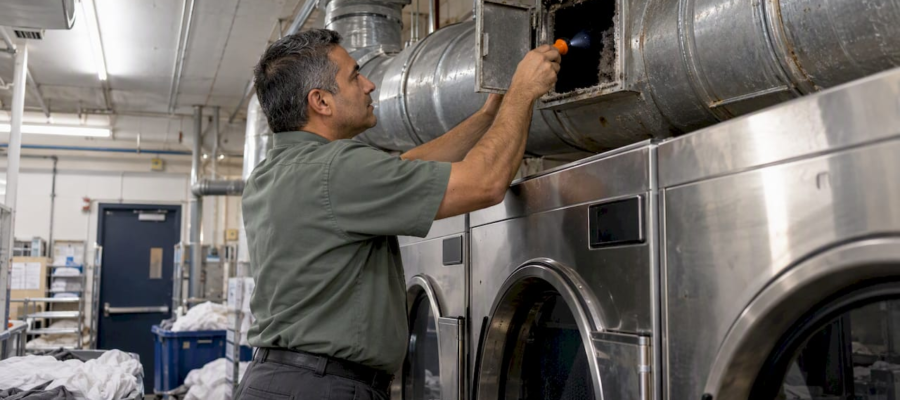
Staff can handle lint screens and visual checks. The duct itself needs a technician with the right tools, because the buildup you can reach from the dryer is only the front end of the problem.
A proper commercial dryer vent cleaning visit generally includes:
- Walkthrough and access check. The technician traces the run from each dryer to the termination and notes materials, joints, turns and length.
- Disconnecting the dryer from the duct and protecting the surrounding floor and linen.
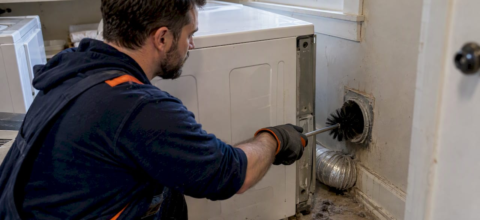
- Mechanical cleaning of the full duct with rotary brushes and a high-powered vacuum, working from one end and confirming from the other.
- Cleaning the dryer’s own exhaust path and the lint chamber where reachable.
- Exterior hood cleaning and check, including flap movement.
- Reconnection and airflow check at the exhaust.
- Written report of what was found, what was done and what should be corrected.
Ask for the report. It is the record you will want if an insurer or inspector asks when the system was last serviced.
Scheduling around occupancy
A hotel can’t shut its laundry for a day during a weekend sellout. Plan the work for a slower midweek window, and if you have several dryers, ask whether the job can be staged so some machines stay in service. For multi-dryer systems that share a common exhaust, the whole system may need to be down at once, so plan for that.
How long does it take?
It depends on the number of dryers, the length of the runs, access and how much buildup there is. A single short run is a much smaller job than a multi-dryer system running up through several floors. A reputable contractor should look at the layout before quoting, not give a flat answer over the phone.
How to judge a dryer vent contractor
In the hospitality trade, you will hear lots of promises. These are the points that separate a legitimate contractor from a risky one:
- Commercial experience. Ask how many hotels, multifamily buildings or commercial laundries they have serviced, and in what area.
- Technician certification. Ask what training and certifications the technicians hold, and ask to see proof rather than take a verbal answer.
- Insurance. Request a certificate of insurance before anyone enters the building.
- Scope in writing. The quote should say which dryers, which runs, whether the roof termination is included and what the report covers.
- A cleaning method that reaches the whole run. If the answer is “we vacuum the lint trap area,” that is a red flag.
- Willingness to flag problems. A trustworthy tech will tell you about crushed duct, screws in the airflow or a bad termination, even when that means more work for someone else.
- Clear pricing. Be wary of unusually low flat quotes that don’t mention the number of dryers or the run length.
One more option to consider is whether your hotel outsources linen to a commercial laundry. For properties that send towels and sheets out, a hotel linen and laundry service takes the dryers off your property entirely. Many hotels still keep on-premises machines for guest items, staff uniforms or spa linens, and those machines still need their vents maintained.
Our perspective: where hotel vents go wrong
We clean dryer vents for homes and commercial properties across New York, New Jersey and Connecticut, and we have more than 10 years of experience doing it. Here is what we think hotel managers most often get wrong.
They treat the lint screen as the whole system. A clean screen is good. It doesn’t tell you what’s in 40 feet of duct behind the wall.
They fix symptoms instead of causes. When dryers slow down, the first reaction is often to call a repair tech for the dryer. Sometimes the dryer is fine and the duct is restricted. Checking the exhaust first can save a service call.
They don’t keep records. When engineering staff change, the history of the vent system leaves with them. A simple log with dates, locations and what was found keeps the next person informed.

They accept shortcuts at install. Flexible plastic transitions, screws through the duct, and a termination blocked by shrubs or snow are all fixable. They are much easier to fix before there is a problem.
We would rather tell you your system is in good shape than sell you a cleaning you don’t need. If the report shows a design problem, such as a very long run or a crushed section, we will say so plainly and explain the options.
— Victor
Our dryer vent and commercial services
If you manage a property in the tri-state area and want the vent run inspected and cleaned, our team handles professional dryer vent cleaning for residential and commercial buildings. Hotels with ducted HVAC can also pair it with commercial air duct cleaning, so both systems are on one schedule. If you’re in New York or New Jersey, you can start at our dryer vent and air duct services page for NJ and NY. We don’t publish fixed prices, because the cost depends on the layout, so we recommend asking for a site-specific quote.
A simple annual plan for your property
Here is a plan you can adapt:
- January to February: Check exterior hoods after storms for snow and ice. Review last year’s cleaning report.
- Spring: Schedule the professional cleaning for a low-occupancy week, and confirm scope in writing.
- Summer: Inspect for nests and vegetation near terminations, as birds are most active then. Review staff training for new seasonal hires.
- Fall: Check dryer performance before the holiday rush, when linen volume is highest. If dryers are slowing, book a mid-year cleaning rather than waiting.
- Always: Log every inspection, cleaning and repair. Keep the contractor’s reports in one binder or shared folder.
For a deeper look at the risks, our article on dryer vent fire hazards walks through how lint ignites, and our dryer vent safety procedure covers the step-by-step basics.
Compliance: what to check locally
Fire and building rules for commercial laundry exhaust vary by state, city and even by building type and age. New York City, New York State, New Jersey and Connecticut all have their own adopted codes and local enforcement. We can’t tell you which section applies to your building, and we won’t guess. Ask your local fire marshal or code official what they inspect, and ask your insurer what documentation they expect. Then keep your cleaning reports on file so you can show them.
FAQ
How often should a hotel dryer vent be cleaned?
There is no one-size answer. As a rule, a full professional cleaning at least once a year is a reasonable baseline, and hotels with heavy daily laundry volume often need it more often. Performance is the best guide: if dryers slow down, don’t wait for the calendar. Confirm any required interval with your insurer and local fire official.
What do professionals use to clean a dryer vent?
Technicians typically use rotary brushes on flexible rods, powerful vacuums and sometimes compressed air, along with tools to clean the exterior hood. The goal is to clear the whole run, not only the section near the dryer. For longer commercial runs, ask how the contractor reaches and confirms the far end.
How long does a professional dryer vent cleaning take?
A short single run can be quick, while a multi-dryer system with long duct runs takes considerably more time. The layout, access points and amount of buildup all matter. A good contractor will review the setup before giving you a time estimate.
What are the signs a hotel dryer vent needs attention now?
Watch for loads that need more than one cycle, a hot laundry room, a hot dryer exterior, a scorched smell, visible lint around the machine or hood, and an exterior flap that barely opens. Any of these is a reason to inspect the vent soon. If you smell burning, stop the dryer and have it checked before using it again.
Sources
- CPSC: annual clothes dryer fire statistics
- U.S. Department of Energy: Dryer Venting
- U.S. Department of Energy: Vent a Clothes Dryer job aid
- U.S. Fire Administration: Clothes Dryer Fire Safety
- U.S. Fire Administration: Clothes Dryer Fires in Residential Buildings
- U.S. Fire Administration: Keep Dryer Lint Filters Clean
- NFPA: Clothes Dryer safety tips
Recommended
- Apartment Dryer Vent Maintenance: A Guide for NY, NJ and CT
- Dryer Vent Clogs: Why Roof Vents Need a Pro in NY, NJ & CT
- NY/NJ/CT Property Managers: Pass IMC 504.11 for Multi Unit Dryer Vents
- Dryer vent safety procedure: 5 essential steps