Co-op Dryer Vent Rules in NYC: What Shareholders Need to Know
In a New York City co-op, two sets of rules govern your dryer vent. The first is the city’s Mechanical Code, which says how a dryer must exhaust. The second is your building’s own paperwork (proprietary lease, house rules and alteration agreement), which says whether you may install or change anything at all. Both apply at once, and the stricter one wins in practice. Below we walk through what each requires, where shareholders usually get stuck, and how to keep a vent compliant and clear.
TL;DR
- Check your house rules and alteration agreement first. Some co-ops ban in-unit dryers outright, and others require advance notice to the managing agent for any change.
- NYC Mechanical Code section 504 requires a dryer to exhaust to the outdoors through its own duct, with a narrow exception for listed and labeled condensing (ductless) electric dryers.
- Rules differ for a single dryer and a shared system: a backdraft damper for one, none for multiple dryers, and a cleanout opening in common shafts.
- Responsibility depends on your lease. Shareholders typically own apartment appliances and fixtures, while the co-op owns standard building systems.
- Have the vent cleaned on a schedule, and tell the managing agent first if the work touches anything shared.
Table of Contents
- Who decides: the board, the code, or both
- What the NYC Mechanical Code requires
- Ducts, length and termination
- Walls, floors and fire-rated assemblies
- Individual versus shared vent systems
- Who is responsible when a vent is blocked or fails code
- Keeping a co-op vent clean and compliant
- Before you ask your board: a short checklist
- Dryer vent cleaning for co-op owners and managers
- FAQ
- Sources
Who decides: the board, the code, or both
The city code sets the minimum. Your co-op can add to it, and often does. There is no single citywide co-op dryer rule, because each corporation writes its own house rules and alteration agreement. The examples below come from real buildings’ published documents and show the range you may meet.
- Permission with conditions. One Fifth Avenue building’s alteration agreement allows kitchen, bathroom and clothes dryer vents through an existing window opening only as permitted and required by NYC codes, with the location subject to approval by the co-op’s professionals.
- Do not touch existing vents. A West 23rd Street co-op’s alteration package says exhaust vents may not be interfered with, sealed, or used for additional venting apparatuses or dryers. It also requires licensed technicians and permits submitted to the managing agent before work is scheduled.
- An outright ban. The house rules at 67-40 Booth strictly prohibit installing any washing machine or dryer in an apartment.
- Notice first. Another West 23rd Street building’s house rules require shareholders to contact the managing agent in advance of planned repairs, alterations or improvements, so the work complies with the co-op’s guidelines and Department of Buildings regulations.
The pattern is consistent. Even in buildings that allow dryers, the board or its engineer usually controls where a vent can go and who may install it. So the first step is never a purchase. It is reading your documents and asking the managing agent.
City rules also do not disappear because a job is small. The Department of Buildings notes that work exempt from a permit does not excuse compliance with any other law or rule it enforces. A board can therefore require approval even where the city requires no permit.
What the NYC Mechanical Code requires
Dryer exhaust is covered by section 504 of the NYC Mechanical Code. In plain terms:
- Dryers must be exhausted in accordance with the manufacturer’s instructions.
- The dryer exhaust system must be independent of all other systems. You cannot tie it into a bathroom fan or kitchen hood duct.
- It must carry moisture, and any products of combustion for a gas dryer, to the outside of the building.
- The one exception is a listed and labeled condensing (ductless) electric dryer.
That exception matters in co-ops where a vent path is impractical. Department of Buildings guidance, as summarized in the research we reviewed, clarifies that only listed and labeled electric dryers may be exempt from exhausting outdoors. A ventless unit that is not listed and labeled as a condensing dryer does not qualify. Because many boards ban or restrict in-unit dryers anyway, confirm board approval for any model, ventless included.
Gas dryers raise the stakes. The Department of Buildings’ Directive 14 of 1975 says ventilation and exhaust requirements for gas dryers are governed by several code provisions, including sections 504 and 701.2 of the Mechanical Code. A gas line and a dryer vent in the same alteration is a job for a licensed professional and your building’s engineer.
For a wider look at city and state requirements, see our guide to the New York dryer vent code.
Ducts, length and termination
Once a dryer is allowed, the physical details decide whether it passes. The code covers these points.
Duct material, size and support
Under section 504.8:
- Ducts need a smooth interior finish.
- They must be metal at least 0.016 inch thick.
- They must be 4 inches nominal in diameter unless the dryer manufacturer requires larger.
- They must be supported at 4-foot intervals and secured in place.
- Ducts serving a single appliance cannot be joined with screws or similar fasteners that protrude more than 1/8 inch into the duct, because protruding screws catch lint.
Transition ducts and length
The flexible connector between the dryer and the wall is a transition duct. The Mechanical Code limits listed transition ducts (UL 2158A) to 8 feet and bars concealing them. The same section sets a 35-foot maximum from the transition-duct connection to the outlet terminal, reduced for fittings such as elbows. In a pre-war building with a long run to an exterior wall, every bend eats into that allowance. A vent that was acceptable in theory can fail in practice if it was routed with several tight turns.

Termination
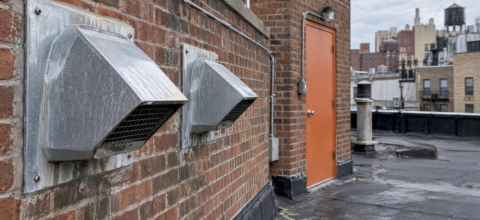
Exhaust ducts must terminate outside. For a single dryer, section 504.4 calls for a backdraft damper. Screens are prohibited at the termination because lint clogs them quickly. Many shareholders are surprised by that last point, since homeowners often add mesh to keep birds out. Our article on the dryer vent bird guard code in NYC covers what is allowed.
Walls, floors and fire-rated assemblies
Co-op buildings are full of fire-rated construction, so a dryer duct often crosses something that matters. Under section 504.2:
- Where the duct passes through a wall or ceiling membrane, the gap around it must be sealed with noncombustible material, approved fire caulking, or a noncombustible dryer exhaust duct wall receptacle.
- A duct may not penetrate or sit within fireblocking, draftstopping or a fire-resistance-rated assembly unless it is galvanized steel or aluminum of the specified thickness and the assembly’s fire rating is maintained.
- Fire dampers, combination fire/smoke dampers and similar devices that obstruct exhaust flow are prohibited in the dryer duct.
This is why boards ask for professional installers and sometimes their own engineer’s sign-off. Cutting through a rated wall without restoring the rating is a building-wide safety problem, not just a private one.
Individual versus shared vent systems
Many co-ops have a common exhaust shaft or a central laundry exhaust instead of a vent per apartment. The rules shift accordingly.
| Feature | Single dryer | Multiple dryers or common shaft |
|---|---|---|
| Backdraft damper | Required at termination | Not to be installed (section 504.4) |
| Independence | Separate from other systems | Serves only dryers, independent of other exhaust |
| Fire protection | Maintain rating where penetrating assemblies | Fire-resistance-rated shaft, no dampers or subducts |
| Duct material | Metal, 0.016 inch minimum | Rigid metal, minimum 0.0187 inch (No. 26 gage) sheet steel |
| Access | Practical access for cleaning | Cleanout opening at least 12 by 12 inches |
For common multistory systems, section 504.10 adds more. Branch ducts of 20 square inches or less can connect without fire dampers if the exhaust fan runs continuously. Branches larger than 20 square inches may not connect to the shared system at all. The shaft also needs a cleanout opening of at least 12 by 12 inches at the base and at every offset and change of direction, specifically so the system can be cleaned and inspected.
If your building has a shared system, you cannot fix a problem in your unit alone. A clogged riser affects the neighbors above and below you. Property managers dealing with this will find more in our guide to multi-unit dryer vents.
Who is responsible when a vent is blocked or fails code
Responsibility comes from your proprietary lease and house rules, so read those first. A representative example: the house rules at 67-40 Booth make the shareholder responsible for plumbing, exposed gas fixtures and equipment, and all appliances in the apartment. A legal digest of 2017 decisions describes the Goldenberg case, in which a lease provision making a shareholder responsible for fixtures and equipment they or a prior lessee installed was enforced according to its plain meaning.
In practice that suggests a simple division, though your own lease controls:
- Likely yours: the dryer, the transition duct behind it, any vent you or a previous owner installed or altered.
- Likely the co-op’s: common shafts, risers and standard building equipment inside walls, ceilings and floors.
- Gray area: a vent that was altered years ago by a previous shareholder. Your lease may make you responsible for it even if you never touched it.
The house rules at 240 West 23rd Street add a point worth sitting with. If the co-op performs a repair that turns out to be the shareholder’s responsibility under the lease, the shareholder pays for it. Telling the managing agent early, and getting a written answer on who owns the problem, avoids a surprise bill. Renters in other building types should see our overview of landlord dryer vent responsibilities.
Keeping a co-op vent clean and compliant
Code compliance is about how the vent is built. Safety depends just as much on whether lint has accumulated since. A few habits help:
- Clean the lint screen after every load.
- Watch for longer drying times, a hot laundry room, or a musty smell. These suggest restricted airflow.
- Make sure the transition duct is not crushed behind the machine.
- Check the exterior termination for lint buildup or a stuck damper.
- Schedule professional cleaning on a regular cycle. Our guide on how often to clean a dryer vent explains how household size and run length affect timing.
In a shared system, cleaning is usually coordinated by the building so access to cleanouts and the roof fan is controlled. If you manage a building or sit on a board, our apartment dryer vent maintenance guide covers planning for NY, NJ and CT properties.
Before you ask your board: a short checklist
- Pull your proprietary lease, house rules and alteration agreement. Search for “dryer,” “vent,” “exhaust” and “appliance.”
- Ask the managing agent in writing whether in-unit dryers are allowed and whether a prior alteration exists in your unit.
- If you are buying, ask your attorney to confirm this before closing. Agents advising buyers will find it useful to raise the question early.
- Ask whether the building requires a licensed contractor, insurance certificates or an engineer’s review.
- Note whether your unit connects to a shared shaft and where the cleanout openings are.
- Keep copies of every approval and every cleaning record.
Our perspective
We clean dryer vents across New York, New Jersey and Connecticut, and co-op jobs are rarely just about lint. The first question we hear is usually “is this my problem or the building’s?” That is the right question, and the answer sits in your lease and the building’s records.
Our view is simple. Get the paperwork clear first, then have the vent cleaned by technicians who understand that a dryer duct is a fire-safety component. Our team has more than 10 years of experience with residential and commercial properties, and we hold our technicians to a strict certification standard.
For co-ops, that means we are comfortable working with managing agents, coordinating access, and keeping the job within the building’s rules. A clean, properly terminated vent is a small cost next to the problems a neglected one can create.
Victor
Dryer vent cleaning for co-op owners and managers
If your vent is due for cleaning, or you are preparing a unit for sale, our dryer vent cleaning service serves residential and commercial properties in New York, New Jersey and Connecticut. We can work with your managing agent on access and scheduling.

To get a quote or schedule an appointment, visit Amazon Air Duct Cleaning and tell us whether your building has individual vents or a shared shaft. That helps us plan the visit.
FAQ
Do I need co-op board approval to change my dryer vent?
In most buildings, yes in some form. Published alteration agreements and house rules show boards requiring advance notice to the managing agent, approval of the vent location by the co-op’s professionals, or a ban on the work. Check your own documents and ask the managing agent in writing before any contractor starts.
Can I use a ventless dryer in a NYC co-op?
The Mechanical Code exempts only listed and labeled condensing (ductless) electric dryers from exhausting outdoors. Your co-op’s house rules can still prohibit in-unit dryers, as at least one published set does. Get written board approval for the specific model first.
Can I put a screen or bird guard on the vent outlet?
The NYC Mechanical Code prohibits screens at dryer exhaust terminations, and a single-dryer termination needs a backdraft damper. Our bird guard code article explains what is allowed.
How long can a dryer vent run be?
The NYC Mechanical Code sets a 35-foot maximum from the transition-duct connection to the outlet terminal, reduced for fittings. Listed transition ducts are limited to 8 feet and cannot be concealed. Your dryer manufacturer’s instructions must also be followed, so check the manual.
Who pays if the shared dryer exhaust is clogged?
It depends on your lease and house rules. Common building systems are generally the co-op’s responsibility, while apartment appliances and fixtures you installed are generally yours. Ask your managing agent for the answer in writing.
Sources
- NYC Mechanical Code, Section 504: Clothes Dryer Exhaust
- NYC Mechanical Code, 504.8 Domestic clothes dryer ducts
- Common Multistory Exhaust Systems for Clothes Dryers
- NYC DOB Directive 14 of 1975
- NYC DOB Project Requirements for Owner Alterations, Residential
- 51 Fifth Avenue alteration agreement
- 300 West 23rd Street alteration package
- 67-40 Booth house rules
- 240 West 23rd Street house rules
- Significant Legal Decisions of 2017
Recommended
- New York Dryer Vent Code: What NYC and NYS Require
- Laundry Room Dryer Vent Code in NYC: What You Need to Know
- Landlord Dryer Vent Responsibilities in NY, NJ and CT
- NY/NJ/CT Property Managers: Pass IMC 504.11 for Multi Unit Dryer Vents