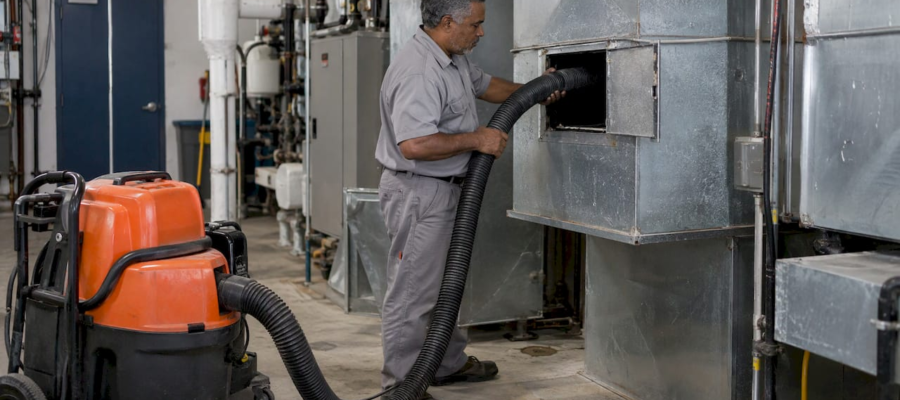
Commercial Duct Cleaning Requirements in NY, NJ and CT
No federal law tells a commercial building owner to clean HVAC ducts every so many months. What you face is a layered set of obligations: OSHA’s general duty to provide a safe workplace, fire codes for kitchen exhaust, public-building rules, and the specifications your insurer, lender or tenant puts in writing. Those layers decide what “required” means for your property. At Amazon Air Duct Cleaning we handle commercial air duct cleaning for New York, New Jersey and Connecticut properties, and the sections below are the framework we would walk a facility manager through.
TL;DR
- There is no general federal rule setting how often commercial ducts must be cleaned. OSHA’s indoor air quality guidance is advisory, but the General Duty Clause still requires a workplace free from recognized hazards.
- Commercial kitchen exhaust is different: it is regulated by fire codes, and in New York City the cleaning must be done by an FDNY-approved company.
- The industry benchmark is the NADCA ACR standard. Public and institutional buyers, such as NYCHA, write it into their contracts.
- Hire a contractor with a NADCA-certified ASCS supervising, general liability insurance, a written work plan and a cleanliness verification step.
- Keep the paperwork: work plan, photos, verification results and any report on areas that could not be cleaned.
Table of Contents
- Is commercial duct cleaning legally required?
- Where the real requirements come from
- The standard everyone points to: NADCA ACR
- What a qualified commercial contractor must show
- The work plan: what it should contain
- How often should commercial ducts be inspected and cleaned?
- Restaurants and commercial kitchens: a stricter set of rules
- Cleanliness verification: proving the job is done
- Records to keep after the job
- Where our team fits
- FAQ
- Sources
Is commercial duct cleaning legally required?
For ordinary office, retail, school or healthcare HVAC ductwork, the answer is generally no fixed schedule in federal law. OSHA has no general indoor air quality standard. Its guidance for commercial and institutional buildings is advisory and does not create new legal obligations. The same document points to the OSH Act General Duty Clause, which requires employers to give workers a workplace free from recognized hazards likely to cause death or serious physical harm.
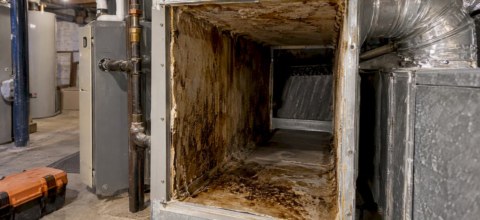
In practice, that means a duct system with visible mold, water-damaged insulation or heavy debris can become your problem even if no code names a cleaning interval. Documented inspections protect you if a tenant, employee or inspector raises a complaint.
Some states go further for specific buildings. New Jersey’s indoor air quality standard, N.J.A.C. 12:100-13, covers existing buildings occupied by public employees during regular working hours. If you manage a public-sector facility in New Jersey, that rule is the one to check first. Rules also exist elsewhere in the country, but for NY, NJ and CT properties the practical drivers are the ones below.
Where the real requirements come from
Most commercial properties end up with duct cleaning obligations from four places.
| Source | What it does | Typical effect on you |
|---|---|---|
| OSHA General Duty Clause | Requires a workplace free from recognized hazards | Obligation to act when ducts are a documented hazard |
| Fire code and NFPA 96 | Sets inspection and cleaning for kitchen exhaust | Mandatory schedule for restaurants and cafeterias |
| Contract specifications | Cites NADCA ACR and requires certified supervision | Binding on the contractor and the owner’s scope |
| Lease, insurance, lender terms | Require maintenance records | Records you must be able to produce |
The first row is the safety net, the second is hard law for kitchens, and the last two are where most facility managers feel the pressure day to day. Read your lease and your insurance policy before you assume nothing applies.
The standard everyone points to: NADCA ACR
The benchmark for how duct cleaning is done is NADCA’s ACR standard. The ACR 2025 edition defines minimum performance and procedural requirements for assessing, cleaning and restoring HVAC system components, and it is considered the standard of care for the industry. It supersedes earlier editions, so a spec that still cites an older version is worth updating.
ACR is not a statute. It becomes mandatory when a contract, a facility’s design guidelines or an inspector’s requirement cites it. New York City’s housing authority is a clear local example. Its HVAC air duct cleaning specification, issued November 2025, requires compliance with applicable federal, state and local rules and requires cleaning, inspection and remediation to follow NADCA ACR. Where ACR says “recommended,” “highly recommended” or “ideally,” the NYCHA contractor must do it unless it clearly does not apply.
If you bid on or manage work for public agencies, schools or hospitals in the region, expect similar language. Our guide to ACR duct cleaning specs for healthcare facilities in NY, NJ and CT goes deeper on the survey side.
What a qualified commercial contractor must show
NADCA’s own commercial checklist sets out the baseline: at least one certified Air Systems Cleaning Specialist (ASCS) on staff, general liability insurance, and an agreement to clean according to ACR. The NIH fact sheet on HVAC duct cleaning likewise recommends hiring a member in good standing of NADCA, noting that all members must have certified ASCS staff who passed the certification exam.
For larger or institutional jobs, the bar is higher. The NADCA 2021 General Specification asks for qualification statements covering membership status, project experience and certifications for the contractor, supervisor, inspector, hygienist and testing agency. It calls for a current NADCA member with experience on projects of similar size and complexity, with a NADCA-certified ASCS as supervisor. The University of Maryland’s Division 23 specification goes as far as requiring that the ASCS be employed full time by the contractor as supervisor.
Use this as a bid-review checklist:
- Certification: a named ASCS responsible for oversight of the project. ACR recommends that someone with ASCS or equivalent certification oversee any HVAC cleaning project.
- Insurance: a current certificate of general liability coverage.
- Experience: comparable commercial projects, not only residential work.
- Written work plan: delivered before work starts.
- Verification method: how the contractor proves the system is clean.
- Documentation: what you will hold at closeout.
Our own article on verifying the crew rather than the logo explains how to confirm certification for technicians who will actually be on your site.
The work plan: what it should contain
A written plan is the clearest sign that a job will be run properly. Under the NADCA 2021 General Specification, the contractor submits a work plan before commencing work that includes:
- the scope of work, identifying which HVAC components will be cleaned;
- itemized environmental engineering controls;
- detailed means and methods;
- names and contact information of every firm and contractor involved.
The ACR standard organizes the work around inspection, work plans, engineering controls, cleaning and restoration procedures, and cleanliness verification, the same sequence the NADCA commercial checklist follows.
Occupied buildings add a layer. NYCHA’s specification requires adequate controls or containment when parts of the facility stay occupied during cleaning, so unauthorized people cannot enter the spaces being cleaned. It also requires that if unforeseen mold or other biological contamination turns up, the architect is notified immediately with the areas affected and the extent and type of contamination. For a hospital wing, a school or a medical office, ask how the plan handles containment, scheduling around occupants and what happens if the crew finds growth they did not expect.
How often should commercial ducts be inspected and cleaned?
No single figure applies to every building, but the published guidance gives you a sound framework.
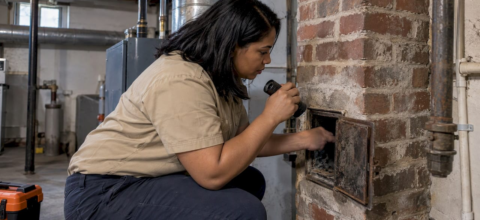
Inspection comes first. OSHA’s guidance recommends a written inspection and maintenance program, with routine inspection of ducts for debris and microbial growth semiannually. It also recommends provisions for cleanout within four feet downstream of duct expansions, and ductwork that is attached, not dented, with intact insulation that is dry and free of microbial growth.
ASHRAE sets minimums for maintenance. ANSI/ASHRAE/ACCA Standard 180-2018 establishes minimum HVAC inspection and maintenance requirements for commercial buildings. They include:
- semiannual inspection of grilles, registers and diffusers for dirt accumulation;
- annual inspection of exposed ductwork for insulation and vapor barrier integrity;
- annual inspection of internally lined ductwork within 20 feet of potential moisture sources for water damage and biological contamination.
Cleaning is triggered by condition. The NIH/DOHS fact sheet describes cleaning as appropriate for persistent water damage, observed slime or microbial growth, debris restricting airflow, dust discharging from supply diffusers, or offensive odors coming from ductwork or HVAC components. It adds an important point: cleaning should follow identifying and controlling the source of the contaminant. If a leak caused mold, fix the water source first, or cleaning is only temporary.
An inspection schedule on paper, with cleaning when conditions call for it, is easier to defend than an arbitrary calendar. Our 5 signs your air ducts need cleaning page lists visible indicators your maintenance staff can watch for between inspections.
Restaurants and commercial kitchens: a stricter set of rules
Kitchen exhaust is where “requirement” stops being a recommendation. Grease buildup in exhaust ducts is a fire hazard, so inspection and cleaning are set by fire code, built on NFPA 96, and enforced locally.

In New York City, FDNY certifies companies to clean commercial cooking exhaust systems. The certification is valid for one year, and Fire Code section 901.6.3.3 sets out the requirements. FDNY’s fire safety guide for commercial cooking locations states that cleaning of the exhaust ducts and components above the hood must be done by FDNY-approved licensed companies and their certified employees, while grease filters can be handled by a trained person. It lists minimums of inspection every three months and cleaning every six months, and notes that more frequent cleaning may be needed. It also tells owners to confirm the duct is cleaned to bare metal and to keep documentation, since an insurance company may ask for photos.

A step the law assigns to an authority or a licensed provider is part of the process, not a place to cut corners. Outside the city, your local fire marshal and insurer set the terms. Check with them for your town. Our restaurant HVAC duct checklist for NY, NJ and CT covers what inspectors tend to look at.
General HVAC ducts and grease exhaust are separate systems with separate rules. Kitchen exhaust is judged on combustible grease. Supply and return ductwork is judged on debris, moisture and microbial growth. Keep their service records separate.
Cleanliness verification: proving the job is done
A contractor saying the ducts are clean is not verification. ACR 2025 Section 5 covers it with a defined method. The NADCA Vacuum Test sets a passing criterion: the net weight of debris collected on filter media must not exceed 0.75 mg per 100 cm². Analysis is based on NIOSH Method 0500 for total nuisance dust, and results are reported in milligrams per 100 square centimeters (ACR 2025).
You do not need to run the test yourself. You need the specification to name the verification method before work starts, so that a pass or fail is not a matter of opinion. Visual verification with photos is common for routine jobs. Quantitative testing is more common in healthcare, labs and other sensitive settings.
Records to keep after the job
Documentation is what turns a completed cleaning into a compliance asset. ACR 2025 Section 5.6 says post-project documentation should be organized and legible, written and visual. If the NADCA Vacuum Test was used, include the lab results. If outside laboratories were used, add chain-of-custody documentation. Photos, HVAC plans and submittal forms for materials used are recommended. The NADCA 2021 General Specification adds warranties or guarantees and areas needing repair as closeout items.
For your ongoing program, ASHRAE 180 expects a maintenance plan that documents the work at scheduled intervals, describes each task and its frequency, names the responsible party and the authorizing party, and sets how completion is documented and monitored. Tasks are performed on the set frequency or when an unacceptable condition is documented.
For kitchens under NFPA 96, a certificate showing the servicing company, the person who did the work and the date must be kept on the premises, and the owner must receive a written report on areas that were inaccessible or not cleaned. Our guide on how to document duct cleaning gives a practical filing routine.
A simple closeout folder should hold:
- the signed work plan and scope;
- contractor insurance certificate and ASCS certification;
- before and after photos by section;
- verification results;
- a list of areas not accessible or needing repair;
- warranty or guarantee paperwork;
- your next scheduled inspection date.
Where our team fits
We serve commercial and residential clients in New York, New Jersey and Connecticut, with over 10 years of experience. For commercial properties we offer commercial air duct cleaning, along with evaporator coil and blower cleaning, condenser coil cleaning and antimicrobial and deodorizing duct system cleaning. Facility managers, property managers and business owners book us for scheduled work on offices, schools, healthcare facilities and other commercial buildings. Pricing is not published on our site, so the way to get a figure for your building is to request a quote.

If you are preparing a bid package or a lease compliance review, bring us the specification and we can help you match scope to what it requires. You can reach us through our commercial duct cleaning page for NY and NJ or from amazonairpro.com.
Our view on commercial duct cleaning requirements
Facility managers often ask us what the law says, and the honest answer is that for general HVAC ducts the law says very little. That does not make the question easy. Your real obligations come from the hazard standard, your lease, your insurer and any contract that cites NADCA ACR.
We think the right way to meet them is to treat the paperwork as part of the job. A building that has a written inspection program, a work plan, verified results and a closeout file is in a strong position with a tenant, an inspector or an insurer. That is how we approach commercial work: define the scope against the specification, clean to the standard the contract names, and give you records you can file.
Our team is built around certified technicians and over 10 years of experience in both commercial and residential buildings across New York, New Jersey and Connecticut. Where cleaning is called for, doing it under a written plan, with documentation, is what protects your occupants and your liability position.
Victor
FAQ
Is commercial duct cleaning required by law in New York, New Jersey or Connecticut?
There is no general federal schedule for cleaning commercial HVAC ducts, and OSHA’s air quality guidance is advisory. Binding requirements usually come from fire codes for kitchen exhaust, public-employee building rules such as New Jersey’s N.J.A.C. 12:100-13, and contracts that cite NADCA ACR. Check your lease, insurer and local fire marshal for your building.
How often should commercial ducts be inspected?
OSHA’s guidance recommends semiannual inspection of ducts for debris and microbial growth, and ASHRAE Standard 180-2018 sets semiannual and annual inspection tasks for different components. Cleaning follows what the inspection finds, such as water damage, microbial growth, restricted airflow or odors from the ductwork.
What certification should a commercial duct cleaner have?
Look for a NADCA-certified Air Systems Cleaning Specialist (ASCS) supervising the work, general liability insurance and an agreement to follow ACR. Larger specifications also ask for a written work plan and qualification statements for the supervisor and testing agency.
Are restaurant exhaust systems treated differently?
Yes. Kitchen exhaust is governed by fire code and NFPA 96 because of grease buildup. In New York City, the cleaning must be performed by an FDNY-approved company with certified employees, and you should keep the service certificate and any report on areas not cleaned.
What paperwork should I keep after a cleaning?
Keep the work plan, photos, verification results (including lab results if the NADCA Vacuum Test was used), warranty documents and a list of areas that were inaccessible or need repair. For kitchens, keep the on-premises service certificate as well.
Sources
- OSHA: Indoor Air Quality in Commercial and Institutional Buildings
- NJ indoor air quality standard reference (N.J.A.C. 12:100-13)
- NADCA ACR 2025 Standard
- NYCHA Section 23 01 30.51 HVAC Air Duct Cleaning
- NADCA Commercial Checklist
- NIH/DOHS Fact Sheet on HVAC Duct Cleaning
- NADCA 2021 General Specification
- University of Maryland Division 23 HVAC specification
- ANSI/ASHRAE/ACCA Standard 180-2018
- FDNY: Commercial Cooking Exhaust Certificates
- FDNY: Fire Safety in Commercial Cooking Locations
Recommended
- Vent cleaning for businesses: essential guide for NY, NJ, CT
- Pass Inspections: NADCA Restaurant HVAC Duct Checklist NY/NJ/CT
- Avoid Survey Failures: NADCA ACR-2021 Duct Cleaning Specs for NY/NJ/CT
- How to prepare for duct cleaning in NY, NJ & CT