Stop Cigarette Smell in Vents Without Ozone: NY/NJ/CT Homeowners’ Fix
The only fix that fully solves cigarette smell in vents is removing the smoking source or sealing the pathways that let smoke enter your ductwork. Until that happens, closing the affected registers, stopping the source if you can identify it, and running a portable HEPA purifier will cut your exposure. These steps help right away, but they manage the problem rather than end it.
TL;DR:
- Sealing entry points or the smoking source is essential for a permanent fix, as cleaning and filters alone do not eliminate cigarette odor.
- Identifying whether the smoke comes from inside your system or leaks in from outside guides whether cleaning, sealing, or both are necessary.
- Cigarette smoke residue can persist for days to weeks in ducts, especially on porous surfaces, and leaky ducts worsen recontamination issues.
- High-efficiency filters like HEPA with activated carbon stages address both particles and gases better than standard filters and are recommended for odor removal.
- Engaging a professional is advised if odor persists after DIY cleaning, especially with heavy deposits or suspected mold, to ensure a safe and thorough resolution.
Table of Contents
- Quick action checklist: what to do right now and within 24 hours
- Common causes: internal smoking versus outside intrusion
- Why smoke lingers in ducts long after the cigarette is out
- DIY cleaning steps for registers, grilles, and exposed duct sections
- What filters and air cleaners can and can’t fix
- Durable fixes: sealing ducts and balancing pressure for good
- When to call a professional and what to expect
- Health and safety: what CDC and ASHRAE guidance actually says
- A field perspective on what actually works
- How Amazon Air Duct Cleaning can help clear the air
- Sources
- FAQ
Quick action checklist: what to do right now and within 24 hours
Start by figuring out where the smell is strongest and when. Note which rooms it hits, what time of day it shows up, and whether it fades or lingers, because that pattern tells you a lot before you touch a single vent.
- Identify the source room or register where the odor is worst, and check if it tracks with your HVAC system running or someone else’s schedule.
- Close the supply registers and doors in the affected rooms to slow the spread while you investigate.
- Run a portable HEPA purifier with an activated carbon stage in the room, and keep windows cracked if weather allows.
- Temporarily seal obvious gaps around registers or duct boots with painter’s tape or foam weatherstripping as a short-term test, not a permanent repair.
- Write down when the smell appears, how strong it is, and any pattern with neighbors or shared systems. This log becomes useful if you need a professional diagnosis later.
Pro Tip: Take a phone photo of the register and duct opening before you seal anything. It gives a technician a clear before-and-after reference if the smell returns.
Common causes: internal smoking versus outside intrusion
Before you spend money on cleaning or sealing, figure out whether the smoke is coming from inside your own system or leaking in from somewhere else.
- Internal smoking residue shows up as a steady, localized smell tied to a specific room, closet, or piece of furniture, and it’s usually detectable even when the HVAC system is off.
- Intrusion from outside tends to get stronger only when the blower or return air runs, or it seems to match a neighbor’s schedule in an attached or multifamily building.
- Contaminated components such as a soiled filter, a dirty blower wheel, or dust-caked coils can hold old smoke residue and re-release the odor every time air moves across them.
Knowing which pattern fits your home narrows down whether you need cleaning, sealing, or both.
Why smoke lingers in ducts long after the cigarette is out
Cigarette smoke is not one substance. It’s a mix of ultrafine particles and gaseous volatile organic compounds (VOCs), and each behaves differently once it enters your ducts. Particles settle onto metal, insulation, and dust inside the system, while VOCs bond to duct linings, fabric, and other porous surfaces, a process called sorption.
Nicotine residue can persist on indoor surfaces for days to weeks, with one CDC-cited study finding it lasted around four days on glass and up to 16 days on terrycloth. That persistence is why a single cleaning often doesn’t erase the smell.
Leaky return ducts make the problem worse. When a return duct runs through an attic, crawlspace, or shared wall with gaps, pressure differences can pull contaminated air into the system and distribute it through every room the blower serves.

DIY cleaning steps for registers, grilles, and exposed duct sections
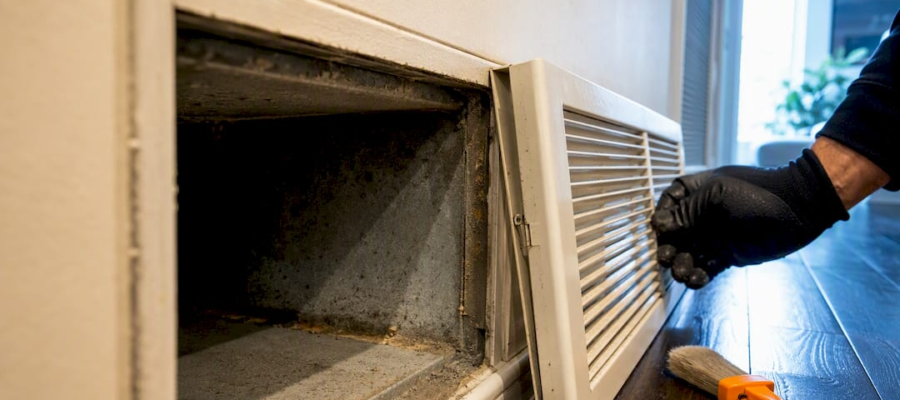
You can handle the parts of the system you can physically reach. Gloves, an N95 mask, a soft-bristle brush, a vacuum with a brush attachment, and a mild detergent or diluted vinegar solution are enough for most jobs.
- Remove the register or grille cover and vacuum both sides before wiping with the detergent solution, then dry it completely before reinstalling.
- Vacuum the first foot or two of visible duct or plenum through the opening, working from the outside in so you don’t push debris deeper into the system.
- Wipe return grilles and the surrounding wall or ceiling surface, since nicotine film often collects there too.
- Replace your filter after cleaning so it isn’t reintroducing residue you just removed.
Pro Tip: Skip bleach inside ductwork and skip aerosol deodorizers as your main strategy. Bleach can corrode metal components and doesn’t neutralize the VOCs causing the smell, and air fresheners just mask it temporarily.
What you can’t reach matters more than what you can. Internal coil surfaces and blower wheels often carry the heaviest residue, and getting to them safely calls for professional-grade equipment. If you’ve cleaned every accessible surface and the smell persists, that’s usually where it’s hiding. If you’d rather see how the process for other stubborn odors like pet smells in ducts compares, the techniques overlap closely.

What filters and air cleaners can and can’t fix
Filters and portable air cleaners help, but they’re often misunderstood. A MERV rating measures how well a filter traps particles of a given size, while HEPA is a specific, higher standard built for very fine particles.
- Low-MERV filters (MERV 1 to 4), the type in many basic residential systems, are largely ineffective against the sub-micron particles found in cigarette smoke.
- Higher-efficiency pleated filters capture more particulate matter, but mechanical filtration alone cannot control the gaseous VOCs responsible for the smell.
- Portable HEPA units with an activated carbon stage address both particles and odor-causing gases, and they work best placed near the source room and run continuously rather than intermittently.
Removing particles in the 0.5 micron range, the size common in tobacco smoke, generally requires filtration above the basic residential grade, according to ASHRAE’s filtration guidance. That single fact explains why a standard filter swap rarely solves a smoke odor complaint on its own.
Skip ozone generators entirely. They can break down some odor molecules, but reaching an effective concentration often exceeds safe indoor air limits and can form harmful byproducts. For more on portable setups that actually help, see our guide on how to purify air from smoke.
Durable fixes: sealing ducts and balancing pressure for good
Cleaning and filtration manage symptoms. Sealing the pathways that let smoke enter in the first place is what actually stops it from coming back.
- Manual sealing at register boots, duct joints, and air handler cabinets closes the most common entry points.
- Aerosolized duct sealing (an Aeroseal-style approach) can reach long or hard-to-access duct runs that manual sealing can’t, and Building America research shows most measurable leakage reduction happens at these register and handler junctions.
- Pressure mapping before and after sealing confirms the fix worked and didn’t create new problems elsewhere in the system.
Pro Tip: Any time ductwork is sealed significantly, ask for a combustion safety check on gas appliances. Changing pressure balance in a home can affect how furnaces or water heaters draft, and skipping this step is a real safety risk.
In multifamily buildings, sealing your own ducts sometimes isn’t enough if the intrusion comes from shared chases or a building-level ventilation issue. In those cases, relocating an intake or addressing the shared system may be the only lasting answer.
When to call a professional and what to expect
DIY cleaning and sealing tests have limits. Call a professional when the odor persists after you’ve cleaned every accessible surface, when you can see heavy deposits inside the ductwork itself, when the smell is coming from a neighbor’s unit, or when you suspect mold alongside the smoke odor.
- A credible inspection includes a visual walkthrough, scope photos of duct interiors, and pressure diagnostics to locate leaks.
- Expect a written quote listing the specific remedy, whether that’s sealing, cleaning, coil work, or antimicrobial deodorizing treatment.
- Ask about technician certification, NADCA membership, before-and-after documentation, and what any deodorizing product actually contains.
The EPA notes that duct cleaning hasn’t been shown to reliably prevent health problems on its own, so a quality contractor treats it as one part of a targeted plan, not a blanket cure.
Health and safety: what CDC and ASHRAE guidance actually says
No amount of ventilation or filtration fully replaces removing the smoking source. That’s a point worth sitting with, especially if children, older adults, or anyone with respiratory conditions share the home.
There is no safe level of exposure to secondhand smoke, and engineering controls like ventilation and filtration cannot reliably prevent smoke from traveling between rooms or units.
CDC
Temporary mitigations still matter for vulnerable occupants while a permanent fix is underway. If source control isn’t possible in your situation, prioritize sealing, filtration upgrades, and, where needed, relocating the affected person until the issue is resolved. Avoid unapproved ozone devices, and bring in a professional before making major changes to ductwork.
A field perspective on what actually works
In practice, sealing leaks and removing the smoking source together resolve most persistent re-entry cases, while cleaning alone only knocks down transient odor. The most common mistakes I see are homeowners relying on cheap filters to do a filter’s job and a sealant’s job at once, reaching for unsafe odor treatments like ozone machines, or sealing ductwork without checking combustion safety afterward. When you’re not sure which problem you have, a diagnostic inspection is the fastest way to find out.
— Victor
How Amazon Air Duct Cleaning can help clear the air
If you’ve tried the DIY steps and the smell keeps coming back, a targeted inspection usually finds what’s letting smoke in and how deep the residue actually goes. A local professional service serves homeowners across New York, New Jersey, and Connecticut with a full range of services suited to smoke odor problems.

- Air duct cleaning to remove accumulated deposits inside the system.
- Antimicrobial and deodorizing duct treatments aimed directly at odor-causing residue.
- UV light installation for ongoing indoor air support.
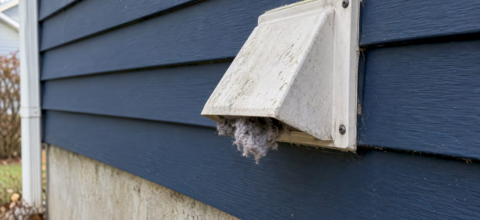
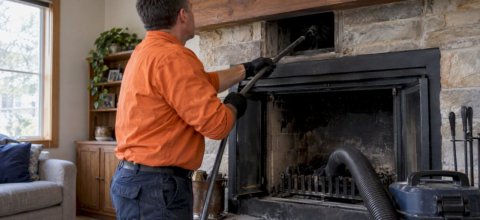
- Dryer vent and chimney cleaning for related ventilation concerns.
An inspection includes a visual review, scope photos, and a recommended plan built around what’s actually causing your smell, not a one-size-fits-all package. Request a quote through our air duct cleaning page and get a clear answer on what it will take to fix it for good.
This article is general information, not a substitute for advice from a qualified doctor. Consult a qualified healthcare professional about your own circumstances before acting on anything here.
Sources
- CDC — Secondhand smoke
- ASHRAE — Air cleaners and filtration guidance (chapter)
- EPA — Should you have the air ducts in your home cleaned?
FAQ
What smell can be mistaken for cigarette smoke?
A musty or sour odor from mold, mildew, or a dirty condensate drain can sometimes resemble stale smoke, especially in humid climates. An electrical or burning smell is different and calls for immediate attention rather than cleaning; our guide on HVAC burning smells covers that distinction.
Why does my house randomly smell like cigarettes?
Intermittent smoke smell often means intrusion from a neighbor’s unit through shared ductwork, walls, or pressure imbalances, and it tends to appear only when the HVAC system runs. It can also mean nicotine residue trapped in ducts or fabrics is re-releasing odor as temperature or humidity shifts.
What is the best HVAC filter to remove cigarette smoke?
A pleated filter paired with a portable HEPA unit that includes an activated carbon stage handles both the fine particles and the gaseous VOCs in smoke better than a basic filter alone. Low-efficiency filters (MERV 1 to 4) common in many systems are not built to catch particles this small.
Can mold in a house smell like cigarette smoke?
Yes, certain mold species produce a musty or acrid odor that some people describe as similar to stale smoke, particularly in damp basements or bathrooms. If cleaning doesn’t resolve the smell and you notice visible growth or moisture issues, that points toward mold rather than smoke residue.
Recommended
- Dead Animal Smell in Vents for NY/NJ/CT Homes
- Stop Chimney Smoke Backdrafts in NY, NJ, CT: 6 Quick Fixes
- Chimney Odor Elimination Steps for Homeowners
- How To Purify Air From Smoke