HOA Dryer Vent Requirements in NJ: What Applies to You
New Jersey has no single statewide law that sets a cleaning schedule for HOA and condo dryer vents. Two layers of rules apply instead: the state construction and fire codes, which govern how a vent is built and kept clear, and your association’s own governing documents, which usually set how often it is cleaned, who arranges it and who pays. If you own, buy, sell or manage a unit, you need both layers. Our team at Amazon Air Duct Cleaning cleans dryer vents in New Jersey for homeowners, property managers and facility managers, so this guide is written around the questions those readers bring to us.
TL;DR
- The state codes decide how a dryer vent is built: smooth metal duct, 4 inches wide, no protruding screws, no booster fans, and a 35-foot maximum length under the Mechanical Subcode.
- The Fire Subcode requires the lint trap and exhaust duct to be maintained so lint does not block the exhaust, but it sets no fixed cleaning interval.
- The cleaning interval usually comes from your association. Every two years is a common rule in published NJ condo policies.
- Your master deed decides whether the vent is a unit element (owner pays) or a common element (association pays).
- A properly adopted board policy can be enforced, including by court order if an owner refuses access.
Table of Contents
- Two layers of rules: state code and your association
- What the NJ codes require of the vent itself
- What the fire code requires: keeping it clear
- How often must an HOA dryer vent be cleaned?
- Who is responsible: the HOA or you?
- Can an NJ HOA require cleaning and enter your home?
- Practical steps for owners, buyers and agents
- For property managers and facility managers
- Our view as a dryer vent team
- Book a dryer vent cleaning for your unit or community
- FAQ
- Sources
Two layers of rules: state code and your association
Think of the state code as the minimum for the building and the association’s rules as the maintenance schedule on top of it.
The state layer is the Uniform Construction Code. New Jersey’s current construction codes are the 2024 editions of the I-Codes, according to the NJ Department of Community Affairs, which lists them as current as of August 17, 2026. The I-Codes are the model building, mechanical and fire codes that the state adopts and adjusts. The mechanical and fire subcodes are the ones that matter for a dryer vent.
The association layer is the master deed, bylaws and rules. Most association rules do not come from a statute. They come from the deed of restrictive covenants or the master deed, which empower the board to create and enforce rules. Because those documents are filed with the county clerk, owners are bound by them whether or not they have read them.
So when someone asks what the HOA dryer vent requirements are in NJ, the honest answer is: the code tells you how the vent must be built and kept clear, and your documents tell you the schedule.
What the NJ codes require of the vent itself
These are the build requirements an inspector, a buyer’s inspector or a technician will look at.
| Requirement | What the code says | Source |
|---|---|---|
| Duct material | Smooth-interior metal, at least 0.016 inch thick | NJ IMC 2024, Section 504 |
| Duct size | 4 inches nominal diameter | NJ IMC 2024, Section 504 |
| Support | Supported at 4-foot intervals | NJ IMC 2024, Section 504 |
| Maximum length | 35 feet, reduced for each fitting (elbows count as extra length) | NJ IMC 2024, Section 504 |
| Cleanouts | Each vertical riser needs one | NJ IMC 2024, Section 504 |
| Fire dampers | Not allowed in dryer ducts | NJ IMC 2024, Section 504 |
| Booster fans | Not allowed; a UL 705-listed power ventilator is required instead | NJ IMC 2024, Section 504 |
| Fasteners | Screws may not extend more than 1/8 inch into the duct | NJ DCA Construction Code Communicator, Spring 2024 |
Two of these deserve a closer look.
Screws and joints. Lint catches on anything that sticks into the airflow. The state’s code assistance unit explained in 2024 that since the 2015 code cycle, screws have been the preferred way to join dryer ducts as long as they do not penetrate more than 1/8 inch, because earlier sealant-only joints came apart during duct cleaning. If your vent was assembled with long sheet-metal screws, it can be a code problem and a lint trap at the same time.
Length. The 35-foot figure comes from the Mechanical Subcode. Older New Jersey residential code editions used a 25-foot maximum with deductions of 2.5 feet per 45-degree bend and 5 feet per 90-degree bend. If your building is older, the vent may have been installed under an earlier edition. Ask your township’s code official which edition applied when your building was permitted. We cover the length rules in more detail in our guide to the New Jersey dryer vent code.

The same older residential code also required the vent to end outdoors at least 3 feet from openings, with a backdraft damper and no screen at the termination. A screen is a common finding on older buildings, because lint packs into it quickly.
Flexible foil and vinyl duct
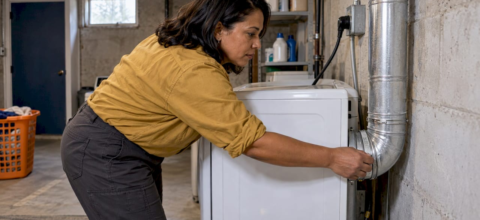
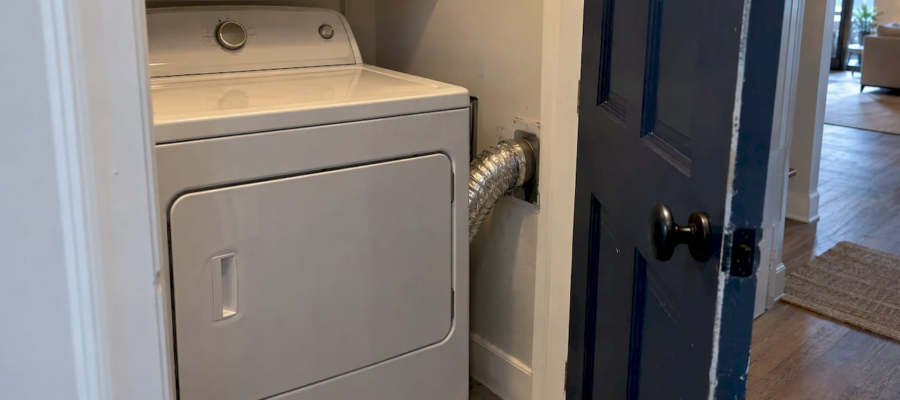
The NJ Division of Fire Safety advises replacing white vinyl or foil accordion pipe with rigid or semi-rigid metal. If you are buying a condo, look behind the dryer. A crushed accordion hose is one of the first things a vent technician flags.
What the fire code requires: keeping it clear
The Fire Subcode does not name a cleaning date. Section 610.1.2 of the NJ edition of the International Fire Code requires the lint trap, the dryer’s mechanical and heating components and the exhaust duct to be maintained according to the manufacturer’s instructions so lint does not accumulate and block the exhaust. It also lets the fire code official require an owner or occupant to fix an unsafe condition.
That is why a vent can fail an inspection even when nobody has set a schedule. The standard is the outcome: a clear exhaust path.
The reason for the standard is documented. The NJ Division of Fire Safety reports that more than 13,000 fires a year start in laundry rooms or areas, nearly 4,000 are directly caused by lint buildup in the dryer or vent pipe, and failure to clean is the number one factor contributing to clothes dryer fires. In a shared building, a fire that starts in one unit threatens every neighbor, which is why associations take this seriously.
How often must an HOA dryer vent be cleaned?
No New Jersey statute sets one interval for every association. Published condo policies show the pattern, though:
- One condominium association’s regulatory resolution makes each owner responsible for a professional inspection and, if needed, cleaning of the unit’s vent, with proof due to management every two years.
- Another New Jersey community requires all dryer vents to be cleaned by a certified company every two years. Management hires the cleaner, the cost is assessed per unit, and residents must allow access from inside the unit.
- Association counsel in New Jersey recommend that boards adopt a resolution requiring dryer vent and chimney cleanings and inspections at least every two years to reduce lint and soot fire risk.
Two years is a reasonable floor for a typical household. Heavy laundry loads, long duct runs with several bends, or a vent that runs up through a roof raise the odds of buildup. Warning signs between cleanings include clothes that stay damp after a full cycle, a laundry room that feels unusually hot, and a vent flap that barely moves while the dryer runs. Our page on how often to clean a dryer vent explains how to judge your own household.
If your association has no written interval, the code still applies. Keeping the duct clear is your obligation either way.
Who is responsible: the HOA or you?
This is the question that causes most disputes, and the answer sits in your master deed.
An NJ attorney explained in CooperatorNews that the master deed determines whether an item is a unit element or a common element. Unit owners maintain unit elements, associations maintain common elements, and changing that allocation takes an amendment to the governing documents.
In practice:
- Find the definition. Read the master deed’s definition of unit and common elements. Look for words like “ducts,” “vents,” “exhaust” or “mechanical.”
- Find the boundary. Many deeds treat the duct inside the unit as the owner’s and the shared riser or roof termination as the association’s.
- Check for a resolution. Even where a resolution assigns cleaning to owners, an attorney writing in CooperatorNews in 2026 said it may be appropriate and lawful for a condominium to use common expenses to ensure the cleanliness and safety of all dryer vents. Some boards choose to bundle cleaning for the whole building.
- Ask in writing. If the documents are unclear, ask the board or management agent for a written answer and keep it.
If you rent out a unit, you may also be the “owner” under the state’s multiple dwelling rules. N.J.A.C. 5:10 applies to the repair, maintenance, occupancy and use of new and existing multiple dwellings and makes the owner responsible for safe maintenance of the building and its facilities, with exclusions for certain owner-occupied condominium or cooperative sections of four or fewer units. Landlords can see how this plays out in our landlord dryer vent responsibilities guide.
Can an NJ HOA require cleaning and enter your home?
Generally, yes, if the board follows the right process. An attorney writing in CooperatorNews explained that a dryer-vent cleaning policy is enforceable when the board adopted or ratified it at an open meeting, recorded it in open-session minutes, and put it in the association’s published rules, and when the master deed or bylaws authorize fines. If owners still refuse, the association can deny access to common amenities and seek a court order compelling compliance, possibly with recovery of legal fees.
Access is the sticking point. Some points that help you assess your position:
- Notice. In a 2026 unpublished opinion, the NJ Appellate Division upheld a cooperative’s right to enter an apartment at a reasonable hour on written notice to make or facilitate repairs, and upheld termination of a shareholder’s lease and stock after the owner refused access despite court orders. It is a cooperative case and is not binding precedent, but it shows how seriously courts treat repeated refusal.
- Local housing codes. Some townships write access into their ordinances. Plainsboro’s housing code, for example, requires occupants to give owners or agents access on 24 hours’ notice for compliance repairs, and immediately in a safety emergency. It also says dryer exhaust systems must be independent of other systems and vented outside, and cleaned per manufacturer recommendations.
- Your own documents. The right to enter, the notice period and the fines all depend on what your master deed and bylaws say. If you dispute a fine or an entry demand, talk to a New Jersey attorney who handles community association law.
The simplest way to avoid a dispute is to schedule the service yourself before the deadline and send the certificate to management.
Practical steps for owners, buyers and agents
If you own a unit
- Pull your master deed, bylaws and the current rules and regulations. Look for a dryer vent or “mechanical” policy.
- Note the deadline and what proof the association wants, such as a dated invoice or certificate from a certified company.
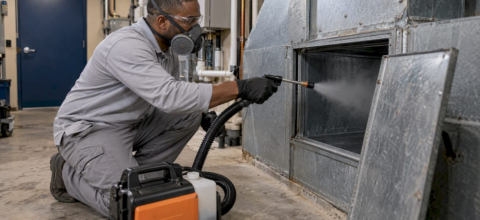
- Book a cleaning before the deadline. A technician should clear the full run from the dryer to the outside termination, not just the first few feet behind the machine.
- Keep the paperwork. It protects you against a fine and helps at resale.
If you are buying
Ask for the association’s dryer vent policy in the resale package, and ask the seller for the date of the last cleaning. Look for a flexible foil hose, a screened termination or a vent that runs a long way. Fixing these after closing is easier if you know about them in advance.
If you are a real estate agent
A dated vent cleaning record is a small thing that answers a buyer’s inspector before the question comes up. Suggest sellers in HOA communities have it on hand with their resale documents.
If a vent is missing or connected to a shared system
Code requires dryer exhaust to be independent of other systems, so a vent that ties into a bathroom exhaust, a crawl space or another unit’s duct is a problem to report. Ask your association or management agent who owns the shared run, and have the vent assessed before using the dryer. For multi-unit properties, our guide to IMC 504 compliance for multi-unit dryer vents lays out what managers should document.
For property managers and facility managers
If you manage a community, you carry the paper trail. The practical routine is:
- Adopt the policy at an open board meeting and record it in the minutes, as described above.
- Publish it in the rules and regulations and send it to every owner and resident.
- Decide whether owners hire their own vendors or the association contracts one building-wide, which keeps cleaning dates and documentation consistent.
- Collect proof of cleaning by the deadline and follow up in writing with those who have not responded.
- Keep riser cleanouts and rooftop terminations on your maintenance list, since they are typically shared elements.
Our guides on property manager dryer vent responsibilities and condo dryer vent cleaning go deeper on frequency and scheduling for communities.
Our view as a dryer vent team
Most of the HOA vent disputes we hear about are about process, not about whether cleaning matters. A policy that is adopted openly, written down and paired with a clear deadline is much easier for everyone to follow than a surprise notice.
We have more than 10 years of experience serving residential and commercial clients in New York, New Jersey and Connecticut, and our technicians are certified. For an HOA, that means one team that can clean an individual unit, a townhome row or a whole building and hand the board the documentation it needs.
Our advice is to treat the vent as part of the building’s fire safety, not as a chore. Clear the full run, replace flexible foil with rigid metal where it is found, and keep a dated record. Do that every two years or sooner, and you will meet the code’s goal and most association policies.
Victor
Book a dryer vent cleaning for your unit or community
If your association has set a deadline or you want a dated record before a sale, our dryer vent cleaning service covers residential and commercial properties in New Jersey. We also work with managers of multi-unit buildings through our NJ dryer vent cleaning page. Contact us for a quote, since we do not publish a standard price.

In Mercer County and along the shore, see our local pages for Mercer County and the Jersey Shore.
FAQ
Is the HOA responsible for dryer vent cleaning in New Jersey?
It depends on your master deed. If the vent is a unit element, the owner is responsible. If it is a common element, the association is. Boards may also lawfully use common expenses to clean all vents in the building, even where a resolution gives cleaning to owners.
How long can a dryer vent be in New Jersey?
The NJ Mechanical Subcode sets a 35-foot maximum for the exhaust duct, reduced by an equivalent length for each fitting. Older residential code editions used 25 feet, so confirm which edition applied to your building with your local code official.
Is a 3-inch dryer vent okay?
The NJ mechanical code calls for domestic dryer exhaust ducts of 4 inches nominal diameter, in smooth-interior metal at least 0.016 inch thick. A 3-inch duct does not meet that standard, so have it assessed by a qualified technician.
Can my HOA make me clean my dryer vent?
If the board adopted the policy properly, put it in the published rules and has fine authority in the master deed or bylaws, it should be enforceable. Associations can also seek a court order for access. Contact an NJ attorney for advice on your specific documents.
Does New Jersey require dryer vent cleaning every year?
No statewide interval exists. The Fire Subcode requires lint buildup to be prevented per the manufacturer’s instructions, and many associations set a two-year schedule in their rules.
Sources
- NJ Department of Community Affairs: current codes
- NJ Mechanical Subcode 2024, Chapter 5 Exhaust Systems
- NJ Fire Subcode, Chapter 6 Building Services and Systems
- NJ DCA Construction Code Communicator, Spring 2024
- NJ Residential Code, Chapter 15
- NJ Division of Fire Safety: Fire Safety Facts, dryers
- N.J.A.C. 5:10, Hotel and Multiple Dwelling Law regulations
- CooperatorNews NJ: Common elements vs. individual unit elements
- CooperatorNews NJ: Venting Q&A
- CooperatorNews NJ: Getting rid of the lint in dryer vents
- NJ Appellate Division opinion A-0795-23/A-1665-23
- Township of Plainsboro housing code ordinance
- The Association Lawyers: association rules
- The Oakton dryer vent policy 2009-04
- Arbors Rules and Regulations, June 2023
Recommended
- Stop Lint Fires: 35 Foot Limit and Key NJ Dryer Vent Rules
- Landlord Dryer Vent Responsibilities in NY, NJ and CT
- Property Manager Dryer Vent Responsibilities in NY, NJ and CT
- NY/NJ/CT Property Managers: Pass IMC 504.11 for Multi Unit Dryer Vents