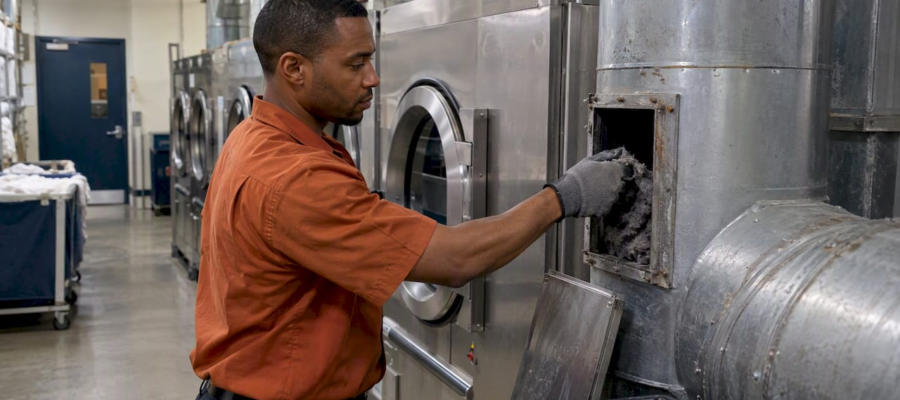
Hospital Dryer Vent Cleaning: What Facilities Need to Know
Hospital dryer vent cleaning is the removal of lint and debris from the exhaust ducts, lint traps and surrounding surfaces of the dryers that process patient linens, scrubs and towels. In a healthcare building it does two jobs at once. It lowers the risk of a lint fire, and it supports the infection control that keeps clean textiles clean. If you manage a hospital, nursing home, rehab center or clinic laundry in New York, New Jersey or Connecticut, this guide covers what the regulators expect, what a proper service includes and how to tell a legitimate contractor from one that only uses the words “hospital grade.”
TL;DR
- Lint is a fire fuel, and failure to clean was the leading factor in residential dryer fires at 31% to 34%. Commercial-size dryers running all day collect lint faster than a home unit.
- OSHA’s fire prevention standard, 29 CFR 1910.39, applies to hospital laundries, and OSHA’s hospital laundry guidance names lint build-up as a hazard.
- The CDC treats laundry ventilation as part of infection prevention, not only maintenance. Work in the laundry must not stir lint into the clean side.
- “Hospital grade” is a marketing phrase, not a certification. Ask for the scope of work, the containment plan and the products used.
- Set a written schedule. Annual cleaning is the common baseline for homes, and high-use commercial dryers need it more often.
Table of Contents
- Why a hospital dryer vent is not a home dryer vent
- The fire side: what the numbers and the rules say
- The infection control side
- What a proper hospital dryer vent service includes
- Warning signs your dryer vent needs attention
- How often should a hospital clean its dryer vents?
- What it costs
- Questions to ask any contractor
- Commercial laundries and kitchens share the same logic
- Our perspective on healthcare dryer vents
- Where Amazon Air Duct Cleaning fits
- A simple maintenance routine for facility teams
- FAQ
- Sources
Why a hospital dryer vent is not a home dryer vent
A household dryer might run a few loads a week. A hospital laundry, whether on site or in a dedicated wing, can run dryers for many hours a day, every day. Heat, moisture and fine fibers move through the exhaust duct all that time, and the duct is where lint settles.
Three things make the healthcare setting different:
- Volume. More loads mean faster lint build-up in the duct, the lint trap and the room itself.
- Occupants. A fire or smoke event in a building with patients who cannot self-evacuate has consequences that a house fire does not.
- Infection control. Lint and dust are not just flammable. In a moist, lint-rich space they can support fungi, and the work of cleaning can send particles into the air.
That third point is the one most vent cleaning pages skip, and it is the reason a generic residential service is not enough for a healthcare site.
The fire side: what the numbers and the rules say
The U.S. Fire Administration’s report on residential dryer fires found that failure to clean is the primary cause of 31% to 34% of those fires. Its more recent consumer page repeats that failure to clean (31%) was the leading factor in home dryer fires from 2018 to 2020. Those are residential figures. They do not measure hospital laundries, but the mechanism is identical: lint restricts airflow, the dryer runs hotter, and the lint in the duct becomes fuel.
For employers, the rules are specific. OSHA’s hospital laundry guidance notes that lint build-up on ceilings, other surfaces and in dryer lint traps raises fire risk, and points to the Fire Prevention Standard, 29 CFR 1910.39. That standard calls for a written fire prevention plan, and the plan covers how you handle fire hazards in the workplace, including housekeeping and maintenance of equipment. In practice, that means vent cleaning belongs in the plan as a scheduled, documented task, and staff should be trained to recognize lint accumulation.

The fire door problem
One compliance failure shows up again and again in laundry areas: a self-closing fire door that does not close. OSHA’s inspection records include a citation where a self-closing fire door did not remain closed in a laundry area. Heavy carts move constantly between clean and dirty processing zones, and a cart parked in a doorway is an easy habit. Tell your staff and your vent contractor alike: propping or blocking fire doors during service is not acceptable.
The infection control side
The CDC’s guidance on laundry says that laundry equipment must be used and maintained according to the manufacturer’s instructions to prevent microbial contamination, and that clean textiles should be protected from dust and lint, including in transport. It also recommends separating dirty and clean zones.
A CDC-hosted paper on healthcare linen, Keeping Healthcare Linens Clean, goes further. It asks infection preventionists to evaluate the laundry’s built environment, with particular attention to the HVAC system, and notes that several healthcare-textile-associated mucormycosis outbreaks involved laundry environments. Its practical points matter to anyone scheduling vent work:
- Soiled areas should be under negative pressure and clean areas under positive pressure, so air flows from clean to dirty.
- Open louvers, windows or dock doors on the clean side are red flags for environmental exposure.
- Moist, lint-rich spaces can support fungi such as Aspergillus and the molds that cause mucormycosis.
The takeaway for a facility manager is to treat the dryer exhaust as part of the same system. A vent cleaning that disturbs lint in the wrong place, or that leaves a clean-side door open to the loading dock, can undo what the laundry’s design is trying to do. Before any contractor works, involve your infection preventionist. They should know the day, the zones affected and the containment plan.
What a proper hospital dryer vent service includes
The pages ranking for this topic mostly describe “hospital grade” duct cleaning with HEPA vacuums and disinfectants. Those details can be real, but the phrase alone tells you little. Here is what we would expect in a written scope for a healthcare laundry.
Before the work
- Walk-through and risk review. The contractor and your facilities and infection prevention staff mark the dryer locations, duct runs, termination points and adjacent clean areas.
- Scheduling around operations. Work is planned for a window when the dryers can be shut down and cooled, ideally when clean linen is not being staged nearby.
- Containment. Plastic barriers or other controls separate the work area from clean textile storage. Any plan should respect the room’s pressure design.
During the work
- Dryer disconnected and locked out, with the power or gas supply handled by authorized staff according to your procedures.
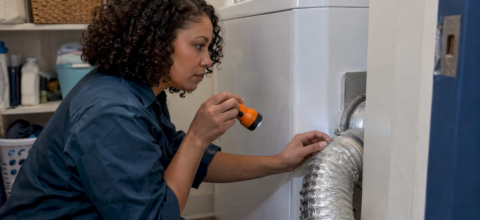
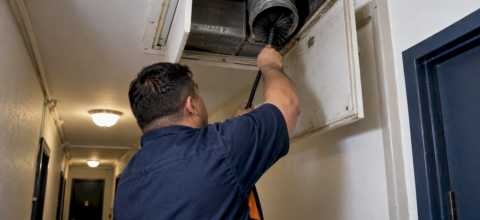
- Full-length duct cleaning, not only the first few feet behind the machine. Rotary brushes and high-airflow vacuum collection draw lint out of the duct and into a sealed, filtered collector, so it does not drift into the room.
- Lint trap housing and cavity cleaning, where fine lint hides.
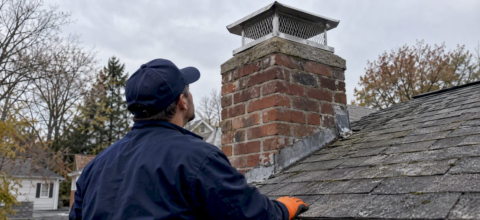
- Termination check. The exterior cap or louver should open freely and be clear of bird nests, debris or snow. The National Fire Protection Association’s dryer safety tips include checking that the outdoor vent flap is not covered by snow, which is a real concern from Buffalo to Hartford.
- Surface cleaning of the laundry room, since OSHA flags lint on ceilings and other surfaces, not just inside the duct.
After the work
- Airflow check and a test run of the dryer.
- Inspection of duct material. Flexible plastic or vinyl exhaust ducting is a fire hazard and should be replaced with rigid metal duct that meets UL standards.
- Written report with the date, the equipment and areas serviced, findings such as crushed sections, excess moisture or obstruction, and recommendations. This is the record your fire prevention plan and your surveyors will want.
If a contractor mentions disinfectants, ask which products, where they are applied and why. The CDC advises facilities to confirm that contractors use EPA-registered disinfectants. Spraying chemicals into a dryer exhaust duct is rarely the point of a lint removal job, so a clear reason should accompany any product use.
Warning signs your dryer vent needs attention
Do not wait for a scheduled date if you see any of these:
- Loads take longer than normal to dry.
- The laundry room feels unusually hot or humid, or the exterior of a dryer is hot to the touch.
- A burning smell appears during a cycle.
- Lint collects around the exterior vent cap, on ceiling surfaces or on top of equipment.
- The outside flap does not open when the dryer runs.
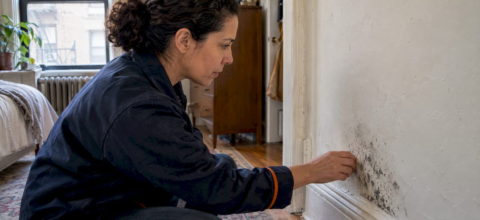
- Visible moisture or mold near the duct. The USFA report notes that a blockage, such as a bird’s nest or damage to the venting system, can stop the dryer from exhausting properly to the outside.
Our own pages on spotting signs of dryer vent blockage and five warning signs of a fire hazard go deeper on what staff can check between professional visits.
How often should a hospital clean its dryer vents?
No single national number fits every facility. For homes, the common guidance is an annual cleaning, with more frequent service for high-use situations. A hospital or nursing home laundry is a high-use situation. Your schedule should rest on:
- The dryer manufacturer’s instructions, which the CDC says to follow.
- Daily run hours and load volume.
- The length and bends of each duct run. Long runs and many elbows trap more lint.
- Findings from your last inspection. If a duct had heavy build-up after six months, do not wait twelve.
- Your written fire prevention plan, which should state the interval and who verifies it.
Many facilities set a quarterly or semiannual interval for on-premises laundries and an annual one for small satellite units such as a clinic’s single washer and dryer. Treat those as starting points to confirm with your fire safety and infection prevention teams. For more on timing, see our guide on how often to clean a dryer vent.
What it costs
For ordinary residential dryers, HomeAdvisor reports an average of $145, with a typical range of $104 to $188 as of June 2026. It also says vents on a rooftop or second story can run $150 to $250 or more because of labor and equipment. Those figures describe homes. A hospital laundry with several large dryers, long duct runs, rooftop terminations and containment requirements is priced by scope, so expect a quote after a site visit rather than a flat rate. A quote based on a phone call alone, for a facility with patients, is a red flag.

Questions to ask any contractor
Use this list when you compare bids. A legitimate contractor will answer without hesitation.
| Question | What a good answer sounds like |
|---|---|
| Have you worked in healthcare or other regulated buildings? | Specific examples of site types, and willingness to coordinate with infection prevention |
| How do you contain lint during the work? | Sealed collection, filtered vacuums, barriers where needed, no open doors to clean areas |
| Do you clean the full duct to the exterior? | Yes, with a written description of the method and a termination check |
| Will you provide a report? | Date, equipment serviced, findings, photos and recommendations |
| What products will you use, if any? | A named list and reason, with EPA registration for disinfectants |
| Are your technicians trained and certified? | Clear answer on training and certifications held |
| Can you work in a shutdown window? | Flexible scheduling and a plan for cooldown and restart |
Also check that the contractor carries insurance appropriate for work inside a healthcare building. Your risk manager will likely require a certificate anyway.
Commercial laundries and kitchens share the same logic
A hospital also has exhaust systems that are not dryers, most obviously the kitchen. Grease, not lint, is the fuel there, but the principle is the same: airflow design and routine cleaning determine risk. If you want to understand how engineers think about ventilation design for commercial kitchens, the same questions apply to the laundry: where air comes from, where it goes and what it passes through on the way. Keep each system on its own schedule and its own specialist.
Our perspective on healthcare dryer vents
We have worked on residential and commercial properties across New York, New Jersey and Connecticut for more than 10 years, and the same pattern repeats. Facilities treat dryer vents as something to deal with when a machine stops working properly. By then, lint has been building for months.
We would change three habits. First, put the vent on the calendar, with a date, an owner and a report on file. Second, bring in your infection prevention people before the contractor arrives, not after. Third, judge a contractor by its scope of work, not by the adjective in its advertising. If a company cannot say how it contains lint, which parts of the duct it reaches or what it will hand you at the end, keep looking.
We also think plain honesty helps. Some duct problems are not a cleaning issue. A crushed run, a plastic transition hose or a duct that is simply too long needs repair or rerouting, and we would rather tell you that than clean around it. Our technicians are certified and trained for both residential and commercial work, and we would rather you have a clear plan than a quick appointment.
— Victor
Where Amazon Air Duct Cleaning fits
We provide professional dryer vent cleaning and commercial air duct cleaning for properties across New York, New Jersey and Connecticut, including facilities that answer to property managers and facility managers. If you manage a healthcare or education site, tell us about the laundry, the number of dryers and your shutdown windows, and we will talk through a scope that fits your fire prevention plan. You can also read about our dryer vent services in NY and NJ.
A simple maintenance routine for facility teams
Between professional visits, give your laundry staff a short checklist:
- Clean the lint trap or screen after every load or as the manufacturer directs.
- Wipe lint from dryer tops, back panels and nearby surfaces so it does not accumulate.
- Keep the area around dryers clear of boxes, cleaning supplies and clothing, as the NFPA tips advise.
- Keep fire doors closed and carts out of their path.
- Walk outside once a month and check that the exhaust flap opens and is not blocked.
- Log any longer-than-normal drying times and report them to maintenance the same day.
- Never mix cleaning chemicals. OSHA’s laundry guidance warns that ammonia and chlorine products form a deadly gas when combined.
These steps do not replace professional cleaning. They make the gap between visits safer and help your contractor see problems early.
FAQ
Is hospital grade dryer vent cleaning a real certification?
No. We are not aware of a recognized certification by that name, and the term is used loosely in advertising. What matters is the written scope: containment, full-duct cleaning, filtered collection, documented findings and any disinfectant being EPA-registered. Ask for those details in writing.
Does OSHA require dryer vent cleaning in a hospital laundry?
OSHA’s Fire Prevention Standard, 29 CFR 1910.39, requires a written fire prevention plan, and OSHA’s hospital laundry guidance identifies lint build-up as a hazard to address through housekeeping and maintenance. The standard does not set a cleaning interval, so your plan should state one. Confirm details with your safety officer or counsel.
How much does dryer vent cleaning cost?
For a typical home, HomeAdvisor lists an average of $145 and a range of $104 to $188. Healthcare laundries vary much more with the number of dryers, duct length and access, so a site visit is the reliable way to get a price.
Can vent cleaning contaminate clean linens?
It can if it is poorly planned. The CDC stresses protecting clean textiles from dust and lint and keeping clean and dirty zones separate. Schedule work when clean linen is not exposed, use contained collection and have your infection preventionist approve the plan.
Sources
- USFA: Clothes Dryer Fires in Residential Buildings (2008-2010)
- USFA: Appliance and Electrical Fire Safety
- OSHA eTool: Hospitals, Laundry, Fire Hazards
- OSHA eTool: Hospital Laundry
- OSHA inspection record: self-closing fire door citation
- CDC: Laundry and Bedding
- CDC: Keeping Healthcare Linens Clean
- NFPA: Clothes Dryer safety tips
- HomeAdvisor: How Much Does Dryer Vent Cleaning Cost?
Recommended
- DIY vs. Professional Dryer Vent Cleaning: All You Need to Know
- Safety First: 5 Reasons to Get Your Dryer Vent Cleaned
- Dryer vent safety procedure: 5 essential steps
- How Often Should You Clean Your Dryer Vent