How to Train Staff on Duct Hygiene: A Facility Manager Playbook
Train staff to handle four things: safe filter and register care, objective visual inspections, photo-documented logs, and escalation the moment specific red flags show up. Those red flags include visible mold, standing moisture, pest activity, persistent odors after a filter change, or measurable airflow loss. Anchor your program to guidance from NADCA, ASHRAE, and the NIH’s DOHS fact sheet so trainers have something concrete to point to during briefings.
Two tasks to assign on day one:
- Monthly filter checks, logged with a date and a pass/fail note.
- Photo documentation at every quarterly walkthrough, even when nothing looks wrong.
Key Takeaways
Effective duct hygiene training combines routine, documented staff tasks with objective escalation triggers, keeping in-house work safe while routing real problems to certified professionals fast.
| Point | Details |
|---|---|
| Define tasks narrowly | Staff handle filters, registers, and grilles; interior cleaning and contamination are contractor-only work. |
| Use objective criteria | Replace subjective terms with thresholds like visible mold, persistent odor, or measurable airflow loss. |
| Document every check | Log date, inspector, location, photos, and findings to support trend analysis and contractor referrals. |
| Escalate on clear triggers | Occupant allergy clusters, mold, pests, moisture, or airflow loss all warrant an immediate ticket. |
| Call a certified contractor | Amazon Air Duct Cleaning offers NADCA-standard inspections and ASCS-qualified service across NY, NJ, and CT. |
Table of Contents
- How Do You Train Staff on Duct Hygiene Basics?
- What Counts as “Clean” During an Inspection?
- Which Duct Hygiene Tasks Are Safe for In-House Staff?
- When Should Staff Escalate to a Professional?
- What Should a Training Session Actually Look Like?
- Building a Simple SOP for Routine Duct Care
- When It’s Time to Call a Professional Duct Cleaning Team
- Sources
- FAQ
How Do You Train Staff on Duct Hygiene Basics?
Effective staff training duct maintenance programs start narrow, not broad. You are not turning custodial or maintenance staff into duct cleaning technicians. You are teaching them a repeatable routine: check, wipe, log, and know when to stop and call someone. That distinction keeps liability low and keeps your team focused on what actually prevents indoor air quality problems, which is catching source issues early rather than waiting for a full-blown complaint.
A duct hygiene training program built around a checklist beats one built around a lecture. Staff retain physical tasks better when they see them demonstrated and then repeat them under supervision, which is why hands-on practice belongs in every session, not just the first one.
Core tasks every trained staff member should master:
- Wipe or wash register and grille covers on a set schedule
- Inspect and replace filters monthly
- Perform a basic visual duct access check where accessible
- Log every complaint or observation, even minor ones
| Task | Frequency | Assigned To |
|---|---|---|
| Filter inspection/replacement | Monthly | Maintenance staff |
| Register/grille wipe-down | Before visible soil hardens (roughly monthly) | Custodial or maintenance staff |
| Visual duct access check | Quarterly | Maintenance supervisor |
| Full inspection (condition-driven) | Annually, or sooner if risk factors present | Maintenance lead or contractor |
Goodway’s HVAC maintenance guidance backs this up: condition-driven scheduling beats rigid calendar rules, with more frequent checks warranted in high-traffic or high-pollution settings. Build this matrix into your CMMS so shift handoffs carry the same task list forward instead of relying on memory.
What Counts as “Clean” During an Inspection?
Vague words like “dirty” or “fine” create inconsistent training with duct maintenance decisions. Replace them with thresholds your team can actually apply without guessing.
Objective criteria to teach:
- Visible debris beyond a thin, even dust layer (use a reference photo, not a guess)
- Any visible mold or slime coating on register surfaces
- Musty or sour odor that persists after a fresh filter is installed
- Pest droppings, nesting material, or insect activity near vents
- Moisture beads, staining, or rust on registers or plenum surfaces
- A noticeable airflow drop, checked with a simple tissue or smoke test at the register
Photo documentation needs its own rules: consistent camera angle, a timestamp, the location name, and the inspector’s name in the file or log entry. Checklists built for HVAC inspection programs recommend pairing before-and-after photos with a fixed acceptance threshold rather than a subjective call, which is exactly the discipline you want from in-house staff.
Pro Tip: Build a reference photo set, a clean baseline shot plus two or three staged examples of debris, mold, and moisture, and hand it out during training. New hires calibrate their judgment against the same images instead of guessing what “too much dust” means.

Which Duct Hygiene Tasks Are Safe for In-House Staff?

Staff can safely handle the surface layer. They should never touch the interior. That line matters because surface cleaning and full-system cleaning aren’t interchangeable: professional full-system work removes far more particulate and requires containment that in-house crews simply don’t have the equipment or training to replicate safely.
Teach these tasks:
- Monthly filter inspection and replacement
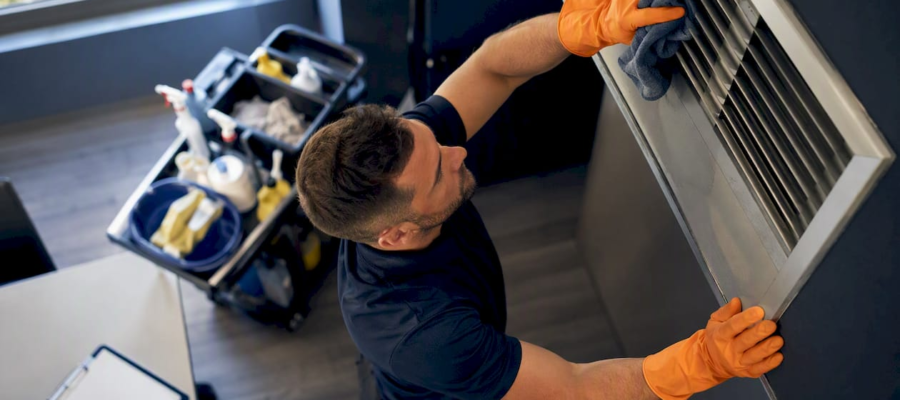
- Wiping or washing register covers and diffusers
- Clearing obvious obstructions from registers
- Light grille vacuuming
- Logging every finding, no matter how minor
Do not teach staff to attempt:
- Interior duct cleaning or rotary agitation
- Mold remediation of any kind
- Pest removal from ductwork
- Deep contamination cleanup
These are all escalation triggers, not training exercises. For PPE and safety guidance, require gloves, eye protection, and an N95 mask when dust is heavy. Anyone working near an air handling unit needs basic lockout/tagout awareness, even for something as simple as a filter swap, so nothing energizes unexpectedly mid-task.
When Should Staff Escalate to a Professional?
Escalate the moment one of these signs appears, rather than waiting to see if it resolves on its own:
- Multiple occupants report allergy symptoms clustered in one area
- A musty odor persists after the filter has already been replaced
- Visible mold or slime shows up on any register or accessible duct surface
- Pest droppings or nesting material appear near vents
- Moisture, staining, or rust shows up on registers or plenum surfaces
- Debris visibly discharges from a register during airflow
- Airflow loss persists after filter replacement and register cleaning
The CDC’s indoor air quality guidance lists these same categories as legitimate triggers for professional evaluation, not for more in-house scrubbing.
Once a trigger appears, the workflow is straightforward:
- Secure the affected area if occupants are present
- Photograph the issue from multiple angles with a scale reference
- Note the last filter change date and any recent complaints
- Open a CMMS ticket with location, symptoms, photos, date/time, and any mitigation already tried
- Notify the maintenance lead before contacting a contractor
When you do call a contractor, ask directly whether their technicians are NADCA-member and ASCS-certified, what their containment plan looks like, whether they document before-and-after conditions, and what downtime and cost you should expect. A vague answer to any of those questions is its own red flag.
What Should a Training Session Actually Look Like?
Skip the hour-long lecture. A 60 to 90 minute blended session, split between a short classroom briefing, a hands-on demo, and a supervised field check, teaches more than a slide deck ever will. ISSA’s training research backs this format specifically: structured programs that combine safety, inspection technique, and hands-on practice build stronger in-field competence than lecture-only formats. Run a short refresher every quarter so the routine doesn’t drift.
A sample agenda:
- Safety briefing and PPE review (10 minutes)
- Inspection criteria walkthrough with reference photos (15 minutes)
- Hands-on register and filter practice (25 minutes)
- Photo-documentation practice (15 minutes)
- Competency check with clear pass/fail criteria (15 minutes)
Track results in a training log with trainer name, trainee name, skills demonstrated, pass or fail, and a retraining date if needed. Without that record, you have no way to prove staff were properly trained if a facility complaint ever escalates into something formal.
Building a Simple SOP for Routine Duct Care
A one-page SOP keeps everyone working from the same rules instead of improvising. Structure it around purpose, scope (explicitly what staff may and may not do), required PPE, step-by-step procedures for filter and grille care, photo-documentation requirements, and escalation triggers.
Record these fields after every check:
- Date and time
- Inspector name
- Location
- Task performed
- Photo filenames
- Observed issues
- Immediate action taken
- Escalation ticket ID, if one was opened
Keep inspection photos and tickets for at least a year. That history is what lets a contractor scope a job accurately on the first visit instead of re-inspecting from scratch, and it’s what lets you spot a slow-building pattern, like recurring moisture near one specific run of ductwork, before it turns into a bigger repair.
Standards Your Training Materials Should Cite
Cite NADCA’s ACR standard for contractor qualifications and containment expectations, ASHRAE for airflow and ventilation norms, and the NIH/DOHS fact sheet for source-control guidance before any cleaning decision. OSHA guidance covers PPE and general workplace safety, while ISSA resources support your hands-on training curriculum. For escalation decisions specifically, NADCA and NIH guidance carry the most weight; OSHA and ISSA are your go-to references for safety procedure and training structure.
Why This Approach Holds Up in the Field
Routine tasks paired with clear escalation rules protect indoor air quality better than either extreme, endless in-house scrubbing that never touches the real problem, or calling a contractor for every dust bunny. Source control has to come first: fixing a leak or relocating a bad intake location does more than any cleaning cycle. Amazon Air Duct Cleaning’s work across New York, New Jersey, and Connecticut properties has shown this pattern again and again, and this framework holds up whether you’re training two custodians or a twelve-person maintenance crew with limited tools.
When It’s Time to Call a Professional Duct Cleaning Team
Once your team spots one of the escalation triggers, or your facility simply doesn’t have the containment equipment or airflow measurement tools to verify a problem properly, that’s the point to bring in a NADCA-standard inspection instead of pushing staff past their scope. Amazon Air Duct Cleaning works with facility and property teams across New York, New Jersey, and Connecticut, and every job includes ASCS-qualified technician oversight and documented before-and-after reporting your team can drop straight into a maintenance file.

For commercial properties specifically, our commercial air duct cleaning service covers full-system cleaning, coil cleaning, and antimicrobial or deodorizing treatments where source-control issues have already been addressed. When you call, expect us to confirm NADCA membership and ASCS certification upfront, walk through a written work plan, explain our containment measures, and give you a scope-based quote instead of a flat guess. If your team just flagged a musty odor that survived a filter change or found moisture staining on a plenum, request a quote and we’ll schedule an inspection around your facility’s hours.
Sources
- ACR, The NADCA Standard — 2021 edition
- How often should industrial HVAC maintenance be done? – Goodway (2026-01-01)
- Duct cleaning training — ISSA (2026-02-25)
- DOHS Fact Sheet on HVAC Duct Cleaning — NIH/ORS
Embed each of these in your SOP document and LMS modules so staff can click through during a briefing instead of hunting for them later.
FAQ
How often should staff check duct filters?
Filters should be inspected monthly, though high-traffic or high-pollution facilities may need more frequent checks based on visible soil buildup.
What’s the difference between routine hygiene and professional duct cleaning?
Routine hygiene covers filters, registers, and grilles that staff can safely wipe or replace; professional cleaning addresses the interior duct system and requires containment equipment staff don’t have.
What are the clearest signs staff should escalate immediately?
Visible mold, persistent musty odor after a filter change, pest evidence, moisture or rust on registers, and noticeable airflow loss all warrant an immediate escalation ticket.
Do we need NADCA certification to train our own staff?
No. In-house training only needs to cover safe routine tasks and escalation criteria; NADCA/ASCS certification applies to the professional contractors you call in for full-system cleaning.
How does Amazon Air Duct Cleaning support facility teams after training?
Amazon Air Duct Cleaning provides NADCA-standard inspections, ASCS-qualified technicians, and documented before-and-after reporting for facilities in New York, New Jersey, and Connecticut once staff identify an escalation trigger.
Recommended
- How to Train Janitorial Staff for Vent Cleaning – Amazon Air Duct Cleaning
- How to Reduce Workplace Dust: A Facility Manager’s Guide – Amazon Air Duct Cleaning
- How to Document Duct Cleaning: A Property Owner’s Guide – Amazon Air Duct Cleaning
- Multi-unit duct cleaning: what managers need to know – Amazon Air Duct Cleaning