NY/NJ/CT Homeowners: Clean Coils When Delta T Falls or Pressure Rises
Clean your HVAC coils at least once a year, ideally four to six weeks before peak cooling season, and more often if you live near the coast, deal with heavy dust or pets, or run your system hard. Beyond that annual baseline, let your equipment’s own performance data decide: a widening Delta-T gap, rising static pressure, or climbing amp draw all mean it’s time to clean now, regardless of the calendar.
TL;DR:
- Homeowners near the coast, with heavy pollen, or running their systems frequently should consider cleaning coils twice a year instead of once.
- Monitoring performance metrics like Delta-T, static pressure, and amp draw provides the most reliable signals for when coil cleaning is actually needed.
- Professional cleaning costs typically range from $100 to $400, with complex or hard-to-reach units requiring more time and higher expenses.
- DIY rinsing of outdoor condenser fins is safe when using low-pressure water, but deep cleaning of evaporator coils should be handled by specialists.
- Timing the main coil cleaning four to six weeks before the peak cooling season helps maintain system efficiency and prevents performance issues.
Table of Contents
- What Are Evaporator and Condenser Coils, and Why Does Cleanliness Matter?
- How Often Should You Clean HVAC Coils Based on Your Environment?
- What Are the Warning Signs of Dirty Coils?
- DIY Coil Cleaning vs. Hiring a Professional: What’s Safe and What It Costs
- When Should You Schedule Coil Cleaning, and What Belongs on Your Checklist?
- Why Local Conditions Change the Coil Cleaning Conversation
- Get Your Coils Cleaned Before Peak Season Hits
- Sources
- FAQ
What Are Evaporator and Condenser Coils, and Why Does Cleanliness Matter?
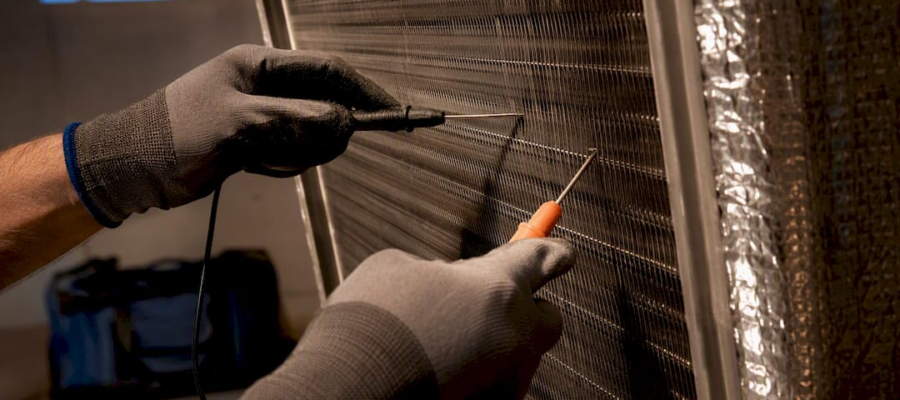
Your system has two coils doing very different jobs. The evaporator coil sits inside, usually in the air handler or above the furnace, and absorbs heat from indoor air as refrigerant moves through it. The condenser coil sits outside, rejecting that heat into the atmosphere.
Both rely on bare metal fins to transfer heat efficiently. A thin layer of dust, pollen, or grease on those fins acts like a blanket, forcing the compressor to run longer to hit the same temperature. Fouled evaporator coils can also ice over, which restricts airflow further and, over time, stresses the compressor.
- Evaporator coils are enclosed and harder to reach, which usually rules out a full DIY cleaning.
- Condenser coils sit outdoors and are more exposed to leaves, grass clippings, and coastal salt buildup.
- Dirty coils on either side increase energy use and shorten equipment life.
Understanding why dirty condenser coils cause visible performance drops helps explain why cleaning frequency isn’t one-size-fits-all.
How Often Should You Clean HVAC Coils Based on Your Environment?
An annual cleaning, timed just before your system’s busiest season, is the field-standard minimum for most homes. That guidance holds up across independent maintenance research, which also flags several situations where once a year isn’t enough.
Twice a year makes sense if you live in a coastal community in Connecticut or New Jersey, where salt air accelerates corrosion and grime buildup on condenser fins. The same applies to homes surrounded by heavy pollen, or anyone running central air nearly nonstop through humid summers.

Quarterly to semiannual cleaning fits very dusty properties, homes with multiple pets shedding near return vents, and commercial or high-occupancy buildings where the system barely gets a break. Industry data on industrial HVAC maintenance cadence shows commercial systems commonly receive at least two professional visits per year, layered with monthly visual checks and quarterly inspections.
Beyond the calendar, condition-based monitoring is the most reliable way to know when a system actually needs attention:
- Delta-T (the temperature difference between return and supply air) drops when coils are fouled and heat exchange suffers.
- Static pressure climbs as airflow gets restricted by dirt and debris.
- Compressor amp draw rises as the system works harder to compensate.
If any of these three metrics drift noticeably from their baseline, that’s your cue to clean, whether or not the calendar agrees.
What Are the Warning Signs of Dirty Coils?

Some signs of dirty coils are obvious the moment you look. Others only show up in the numbers your technician records at each visit.
Watch for these observable signs:
- Weaker airflow from your supply vents, even with a clean filter installed.
- Cooling cycles that run noticeably longer to hit the same thermostat setting.
- Frost or ice forming on the evaporator coil, which usually points to restricted airflow or low refrigerant.
- Visible grime, pet hair, or grass clippings coating the outdoor condenser fins.
Watch for these measured triggers, which matter even when nothing looks obviously dirty:
- A Delta-T reading that’s fallen several degrees below what it measured at the last cleaning.
- Static pressure that has risen more than 0.5 inches of water gauge above baseline.
- Compressor amp draw climbing above its typical range for your system.
Pro Tip: Ask your technician to write down Delta-T, static pressure, and amp draw at every visit. That baseline turns your next inspection into a real comparison instead of a guess, and it’s the fastest way to catch a problem before it becomes an expensive one.
DIY Coil Cleaning vs. Hiring a Professional: What’s Safe and What It Costs
You can handle a few coil-adjacent tasks yourself without much risk. Beyond that, it’s worth bringing in a professional, both for safety and for results that actually last.
Safe to do yourself:
- Replacing or cleaning air filters on schedule.
- Clearing leaves, grass, and debris from around the outdoor condenser unit.
- Rinsing condenser fins gently with a garden hose on low pressure (never a pressure washer).
- Checking that the condensate drain pan and line aren’t clogged or backed up.
Best left to a professional:
- Deep cleaning the evaporator coil, which usually means partially disassembling the air handler.
- Chemical coil cleaning for heavy grease or biological buildup.
- Straightening bent condenser fins without damaging them further.
- Any work touching refrigerant lines or electrical components.
Statistic Callout: Most homeowners pay between $100 and $400 for professional AC coil cleaning, averaging around $250. Price depends on how accessible your coils are, whether you’re cleaning one coil or both, and how severe the buildup has become. A typical residential job takes one to two hours per unit, while commercial rooftop units or larger air handlers can take two to four hours.
For homeowners deciding between professional condenser coil cleaning and a DIY rinse, the deciding factor is usually access and severity, not cost alone.
When Should You Schedule Coil Cleaning, and What Belongs on Your Checklist?
Time your main coil cleaning four to six weeks before peak cooling season kicks in, giving your system a clean start right when demand ramps up. In heavy-fouling areas, add a mid-season check to catch buildup before it drags down performance during the hottest stretch.
A short checklist keeps you ahead of problems between professional visits:
- Replace or inspect filters monthly, more often if you have pets.
- Clear vegetation, mulch, and debris from around the condenser unit each season.
- Check the drain pan for standing water or slow drainage.
- Note any change in runtime or thermostat behavior and mention it at your next service.
- Schedule a professional cleaning immediately if Delta-T, static pressure, or amp draw metrics deviate from baseline.
Bundling coil cleaning with a seasonal HVAC tune-up is typically the most cost-effective route, since one visit covers both the cleaning and a broader system check. A structured process like the one outlined in PerfectHost’s home maintenance guide reflects the same layered approach: routine checks, periodic inspections, and a deeper annual service working together.
Why Local Conditions Change the Coil Cleaning Conversation
After more than a decade servicing systems across New York, New Jersey, and Connecticut, a pattern shows up again and again: the “annual cleaning” advice you read online rarely accounts for what these homes actually deal with. Coastal properties in Fairfield County and along the Jersey Shore see condenser fins corrode faster from salt air, sometimes needing attention twice a year even with mild summers. Older homes in Brooklyn or Newark often have air handlers tucked into tight closets or crawlspaces, which changes what’s realistically safe for a homeowner to attempt versus what needs a technician with the right tools.
The most useful habit any property owner can build isn’t a stricter schedule. It’s tracking Delta-T and static pressure at every visit, so the next cleaning decision is based on your system’s actual condition rather than a guess. That single practice does more for long-term efficiency than doubling your cleaning frequency blindly.
— Victor
Get Your Coils Cleaned Before Peak Season Hits
A professional coil cleaning service can provide a more reliable approach to maintaining your HVAC system, especially for coastal properties or older homes with hard-to-reach equipment. Expert teams typically handle both evaporator and condenser coil cleaning in the New York, New Jersey, and Connecticut area, often using condition-based approaches that include checking performance metrics at every visit so system needs are identified timely rather than relying solely on calendar schedules.

Whether you need a straightforward condenser coil cleaning in NY or NJ, a deeper evaporator coil service in Norwalk, or you’re not sure which one your system needs, book a pre-season inspection and we’ll tell you exactly what your coils need and why.
Sources
- How Much Does It Cost to Clean AC Coils? (HomeAdvisor)
- HVAC coil cleaning: condenser and evaporator best practices (OxMaint)
FAQ
How Often Do HVAC Coils Need to Be Cleaned?
Clean coils at least once a year, timed before peak cooling season, and twice a year if you’re in a coastal, high-pollen, or heavy-use environment.
How Much Does It Cost to Have an HVAC Coil Cleaned?
Professional coil cleaning typically runs between $100 and $400, averaging around $250, depending on accessibility and severity of buildup.
Is HVAC Coil Cleaning Worth the Cost?
Yes. Clean coils improve heat transfer, cut cooling run times, and help avoid the compressor strain that leads to costly repairs down the road.
What Is the $5,000 Rule for AC Units?
The $5,000 rule is a rule of thumb where multiplying your estimated repair cost by your system’s age in years helps decide if replacement is more economical than repair.
Can I Clean My HVAC Coils Myself?
You can safely rinse condenser fins with a garden hose and clear debris around the outdoor unit, but deep evaporator cleaning and refrigerant-adjacent work call for a licensed professional.
Recommended
- 6 Signs Your Condenser Coil Is Dirty: NY/NJ/CT Tech Checklist
- Budget $75 to $350 for Condenser Coil Cleaning in NY/NJ/CT
- How to Prepare Your HVAC for Spring: A Homeowner’s Guide