10x More Power for Air UV vs Coil: HVAC UV Light Types for NY/NJ/CT
There are two main HVAC UV light types: coil (surface) UV lights, which keep evaporator coils clean and free of biofilm, and in-duct (air) UV lights, which target airborne microorganisms passing through the ductwork. A related option, upper-room UVGI, applies mainly to occupied commercial spaces. For most homes and small properties across New York, New Jersey, and Connecticut, coil UV delivers the most reliable payoff. Both use UVC, the germicidal band of ultraviolet light.
TL;DR:
- Coil-mounted UV lights are most cost-effective for homeowners in New York, New Jersey, and Connecticut because they continuously treat the evaporator coil, preventing mold and biofilm.
- Proper in-duct UV systems require high irradiance levels above 1,000 microwatts per square centimeter, and size must be engineered using dose calculations, not rules of thumb.
- The primary benefit of UV is controlling biofilm and mold on coils, which often causes musty odors, rather than reducing dust or allergens.
- UV systems typically need annual bulb replacements, and installation safety depends on correct placement, proper shielding, and adherence to industry protocols.
- Effectiveness hinges on the UV dose, with surface treatments needing far less irradiance than air disinfection, which requires carefully designed, high-output systems.
Table of Contents
- What Are Coil-Mounted UV Lights and How Do They Work?
- How Do In-Duct and Upper-Room UV Lights Disinfect the Air?
- Why Does UVC Wavelength and Dose Determine Real Results?
- What Are the Pros and Cons of Adding UV to Your System?
- What Should Go on an Installation and Safety Checklist?
- What Does the Research Actually Show About UV Effectiveness?
- A Field Perspective on When UV Actually Makes Sense
- How to Get UV Installed the Right Way in Your Home
- Where to Read More on UV and HVAC Standards
- Sources
- FAQ
What Are Coil-Mounted UV Lights and How Do They Work?
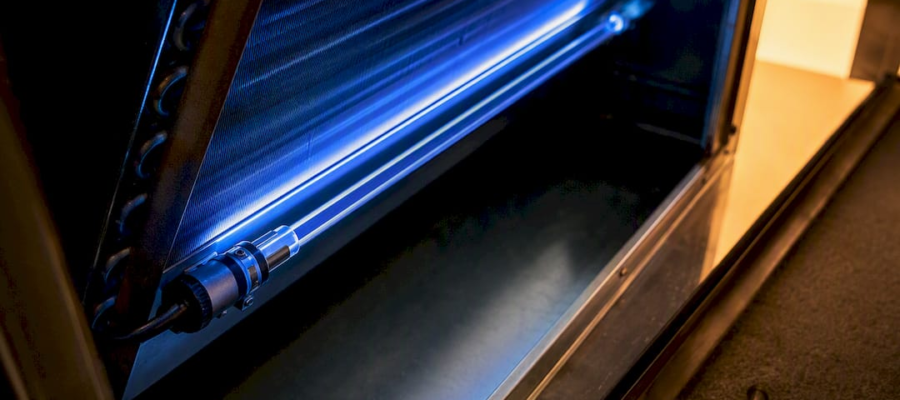
Coil-mounted UV lights sit inside the air handler, aimed directly at the evaporator coil and drain pan. That placement isn’t arbitrary. Evaporator coils stay cool and wet for hours at a time, and that combination is exactly what mold, bacteria, and biofilm need to establish themselves. A coil light bathes that surface in constant germicidal light, interrupting growth before it builds into a visible film.
Surface treatment and air treatment aren’t the same job, even though both use UVC. A coil sits in the light’s path continuously, so the required dose builds up over time rather than in a single pass. That’s why coil-mounted lights can run at comparatively modest irradiance and still work. Air moving past a duct-mounted lamp gets a fraction of a second of exposure, which is a much tougher problem, covered in the next section.
What does a coil light actually change day to day? Homeowners typically notice:
- Less musty odor coming from supply vents, since the smell is often a biofilm byproduct
- Cleaner coil fins over time, which can help the system hold onto its rated efficiency
- Fewer visible mold streaks on the coil and drain pan during seasonal maintenance checks
Coil lights are almost always left running 24/7, because the coil stays damp between cooling cycles too. Bulbs commonly need replacement on an annual basis as output fades, even when the light still appears to be on.
How Do In-Duct and Upper-Room UV Lights Disinfect the Air?
In-duct air sanitizing systems mount inside the supply or return ductwork, positioned to irradiate the air stream as it passes rather than a fixed surface. Some installations use a single high-output lamp near the air handler; others use multiple lower-output fixtures spaced along a duct run to increase total exposure.
Airborne disinfection is a fundamentally harder engineering problem than coil disinfection. Air moving at typical residential duct speeds gives microorganisms only a brief pass by the lamp, so the system needs far higher irradiance to have any real effect. Surface UVC treatments often operate around 50 to 100 microwatts per square centimeter, while effective air disinfection frequently requires output above 1,000 microwatts per square centimeter for meaningful single-pass results.

Upper-room UVGI is a different category entirely, more common in offices, waiting rooms, and other occupied public spaces than in single-family homes. Fixtures mount high on a wall or ceiling, angled so germicidal light circulates through the upper air layer without shining directly on occupants below.
A few operational distinctions matter here:
- In-duct lights are often synced to the blower fan, so they only irradiate air when it’s actually moving through the duct
- Coil lights, by contrast, typically stay on independent of fan cycles
- Fan-synced operation means duct geometry, air velocity, and lamp placement all directly affect real-world performance, not just the lamp’s rated output
Why Does UVC Wavelength and Dose Determine Real Results?
UVC covers roughly 200 to 280 nanometers, with the germicidal peak sitting near 265 nanometers. Most common HVAC lamps are low-pressure mercury bulbs emitting around 253.7 nanometers, close enough to that peak to be effective when properly engineered.
What actually determines whether a UV light does anything useful is dose, expressed as intensity multiplied by exposure time (I × t). A weak lamp positioned too far from a coil, or an in-duct fixture fighting fast-moving air, can under-deliver dramatically even while technically “working.”
UVC by the Numbers
Effective air disinfection typically needs irradiance above roughly 1,000 microwatts per square centimeter, compared with just 50 to 100 for surface applications, according to peer-reviewed analysis of UVC germicidal performance. That gap is why a lamp sized correctly for a coil can be badly undersized for duct air.
This is exactly why ASHRAE guidance warns against relying on rules of thumb for in-duct sizing and recommends engineered dose calculations instead. Newer UVC LED fixtures exist, running near 265 to 280 nanometers, but they generally still trail mercury lamps in output efficiency and need careful heat management to hold their rated performance.
What Are the Pros and Cons of Adding UV to Your System?
UV isn’t a universal fix, and treating it as one sets homeowners up for disappointment. It solves specific problems well and leaves others completely untouched.
Here’s where UV genuinely earns its place:
- Biofilm and mold control on the coil — constant exposure keeps the growth that causes musty odors from taking hold
- Odor reduction — much of that “AC smell” traces back to microbial buildup on wet coil surfaces
- Possible efficiency support — a cleaner coil transfers heat more effectively than one coated in biofilm
- Low chemical use — UV disinfects without introducing cleaning agents into the airstream
And here’s where expectations need to stay realistic:
- Not a particle or allergen solution — UV kills or damages microorganisms; it does nothing for dust, pet hair, or pollen, which is a filtration job
- Ongoing cost — bulbs degrade and typically need annual replacement regardless of how the light looks
- Material and ozone risk — mis-specified lamps can degrade certain plastics or gaskets over time, and improperly rated bulbs can generate ozone
Pro Tip: If your main complaint is a musty smell every time the AC kicks on, that’s a classic coil-biofilm signature, and coil UV usually solves it faster than any duct cleaning alone.
Recurring coil mold after cleanings is the strongest case for UV. Persistent dust or allergy symptoms point toward filtration and ventilation first.
What Should Go on an Installation and Safety Checklist?
Before anyone installs a UV light in your system, a short checklist saves you from paying for the wrong fixture in the wrong spot.
Placement questions come first:
- Is the lamp going on the coil and drain pan, or inside the return duct?
- Are nearby plastic components, wiring insulation, or gaskets rated for UV exposure, or do they need shielding?
Safety can’t be an afterthought either, since these lamps produce light strong enough to burn skin and eyes on contact. AHRI-aligned industry guidance recommends protecting non-UV-resistant materials and running coil systems continuously for consistent results. Technicians should always disconnect power before servicing a fixture, use interlocks or lockout/tagout procedures on access panels, and wear gloves, since skin oils on a bulb reduce its output.
Pro Tip: Ask your installer for the lamp’s rated dose at your specific coil distance, not just its wattage. Wattage alone doesn’t tell you what the coil is actually receiving.
Maintenance follows a simple rhythm: wipe dusty bulbs with alcohol, replace lamps annually as intensity fades, and recycle old bulbs properly since they contain small amounts of mercury.

What Does the Research Actually Show About UV Effectiveness?
The clearest finding across engineering literature is the gap between surface and air disinfection requirements. Surface treatments need far less irradiance because coils sit in continuous exposure, while air disinfection demands intensity many times higher to compensate for the brief contact time as air rushes past.
Case evaluations cited by ASHRAE found that properly engineered in-duct proposals could reach roughly 90% reduction for airborne SARS-CoV-2 when the dose calculation accounted for plenum length, lamp placement, and air velocity, but that level of performance came with real cost and design complexity.
UVGI effectiveness depends on dose, not on the presence of a lamp. A fixture that isn’t sized to the duct’s air velocity and geometry can underperform badly compared to its rated output, which is why ASHRAE recommends engineered dose calculations over generic sizing charts.
The EPA’s own position reinforces this: UV works as a supplementary tool alongside filtration and ventilation, not as a replacement for either.
A Field Perspective on When UV Actually Makes Sense
Over more than a decade in HVAC systems across the region, the pattern is consistent: coil-mounted UV solves recurring musty odors and coil mold far more often than it solves dust or allergy complaints, which point to filtration instead. If your system keeps growing biofilm after cleanings, that’s when we recommend it. If you’re in New York, New Jersey, or Connecticut and want a straight answer on which fits your property, an assessment settles it quickly.
— Victor
How to Get UV Installed the Right Way in Your Home
Amazonairpro is the practical alternative to guessing which lamp to buy online: our technicians handle sizing, placement, and safe installation so you’re not the one calculating dose calculations off a manufacturer’s chart. With over 10 years serving New York, New Jersey, and Connecticut, we install coil-mounted UV systems sized to your actual coil, not a generic kit.

A typical assessment visit includes inspecting your coil and drain pan for existing biofilm, checking duct access for in-duct options, and confirming your system’s airflow before recommending a fixture. We often pair UV installation with evaporator coil and blower cleaning when a coil already shows buildup, since starting clean makes the UV lamp’s job easier from day one. If your property is in our New York, New Jersey, or Connecticut service area, book a UV light installation assessment and get a straight recommendation based on what’s actually happening inside your system.
Where to Read More on UV and HVAC Standards
Readers who want the underlying technical detail behind these recommendations can go straight to the source material:
- ASHRAE’s Schoen analysis covers dose calculation methodology and case studies for in-duct UVGI sizing.
- AHRI’s air filtration and UV treatment overview details placement guidance and maintenance recommendations from equipment manufacturers.
- Peer-reviewed research on UVC germicidal mechanisms explains wavelength science and the irradiance gap between surface and air disinfection.
- EPA guidance on UV and mold frames realistic expectations for UV as part of a broader indoor air quality approach.
- For contractor-level detail on lamp swaps and service intervals, Ricotta Heating & Air’s UV maintenance guide is a useful supplementary read.
Sources
- PMCID: PMC8683362
- Evaluating Ultraviolet — ASHRAE (Schoen)
- Air filtration and ultraviolet light treatment (AHRI)
- Does ultraviolet (UV) radiation / UV lamps kill mold? — EPA
FAQ
Which UV Light Is Best for an HVAC System?
For most homes, coil-mounted UV is the better starting point because it targets the coil’s constant moisture problem with a comparatively simple, low-maintenance setup. In-duct air UV makes more sense when airborne microorganism control is the specific goal, but it requires more careful sizing to work as intended.
What Are the Three Types of UV Light?
Ultraviolet light splits into UVA, UVB, and UVC. UVC, spanning roughly 200 to 280 nanometers with a germicidal peak near 265 nanometers, is the band used in HVAC systems because it damages microbial DNA effectively.
Do UV Lights in HVAC Systems Really Work?
Coil-mounted UV lights reliably reduce biofilm and mold buildup on evaporator coils, since the coil sits in continuous exposure. In-duct air systems can work too, but ASHRAE-style engineered dose calculations matter far more for air treatment than for surface treatment.
Should HVAC UV Light Stay on All the Time?
Coil-mounted UV lights are typically left running 24/7, since the coil stays damp between cooling cycles even when the system is off. In-duct air lights are often synced to the blower fan instead, since they only need to run when air is actually moving past the lamp.
How Much Does UV Light Installation Cost Through Amazonairpro?
Pricing depends on your system’s size and the fixture type needed, so current pricing is available directly through Amazonairpro’s UV light installation page or by requesting an assessment.
Recommended
- Professional UV Light Installation in NY & NJ
- UV Light Installation in Norwalk, CT
- Myth vs. Fact: Do HVAC UV Lights Actually Work for Coastal Homes?
- UV Light Installation Stamford CT | 10+ Years Trusted