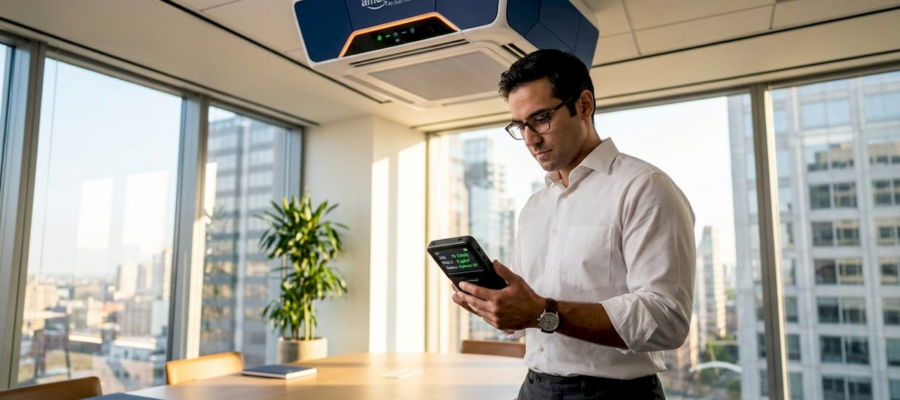
How air purification enhances commercial indoor air quality
TL;DR:
- Air purifiers are a valuable component of a comprehensive indoor air quality strategy but require proper integration with source control and ventilation to be effective.
- In commercial buildings, pollutants like PM, VOCs, and biological contaminants accumulate silently, impacting health and productivity without triggering alarms.
- The most effective approach involves multi-stage purification technology, strategic placement, routine maintenance, and ongoing monitoring to ensure optimal IAQ outcomes.
Air purifiers have become a fixture in office lobbies, conference rooms, and retail floors, and it’s easy to assume that plugging one in solves the problem. The reality is more nuanced. Indoor air quality requires source control and ventilation working together with purification, not just a device humming in the corner. For business owners and facility managers, understanding how these pieces fit together is the difference between genuinely healthier air and the appearance of action. This guide lays out exactly how purification fits into a complete, effective IAQ strategy for commercial buildings.
Table of Contents
- Why air purification matters in commercial buildings
- How commercial air purification works: methods and mechanics
- The “layered” IAQ approach: integration with ventilation and source control
- Real-world results and limitations: what actually happens in practice
- Optimizing results: placement, sizing, and when purification matters most
- What most facility managers miss about air purification
- Ready to improve your building’s air quality?
- Frequently asked questions
Key Takeaways
| Point | Details |
|---|---|
| Layered approach is best | Effective air quality uses air purification as a supplement to ventilation and source control. |
| Match technology to need | Choose purification methods based on specific pollutants and building use. |
| Real-world testing matters | Continuous monitoring and flexible operation are key to reliable results in commercial spaces. |
| Maintenance ensures performance | Regularly changing filters or UV components is essential for effective air cleaning. |
| Air purifiers aren’t stand-alone solutions | They provide significant value only as part of a comprehensive building IAQ strategy. |
Why air purification matters in commercial buildings
Commercial buildings present air quality challenges that residential spaces simply don’t face at the same scale. High occupancy means more carbon dioxide, more body odor compounds, and more respiratory droplets circulating through shared air. Diverse activities, from printing and cleaning to cooking in break rooms and applying personal care products, introduce a constant mix of pollutants that no single measure can address alone.
The pollutants you can’t see are often the ones causing the most harm. Particulate matter (PM2.5 and PM10), volatile organic compounds (VOCs) from furniture and cleaning products, and biological contaminants like mold spores and bacteria don’t trigger alarms the way a smoke detector does. They accumulate quietly, affecting cognitive performance, respiratory health, and absenteeism over time. The importance of indoor air quality becomes very clear when you connect it to employee productivity and tenant satisfaction data.
Here’s the core issue: most commercial HVAC systems are designed for thermal comfort and basic ventilation, not comprehensive air cleaning. That gap is where purification becomes valuable. Key pollutant categories that standard HVAC alone doesn’t fully address include:
- Particulate matter (dust, pollen, mold spores, fine combustion particles)
- Volatile organic compounds (off-gassing from carpets, furniture, adhesives, cleaning agents)
- Biological contaminants (bacteria, viruses, allergens)
- Carbon dioxide buildup in high-occupancy meeting rooms and open-plan areas
- Chemical pollutants from printing equipment, cooking, and pest control
“The EPA consistently recommends source control, ventilation, and air cleaning as the foundational strategies for improving commercial indoor air quality. Purification is a crucial layer, but it works best when the other two pillars are already in place.”
Understanding air purification for businesses starts with accepting that no single device is a complete solution. The buildings that get IAQ right treat purification as one essential component in a coordinated system.
How commercial air purification works: methods and mechanics
Knowing the “why” behind air purification, let’s break down “how” these technologies function and what options you can actually specify for your building.
Air purification methods fall into three broad categories, each targeting a different class of pollutant. The most effective commercial systems use a multi-stage approach that combines two or more of these technologies in a single unit or across a coordinated system.

| Technology | Target pollutants | Best application |
|---|---|---|
| HEPA filtration | Particles, dust, pollen, mold spores, PM2.5 | General occupancy, healthcare, offices |
| Activated carbon | VOCs, odors, gases, chemical compounds | Labs, print rooms, break areas |
| UV-C germicidal | Bacteria, viruses, mold spores | Healthcare, high-traffic areas, HVAC coils |
| Electrostatic precipitators | Fine particles, smoke | Industrial, high-dust environments |
| Bipolar ionization | Particles, some VOCs, microbes | Whole-building HVAC integration |
The deployment model matters as much as the technology itself. You have three main options for commercial settings:
- Whole-building integration: Units installed directly within your HVAC air handling equipment, treating all circulated air. Best for consistent coverage across large floor plates.
- Zone-based units: Standalone or ceiling-mounted units in high-priority areas like conference rooms, waiting areas, or production floors. Targeted and easier to scale.
- Portable units: Flexible and cost-effective for temporary needs or areas with changing occupancy, but limited in coverage area.
Pro Tip: When specifying a commercial air purifier, look for the Clean Air Delivery Rate (CADR) rating and match it to at least two-thirds of the room’s square footage. A unit rated for 300 square feet won’t meaningfully clean a 1,000-square-foot open-plan area, no matter how advanced the filter media is.
No single purification method addresses every pollutant category, which is why proper selection and sizing are so critical. A HEPA filter does nothing to reduce VOC levels, and an activated carbon filter won’t stop a virus from spreading. You need to match the technology to your building’s actual pollutant sources, not just buy the most expensive unit available.

Maintenance is also non-negotiable. HEPA filters lose efficiency as they load with particles. Carbon beds become saturated and stop adsorbing gases. UV-C lamps degrade over time and must be replaced on schedule, typically every 12 months. These are not optional upkeep tasks. They are the reason your system either performs or doesn’t. Check out air purification technology options for a deeper breakdown of what works in specific commercial contexts. And if you’re managing a larger portfolio, facility HVAC maintenance tips can help you build maintenance schedules that keep performance consistent.
The “layered” IAQ approach: integration with ventilation and source control
Now that you know the technologies, see how purification complements other IAQ pillars for maximum occupant protection and regulatory compliance.
EPA and ASHRAE are consistent on this point: effective commercial IAQ is not a one-step fix. ASHRAE Standard 241, which focuses on infection risk reduction, centers on achieving “equivalent clean airflow” through a combination of strategies. The layered approach works like this:
- Source control: Address pollutants where they originate. Switch to low-VOC cleaning products and paints, improve waste management, isolate high-emission equipment like laser printers, and use moisture control to prevent mold growth. This is the most cost-effective IAQ intervention available because it reduces the total pollutant load before it ever enters the breathing zone.
- Ventilation: Bring in fresh outdoor air to dilute contaminants that source control doesn’t eliminate. ASHRAE 62.1 sets minimum outdoor air rates for commercial occupancies, but simply meeting minimums isn’t always enough in high-occupancy situations. Energy recovery ventilators (ERVs) are increasingly common because they deliver fresh air without spiking energy costs.
- Air purification: Filter or inactivate what ventilation can’t remove. This is where your HEPA, carbon, and UV-C technologies do their work, capturing particles and neutralizing microbes in the recirculated air stream.
- Monitoring and adjustment: Real-time air quality sensors let you see when CO2 climbs in a packed conference room or when PM2.5 spikes during construction nearby. This data closes the loop and lets you adjust ventilation rates or purification capacity dynamically.
| IAQ layer | Primary function | Limitation |
|---|---|---|
| Source control | Reduces total pollutant load | Requires behavioral and material changes |
| Ventilation | Dilutes pollutants with fresh air | Energy cost, outdoor air quality dependence |
| Air purification | Removes/inactivates specific pollutants | Technology-dependent, requires maintenance |
| Monitoring | Identifies gaps and guides adjustments | Adds cost, requires interpretation |
Pro Tip: Before investing in additional purification equipment, audit your ventilation rates. In many commercial buildings, practical indoor air quality steps like simply increasing outdoor air delivery by 20 to 30 percent during occupied hours can have a bigger impact than adding more purification devices.
Real-world IAQ improvement depends on matching strategies to your specific pollutants and space usage, not just activating equipment. A well-designed step-by-step IAQ improvement process always starts with understanding what you’re actually dealing with before specifying solutions.
Real-world results and limitations: what actually happens in practice
With the technical framework in mind, it’s time to look at real data: how purification measures up when the doors are open, meetings are in session, and people are moving around.
The research picture is genuinely mixed, and that’s worth acknowledging directly. Real-world performance frequently differs from laboratory benchmarks because occupant behavior, building construction, and outdoor conditions introduce variability that controlled testing doesn’t replicate.
Here are the most relevant findings for your planning:
- A classroom study from South Korea found that air purifiers reduced PM10, PM2.5, and CO2 by over 21% in restricted-ventilation conditions, demonstrating real value in scenarios where opening windows isn’t practical or safe.
- Research into viral exposure specifically found that HEPA-based air cleaning does not consistently reduce all viral exposure outcomes, meaning you cannot rely on a single purifier to make a meeting room genuinely low-risk during an active illness event.
- Studies consistently show that undersized or poorly placed units produce little measurable improvement, even when the technology is correct.
“The takeaway from the research is not that air purification doesn’t work. It’s that air purification works best when you’ve correctly identified your pollutant sources, matched the technology to those sources, sized the system appropriately, and kept it maintained.”
The office air quality impact on productivity and absenteeism is well-documented, but those gains only materialize when the purification strategy is actually effective. Facility managers who buy devices and then forget about them for two years are often investing in equipment that stopped performing months earlier.
Setting clear, measurable IAQ goals before you purchase equipment also matters. Are you targeting PM2.5 reduction? VOC levels? CO2 in specific zones? Defining the outcome you want makes it possible to verify whether your investment is working.
Optimizing results: placement, sizing, and when purification matters most
Finally, let’s zero in on the on-the-ground actions that make purification investments pay off in busy, variable commercial settings.
Placement is genuinely underrated. CDC/NIOSH aerosol modeling shows that air cleaner location and airflow configuration can reduce inhalation exposures by up to 93% when optimized, compared to much smaller reductions when units are placed without considering room airflow. That’s a massive performance gap driven entirely by where you put the machine.
Follow these steps to maximize placement and sizing effectiveness:
- Map your airflow first. Identify supply and return vents, understand how air moves through each zone, and locate dead zones where air stagnates. Purifiers placed in dead zones circulate clean air back into stagnant pockets, not into the general breathing zone.
- Position units at occupant height or near pollutant sources. For particulates and germs, breathing-zone placement (roughly 3 to 5 feet off the floor) is more effective than ceiling-mounted units in low-ceiling spaces.
- Size for actual occupancy, not just floor area. A conference room that holds 20 people for two hours at a time needs significantly higher clean air delivery than a private office with one occupant.
- Plan for edge cases. Construction phases, wildfire smoke events, or nearby traffic pollution spikes are times when air purifiers deliver their most critical value. Having portable backup units staged and ready is a smart contingency for facilities in New York, New Jersey, and Connecticut, where outdoor air quality varies seasonally.
- Schedule filter and lamp replacements in your maintenance calendar. Tie these to your existing HVAC service intervals so they don’t get overlooked.
Pro Tip: Plants can provide supplemental air cleaning in low-traffic areas and contribute to occupant wellbeing, though they are not a substitute for mechanical filtration. Pairing them with a solid HVAC maintenance routine creates a healthier baseline that makes every purification investment go further.
Periodic air quality monitoring, even quarterly spot checks with a portable sensor, gives you real data to justify equipment costs, identify gaps, and guide future upgrades. It also demonstrates due diligence to tenants, employees, and any regulatory requirements you may be working within.
What most facility managers miss about air purification
After years of working in commercial buildings across New York, New Jersey, and Connecticut, here’s a perspective that doesn’t show up in most equipment brochures: the biggest obstacle to effective air purification isn’t technology selection, it’s how the equipment is integrated into the facility’s operational culture.
Too many managers treat air purification as a plug-and-play installation. The device goes in, someone flips a switch, and the assumption is that IAQ is handled. The underlying value of proactive air quality management is only realized when purification is treated as an ongoing process, not a one-time purchase.
The most effective facility teams we encounter do a few things differently. They track outcomes, not just equipment specs. They collect occupant feedback alongside sensor data and look for correlations between IAQ performance and absenteeism or productivity trends. They also adjust their strategies seasonally, running higher purification capacity during pollen season or when nearby construction kicks up dust, and scaling back when conditions are favorable to save energy.
There’s also an occupant communication piece that’s consistently overlooked. When employees and tenants understand that the building has an active IAQ strategy, they’re more likely to report concerns early, follow ventilation protocols, and avoid behaviors that undermine air quality. That’s not a soft benefit. It’s a real operational advantage.
Bench-test performance is just the starting point. Real-world results come from pairing good technology with smart placement, regular maintenance, and a team that treats clean air as a measurable, manageable outcome rather than a background feature of the building.
Ready to improve your building’s air quality?
If this guide has clarified where air purification fits in your IAQ strategy, the next practical step is making sure your duct system is clean enough to support it. Dirty ductwork recirculates dust, mold spores, and debris through every space in your building, undermining even the best purification equipment.

At Amazon Air Duct Cleaning, we specialize in commercial air duct cleaning for facilities across New York, New Jersey, and Connecticut. Our team has over 10 years of experience helping business owners and facility managers build a cleaner foundation for their IAQ strategies. Before you add new purification equipment, use our duct cleaning checklist to assess where your system stands. Then contact us to schedule a professional evaluation and take the guesswork out of your next step.
Frequently asked questions
What is the most effective air purification technology for commercial buildings?
The most effective approach combines HEPA filters for particles, activated carbon for gases and VOCs, and UV-C for pathogens, but no single method addresses all pollutant types, so technology must be matched to your building’s specific pollutant profile.
Can air purifiers replace ventilation systems in offices?
No. Air purification should supplement ventilation and source control, not replace them, because purifiers cannot replicate the dilution effect of fresh outdoor air or eliminate pollutants at their source.
How do I know if my air purifier is working in my building?
Use real-time air quality monitors to track PM2.5, VOC, and CO2 levels before and after installation, and verify that filter and UV lamp maintenance is on schedule, since degraded components directly reduce real-world performance.
When is air purification most critical in a commercial setting?
Purification delivers its highest value during poor outdoor air conditions such as wildfire smoke events or high traffic pollution days, during high occupancy periods, or in zones where ventilation is restricted by building design.
Does air purification reduce viral transmission risks?
Air purification can reduce some airborne viral risks, but HEPA-based air cleaning does not consistently reduce all viral exposure outcomes, so proper targeting, sizing, and layering with ventilation are essential for meaningful risk reduction.
Recommended
- Improving Air Quality in Your Business (11% Productivity Boost?)
- Best air purification options: a complete list for cleaner air – Amazon Air Duct Cleaning
- Plants to improve indoor air quality – Amazon Air Duct Cleaning
- Improve indoor air quality: steps for healthier spaces – Amazon Air Duct Cleaning