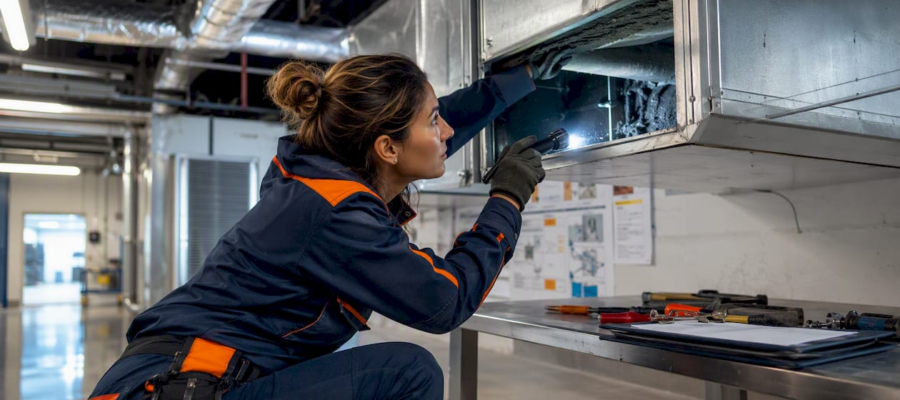
Clinic Air Management Guide for NY/NJ/CT Facility Managers
TL;DR:
- Effective clinic air management relies on a written Ventilation Management Program, regular condition-based inspections, and verified cleaning only when contamination occurs.
- Hiring NADCA-qualified contractors and maintaining detailed documentation supports compliance and enhances occupant safety.
Effective clinic air management comes down to four non-negotiable actions: establish a written Ventilation Management Program (VMP) with named owners, run condition-based annual inspections of every air-handling unit (AHU) and duct zone, engage a NADCA-qualified contractor only when inspection confirms a cleaning trigger, and verify results with airflow, pressure, and particle documentation before reoccupying affected spaces. Here is the immediate handoff list for your clinical or vendor team:
- Check AIIR differential pressure monitors today and log the reading.
- Schedule a visual inspection of each AHU regularly.
- Tag any space with suspected contamination, odors, or recent water intrusion as a hold zone.
- Pull your current VMP (or note that one does not exist) and identify the named owner.
- Confirm your cleaning contractor holds NADCA membership and employs ASCS-certified technicians.
Pro Tip: Never schedule duct cleaning before you have identified and controlled the moisture or debris source. Cleaning contaminated ducts while the source remains active guarantees repeat contamination within months.
Table of Contents
- What ASHRAE/ASHE Standard 170 and Guideline 43 require for clinic ventilation
- When do inspections and cleaning become necessary?
- What a Ventilation Management Program must include
- What professional HVAC and duct cleaning for clinics must include
- How to hire a contractor for clinical HVAC and duct cleaning
- Timeline, cost drivers, and disruption planning
- How to verify cleaning was effective and what records to keep
- Key Takeaways
- What facility managers often get wrong about clinic cleanings
- Amazonairpro serves clinics across NY, NJ, and CT
- Useful sources for clinic air management
- FAQ
What ASHRAE/ASHE Standard 170 and Guideline 43 require for clinic ventilation
ANSI/ASHRAE/ASHE Standard 170-2025 is the enforceable baseline. It sets minimum air change rates, pressurization relationships, filtration classes, and humidity bands for every space type in a health care facility. Outpatient clinics are subject to Standard 170, though the 2017 revision significantly redefined outpatient requirements, so older clinic builds may not meet current minimums without upgrades.

ASHRAE/ASHE Guideline 43 is advisory, not enforceable, but it is the operational playbook that translates Standard 170 into day-to-day management. ASHE’s goal is for CMS to recommend Guideline 43 as the reference document for ventilation management, much as CMS already does for water management programs. Adopting it now puts your facility ahead of that expectation.
Minimum items your team must track under Standard 170 and Guideline 43:
- ACH rates by space type (e.g., appropriate ACH targets for AIIRs and acute care patient rooms)
- Pressure relationships: AIIRs negative to corridor; protective environment rooms positive
- Filter differential pressure readings and replacement schedules
- Relative humidity within the 40%–60% range for patient spaces
- Monitoring frequencies for high-risk spaces as defined in Guideline 43
Guideline 43 recommends monitoring high-risk spaces such as AIIRs and operating rooms more frequently than general clinic areas — daily pressure checks for AIIRs and at minimum quarterly airflow verification for other clinical zones. Annual visual inspections of AHUs and supply/return ductwork are the recommended baseline for all healthcare HVAC components.
When do inspections and cleaning become necessary?
Clean only when inspection or testing shows contamination that affects system performance or occupant safety. Scheduling cleaning on a fixed calendar without a confirmed trigger wastes money and can actually disturb settled debris that would otherwise stay inert.
Clean when any of the following conditions are present:
- Visible debris discharging from supply registers into occupied spaces
- Persistent, unacceptable odors that cannot be traced to a non-HVAC source
- Mold at Condition 2 (settled spores, staining) or Condition 3 (active growth) per NADCA/IICRC definitions
- Contamination following construction, renovation, fire, smoke, or water damage events
- Confirmed pest infestation within ductwork
- Compromised system performance: filter bypass, reduced airflow, or failed pressure relationships
Condition 1 means the system is clean and no remediation is needed. Condition 2 indicates contamination that cleaning can address. Condition 3 requires remediation before cleaning proceeds. For post-construction or post-damage events, initiate inspection within 72 hours of the event and complete remediation before reoccupying affected clinical spaces.
“Duct cleaning should be a last resort and only after the contaminant source is identified and controlled.” — NIH/DOHS Fact Sheet on HVAC Duct Cleaning
When the trigger is ambiguous, use NADCA Method 2 surface comparison tests or vacuum tests to make an objective, documented decision rather than a judgment call.
What a Ventilation Management Program must include
A written VMP with named owners and defined condition indicators is the operational core of any clinic air management strategy. Without it, inspections happen inconsistently, excursions go unlogged, and accreditation auditors have nothing to review.
Core VMP components:
- A designated VMP committee with representation from facilities operations and clinical leadership
- A complete space inventory with risk ranking (AIIR, OR, general patient room, waiting area)
- Defined condition indicators: ACH targets, pressure differentials, filter differential thresholds
- A monitoring schedule with assigned staff and logging formats
- Excursion response procedures: who is notified, what interim measures are taken, when reoccupation is permitted
- Documentation and training records retained for accreditation and CMS review
The flow of responsibility runs: facilities operations monitors and logs daily/weekly indicators; clinical leadership communicates high-risk activities (aerosol-generating procedures, isolation patients) to facilities in advance; vendor teams are called for remediation events with a written scope and post-work report filed back into the VMP record. ASHE’s infection control guidance is direct on this point: frequent, clear communication between clinical and facility teams is best practice, not optional.
Pro Tip: Update your VMP before construction begins, not after. Renovation dust is one of the most common contamination triggers in clinic HVAC systems, and a pre-construction HVAC protection plan should be a named section of every infection control risk assessment (ICRA).
What professional HVAC and duct cleaning for clinics must include
Clinical HVAC cleaning must be targeted, documented, and aligned to NADCA ACR standards and infection-control protocols. A cosmetic sweep of visible registers does not meet the standard and will not satisfy a TJC or CMS reviewer.

| Task | Purpose | Minimum evidence of completion |
|---|---|---|
| AHU access and full inspection | Identify coil fouling, drain pan contamination, and filter bypass | Signed ASCS inspection checklist with photos |
| Coil and condensate pan cleaning | Remove biofilm and standing water that feed microbial growth | Before/after photos; pan dry and clean on final inspection |
| Fan compartment cleaning | Eliminate debris that degrades airflow and harbors pathogens | Photo documentation; balometer airflow reading post-clean |
| Supply and return duct cleaning | Remove accumulated dust, debris, and contamination | HEPA vacuum log; before/after photos at access points |
| Containment and negative air | Protect occupied spaces during work | Negative air machine placement log; pressure differential maintained |
| Surface testing (if indicated) | Confirm post-cleaning cleanliness meets NADCA ACR criteria | Written test results with pass/fail against accepted threshold |
Safety requirements vendors must follow:
- Schedule work during low-occupancy hours (nights, weekends) per NIH/DOHS guidance
- Use HEPA-filtered negative air machines and seal off supply/return openings in occupied zones
- Do not apply biocides to fiberglass duct liner or porous materials; replacement is the correct remedy
- Protect filters in adjacent zones from dislodged debris during cleaning
Pro Tip: If your ductwork includes original fiberglass duct board that shows surface deterioration or mold, budget for replacement rather than cleaning. Cleaning damaged fiberglass releases fibers and does not eliminate embedded contamination.
How to hire a contractor for clinical HVAC and duct cleaning
Require NADCA membership, ASCS-certified technicians, written method statements, liability and pollution insurance, and clear deliverables before any contractor sets foot in a clinical space.
Step-by-step procurement checklist:
- Prequalification: Confirm NADCA membership and at least one ASCS-certified technician on the crew. Ask for references from healthcare jobs specifically.
- Scope confirmation: Require a written scope of work referencing NADCA ACR and your facility’s space inventory before pricing.
- Insurance and credentials: Obtain certificates of general liability, workers’ compensation, and pollution liability insurance.
- Testing and acceptance criteria: Specify which tests will be used (balometer, particle counter, NADCA surface tests) and what pass thresholds apply.
- Post-work documentation: Require before/after photos, a signed ASCS component checklist, airflow readings, and a written report within five business days of completion.
Contract clauses to include:
- Accepted test methods and pass/fail thresholds written into the scope
- Remediation limits: define what triggers a rework hold before reoccupation
- Evidence deliverables: photos, test results, and component checklists
- Record retention period aligned to your accreditation cycle (typically three years minimum)
- Change-order procedures for unexpected conditions (mold Condition 3, damaged components)
Questions worth asking every vendor: How do you contain work in an occupied clinical building? What negative air equipment do you use? Have you worked in AIIRs or ORs? What is your process if you find mold during cleaning?
Timeline, cost drivers, and disruption planning
Projects range from a same-day single-zone cleaning to a multi-day AHU and full duct system remediation. Costs are driven by access complexity, contamination level, containment requirements, and whether after-hours scheduling is needed.
Typical timeline estimates:
- Small zone (one AHU, limited ductwork): 4–8 hours, often completable in one overnight shift
- Mid-size clinic (2–4 AHUs, multiple zones): 2–3 days with phased zone isolation
- Full facility remediation (post-construction or post-water damage): 5–10 days depending on scope and mold conditions
Primary cost drivers:
- AHU access difficulty and number of units
- Contamination level (Condition 2 vs. Condition 3 requiring remediation)
- After-hours or weekend scheduling premiums
- Component replacement (coil sections, duct board, drain pans)
- Particle testing and third-party verification fees
Minimize disruption by phasing work zone by zone, communicating with clinical leadership at least two weeks in advance, and designating temporary isolation spaces for any patients who cannot be relocated during HVAC work.
Pro Tip: Consider including a contingency in your cleaning budget to cover unforeseen conditions such as porous material replacement or mold remediation. Discovering Condition 3 mold mid-project without budget flexibility forces rushed decisions that compromise both safety and documentation quality.
How to verify cleaning was effective and what records to keep
Accept work only after objective verification, meaning visual evidence plus performance testing. A verbal “all clear” from the contractor is not sufficient for accreditation purposes.
Required deliverables before signing off:
- Before/after photographs of every AHU component and duct access point
- HVAC component checklist signed by an ASCS-certified technician
- Balometer airflow readings confirming ACH targets are met post-cleaning
- Filter differential pressure gauge readings confirming proper installation
- Particle count results if testing was specified in the contract
- Written report summarizing work completed, any corrective actions taken, and components replaced
Retain all records for a minimum of three years, or longer if your accreditation body requires it. File documentation directly into your VMP committee meeting minutes so the record is traceable during a TJC or CMS audit.
If verification fails, issue a documented rework order and hold reoccupation of the affected space until a second round of testing passes. Never reopen a clinical space based on contractor assurance alone.
Pro Tip: Tag each verification report with the space identifier from your VMP space inventory. Auditors look for traceability between the VMP space list and the cleaning/testing records. A mismatch in naming conventions is a common, avoidable finding.
Key Takeaways
A compliant clinic air management program requires a written VMP, condition-based inspections, NADCA-qualified contractors, and objective post-cleaning verification retained for accreditation review.
| Point | Details |
|---|---|
| Written VMP with named owners | Assign a VMP committee with facilities and clinical representation before any cleaning is scheduled. |
| Annual AHU inspections | Conduct regular inspections; monitor AIIRs frequently for pressure and airflow. |
| Trigger-based cleaning only | Clean when inspection confirms a Condition 2/3, odor, debris, or post-event trigger, not on a fixed calendar. |
| NADCA/ASCS contractor required | Require NADCA membership, ASCS certification, written scope, and pollution insurance before work begins. |
| Amazonairpro for NY/NJ/CT clinics | Amazonairpro provides NADCA-aligned commercial HVAC cleaning with documented verification deliverables across New York, New Jersey, and Connecticut. |
What facility managers often get wrong about clinic cleanings
Most facility managers I speak with treat HVAC cleaning as a maintenance checkbox rather than a clinical safety event. That framing leads to the most common and costly mistakes: scheduling cleaning on a calendar rather than a trigger, accepting a contractor’s verbal sign-off instead of a written verification report, and failing to loop in clinical leadership until work has already started.
The coordination piece is where things break down most often. Facilities teams know the mechanical side, but clinical leaders know which spaces are housing high-risk patients, which procedures are scheduled, and which zones cannot tolerate even brief pressure disruptions. When those two teams plan together before a project, the work gets done faster, safer, and with far less rescheduling. Document every coordination decision in the VMP. If an auditor asks why a particular space was cleaned on a particular date, the answer should be in writing, not memory.
Amazonairpro serves clinics across NY, NJ, and CT
Clinic managers in New York, New Jersey, and Connecticut have a local option that aligns directly with the procurement checklist above. Amazonairpro provides commercial HVAC and duct cleaning with NADCA-aligned methods, ASCS-trained technicians, and the documented verification deliverables your accreditation records require.

Services relevant to clinical facilities include AHU coil and blower cleaning, evaporator coil cleaning, commercial duct cleaning with HEPA containment, condenser coil cleaning, UV light installation, and antimicrobial duct treatment where appropriate. Every job includes before/after photographic documentation and a written report you can file directly into your VMP records.
Amazonairpro has served commercial and healthcare-adjacent clients across NY, NJ, and CT for over 10 years. To request a scope review or book an assessment for your clinic, visit the air duct cleaning service page or call to discuss your facility’s specific needs.
Useful sources for clinic air management
These are the primary documents your VMP committee should retain and reference:
- Design and operational minimums: ANSI/ASHRAE/ASHE Standard 170-2025 — the enforceable baseline for ACH, pressurization, filtration, and humidity in health care facilities.
- Operations and monitoring guidance: ASHRAE/ASHE Guideline 43 — the VMP framework, condition indicators, monitoring cadences, and excursion response procedures.
- Cleaning scope and contractor qualifications: NADCA ACR 2021 Standard — defines acceptable methods, inspection minimums, and ASCS certification requirements.
- Occupant protection and when to clean: NIH/DOHS Fact Sheet on HVAC Duct Cleaning — covers containment requirements, biocide restrictions, and the “last resort” principle.
- Infection control and HVAC: ASHE Infection Control Guidance for Facility Managers — connects HVAC maintenance to airborne transmission prevention and pressure monitoring tools.
FAQ
What is a Ventilation Management Program and does my clinic need one?
A VMP is a written operational plan that assigns responsibility for monitoring, maintaining, and documenting your clinic’s HVAC system. ASHRAE/ASHE Guideline 43 provides the framework, and adopting it supports CMS and accreditation expectations.
How often should clinic HVAC systems be inspected?
At minimum, conduct annual visual inspections of all AHU components and ductwork; check AIIR pressure relationships daily and verify airflow quarterly for high-risk clinical spaces per Guideline 43 recommendations.
When is duct cleaning actually required in a clinic?
Cleaning is indicated when inspection confirms visible debris discharge, persistent odors, mold at Condition 2 or 3, or contamination following construction, water, fire, or smoke events — not on a fixed schedule without a confirmed trigger.
What certifications should a clinic HVAC cleaning contractor hold?
Require NADCA membership and at least one ASCS-certified technician on every crew, along with general liability, workers’ compensation, and pollution liability insurance before work begins.
Can Amazonairpro handle clinical HVAC cleaning in NY, NJ, and CT?
Yes. Amazonairpro provides NADCA-aligned commercial duct and HVAC cleaning with HEPA containment, documented verification reports, and ASCS-trained technicians serving New York, New Jersey, and Connecticut.
Recommended
- Indoor air quality guide for NY, NJ & CT homeowners – Amazon Air Duct Cleaning
- Spring AC Maintenance Checklist for White Plains Facility Managers
- Property Manager HVAC Essentials: Your 2026 Field Guide – Amazon Air Duct Cleaning
- Hospital Air Cleaning Protocols: 2026 Compliance Guide – Amazon Air Duct Cleaning