Tenant Ventilation Care Guide for Renters
Those five habits cover the majority of moisture problems tenants face in New York, New Jersey, and Connecticut apartments. This tenant ventilation care guide walks you through every step, from spotting early warning signs to documenting problems and knowing when to call a professional.
Do these today:
- Turn on bathroom and kitchen exhaust fans right now and verify they actually push air out
- Wipe any visible condensation off windows and window frames
- Pull furniture a few inches away from exterior walls to allow air circulation
- Take dated photos of any damp spots, mold patches, or condensation you see
Pro Tip: If you can already see mold, smell something musty, or anyone in the household is experiencing unexplained allergy symptoms, stop adding moisture to that space immediately, document everything with photos and written notes, and notify your landlord in writing today. Do not wait.
Key Takeaways
Good ventilation habits, consistent humidity monitoring, and clear documentation are the three things that separate tenants who stay ahead of moisture problems from those who deal with repeated mold remediation.
| Point | Details |
|---|---|
| Run exhaust fans consistently | Use bathroom fans during and 15–20 minutes after showers; run kitchen fans while cooking. |
| Keep humidity between 30–50% | Use an inexpensive hygrometer and a dehumidifier if readings consistently exceed 50% RH. |
| Document everything in writing | Dated photos, humidity logs, and written notices are your strongest tools in any landlord dispute. |
| Know the EPA threshold | Professional remediation is recommended for mold areas larger than approximately 10 square feet or mold inside HVAC systems. |
| Amazonairpro for professional service | Amazonairpro provides duct, dryer vent, and chimney cleaning across NY, NJ, and CT for renters who need professional help. |
Table of Contents
- What does ventilation actually mean for your health and air quality?
- How do you recognize poor ventilation in your apartment?
- Everyday ventilation habits that make a real difference
- How to measure and control humidity in your rental
- What HVAC and vent maintenance can you do as a tenant?
- How to document and report ventilation problems to your landlord
- When should you call a professional instead of handling it yourself?
- How to safely clean small mold patches yourself
- Quick fixes for common tenant moisture problems
- How to ventilate without wasting heat or cooling
- A simple monthly, quarterly, and yearly maintenance schedule
- A practitioner’s perspective on what tenants get wrong
- When it makes sense to bring in a professional service
- Sources
- FAQ
What does ventilation actually mean for your health and air quality?
Ventilation is the process of replacing stale indoor air with fresh outdoor air while removing moisture, odors, and airborne pollutants. For renters, it breaks down into three practical types. Local exhaust ventilation pulls air out of a specific space, like a bathroom fan or range hood. Natural ventilation uses open windows and pressure differences to move air through a unit. Mechanical or balanced ventilation uses both supply and exhaust equipment to maintain controlled airflow throughout a building.

Why does this matter? Every shower, pot of boiling water, and breath you take adds moisture to your indoor air. Without adequate airflow, that moisture accumulates on cold surfaces, raises relative humidity, and creates the conditions mold needs to grow. The CDC’s ventilation guidance supports basic ventilation practices as a practical tool for reducing airborne risks in occupied spaces. ASHRAE Standard 62.2 sets the technical benchmark for residential ventilation rates, including specific exhaust requirements for kitchens and bathrooms in dwellings.
The U.S. EPA’s indoor air quality resources for apartments confirm that tenants can often improve air quality by increasing ventilation and removing pollutant sources, but structural and mechanical fixes belong to the building owner. Understanding that boundary saves you time and protects your rights.
Statistic callout: EPA mold guidance notes that sustained relative humidity above 60% can allow mold to develop within 24 to 48 hours under favorable conditions. Keeping RH between 30–50% is the most direct way to prevent that.
How do you recognize poor ventilation in your apartment?
Poor ventilation rarely announces itself all at once. It tends to show up gradually, and by the time you notice visible mold, the problem has usually been building for weeks.
Classic warning signs:
- Persistent condensation on windows, especially in the morning
- A musty or earthy odor that does not go away after cleaning
- Visible black, green, or gray spots in corners, on grout lines, or behind furniture
- Recurring allergy symptoms (sneezing, itchy eyes, congestion) that improve when you leave the apartment
- Black staining along ceiling edges or in closets
- Paint bubbling or peeling on exterior walls
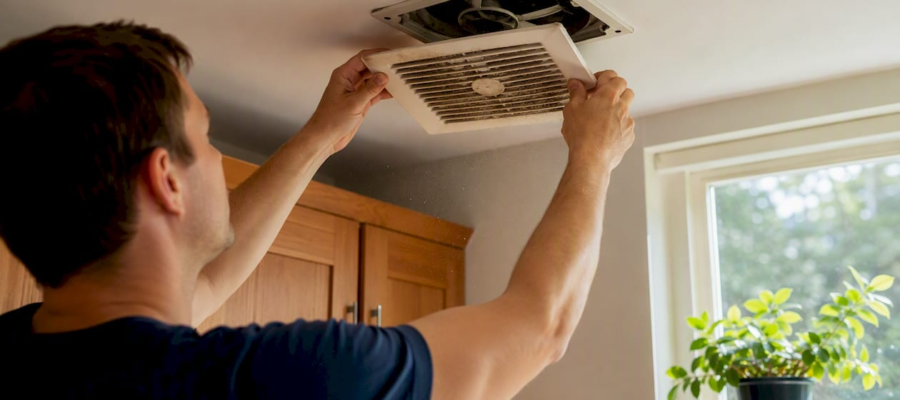
A quick DIY airflow check takes about 30 seconds. Hold a single sheet of tissue paper near your bathroom exhaust fan grille while the fan is running. If the tissue barely moves or falls away from the grille, the fan is either blocked, underpowered, or not actually venting to the outside. The same test works near supply and return vents in your HVAC system.
Urgency matters here. A small patch of surface mold on a tile grout line is a different situation from mold spreading across a wall, appearing in multiple rooms, or growing inside a closet where it has been hidden. If the mold covers more than a localized spot, or if anyone in the household is experiencing respiratory symptoms, escalate to your landlord immediately rather than attempting to clean it yourself.
Everyday ventilation habits that make a real difference
Good ventilation habits cost nothing and take almost no extra time once they become routine. The sequence below is the most practical starting point for any renter.
Step-by-step daily habits:
- Turn on the bathroom exhaust fan before you start showering, not after.
- Keep it running for 15–20 minutes after you finish to clear residual steam.
- Turn on the kitchen range hood or exhaust fan before you start cooking, especially when boiling water or frying.
- Open windows on opposite sides of your unit for 5–10 minutes when outdoor air is dry and the temperature is reasonable. Cross-ventilation moves far more air than opening a single window.
- Avoid drying laundry indoors when possible. A drying rack in a closed bedroom can add significant moisture to the air.
Do this / avoid this:
- Do use lids on pots while cooking to reduce steam output
- Do move furniture 2–3 inches away from exterior walls so air can circulate behind it
- Do leave interior doors open when running exhaust fans to help air move through the unit
- Avoid blocking supply or return air grilles with furniture, curtains, or storage
- Avoid using unvented combustion appliances (propane heaters, certain space heaters) indoors
- Avoid ozone-producing air purifiers, which the EPA flags as potentially harmful at elevated concentrations
For equipment, an inexpensive digital hygrometer (typically $10–$20) tells you the exact humidity in any room. A basic portable dehumidifier handles moisture in a bedroom or bathroom when ventilation alone is not enough. Bathroom fan timer switches replace a standard wall switch and automatically run the fan for a set period after you leave, which is useful if you tend to forget.
Pro Tip: Place a second hygrometer in the room where you notice the most condensation or musty smell. Humidity often varies significantly between rooms in the same apartment, and that reading tells you exactly where to focus your efforts.
How to measure and control humidity in your rental
The target range for indoor relative humidity is 30–50%, a figure supported by EPA mold guidance. Below 30%, air becomes uncomfortably dry and can irritate airways. Above 50%, mold risk climbs steadily. Above 60%, conditions become actively favorable for mold growth.
Where to place hygrometers:
- Bathroom (on a shelf, not directly in the shower spray zone)
- Behind or beside a large wardrobe or bookcase against an exterior wall
- In any basement or below-grade room
- In a bedroom corner that has shown condensation before
These spots are microclimates. The humidity there often runs 10–15 percentage points higher than the center of the room, which is why a single reading in the living room can give you a false sense of security.
Dehumidifier sizing by room type:
Note: these are general starting points based on moderate moisture conditions. A basement with active water intrusion or a unit in a humid summer climate may need a larger unit or continuous drainage.
Maintenance basics for dehumidifiers:
- Empty the water reservoir daily when running continuously, or connect a drain hose if the unit supports it
- Clean or rinse the air filter every two weeks during heavy use
- Run the unit during the warmest months (typically May through September in the NY/NJ/CT region) and store it clean and dry in winter
- In tightly sealed or energy-efficient apartments, Building America guidance notes that supplemental dehumidification may be necessary even with adequate ventilation, because reduced sensible cooling loads allow humidity to rise
What HVAC and vent maintenance can you do as a tenant?
Most tenants have more control over their HVAC system than they realize, and a few simple tasks can meaningfully improve air quality and system performance.
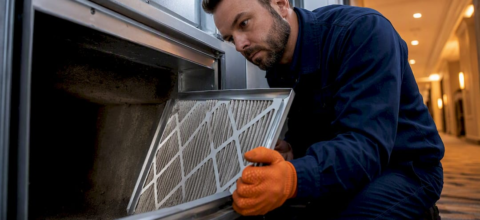
Filter changes: If your lease gives you access to the HVAC air handler or furnace, check the filter monthly and replace it on the schedule printed on the filter frame. A standard 1-inch fiberglass filter typically needs replacement every 30–60 days. A thicker pleated filter (2–4 inches) can last 60–90 days. A clogged filter restricts airflow, forces the system to work harder, and recirculates dust and allergens. For a deeper look at HVAC cleaning and what it involves, the scope goes well beyond the filter.
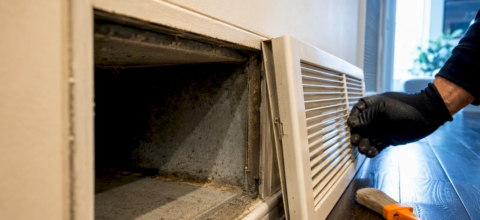
Supply and return grilles: Walk through your unit and confirm no grilles are blocked by furniture, rugs, or stored items. A blocked return grille is one of the most common and easily fixed causes of uneven airflow in apartments.
Dryer vent checklist:
- Go outside and locate where your dryer vent exits the building (usually a louvered cap on an exterior wall)
- Run the dryer on a heat cycle and confirm you can feel warm air coming out of that cap
- Check the vent hose behind the dryer for kinks, crushing, or disconnection
- Never run the dryer if the vent appears blocked or the cap is clogged with lint
- Dryer vent cleaning frequency depends on usage, but annual professional cleaning is the standard recommendation for most households
When the issue is the landlord’s responsibility: System-wide pressure problems, failed mechanical ventilation equipment, contaminated ductwork, and persistent moisture from structural sources (roof leaks, foundation seepage) are not tenant-level fixes. The EPA’s apartment IAQ guidance is clear that building owners handle structural and mechanical repairs. Document the problem and report it in writing.

How to document and report ventilation problems to your landlord
Written documentation is your most important tool if a ventilation or moisture problem goes unresolved. A verbal conversation is easy to forget or dispute. A dated email with photos attached is not.
What to document:
- Dated photos of every affected area (mold, condensation, water stains, damaged fans)
- Humidity readings from your hygrometer, logged with date and time
- A written description of when you first noticed the problem and how it has changed
- Records of any conversations with your landlord, including date and what was said
Escalation steps:
- Send a polite, factual written notice to your landlord (email is ideal for the paper trail) describing the problem, attaching photos, and requesting a specific repair within a reasonable timeframe (10–14 days is standard for non-emergency issues).
- If there is no response or the repair is not completed, send a follow-up in writing referencing your first notice and setting a new deadline.
- If the landlord still does not act, contact your local housing code enforcement office. In New York City, that is 311 or the NYC Department of Housing Preservation and Development. In New Jersey, contact your municipal code enforcement officer. In Connecticut, reach out to your town’s housing code enforcement department.
- The Environmental Law Institute’s Indoor Air Quality Guide for Tenants is a practical reference that explains tenant and landlord responsibilities and where to find local assistance for IAQ issues.
The clean vents and tenant safety guide for property managers is also worth reading if you want to understand what a landlord is typically expected to maintain, which strengthens your position when reporting problems.
When should you call a professional instead of handling it yourself?
Some situations go beyond what a tenant can or should address independently. Knowing the threshold protects both your health and your legal standing.
EPA guidance on mold cleanup recommends professional remediation for any mold area larger than approximately 10 square feet, or when mold is present inside HVAC systems, inside wall cavities, or in other hidden building spaces. That roughly 10-square-foot threshold is a practical rule of thumb: if the affected area is larger than a standard ceiling tile, call a professional.
Situations that require professional services:
- Mold covering more than approximately 10 square feet
- Mold visible inside supply or return air vents
- Mold suspected inside walls (indicated by musty smell without visible growth)
- Persistent moisture from a structural source (roof, foundation, plumbing inside walls)
- HVAC system producing unusual odors, reduced airflow, or visible contamination
- Dryer vent that cannot be cleared by the tenant or that has not been professionally cleaned in over a year
What to ask before hiring:
- Request a written scope of work before any job begins.
- Ask for before-and-after photos as part of the service record.
- Confirm the contractor uses containment methods to prevent cross-contamination during mold remediation.
- Ask how waste (contaminated materials, debris) will be disposed of.
- Request proof of liability insurance and, for mold work, any applicable certifications.
- Get an expected timeline in writing.
For duct and dryer-vent work specifically, understanding what equipment professionals use to clean air ducts helps you evaluate whether a contractor’s scope is legitimate or superficial.
How to safely clean small mold patches yourself
If the mold is on a non-porous surface (tile, glass, sealed paint), covers less than roughly 10 square feet, and you can identify and fix the moisture source, surface cleaning is a reasonable tenant task. If any of those conditions are not met, stop and call a professional.
Safety first: Mold spores become airborne during cleaning. At minimum, wear disposable gloves and eye protection. An N95 respirator significantly reduces your inhalation exposure and is worth using whenever available.
Cleaning steps for non-porous surfaces:
- Open a window or run the exhaust fan to ventilate the space before you start.
- Lightly mist the moldy surface with water before scrubbing to reduce airborne spores.
- Scrub the surface with a solution of dish soap and water, or a diluted household cleaner appropriate for the surface type.
- Rinse and dry the surface thoroughly. Mold needs moisture to survive, so leaving the surface wet defeats the purpose.
- Seal all used cleaning materials (cloths, sponges, gloves) in a plastic bag before disposing of them.
- Dry the area completely using the exhaust fan, a portable fan, or a dehumidifier.
For porous materials (drywall, ceiling tiles, grout that has absorbed mold deeply, fabric): surface cleaning does not remove mold from inside the material. Those items generally need to be discarded and replaced. That is a landlord-level repair.
Cleaning mold without fixing the moisture source is only a temporary fix. The mold will return within weeks if the underlying humidity or leak problem remains unresolved.
Quick fixes for common tenant moisture problems
| Problem | Immediate tenant action | When to contact landlord or pro |
|---|---|---|
| Condensation on windows | Wipe daily, run exhaust fan, check RH with hygrometer | If condensation is heavy and persistent despite ventilation, or if frames show rot or seal failure |
| Mold in bathroom corner | Clean surface (see steps above), run fan longer after showers | If mold returns within 2 weeks of cleaning, or if it spreads beyond the corner |
| Damp basement or below-grade room | Run a dehumidifier, check for standing water, improve airflow | If water is entering through walls or floor (structural source) |
| Persistent musty smell | Locate and clean visible mold, check behind furniture and in closets | If smell persists after cleaning and no visible source is found |
| High RH in bedroom (above 50%) | Add a dehumidifier, increase ventilation, move furniture from walls | If RH stays above 50% consistently despite dehumidifier use |
Take humidity readings in each problem area at the same time of day for three to five days in a row. A consistent pattern of high readings points to a structural or mechanical source that needs professional or landlord attention, not just a dehumidifier.
How to ventilate without wasting heat or cooling
Ventilation and energy efficiency feel like they conflict, but a few timing adjustments make both work together.
Seasonal timing tips:
- In winter, open windows for short, wide bursts (5–10 minutes with two windows open across the unit) rather than cracking a single window for hours. Short cross-ventilation exchanges more air with less heat loss.
- In summer, ventilate during early morning or evening when outdoor temperatures are lower and humidity is often reduced.
- Run exhaust fans on a timer rather than continuously. A 20-minute post-shower cycle removes the moisture without running the fan all day.
- Use a dehumidifier during the humid months (May through September in NY/NJ/CT) rather than relying solely on air conditioning to manage moisture.
Pro Tip: In winter, a short wide airing (both windows open for 5 minutes) removes more stale air than a narrow crack left open for an hour, and it loses far less heat in the process. The air exchange happens in the first few minutes; after that, you are just losing warmth.
A simple monthly, quarterly, and yearly maintenance schedule
Monthly:
- Check bathroom and kitchen exhaust fans: run them and confirm airflow with the tissue test.
- Wipe condensation from windows and frames and note whether it is getting worse.
- Check your hygrometer readings in the bathroom, bedroom, and any problem areas.
- Inspect visible supply and return grilles and clear any blockages.
- Replace the HVAC filter if it looks gray or clogged (or per the filter manufacturer’s schedule).
Quarterly:
- Go outside and confirm the dryer vent cap is clear and exhausting warm air during a dryer cycle.
- Clean the bathroom exhaust fan grille (unplug or switch off the circuit, then wipe the cover and blades).
- Check behind large furniture pieces against exterior walls for any early mold or moisture signs.
- Review your humidity log and note any seasonal changes.
Yearly:
- Document the full condition of your unit with photos (fans, vents, windows, walls, under sinks).
- Send a written reminder to your landlord about any outstanding HVAC maintenance, filter changes, or mechanical ventilation checks that are the building’s responsibility.
- Schedule professional dryer vent cleaning if it has not been done in the past 12 months.
- Consider professional duct inspection if you have noticed persistent dust, odors, or reduced airflow.
At move-in: Document every fan, vent, window seal, and any existing moisture damage with dated photos before you move furniture in. That record protects you at move-out.
At move-out: Repeat the same documentation walk-through and compare it to your move-in record.
A practitioner’s perspective on what tenants get wrong
The most consistent mistake tenants make is treating ventilation as a one-time fix rather than a daily habit. A renter will clean a mold patch, feel relieved, and then go right back to closing the bathroom door during showers and skipping the exhaust fan. Three weeks later, the mold is back, and they are surprised.
The second most common mistake is ignoring microclimates. The living room might read 48% RH on a hygrometer, which looks fine. But the corner behind the wardrobe in the bedroom, or the wall behind the bathroom vanity, can easily run 10–15 points higher. Those are the spots where mold starts, and they are invisible until the problem is already established. Placing a second inexpensive hygrometer in a suspected trouble spot catches this early.
From a field perspective, the tenants who avoid repeated remediation calls are the ones who document humidity trends over time. A single high reading is not alarming. That documented pattern is also exactly what a housing inspector or landlord needs to see before they take action.
When it makes sense to bring in a professional service
If you have worked through this guide and still have persistent moisture, unexplained odors, or visible contamination in your vents or ducts, a professional inspection is the logical next step.

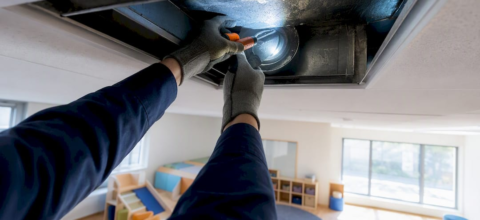
Ask any contractor you contact to inspect or clean the following, depending on what your unit needs: dryer vent (confirm it exits to the outdoors and is clear of lint buildup), supply and return air ducts (check for dust accumulation, mold, or debris), evaporator coil and blower (a common hidden source of mold in central HVAC systems), and a mold scope if contamination is suspected inside walls or cavities. Collect a written scope of work, before-and-after photos, and proof of insurance from any provider before work begins.
Amazonairpro serves residential and commercial clients across New York, New Jersey, and Connecticut, with over 10 years of experience in air duct and HVAC cleaning, dryer vent cleaning, and chimney cleaning. If your dryer vent or ducts are overdue, book a dryer vent cleaning or request a duct inspection to get a written assessment of what your unit actually needs.
Sources
- Indoor Air Quality in apartments | US EPA
- Ventilation measure guideline / Building America
- Indoor air quality guide for tenants | ELI
- Interactive ventilation tool | CDC
This article is general information, not a substitute for advice from a qualified doctor. Consult a qualified healthcare professional about your own circumstances before acting on anything here.
FAQ
What are the signs that my apartment has poor ventilation?
Persistent condensation on windows, a musty odor that does not clear after cleaning, visible mold spots in corners or on grout, and recurring allergy symptoms indoors are the most common signs. A quick tissue test near your exhaust fan grille can confirm whether the fan is actually moving air.
How do you ventilate a room to stop mold from forming?
Run bathroom exhaust fans during and 15–20 minutes after every shower, use kitchen exhaust fans while cooking, and open windows on opposite sides of the unit for short cross-ventilation bursts when outdoor conditions allow.
Are landlords required to provide ventilation in apartments?
Yes, in New York, New Jersey, and Connecticut, housing codes require landlords to maintain habitable conditions, which includes functional ventilation and exhaust equipment. Structural repairs, mechanical system maintenance, and fixes to building-level ventilation failures are the building owner’s responsibility, as the EPA’s apartment IAQ guidance confirms.
When does mold require a professional instead of a DIY cleanup?
EPA guidance recommends professional remediation when the affected area is larger than approximately 10 square feet, when mold is present inside HVAC systems or wall cavities, or when the moisture source is structural and cannot be fixed by the tenant.
Recommended
- Clean vents, safe tenants: essential guide for property managers – Amazon Air Duct Cleaning
- The role of ventilation in indoor health: a property owner’s guide – Amazon Air Duct Cleaning
- Lease Turnover Vent Cleaning: A Property Manager’s Guide – Amazon Air Duct Cleaning
- Ventilation systems explained: a practical guide for healthier indoor air – Amazon Air Duct Cleaning