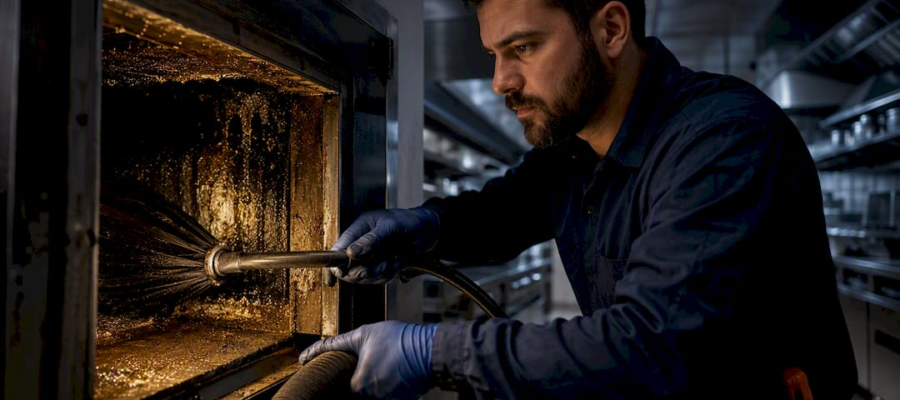
Pass Inspections: NADCA Restaurant HVAC Duct Checklist NY/NJ/CT
If your kitchen exhaust is greasy, your dining room smells stale, or a health inspector has flagged airflow issues, hire a NADCA-aligned commercial duct-cleaning contractor to inspect and clean your system. Restaurant HVAC duct cleaning removes grease and particulate buildup that residential-grade service misses, cuts odors and fire risk, and gives you written before-and-after documentation. Start with an inspection, request a defined scope, and book a provider such as Amazon Air Duct Cleaning if you serve the New York, New Jersey, or Connecticut area.
TL;DR:
- Proper restaurant duct cleaning must include inspection, camera verification, and thorough removal of grease, debris, and microbial buildup from all components the air contacts.
- Grease residue reduces airflow, increases fire risk, and shortens equipment lifespan, making timely cleaning essential based on contamination levels rather than a fixed schedule.
- Verifiable documentation, including before-and-after videos and detailed written reports, is crucial to confirm cleaning quality and satisfy health or insurance inspections.
- Scheduling work during off-hours or in phases can minimize disruption and odors in dining areas, though it may incur additional costs.
- Costs vary widely depending on system size and contamination, requiring a site visit for an accurate quote, with reputable contractors following NADCA standards and providing transparent scope and proof of work.
Table of Contents
- Why Restaurant Ductwork Needs a Different Cleaning Approach
- What a Full Commercial Duct Cleaning Should Cover
- How the Cleaning Process Works and What Proof to Demand
- Scheduling Around Service Hours Without Disrupting Guests
- What Standards Say About Cleaning Frequency and Filtration
- How to Vet a Contractor Before Signing a Contract
- Company Experience and How to Prepare for the Crew’s Arrival
- How Long the Cleaning Job Should Take
- What Restaurant Duct Cleaning Typically Costs
- Why the Standard Advice on Duct Cleaning Falls Short for Restaurants
- Book a Commercial Duct Cleaning Built for Restaurant Kitchens
- Standards and Guidance Worth Bookmarking
- Sources
- FAQ
Why Restaurant Ductwork Needs a Different Cleaning Approach
A restaurant kitchen produces airborne grease particulate that settles inside ductwork at a rate residential systems never see. Cooking oil vapor, combined with long service hours and high customer turnover, coats coils, blower wheels, and duct interiors with a sticky film that ordinary dust never forms. That film attracts more debris over time and becomes a breeding ground for odor-causing bacteria.
The operational stakes are higher too. A dining room running lunch and dinner service seven days a week puts far more strain on an HVAC system than a household unit cycling a few hours a day.
- Grease residue reduces airflow and forces the system to work harder, raising energy costs.
- Trapped odors migrate from the kitchen into dining areas, hurting the guest experience.
- Grease-laden ducts and coils raise fire risk, a concern fire marshals take seriously in commercial kitchens.
- Reduced airflow strains compressors and blower motors, shortening equipment life.
That combination of grease, volume, and occupant density is exactly why generic duct cleaning doesn’t cut it for a working kitchen.
What a Full Commercial Duct Cleaning Should Cover
A proper restaurant HVAC duct cleaning goes well beyond wiping down a few visible vents. The scope should cover every component air actually travels through, not just the parts easiest to reach.
Expect a qualified contractor to address:
- Supply and return trunk lines, plus every branch duct feeding dining and prep areas.
- Registers, grilles, and diffusers, along with the access panels needed to reach them.
- Air handling units, cooling coils, blower wheels, plenum boxes, and makeup air units that bring in replacement air for kitchen exhaust.
One distinction matters more than any other here: HVAC duct cleaning is not the same service as kitchen exhaust hood cleaning. Grease hoods and exhaust ductwork fall under NFPA 96, which sets its own inspection and cleaning frequency, often enforced with municipal certificate requirements. HVAC duct cleaning addresses the comfort-air system, the ductwork moving conditioned air to your dining room and back. Many restaurants need both services, but they are separate contracts with separate standards. A contractor should cut service openings large enough for mechanical tools and run a camera inspection before and after, so you can see what came out of the system rather than take someone’s word for it.
How the Cleaning Process Works and What Proof to Demand
A source-removal mechanical cleaning starts with agitation tools that dislodge grease and debris from duct walls, paired with continuous vacuum collection strong enough to capture what gets loosened before it resettles. That combination, agitation plus vacuum capture, is the NADCA-recommended method for HVAC duct cleaning, and it’s the baseline you should expect any commercial contractor to meet.
Coils and drain pans usually need wet cleaning rather than dry agitation, since grease film doesn’t release with a brush alone. That means water and cleaning agents get applied directly to the coil, and a competent crew captures and disposes of that wastewater properly instead of letting it run into a floor drain untreated.
The process, in sequence, generally looks like this:
- Initial inspection and camera documentation of duct interiors before any work begins.
- Containment setup to keep dislodged debris from spreading into dining or prep areas.
- Mechanical agitation and vacuum collection on ducts, plenum boxes, and grilles.
- Wet cleaning of coils, blower wheels, and drain pans where grease has hardened.
- Post-cleaning camera verification and, where requested, a NADCA cleanliness test.
Pro Tip: Ask for the before-and-after video files, not just still photos. Grease buildup on a duct wall looks dramatically different on camera than it does in a written summary, and video gives you leverage if you ever need to show a health inspector or insurer what was done.
Insist on a written report at the end. Verbal assurances that “it’s clean” mean nothing without documentation you can file for your records or an inspector.
Scheduling Around Service Hours Without Disrupting Guests
Duct cleaning crews and dinner service don’t mix well, so timing is half the battle. Most restaurants handle this one of three ways: overnight or early-morning off-hours work, phased cleaning that tackles one section of the building at a time, or scheduling the entire job on a closed day.
A few coordination habits make the difference between a smooth job and a chaotic one:
- Loop in your kitchen manager early so prep schedules don’t collide with duct access points.
- Ask the contractor to seal off food storage and prep surfaces before any agitation work starts nearby.
- Confirm which registers and access panels sit near active cooking lines, and plan around those last.
- Keep a copy of the written scope on-site during the job in case a health inspector asks what’s happening.
Off-hours scheduling costs a little more in most cases, but it keeps your dining room odor-free and your staff undisturbed during the workday.
What Standards Say About Cleaning Frequency and Filtration
The NADCA Standard sets the performance benchmark most reputable commercial contractors work to, defining how ducts should be assessed, cleaned, and verified as visibly clean. There’s no single universal number for “clean every X months” that applies to every restaurant, because grease load, seating capacity, and hours of operation all shift the math. What the standards do offer is a set of triggers that tell you when it’s time to act.
- Visible grease or dust buildup around registers, grilles, or return vents.
- Persistent odors that linger even after kitchen exhaust cleaning.
- A fire, smoke event, or nearby renovation that sent debris into the system.
- Reduced airflow or rising energy bills with no other clear explanation.
OSHA guidance recommends upgrading to MERV-13 filters where the system allows, since higher-rated filtration captures more airborne particulate between cleanings. ASHRAE’s preventive maintenance checklist recommends semi-annual inspection for debris and microbial growth in commercial kitchen ventilation systems, engaging a NADCA-certified contractor once inspection findings warrant it.
How to Vet a Contractor Before Signing a Contract
Not every company that advertises duct cleaning has the equipment or training to do it right on a commercial kitchen system. The EPA warns that improper cleaning, weak vacuum systems, or inexperienced technicians can actually push contaminants deeper into the system rather than removing them. That’s a real risk with restaurant-grade grease, which resists half-measures far more than household dust.
Ask every bidder these questions before signing anything:
- Do you follow NADCA ACR methods, and can you explain your vacuum collection setup?
- What’s your experience with restaurant kitchens specifically, not just office buildings or homes?
- Can you provide proof of liability insurance and references from other restaurant clients?
- Will you provide before-and-after photo or video documentation as part of the standard scope?
- What does your written scope of work include, component by component?
Watch for these red flags, which show up more often than you’d expect:
- A vague scope that just says “duct cleaning” with no component list.
- Promises of a routine “EPA certification,” which doesn’t exist as a real credential.
- Pressure to apply sealants or biocides as a substitute for actual mechanical cleaning.
- No offer of photo or video verification, or resistance when you ask for it.
A short written scope checklist, listing supply and return ducts, coils, blower wheels, and plenum boxes by name, protects you if a dispute comes up later.
Company Experience and How to Prepare for the Crew’s Arrival
Amazon Air Duct Cleaning has spent more than a decade serving both residential and commercial clients across New York, New Jersey, and Connecticut, with technicians trained on the same NADCA-aligned methods described throughout this guide. That kind of sustained, region-specific experience matters more in restaurant work than almost any other commercial setting, since grease load and kitchen layouts vary so much from one operation to the next.
Getting ready for the crew is mostly about access and coordination:
- Clear a path to every register, grille, and access panel the scope covers.
- Cover or relocate exposed food and prep surfaces near work zones.
- Confirm the appointment window with kitchen and front-of-house staff in advance.
- Review the written scope and verification method before the crew arrives, not after.
A little prep on your end shortens the job and reduces the odds of surprises mid-service.
How Long the Cleaning Job Should Take
A full restaurant HVAC duct cleaning typically runs anywhere from a few hours for a small system to a full day or two for a larger multi-zone building, depending on square footage, number of air handlers, and how much grease has built up. Initial inspection and camera assessment usually take up the first hour or so, since a contractor needs to see the extent of contamination before quoting exact labor time.
The mechanical cleaning phase, agitation and vacuum collection on ducts and grilles, tends to be the longest stretch of the job. Wet cleaning on coils and drain pans adds time because of drying and wastewater handling requirements. A single-story restaurant with one rooftop unit might wrap in half a day. A larger operation with multiple air handlers, a mezzanine dining area, or a food court style layout can stretch closer to two full service days.
Post-cleaning verification, the final camera pass and any NADCA cleanliness testing, adds another hour or so at the end. If you’re scheduling around off-hours work, ask your contractor for a realistic time estimate broken down by phase so you can plan staffing and any temporary closures around it accurately, rather than guessing at a single lump number.

Jobs that involve heavy grease contamination or fire/smoke damage from a prior incident generally take longer than a routine maintenance cleaning, since the crew has to remove hardened residue rather than lighter buildup.
What Restaurant Duct Cleaning Typically Costs
Cost for restaurant HVAC duct cleaning depends heavily on square footage, number of air handling units, duct accessibility, and how much grease has accumulated since the last service. A small single-unit restaurant with straightforward duct runs costs less than a large multi-zone building with several air handlers and hard-to-reach plenum boxes.
Several factors push the price up or down on any given quote:
- System size and complexity: More air handlers and longer duct runs mean more labor hours.
- Contamination level: Heavy grease buildup or fire/smoke residue requires more aggressive wet cleaning than routine maintenance.
- Access difficulty: Ducts buried behind finished ceilings or in tight mechanical rooms take longer to reach.
- Scheduling requirements: Off-hours or overnight work sometimes carries a premium over standard business-hours scheduling.
- Verification requested: Full photo/video documentation and NADCA cleanliness testing add to the scope but give you stronger proof of work performed.
Because every one of these variables shifts the final number, the only reliable way to get an accurate figure is a site inspection and a written quote. Amazon Air Duct Cleaning does not publish flat commercial rates online because restaurant systems vary too much for a one-size number to apply, and any contractor quoting a firm price without seeing your system first should raise a question mark. Request a written estimate that breaks down labor, verification, and any coil or wet-cleaning charges separately, so you can compare bids on an apples-to-apples basis.
Why the Standard Advice on Duct Cleaning Falls Short for Restaurants
Most general advice on duct cleaning treats every building the same: clean every few years, ask for a quote, done. That advice ignores what actually drives the decision for a restaurant, which is grease load and occupant hours, not a calendar. A quiet-hours café and a high-volume dinner house running fryers all night face completely different contamination timelines, and no generic schedule captures that.
The bigger gap in conventional guidance is verification. Plenty of cleaning outfits will show up, run a hose through some ducts, and call it done with no camera proof and no written report. That’s not a minor shortcut. Without before-and-after documentation, you have no way to confirm the job matched the scope you paid for, and no paperwork to show an inspector or insurer if something goes wrong later.
If you take one thing from this guide, prioritize the written scope and verification method over the price quote. A cheap job with no documentation costs you more the first time a health inspector asks questions you can’t answer. Standards like NADCA ACR exist precisely because “clean” is a claim that needs proof, not a feeling.
— Victor
Book a Commercial Duct Cleaning Built for Restaurant Kitchens
A direct option for restaurants needing commercial-grade duct cleaning is available in the New York, New Jersey, and Connecticut area. With over 10 years of combined residential and commercial experience, the team handles commercial air duct cleaning, evaporator coil and blower cleaning, and antimicrobial and deodorizing duct treatments designed for kitchens dealing with grease, odor, and high-traffic airflow demands.

Booking starts with an inspection, followed by a written scope that names every component covered, from supply trunks to plenum boxes. Off-hours and closed-day scheduling keep the work out of your service hours, and photo and video verification comes standard so you have documentation on file. If your restaurant sits in the NY, NJ, or CT service area, request a quote through the commercial duct cleaning page and get a scheduled inspection on the calendar.
Standards and Guidance Worth Bookmarking
- OSHA ventilation guidance: filter and maintenance recommendations.
- CDC ventilation guidance: airflow and filtration for high-occupancy spaces.
- EPA duct cleaning guidance: risks of improper cleaning.
Sources
- Improving Workplace Ventilation During Cold Weather (OSHA)
- Should You Have the Air Ducts in Your Home Cleaned? (EPA)
- Improving Ventilation in Buildings (CDC)
FAQ
How Often Should Commercial Air Ducts Be Cleaned?
There’s no single fixed interval that applies to every restaurant, since grease load and hours of operation vary widely. Standards bodies like ASHRAE recommend semi-annual inspection so you can catch buildup, odors, or microbial growth early and schedule a full cleaning based on actual findings rather than a guess.
What Does Restaurant HVAC Duct Cleaning Typically Cost?
Pricing depends on system size, contamination level, and access difficulty, which is why a firm quote requires a site inspection rather than a phone estimate. Amazon Air Duct Cleaning provides written quotes after assessing your specific setup through its commercial air duct cleaning service.
Is Professional Duct Cleaning Worth It for a Restaurant?
Yes, when it’s done with proper NADCA-aligned methods and verified with before-and-after documentation. Restaurants carry heavier grease and particulate loads than homes or offices, and improved airflow, reduced odors, and lower fire risk generally justify the cost for kitchens running regular service hours.
Can Duct Cleaning Actually Make Air Quality Worse?
Yes, if it’s done improperly. The EPA notes that inadequate vacuum collection or inexperienced technicians can dislodge contaminants without fully removing them, which is why continuous vacuum capture and trained crews matter more than a low price.
What’s the Difference Between Kitchen Exhaust Cleaning and HVAC Duct Cleaning?
Kitchen exhaust hood and grease duct cleaning falls under NFPA 96 and addresses grease removal for fire safety. HVAC duct cleaning covers the separate comfort-air system, supply and return ducts, air handlers, and coils, and most restaurants need both services on different schedules.
Recommended
- Vent cleaning for businesses: essential guide for NY, NJ, CT
- NY/NJ/CT Owners: 1–2 Hour Air Duct Camera Inspection With Footage
- Complete duct cleaning checklist: boost air quality 41%
- Duct System Maintenance Checklist 2026: Frequencies and Fixes