Dryer Vent Bird Guard Code in NYC: What Is Allowed
In New York City, you cannot legally put a bird guard made of screen or mesh on a dryer vent outlet. The New York City Mechanical Code says the duct must end outdoors, a single dryer needs a backdraft damper, and screens shall not be installed at the duct termination. Birds are a real nuisance, but mesh is the wrong fix. It catches lint, and lint is what starts dryer fires.
This guide explains what the NYC rules say, what a compliant termination looks like, what New York State and the rest of our service area (New Jersey and Connecticut) do differently, and what to do when a bird has already moved in.
TL;DR
- NYC Mechanical Code 504.4 prohibits screens at the dryer duct termination, so mesh-style bird guards are out.
- A single dryer must have a backdraft damper at the exterior outlet. Multiple dryers sharing a duct must not.
- Gas dryers in R-3 homes are limited to 25 feet of duct, with deductions for bends, under 1 RCNY 101-02.
- If birds or lint have blocked the outlet, stop using the dryer and have the full run cleaned and the termination checked.
Table of Contents
- What NYC code says about screens and bird guards
- What a compliant termination looks like
- Termination location, length and clearances
- What about New York State, New Jersey and Connecticut?
- How to keep birds out without a screen
- If a bird, nest or lint has already blocked the vent
- Who is responsible for the vent
- Our perspective
- Get your termination checked
- FAQ
- Sources
What NYC code says about screens and bird guards
The rule that answers most of this question is short. Section 504.4 of the NYC Mechanical Code covers dryer exhaust installation. It says dryer exhaust ducts terminate on the outside of the building, that single dryer installations are equipped with a backdraft damper, that multiple dryer installations do not get one, and that screens are not installed at the termination.
That last sentence is the one people miss. A “bird guard” is usually a wire or plastic mesh cap, and mesh is a screen. Even when a product is sold at a hardware store as a dryer vent guard, it does not make it code-compliant in the five boroughs.
The reason is practical. Dryer lint is fine and sticky. It snags on any mesh opening and builds into a felt-like mat within a few loads. Once the outlet narrows, hot moist air backs up in the duct, drying times climb, and the lint inside the duct has a chance to ignite. We see this often enough that a mesh cap is one of the first things we look for on a service call.

What counts as a screen
Treat any of these as a screen for code purposes:
- Wire hardware cloth or window-style mesh over the outlet
- A plastic or metal grille with small slots or holes that lint can bridge
- A cap with a fixed cage that narrows the opening
- Foam or steel wool stuffed in the opening to keep birds out
If you are a homeowner and your building inspector, a buyer’s inspector or a violation notice flags one of these, the usual remedy is removal and replacement with a compliant termination.
What a compliant termination looks like
A compliant termination in NYC does three things: it ends outside, it lets air and lint flow freely, and it closes when the dryer is off.
| Requirement | What it means | Source |
|---|---|---|
| Terminates outdoors | No venting into attics, crawl spaces, walls or shafts | NYC Mechanical Code 504.4 |
| Backdraft damper (single dryer) | A flap that opens with airflow and closes when the dryer stops | NYC Mechanical Code 504.4 |
| No damper (multiple dryers) | Shared systems are explicitly prohibited from having one | NYC Mechanical Code 504.4 |
| No screen | Nothing that traps lint across the opening | NYC Mechanical Code 504.4 |
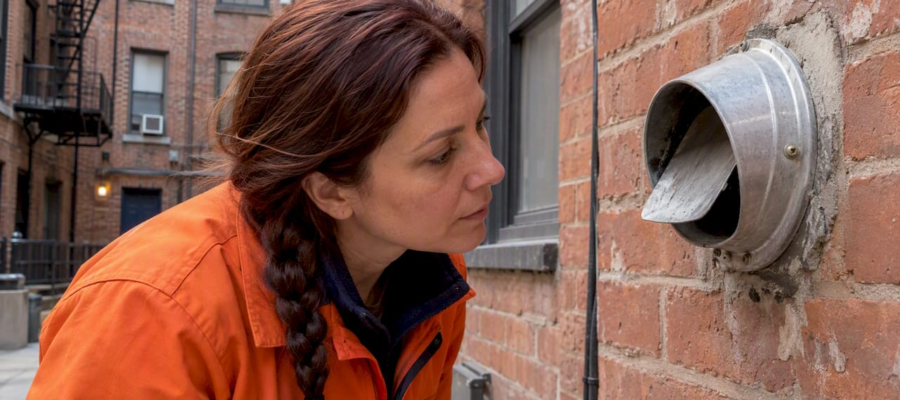
The damper is the code’s own answer to pests and drafts. When it works, the flap sits shut and a bird has little room to enter. When it sticks open, rusts or is clogged with lint, animals get in. So a damper that moves freely matters more than any add-on.
Single dryers versus shared systems
If you own a one- or two-family house or a co-op unit with its own vent, you have a single dryer installation and the damper applies. In a building where several dryers feed one shared exhaust, the code reverses the rule: no backdraft damper. That case is common in older multifamily and laundry-room setups. Property managers should read our guide on passing IMC 504.11 for multi-unit dryer vents before changing any terminations.

Termination location, length and clearances
The bird-guard question usually sits next to other code questions that an inspector will check at the same time. For gas dryers in R-3 occupancies (one- and two-family homes) vented through an exterior wall, 1 RCNY 101-02 sets these limits:
- Duct length: no more than 25 feet from the dryer to the outlet terminal, with deductions for bends.
- Location: the termination cannot be at a lot-line wall or within three feet of a lot line.
- Height: at least three feet above adjacent grade, and free of obstructions.
- Support: the duct must be supported and secured.
That 25-foot figure is stricter than the 35-foot number you will see on many national websites. The 35-foot limit comes from the model residential code and applies where a local rule does not say otherwise. Our page on the maximum dryer vent length walks through how to measure a run and count elbows. In the city, use the NYC number for a gas dryer in a one- or two-family home, and confirm anything unusual with your licensed professional or the Department of Buildings.
Fasteners and seals
Screws that poke into the duct catch lint just like mesh does. The NYC code prohibits duct fasteners that obstruct exhaust flow. The U.S. Department of Energy guidance adds that connections should be sealed with UL 181B or 181B-M listed material, not cloth duct tape. Foil tape or listed clamps, no sheet-metal screws into the airstream.
Commercial dryers
Commercial clothes dryers fall under a different section. NYC MC 504.9 requires a minimum clearance of 6 inches between the duct and combustible materials. Hotels, laundromats and multifamily laundry rooms should have this checked during any routine service. We cover that setting in our hotel dryer vent maintenance guide.
What about New York State, New Jersey and Connecticut?
The NYC rule is the strictest on screens, and it applies only inside the five boroughs. Outside the city, New York State follows its own residential code. That code sets a minimum open area for the outlet: the passageway of dryer exhaust duct terminals must be undiminished in size, with at least 12.5 square inches of open area. A fine mesh cap reduces that open area, so even upstate or on Long Island a screen is a poor choice.
Dryer exhaust rules also differ across state lines. If your property is across the river, our page on New Jersey dryer vent rules covers what applies there. For Connecticut, check with your local building official, since the model code is adopted and amended at the state level.
Two habits hold up everywhere in our area. Follow the dryer manufacturer’s installation instructions, because the model code makes them part of the requirement. And keep the outlet free of anything that narrows it.
How to keep birds out without a screen
Birds nest in dryer vents because the duct is warm, dry and sheltered. You can make the outlet a poor choice without breaking code.
- Make sure the damper closes. Lift the flap by hand with the dryer off. It should swing freely and drop shut under its own weight. Replace it if it sticks.
- Use a termination designed for dryers. Look for a hood or louvered cap built for lint, with an opening that is not reduced by a grille. Check that it is rated for dryer exhaust and does not contain a screen.
- Choose the right location. A termination that sits under an overhang or next to a ledge invites nesting. When a run is being rerouted anyway, the exit point can be chosen with the 3-foot-above-grade and lot-line limits in mind.
- Clear it regularly. A clean duct with strong airflow pushes hot air out each cycle, which deters most nesting.
- Do not stuff or tape the opening. Rags, steel wool and foam are screens in all but name.
Roof terminations are a special case. Roof vents sit exposed, and birds and debris reach them easily. Our page on roof dryer vent problems explains why those runs need a professional, particularly in Brooklyn brownstones and older walk-ups.
If a bird, nest or lint has already blocked the vent
Here is what to check, in order. Stop using the dryer first if clothes are coming out damp after a normal cycle or the laundry room smells hot.
- Look at the outside hood. With the dryer running, you should feel strong warm air at the outlet and see the flap open. Weak or no airflow means a blockage somewhere.
- Look for a screen or cage. If one is installed, it is both a likely cause of the clog and a code problem in NYC.
- Look for nesting material. Twigs, straw, feathers or droppings at the opening mean a bird got past the damper. Wildlife can be protected, so if a nest is active with eggs or young, call a licensed wildlife professional before removing it.
- Check the flap itself. Rust, lint glue or bent hinges can leave it stuck open or stuck shut.
- Check the whole run. A nest at the outlet often means there is lint further back. Long runs, many elbows and flexible foil duct all hold more of it.
Do not push a rod or brush blindly into the duct from outside. You can compact a nest or lint into the run and make the blockage worse. A professional uses rotary brushes and a high-powered vacuum from the dryer side and clears the outlet at the same time.
You can also see the broader signs on our page about how often to clean a dryer vent. The “once a year” rule is a floor, not a promise, and homes with long runs, pets or large families usually need more.
Who is responsible for the vent
If you own the home, the termination and the duct are yours. If you rent, responsibility depends on the building and the lease. Our guide to landlord dryer vent responsibilities in NY, NJ and CT lays out who typically handles what, and our apartment dryer vent maintenance guide helps tenants and managers set a routine.
For real estate agents and new home buyers, the termination is an easy item to inspect. A mesh cap, a missing flap, crushed flexible duct or a vent that exits into a garage or crawl space are all worth raising before closing. If you want to understand the mechanics behind these items, see how your dryer vent works.
Our perspective
Most bird guard calls start the same way. A homeowner put a cap on the vent after finding a nest, the dryer slowly got slower, and months later they called us because towels needed two cycles. The cap was doing what it was built to do, which was to stop birds, and it was also stopping lint.
We do not think the answer is to sell a better screen. Birds will find a damper that does not close, and a clean, straight, correctly terminated duct with a working flap is both the code answer and the practical answer. Our technicians check the flap, the outlet opening, the fasteners and the run length on every dryer vent visit, and we tell you plainly if something in your setup is outside code, even when that means a repair rather than a cleaning.
Two red flags are worth sitting with for a moment. One is any company that offers to install a mesh “guard” in NYC as an upsell. The other is a company that quotes a cleaning without looking at where the duct ends. Both skip the part of the job that matters most.
— Victor
Get your termination checked
If you have a screen on your dryer vent, a stuck flap or signs of nesting, our team can clean the full run and check the termination against the rules that apply to your property. We serve homes, multifamily buildings and commercial properties across New York, New Jersey and Connecticut. See our dryer vent cleaning service or book through the NY and NJ page.

If your building also has a fireplace or heating system with its own code questions, we handle those as well, including NYC chimney code checks.
FAQ
Can I put a bird guard on my dryer vent in NYC?
No, not one that works as a screen. NYC Mechanical Code 504.4 says screens shall not be installed at the dryer duct termination. A single dryer should instead have a backdraft damper that closes when the dryer is off.
Does a backdraft damper keep birds out?
A working damper helps a lot, because the flap stays closed when the dryer is not running. It only works if it moves freely. Lint, rust and bent hinges can leave it open, so check it by hand a few times a year.
Is the dryer vent length limit in NYC 35 feet?
For gas dryers in one- and two-family homes (R-3), 1 RCNY 101-02 sets a limit of 25 feet from the dryer to the outlet, with deductions for bends. The 35-foot figure comes from the model residential code and is not the NYC number for that case. Ask a licensed professional about your exact setup.
What if my building has several dryers on one vent?
NYC code says multiple dryer installations shall not have a backdraft damper, and screens are prohibited there too. Shared systems are more complex, so a property manager should have the whole system inspected rather than adjusting one termination.
Who should I call if there is a nest in my dryer vent?
If the nest is active, contact a licensed wildlife professional first, since birds can be protected. Once it is clear, a dryer vent specialist should clean the full duct and check the damper and outlet.
Sources
- NYC Mechanical Code, section 504 dryer exhaust (American Legal Publishing)
- 1 RCNY 101-02: Dryer-Boiler Installation (NYC Department of Buildings)
- Vent a Clothes Dryer (U.S. Department of Energy)
- Chapter 15 Exhaust Systems: New York State Residential Code (UpCodes)
Recommended
- Maximum Dryer Vent Length: The 35-Foot Code Rule Explained
- NY/NJ/CT Property Managers: Pass IMC 504.11 for Multi Unit Dryer Vents
- Apartment Dryer Vent Maintenance: A Guide for NY, NJ and CT
- Landlord Dryer Vent Responsibilities in NY, NJ and CT