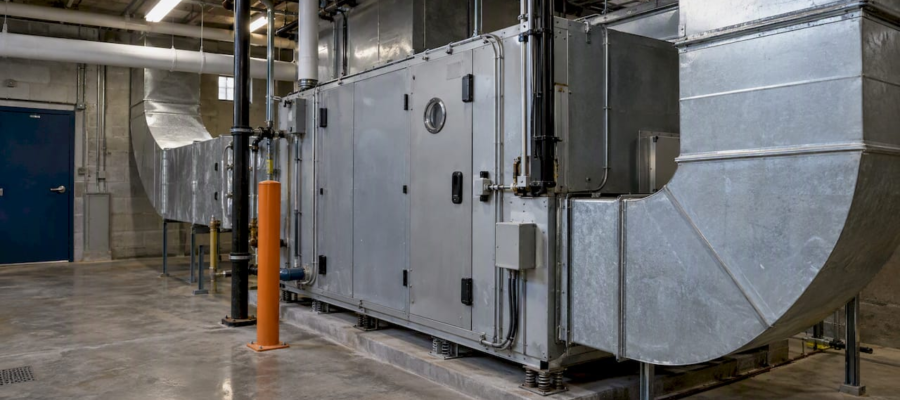
Sick Building Syndrome and HVAC: Causes, Signs, Fixes
Sick building syndrome (SBS) means people feel unwell while they are in a building and feel better soon after they leave, with no single identifiable cause. Your HVAC system is one of the most common places to look, because it controls how much outdoor air comes in, how air is filtered and where moisture collects. A poorly maintained or poorly balanced system can contribute to the problem, and a well-maintained one is among the most practical things you can fix.
This guide is for homeowners, property managers, facility managers and business owners in New York, New Jersey and Connecticut. It explains what SBS is, how HVAC problems feed it, how to investigate in a sensible order, and when professional cleaning makes sense.
TL;DR
- SBS describes symptoms such as headache, fatigue and irritated eyes, nose or throat that tie to time spent in a building and ease after you leave.
- It differs from building-related illness, which is a clinically diagnosable condition traced to airborne contaminants in the building.
- HVAC factors that can contribute include inadequate ventilation, poor air distribution, and microbial growth in stagnant water in ducts and drain pans.
- Investigate in order: walk the space, talk to management, inspect the HVAC system, then test only if the walk-through points you somewhere.
- Cleaning dirty coils, blowers, drain pans and ducts is one part of the fix, alongside ventilation and filter upkeep.
Table of Contents
- What sick building syndrome actually is
- Symptoms that point to the building
- How an HVAC system can contribute
- How to investigate, step by step
- What to check in your HVAC system
- Where duct and coil cleaning fits
- A scenario for each type of reader
- When to call a doctor or an agency
- Perspective
- Book a system inspection and cleaning
- FAQ
- Sources
What sick building syndrome actually is
The U.S. Environmental Protection Agency describes SBS as a situation in which occupants experience acute health effects that seem linked to time spent in a building, without a specific illness or cause being identified. The complaints may be limited to one room or spread throughout the building.
That is different from building-related illness (BRI). With BRI, symptoms are clinically diagnosable and can be attributed to airborne building contaminants. Legionnaires’ disease and hypersensitivity pneumonitis are the textbook examples. If a doctor diagnoses something specific, you are dealing with BRI, and the building investigation changes accordingly.
The distinction matters for a practical reason. SBS is a pattern you notice first and explain later. BRI is a diagnosis you get first and then trace back to the building.
Symptoms that point to the building
The EPA lists the commonly reported symptoms as headache, fatigue, trouble concentrating, dizziness, nausea, and irritation of the eyes, nose, throat or skin. On their own, none of these says “building.” Colds, allergies, poor sleep and stress cause the same things.
The clue is the pattern. The EPA notes that most people report relief soon after leaving the building. So ask yourself:
- Do symptoms start or worsen at a particular time, such as when the system kicks on in the morning or after a weekend shutdown?
- Do they improve on vacations, weekends or after a few hours outside?
- Do other people in the same room or on the same floor report the same thing?
- Do they change with the seasons, for example at the first heavy cooling days or the first cold snap when the furnace runs?
If you are wondering whether your house is making you feel sick, those four questions are a better starting point than any test kit. Several yeses justify a closer look at the HVAC system.
It is also worth sitting with the fact that not every symptom is about air. The EPA points out that lighting, noise, vibration, thermal discomfort and psychological stress can produce symptoms similar to those of poor indoor air quality. A thorough investigation keeps those in view so you do not spend money fixing the wrong thing.
How an HVAC system can contribute
The EPA’s SBS fact sheet names several contributors. Three of them run straight through your HVAC system.
Not enough fresh air, or poor distribution
Inadequate ventilation is thought to be an important contributing factor, and reduced outdoor air rates have been found inadequate to maintain occupants’ health and comfort. Even a system that moves plenty of air can leave dead zones if the air is not distributed well. A conference room that is always stuffy and an office that is always cold are often the same problem seen from two sides.
The energy-saving push toward tighter buildings adds to this. ASHRAE, the professional society for heating and ventilation engineers, notes that airtight construction not balanced by adequate mechanical ventilation has increased the tendency for buildings to accumulate indoor pollutants. That is relevant across our region, where many owners have sealed and insulated older homes and offices to cut heating bills.
ASHRAE’s position is that perceived air quality and health outcomes generally improve as ventilation rates increase, though the best rate depends on indoor and outdoor pollutant levels.
Moisture and microbial growth
The EPA names biological contaminants that breed in stagnant water in ducts and drain pans as a possible contributor. In practice that means the evaporator coil, the condensate drain pan and the blower compartment, where cooling season humidity turns into water that has to go somewhere. A clogged drain line, a pan that never fully empties or a damp coil that stays wet can all create the conditions.

Coastal Connecticut, the Jersey Shore and the New York metro area all see long, humid summers, so these components work hard. If you notice a musty smell when the air conditioning starts, that is a reason to inspect them, not a reason to wait.
Maintenance and operation
ASHRAE’s position document states that failing to properly design, install, commission, operate and maintain HVAC systems is a key factor behind the link between air conditioning and higher SBS reports. In other words, air conditioning itself is not the issue. Neglected air conditioning is. Filters left in too long, dirty coils, blocked returns, closed dampers and exhaust fans that no longer move air all fit that description.
For a deeper look at what builds up inside systems, see our guide to HVAC contaminants and indoor air quality.
How to investigate, step by step
It is tempting to hire an air tester on day one. The EPA’s guidance on investigating suspected problems is more methodical: start with a walk-through inspection, identify possible pollutant sources and form hypotheses rather than testing the air right away. Here is how that looks in practice.
- Write down what is happening. Note who is affected, where, what symptoms, and at what times. A simple log over two weeks is often more useful than a one-time test.
- Talk to the right person. In a workplace, the EPA advises occupants to first raise it with management and, if necessary, contact the state or local health department or an air pollution control agency. In New York, New Jersey or Connecticut that means your state or county health office.
- Walk the building. Look for water stains, damp carpet, blocked supply and return grilles, visible dust around registers, odors near the air handler, and anything new, such as renovation, new furniture or new cleaning products.
- Inspect the HVAC system. The EPA’s Clean Air in Buildings guidance recommends that you assess how outdoor air enters and moves through the building and work with an HVAC expert to inspect ventilation, filtration and air cleaning. It also points to testing and balancing to verify the system does what it should, CO2 monitors where useful, and regular inspection and maintenance.
- Fix what you find, then see whether symptoms change. This is the step people skip. If the log shows improvement, you have your answer. If it does not, widen the search.
If you manage a commercial space, the EPA’s guide for office occupants also lists simple habits that help: do not block air vents or grilles, dispose of garbage promptly, and tell the facility manager right away if you suspect a problem.
What to check in your HVAC system
Use this as a working checklist for a house, an office or a school building.
| Component | What to look for | Why it matters |
|---|---|---|
| Filters | Gray, clogged or missing filters; wrong size leaving gaps | Dirty filters restrict airflow and let particles pass |
| Supply and return grilles | Blocked by furniture, dust buildup, rust or stains | Poor air distribution and visible debris |
| Evaporator coil and blower | Slime, dust mats, musty smell on startup | Wet surfaces support microbial growth |
| Condensate drain pan and line | Standing water, algae, overflow marks | The EPA cites stagnant water as a growth site |
| Ductwork | Visible mold, heavy debris, moisture, pests | Material can circulate to every room |
| Outdoor air intake | Blocked, too close to exhaust or loading areas | Poor-quality or too little fresh air |
| Exhaust fans | Weak airflow, noisy or not running | Moisture and odors stay inside |
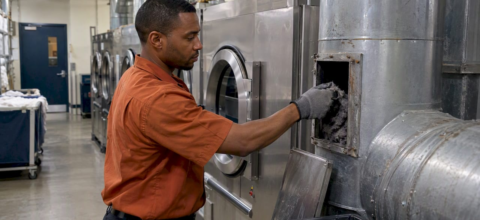
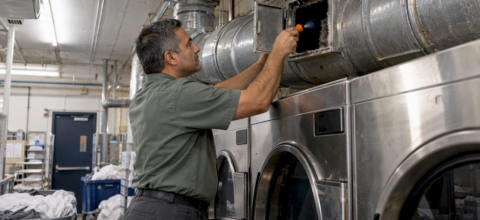
| Dryer vent | Lint buildup, crushed or disconnected duct | Moisture, lint and a fire risk |
Bathroom and kitchen exhaust fans deserve more attention than they usually get, because they remove moisture at the source. A short read on keeping exhaust fans working properly fits well alongside this checklist.
For homeowners, five signs your air ducts need cleaning and how to know whether you need your ducts cleaned cover the visual and smell cues in more detail.
Where duct and coil cleaning fits
A fair account of this topic includes what the EPA says. Its guidance on home duct cleaning says to consider cleaning when there is substantial visible mold growth inside hard-surface ducts or on other parts of the heating and cooling system. The same page notes that some research suggests cleaning components such as cooling coils, fans and heat exchangers may improve system efficiency, with a longer operating life and some energy and maintenance savings.
That last point is why we treat the whole system as one unit. Ducts are only one part. If the evaporator coil is matted with dust and the blower wheel is caked, cleaning only the ductwork leaves a main source of the problem in place. A proper service covers:
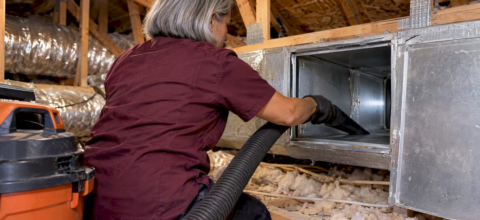
- Supply and return ducts, registers and plenums
- The evaporator coil and blower
- The condenser coil outside, which affects how well the system rejects heat
- The drain pan and line
- Where moisture or odors are an issue, an antimicrobial and deodorizing treatment of the duct system
Cleaning is not a substitute for ventilation or filter care. It works best as one step in a maintenance routine. Our HVAC maintenance guide and the seasonal indoor air maintenance checklist lay out what to do and when.
Filtration and air cleaning
Filtration and air cleaning can be an alternative or a supplement to source control and ventilation, but ASHRAE notes that research on their direct health effects varies considerably. The sensible approach is to treat them as one layer. If you are considering a standalone unit for a bedroom or office, this guide to choosing an air purifier covers the basics, and a properly sized filter in your HVAC system does the same job for the whole building.
A scenario for each type of reader
Homeowner or new buyer. You move into a house and notice morning headaches and a stale smell when the air conditioning starts. Check the filter and return grilles first. Then have the evaporator coil, blower and drain pan inspected. If the previous owners left a dirty system behind, a full cleaning gives you a clean baseline. Our indoor air quality guide for NY, NJ and CT homeowners is a good next read.
Real estate agent. A buyer’s inspection flags a musty odor at the air handler. Having the system inspected and cleaned before closing removes a common objection and gives the buyer something concrete to see.
Property or facility manager. Several tenants on the same floor report headaches. That is the pattern the EPA describes. Log complaints, check the outdoor air intake and air distribution on that zone, inspect the air handler, and ask a qualified HVAC professional to confirm that the system is delivering what it was designed to. Schools and health facilities, where occupants are more sensitive and the paper trail matters, benefit most from a written maintenance schedule. See our commercial air duct cleaning service.
Business owner. Staff complaints and absenteeism are reasons enough to investigate. Start with the free steps above, then bring in help for the parts you cannot see.

When to call a doctor or an agency
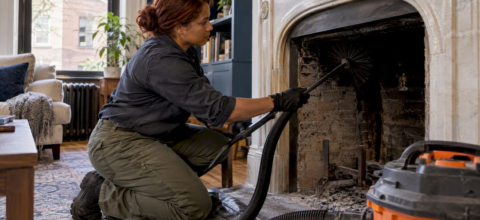
If symptoms are severe, include fever, chest tightness or breathing trouble, or do not ease when you leave the building, see a physician. Those signs can point to building-related illness or a medical condition unrelated to the building. If you suspect carbon monoxide, which causes headache, dizziness and nausea and comes from fuel-burning appliances or a blocked chimney or flue, get everyone outside and call 911 or your fuel utility. Do not wait for an HVAC appointment. Regular chimney cleaning and dryer vent cleaning are part of keeping combustion gases and moisture moving out of the building.
Perspective
Most of the SBS complaints we hear about do not turn out to be mysterious. They turn out to be a neglected system: a coil that has not been cleaned in years, a drain pan with standing water, ducts carrying heavy debris, a filter that has not been changed since spring.
We do not promise that cleaning solves every symptom, and we will tell you if we think the problem is elsewhere, such as ventilation design or a leak. But we do think a clean, dry, properly maintained system is the right foundation, and it is the part of the problem we can fix in a single visit. Our technicians are certified, we serve both homes and commercial properties across New York, New Jersey and Connecticut, and we have been doing this for over 10 years.
If you manage a building where people are complaining, a documented cleaning of the coils, blower and ducts also shows tenants and staff that you took the complaint seriously.
Victor
Book a system inspection and cleaning
If your HVAC system is a suspect, we can clean the parts that matter: ducts, coils, blower and, where needed, antimicrobial treatment or UV light installation to help control growth on the coil. We serve homes and commercial properties across New York, New Jersey and Connecticut.

Start with our air duct cleaning service, or read about UV light installation. To talk through your building, visit Amazon Air Duct Cleaning and request an appointment.
FAQ
What are the symptoms of sick building syndrome?
The EPA lists headache, fatigue, trouble concentrating, dizziness, nausea, and irritation of the eyes, nose, throat or skin. What marks it as SBS is the timing: symptoms tied to time in the building that ease soon after you leave.
Is my house making me feel sick?
It can be, if your symptoms follow a pattern linked to being at home and ease when you are away. Check filters, vents, damp spots and musty odors from the air handler first. If symptoms are severe or persistent, see a doctor, and call 911 immediately if you suspect carbon monoxide.
Why is my HVAC system making me sick?
The EPA and ASHRAE point to inadequate ventilation, poor air distribution, stagnant water in drain pans and ducts, and poor maintenance or operation. A system can contribute without being broken. A professional inspection of the coil, blower, drain pan and ducts shows which factor applies.
Can air duct cleaning fix sick building syndrome?
It can address one real contributor, since dirt and moisture in the system are among the factors cited. SBS often has several causes, so combine cleaning with fresh filters, working ventilation and the step-by-step investigation above.
How often should I have my HVAC system serviced?
Filters need regular replacement, and the system should be inspected at least once a year, ideally before cooling season. Coils and ducts are cleaned based on condition. Our guide to HVAC coil cleaning frequency explains the signs that mean it is time.
Sources
- U.S. EPA: Sick Building Syndrome fact sheet
- U.S. EPA: Do You Suspect Your Office Has an Indoor Air Problem?
- U.S. EPA: Building Air Quality guide
- U.S. EPA: Clean Air in Buildings Challenge
- U.S. EPA: An Office Building Occupant’s Guide to Indoor Air Quality
- U.S. EPA: Should You Have the Air Ducts in Your Home Cleaned?
- ASHRAE: Indoor Air Quality position document
- ASHRAE: Evaluating and Managing Indoor Air Quality
- ASHRAE: Position document on filtration and air cleaning
Recommended
- HVAC Problems That Quietly Drain Your Commercial Building Budget
- Recognize Signs Your Ducts Need Cleaning for Healthier Air
- HVAC Contaminants: Protect Your Indoor Air Quality
- HVAC System Maintenance: Boost Comfort & Air Quality