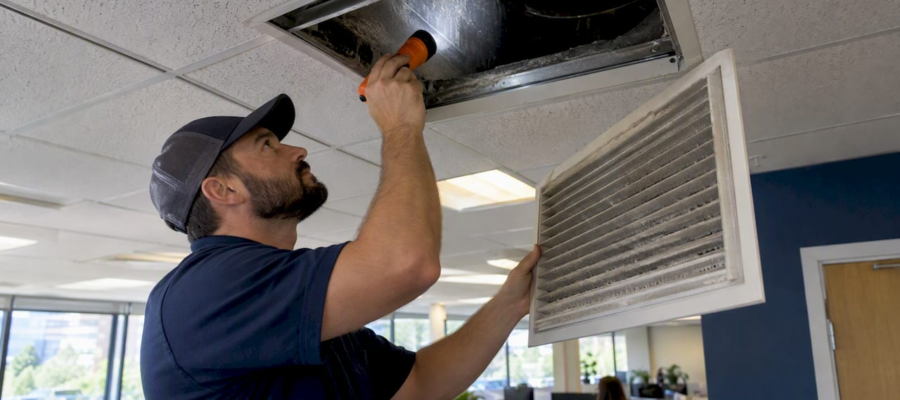
Office Duct Cleaning Frequency: How Often to Schedule It
There is no single date that fits every office. The most defensible schedule is regular visual inspections, with cleaning when an inspection or a symptom shows it is needed. In practice, many commercial buildings land on a full cleaning cycle of roughly every three to five years. Offices with heavy occupancy, construction nearby, past water damage or sensitive occupants are inspected more often and cleaned sooner. Here is how to set that schedule for your own building.
TL;DR
- Inspect first, clean second: the National Air Duct Cleaners Association (NADCA) recommends visual inspections at intervals that depend on how the building is used, not a fixed cleaning date.
- A three-to-five-year cycle is a common planning range for offices. Shorten it for high-occupancy, high-dust, or health-sensitive spaces.
- Clean sooner if you find water damage, microbial growth, airflow-blocking debris, dust blowing from supply diffusers, or persistent odors.
- Fix the source of contamination first. Cleaning without that is only a temporary fix.
- Put it on a written maintenance calendar next to filter changes and coil service so nothing slips.
Table of Contents
- What the guidance says about frequency
- Why a three-to-five-year range shows up so often
- What changes your interval
- Signs an office needs cleaning before the schedule says so
- Find and fix the source before you clean
- Healthcare and school facilities
- Duct cleaning versus routine HVAC maintenance
- How to build an office duct cleaning schedule
- What a proper commercial cleaning looks like
- Our perspective
- Plan your office service with us
- FAQ
- Sources
What the guidance says about frequency
The honest answer starts with what authorities do and do not say. The U.S. Environmental Protection Agency states that it does not recommend routine duct cleaning, only cleaning as needed, and it notes that properly done cleaning has no evidence of being detrimental. That guidance was written mainly with homes in mind, but the logic carries over to offices: the trigger for cleaning is condition, not the calendar.
NADCA, the trade association for the duct cleaning industry, takes a similar line on the inspection side. A National Institutes of Health fact sheet summarizing NADCA and EPA guidance says that NADCA recommends visual inspections at regular intervals depending on building use. It also notes that in healthcare settings, air-handling units and supply and return ducts are inspected annually. The same document describes the value of routine cleaning as questionable and treats it as a last resort after other measures have been exhausted.
That can sound like a reason to do nothing. It is better read as a reason to be systematic. Inspections tell you what is actually inside your system. The NADCA standard, ACR, The NADCA Standard, includes an inspection section with a schedule table and defines when HVAC components are recommended for cleaning. A reputable contractor works from that document.
Why a three-to-five-year range shows up so often
If you search this topic, you will see three to five years repeated for commercial buildings. It is a practical planning range rather than a regulation. Nothing in federal law sets a routine duct cleaning interval for private offices. The range persists because it roughly matches how long it takes dust, paper fibers, and construction debris to build up in a typical office system with decent filtration.
Use it the way a facilities manager would: as a budget placeholder. Plan for a full-system assessment in that window, then let the inspection results confirm, shorten, or extend the interval. If an inspection at year three shows clean metal and light film, you push the cleaning out. If it shows heavy debris on coil faces and in return plenums, you do not wait.
What changes your interval
Two offices of the same size can need very different schedules. These are the factors we weigh when we assess a commercial system.
Occupancy and use
A 40-person open-plan office with a kitchenette produces more skin cells, paper dust, and cooking odor than a five-person consulting suite. Conference rooms with heavy turnover, reception areas that see constant foot traffic, and break rooms with microwaves and toasters all load the return air with particles and smells.
Construction and renovation
Build-outs, demolition, drywall sanding, and floor refinishing release fine dust. If the air handler ran during the work, or returns were not sealed, debris travels into the ductwork. Many facility managers schedule an inspection after any significant tenant improvement and before the new occupants move in.
Water and humidity history
Roof leaks, a condensate pan overflow, a burst pipe, or a humid summer in the Northeast can all put moisture in or near the system. The NIH fact sheet lists persistent water damage and microbial growth among the conditions where cleaning may be appropriate. It also says to avoid biocides and sealants, and that wet or moldy fiberglass duct material should be replaced instead of cleaned, a point both EPA and NADCA make.

Filtration quality and maintenance habits
Better filters, changed on schedule, keep more material out of the ducts. An office that runs the lowest-grade filters and swaps them only when someone remembers will see faster buildup. Preventive maintenance is the cheapest lever you have. The American Industrial Hygiene Association notes that regular HVAC inspection and maintenance can help avoid frequent cleaning.
Who occupies the space
Medical offices, dental practices, childcare, schools, and spaces with asthmatic or immunocompromised occupants warrant shorter inspection intervals and a lower threshold for acting. More on that below.
Signs an office needs cleaning before the schedule says so
The NIH fact sheet lists conditions where cleaning may be appropriate: persistent water damage, microbial growth, debris restricting airflow, dust discharging from supply diffusers, and offensive odors from the ductwork or HVAC system. In an office, they usually show up like this:
- Visible dust or debris at supply diffusers. Black or gray streaking around vents, or dust that returns within days of cleaning the surface.
- Uneven airflow. One corner is stuffy while another is cold, and the thermostat settings are not the cause.
- Odors. A musty or sour smell when the system starts up, especially on Monday mornings after a weekend of off-cycle operation.
- Complaints that cluster. Several employees report stuffiness, coughing, or eye irritation, and symptoms ease when they leave the building. That pattern calls for an indoor air quality assessment, not just a cleaning order.
- A known water event. Any leak that wet insulation, duct liner, or the air handler cabinet.
- Pests. Droppings or nesting material found in registers or plenums.
Our own guides go deeper on how to recognize these: see 5 signs your air ducts need cleaning and signs of dirty air ducts.
Find and fix the source before you clean
Cleaning a system that keeps getting contaminated is money spent twice. The NIH summary of EPA and NADCA guidance is direct on this: before cleaning, confirm the type and quantity of contaminants, whether they can enter occupied spaces, and whether the source is controlled. It adds that effective cleaning must be preceded by identifying and correcting the source of contamination, otherwise it is only a temporary fix.
In an office, the usual sources are:
- Moisture. Leaking roof penetrations, clogged condensate drains, or over-humid supply air. Moisture problems often start in places nobody inspects. The same principle applies at home, as in this overview of where hidden mold tends to be.
- Unsealed returns during construction. Cover returns while work is underway.
- Poor filtration or filter bypass. Gaps around filter racks let unfiltered air through.
- Dirty coils. Coil surfaces that collect film and growth feed debris and odor into the airstream. Evaporator and blower service is often part of the same visit; see our evaporator coil and blower cleaning service.
If mold has already been found and remediated in your building, the ducts should be addressed as part of finishing the job. We explain the sequence in duct cleaning after mold remediation.
Healthcare and school facilities
If you manage a medical suite or an educational facility, your interval deserves a closer look, because the guidance is more specific.
For healthcare facilities, the CDC’s environmental infection control recommendations call for periodically measuring HVAC output and cleaning ventilation ducts as part of routine maintenance. The CDC also says that infection control risk assessments should drive maintenance schedules for air changes, filtration, and pressure differentials, taking into account the age and reliability of the specific system. In plain terms: your risk assessment sets the cadence, and the NIH fact sheet’s annual inspection of air-handling units and supply and return ducts is a sensible baseline for these spaces.
For schools, the U.S. Department of Education’s facilities maintenance guide says HVAC components should be maintained on a timely, routine, and preventive basis, with schedules often derived from manufacturer manuals. Its examples include filter replacement about every 10 weeks and inspection of duct-mounted smoke and heat detectors. It also suggests air balancing at five- to eight-year intervals or after substantial changes in how rooms are used. That last point matters if you have reconfigured classrooms or converted offices: a layout change is a natural moment to inspect the ductwork.
The guide also recommends tracking recurring tasks, whether in a computerized maintenance system or on simple index cards. We agree with that. The interval is only useful if someone owns it.

Duct cleaning versus routine HVAC maintenance
Facility managers often fold these into one line item, so it helps to separate them.
| Task | What it does | Typical rhythm |
|---|---|---|
| Filter replacement | Stops particles before they enter the system | Set by filter type and manufacturer; schools cite about every 10 weeks as one example |
| Visual duct and air handler inspection | Checks for debris, moisture, growth, damage | Regular intervals based on building use; annually in healthcare |
| Coil and blower cleaning | Restores heat transfer and airflow, reduces odor sources | As inspection shows; commonly paired with duct service |
| Full duct system cleaning | Removes dirt, mold, debris and other material from ductwork | When inspection or symptoms call for it; often planned in a three-to-five-year window |
| Air balancing | Adjusts airflow to match room use | After major layout changes; schools cite five to eight years |
The AIHA describes duct cleaning as removing dirt, slime, mold, debris, and other material, while preventive maintenance covers periodic inspection, cleaning, and service as warranted. They work together. The EPA’s guide to managing buildings for indoor air quality also warns that putting off maintenance until something breaks is a false economy that tends to raise eventual repair costs.
How to build an office duct cleaning schedule
Here is a simple process you can adopt this quarter.
- Inventory your systems. List every air handler, rooftop unit, and split system, with age and the areas each serves.
- Pull your history. Note past water events, renovations, odor complaints, and the date of the last cleaning, if anyone knows it.
- Order a baseline inspection. A qualified contractor should look at supply and return ductwork, plenums, coils, the blower, and the drain pan, and show you photos.
- Rank each zone by risk. Kitchens, server-adjacent areas, health-sensitive suites, and spots with prior moisture go to the top.
- Set inspection intervals. Annual for higher-risk zones, longer for low-use areas, adjusting after each result.
- Plan cleaning around the findings. Use the three-to-five-year range as a budget placeholder, then confirm with inspection results.
- Write it down. Put each task in your maintenance calendar, with an owner and a reminder date.
- Schedule after hours. Duct cleaning is invasive and works best when the office is empty, so plan evenings or weekends and give tenants notice.
If you lease space, check who is responsible. Many leases make the landlord responsible for base-building HVAC and the tenant responsible for supplemental units or after-hours service. Get that in writing before you order work.
What a proper commercial cleaning looks like
The method matters as much as the interval. EPA warns that improper cleaning can cause problems, such as releasing dust into the air or damaging the system. Here is what to expect from a legitimate provider:
- A written assessment before work, with photos of problem areas.
- Negative air pressure or equivalent containment, so dislodged material is captured instead of pushed into occupied rooms. We cover how we verify this in 3 pressure readings that prove negative air duct cleaning.
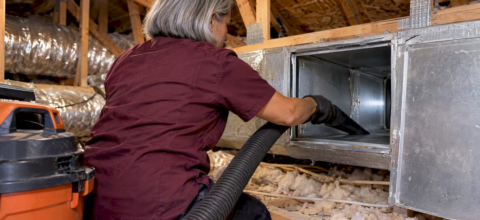
- Mechanical agitation of duct surfaces along with source removal vacuuming. You can read about our tools in what equipment we use to clean air ducts.
- Access panels sealed properly afterward.
- No automatic biocide or sealant sale. The NIH fact sheet advises avoiding biocides and sealants, so a contractor who pushes them as a default is a red flag. Where a documented microbial problem calls for an antimicrobial treatment, it should be explained and justified in writing.
- Clear post-work documentation, ideally with before-and-after photos.
It is also worth reading our list of duct cleaning risks so you know what questions to ask any vendor, including us.
Our perspective
We have been cleaning commercial and residential systems across New York, New Jersey, and Connecticut for over 10 years, and the question we hear most from office managers is whether they are being sold something they do not need. It is a fair question, and the honest answer is that a calendar alone should not drive the decision.
What we recommend is a documented inspection first. If your ducts are clean, we will say so, and you will have a baseline photo record to compare against next time. If they are not, you will see exactly what we see, and you can decide on the scope. Our technicians are certified, and we work on commercial systems regularly, so we know how a tenant build-out, an older rooftop unit, or a damp mechanical room changes the picture.
For most offices, we suggest planning a full system review in the three-to-five-year window, with shorter intervals for medical, education, and high-occupancy spaces. We would rather help you set up a schedule you can stick to than perform a one-time cleaning that is forgotten for a decade. Cleaning the ducts, the coils, and the blower in a single visit, and fixing the moisture or filtration issue that caused the buildup, is what makes the result last.
Victor
Plan your office service with us
If you manage offices, medical suites, schools, or multi-tenant buildings in New York, New Jersey, or Connecticut, our team handles assessment, duct cleaning, and coil and blower service in one coordinated visit, scheduled around your hours. Prices are quoted per property after we see the system, so ask for a written scope.

Start with our commercial air duct cleaning page, or see the NY and NJ commercial service page if your building is in those areas. If your offices also have a laundry or break-room dryer, our dryer vent cleaning service follows its own, shorter schedule.
FAQ
How often should an office have its air ducts cleaned?
Many offices plan for a full cleaning every three to five years, but this is a planning range and not a legal requirement. NADCA recommends regular visual inspections based on how the building is used. Let the inspection decide, and shorten the interval for high-occupancy, health-sensitive, or moisture-prone spaces.
Is routine office duct cleaning required by law?
We are not aware of a federal rule that sets a routine cleaning interval for private offices. EPA does not recommend routine cleaning, only cleaning as needed. Healthcare and school facilities follow more specific maintenance guidance, and your lease, insurer, or local code may add requirements, so check with your building owner or local authority.
What should I do after a water leak or mold finding in the office?
Stop the moisture source first, then have the system inspected. Wet or moldy fiberglass duct material should be replaced rather than cleaned, according to EPA and NADCA guidance summarized by the NIH. Cleaning the remaining system and coils comes after the source is fixed.
Can I schedule duct cleaning without disrupting my staff?
Yes. Commercial cleaning is usually planned for evenings or weekends, zone by zone, so the office stays usable. Give staff notice and clear access to returns, vents, and mechanical rooms beforehand.
Sources
- NIH Division of Occupational Health and Safety: HVAC Duct Cleaning fact sheet
- EPA: Should You Have the Air Ducts in Your Home Cleaned?
- NADCA: ACR, The NADCA Standard, 2021 Edition
- AIHA: What’s Up with Duct Cleaning?
- CDC: Summary of Recommendations, Infection Control
- CDC: Recommendations for Environmental Infection Control
- NCES: Maintaining School Facilities and Grounds
- EPA: Managing Buildings for Good IAQ
Recommended
- How often should I clean my air ducts
- Office Duct Hygiene Workflow for Facility Managers
- Duct System Maintenance Checklist 2026: Frequencies and Fixes
- How Do I Know I Need To Have My Air Ducts Cleaned