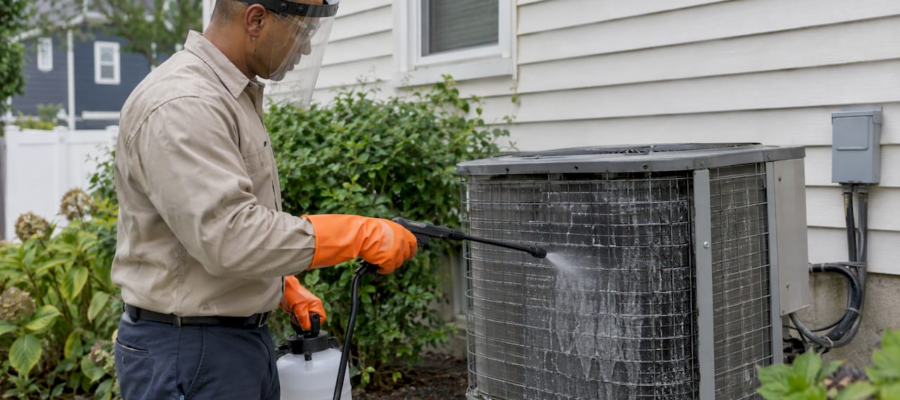
Coil Cleaning Chemicals Safety: What NY, NJ and CT Owners Should Know
Coil cleaning chemicals are strong products. The labels on commercial coil cleaners warn of skin burns, serious eye damage and metal corrosion, and the right product for one coil can harm another. That is why, in New York, New Jersey and Connecticut homes and buildings, this work is best handed to a certified technician who knows the chemistry, the equipment and the cleanup. At Amazon Air Duct Cleaning, our technicians are strictly certified and bring more than 10 years of experience to residential and commercial HVAC cleaning, including evaporator coil and blower cleaning and condenser coil cleaning.
Below is what the hazards are, what the product labels say, where mistakes happen, and what property owners and managers should expect from anyone who cleans their coils.
TL;DR
- Coil cleaners can cause chemical burns, eye injuries, respiratory irritation and toxic fumes, according to the trade association for HVAC cleaning, NADCA.
- Cleaners that are too acidic or too alkaline can damage coil surfaces and shorten coil life, so the product has to match the coil and the location.
- Safe use means shutting the system down, protecting people and surfaces nearby, never mixing products, applying at low pressure and rinsing as the label directs.
- Employers whose workers handle hazardous chemicals must follow OSHA’s Hazard Communication rules: labels, safety data sheets and training.
- Handing the job to a certified technician takes the handling, protection and disposal off your hands.
Table of Contents
- Why coil cleaners deserve respect
- The hazards, in plain terms
- What safe use looks like, step by step
- Water or chemicals?
- What to avoid: mixing, guessing and storing
- Rules for businesses, schools and property managers
- Who this matters to
- Our perspective
- Book coil cleaning with a certified team
- FAQ
- Sources
Why coil cleaners deserve respect
Your air conditioner or heat pump has two coils. The evaporator coil sits indoors, usually in or above the furnace or air handler, and pulls heat and moisture out of your air. The condenser coil sits in the outdoor unit and releases that heat. When either one is coated with dust, grease or biological growth, the system works harder. NADCA notes that soil on cooling coils is extremely hard to remove without a cleaning compound unless the coil is cleaned very often, which is why cleaning compounds exist at all.
The same properties that let a cleaner dissolve grime and scale make it hazardous. The Google results for this topic are mostly safety data sheets and product labels, and they all say the same thing: these are chemicals to be handled by people with protective equipment and training, not casually sprayed from a bottle.
The hazards, in plain terms
Risks to people
NADCA lists the possible effects of chemical products used in HVAC systems: allergic reactions, chemical burns, respiratory irritation or damage, eye injuries, poisoning, toxic fumes and exposure to carcinogens. Which of these applies depends on the product, its strength and how it is used.
Product labels are specific. One Nu-Calgon outdoor coil cleaner label warns of severe skin burns and eye damage. Another label from the same manufacturer tells users not to breathe mist or vapor and to wear protective gloves, clothing, eye protection and face protection.
For a homeowner, the practical concern is a closed utility closet or basement where vapors linger. For a facility manager in a school or clinic, the concern extends to occupants who are more sensitive, which is one reason the work needs planning around building use.
Risks to the equipment
A cleaner that is very high or very low in pH (very alkaline or very acidic) is not just unpleasant to handle. NADCA cautions that such products may damage coils or shorten their service life. Acid cleaners are traditionally used outdoors, while alkaline cleaners can suit greasy indoor coils, but both can harm coil surfaces if misapplied.
That matters financially. A coil replacement costs far more than a cleaning, and the damage from the wrong chemical is not always visible on the day.
Risks to the surroundings
The label of one outdoor coil cleaner notes possible metal corrosion and discoloration or tarnishing of some roofing materials, and recommends testing a small roof area first. This is a real consideration for rooftop units on commercial buildings and for condensers placed near siding, decking or landscaping. NADCA also points out that some jurisdictions restrict discharge of cleaning compounds into storm sewers or roof drains, so where the rinse water goes is part of the job.
What safe use looks like, step by step
This is the routine that manufacturer instructions describe. It shows why the work is more than spraying and rinsing, and what a careful professional does at each step.
- Read the label for this exact product. NADCA’s guidance is to follow the product label for dilution and use, since each manufacturer’s directions may reflect product-specific research. A common starting dilution is one part cleaner to three parts water, but the label decides. Where it goes wrong: assuming one product works the same way on every coil.
- Match the product to the coil and location. One outdoor coil cleaner label states the product is not for indoor coils or indoor use and must be diluted with water. An outdoor product used indoors is a clear example of a costly mistake. A certified technician selects by coil type, soil type and location.
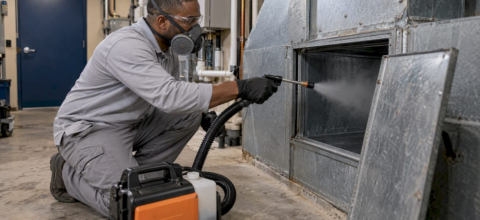
- Put on protective equipment. Goggles, gloves and protective clothing are standard in the manufacturer instructions for an evaporator coil cleaner, along with a firm instruction not to mix chemicals.
- Shut off the system and prepare the space. The same instructions say to turn off the system and air-handling equipment, clear the evaporator drain and pan, and close nearby registers before indoor spraying, which limits airborne droplets. Where it goes wrong: a blower left running spreads mist into the duct system and the rooms beyond.
- Apply at low pressure. A low-pressure sprayer reduces overspray and avoids bending delicate coil fins. This is also why coils that show signs of heavy soiling are best inspected before anything is applied.
- Respect the contact time, then rinse as directed. Cal-Brite Plus directions call for a wait of five to ten minutes and a thorough rinse. Other products differ: the manufacturer of Evap-Green says rinsing is unnecessary when enough condensate provides the flushing. The label for your product settles it.
- Clean the tools and handle the container properly. The Evap-Green instructions say to rinse the sprayer, wand and nozzle after use and, once the container is empty, rinse it, replace the cap and dispose of it properly. Another label says containers should be stored locked up and disposed of under applicable regulations.
Seven steps, each with its own way to go wrong. A certified technician does them every working day, which is the point of hiring one.
Water or chemicals?
The search results include advice that many technicians use plain water unless a coil is badly soiled, particularly on newer microchannel coils (compact aluminum coils with very fine passages). That is a fair description of how careful professionals think: the question is always whether the soil level and coil type justify a chemical at all, and which one.
The answer is rarely obvious from the outside. Light dust on a condenser may rinse away. A greasy, matted evaporator coil in a kitchen-adjacent air handler is a different job. NADCA’s position is that a cleaning compound speeds soil removal where the soil is stubborn, and that the choice should balance effectiveness, potential equipment damage and the risk to occupants and workers. That balance is a professional judgment, and it is easier to make with the coil in front of you.

If you are wondering how often this should happen at all, see our guide on when to clean coils, which explains the performance signs that matter, such as temperature split and pressure readings.
What to avoid: mixing, guessing and storing
The questions people ask most often are what not to use on AC coils and what not to mix. Three rules cover most of it:
- Never mix cleaning products. The manufacturer’s instructions for an evaporator cleaner say so directly. Combining products can release fumes or change how the chemical behaves.
- Never use an outdoor-only product indoors. Labels state where a product may be used, and that line is not a suggestion.
- Never leave chemicals where children, pets or tenants can reach them. Labels call for locked storage and disposal under local, regional and national rules.
For property owners, the safest way to follow all three is to have the product brought, used, rinsed, removed and disposed of by the technician.
Rules for businesses, schools and property managers
If you manage a building, the chemicals are also a workplace matter. OSHA’s Hazard Communication standard requires employers to inform workers about hazardous chemicals through a hazard communication program, labels and warnings, safety data sheets, and training where employees may be exposed in normal use or a foreseeable emergency. OSHA’s May 2024 final rule updated the standard but left its fundamental structure unchanged: programs, labels, safety data sheets and training remain the core.
In practice, ask any contractor for the safety data sheet of each product they plan to use on your premises, and keep those sheets on file. Antimicrobial products add another layer: NADCA notes that EPA registration is required for antimicrobial pesticides used in HVAC systems.

For larger facilities, our pages on commercial HVAC coil cleaning and coil disinfection cover the performance side, and our step-by-step business HVAC cleaning guide covers planning.
Who this matters to
- Homeowners and new home buyers: an unserviced coil in a house you just bought is a common unknown. Having a certified technician inspect and clean it means you do not have to choose or handle a chemical yourself.
- Real estate agents: an HVAC system that has been professionally cleaned is one less open question during a sale.
- Property and facility managers: you carry the duty to occupants and, for employees, the hazard communication obligations above. A contractor who documents products and follows labels simplifies both.
- Business owners: coil condition affects energy use and comfort, and chemical handling affects your staff and customers.
Our perspective
We clean coils across New York, New Jersey and Connecticut, for homes and for commercial and institutional buildings, and we have done this work for more than 10 years. Our view is simple: the chemistry is not the hard part to read, the judgment is.
Every coil is different. Indoor or outdoor, aluminum or copper, light dust or heavy grease, a rooftop unit above a school or a condenser beside a Connecticut porch. Our technicians are strictly certified because choosing the right product, the right dilution and the right rinse for each of those situations is a skill, and the label is only the starting point.
We believe our customers should not have to become chemical handlers to keep their HVAC systems clean. That is what we offer for evaporator coils, condenser coils, and the duct systems connected to them, for residential and commercial clients alike.
Victor
Book coil cleaning with a certified team
If your coils need attention, our team handles evaporator coil and blower cleaning and condenser coil cleaning for homes and commercial properties in New York, New Jersey and Connecticut. You can read about evaporator coil and blower cleaning or request service for your property on our condenser coil cleaning page. Prices are not published, so ask us for a quote for your system.

If your property is near Trenton, we also have a page on condenser coil cleaning in Trenton, NJ, and one for evaporator coil cleaning in Norwalk, CT.
FAQ
Is coil cleaner really worth it?
Where soil is heavy, yes. NADCA says soil on coils is very hard to remove without a cleaning compound unless coils are cleaned very frequently. The product still has to match the coil and be rinsed as the label directs, which is why a certified technician makes the choice.
What safety precautions apply when using cleaning chemicals on coils?
Manufacturer instructions call for goggles, gloves and protective clothing, shutting off the system and blowers, clearing the drain and pan, low-pressure application, and thorough rinsing as directed. They also say never to mix chemicals. Our technicians handle this protective routine on every coil job.
What should you not clean AC coils with?
Nothing the product label does not allow for that coil. Outdoor-only cleaners are not meant for indoor coils, and very acidic or very alkaline products can damage coil surfaces. Mixing products is also prohibited by manufacturer instructions.
Do I need to do anything if I manage a workplace or school?
If your employees handle hazardous chemicals, OSHA’s Hazard Communication standard requires a program with labels, safety data sheets and training. When a contractor performs the work, request the safety data sheets for the products they will use and keep them on file.
Sources
- NADCA: Using Chemical Products in HVAC Systems (2021)
- Nu-Calgon: Nu-Brite label (2020)
- Nu-Calgon: product 4127-08 safety label (2024)
- Nu-Calgon: Cal-Brite Plus instructions
- Nu-Calgon: Evap-Green instructions
- OSHA: 29 CFR 1910.1200 Hazard Communication regulatory text (2026)
- OSHA: Hazard Communication Standard final rule (May 20, 2024)
Recommended
- NY/NJ/CT Homeowners: Clean Coils When Delta T Falls or Pressure Rises
- Commercial HVAC Coil Cleaning: 30% Energy Penalty for NY/NJ/CT
- 6 Signs Your Condenser Coil Is Dirty: NY/NJ/CT Tech Checklist
- Facility HVAC: Recover up to 18% Heat Transfer with Coil Disinfection