Hospital Air Cleaning Protocols: 2026 Compliance Guide
TL;DR:
- Maintaining precise hospital air cleaning protocols is essential to prevent airborne pathogen spread and comply with strict standards. Regular digital monitoring, proper airflow studies, and layered filtration strategies ensure effective containment and patient safety. Facilities that integrate multilayered systems, zone-specific maintenance, and staff training achieve genuine compliance and reduce infection risks.
Maintaining precise hospital air cleaning protocols is one of the most consequential responsibilities a facility manager carries. Airborne pathogens spread through contaminated HVAC systems contribute directly to hospital-acquired infections (HAIs), which affect millions of patients each year. The regulatory framework governing air quality in medical settings, primarily ASHRAE Standard 170 and CDC guidelines, is exacting and non-negotiable. Yet many facilities still struggle with implementation gaps, outdated monitoring methods, and technology decisions that don’t align with actual room requirements. This guide walks you through the standards, technologies, and practical steps that make the difference.
Table of Contents
- Key takeaways
- 1. Understanding the core standards for hospital air cleaning protocols
- 2. Air changes per hour requirements by room type
- 3. Pressure differential management
- 4. Filtration standards: HEPA, MERV ratings, and why sequencing matters
- 5. Technologies used in hospital air purification systems
- 6. Comparing protocols by room type
- 7. Continuous monitoring and alarm systems
- 8. Air mixing effectiveness: the often-missed variable
- 9. Practical implementation and compliance documentation
- 10. HVAC zone-specific maintenance as infection control
- My take on what most facilities get wrong
- How Amazonairpro supports your air quality compliance
- FAQ
Key takeaways
| Point | Details |
|---|---|
| ACH requirements vary by room | Operating rooms need 20+ ACH; isolation rooms require a minimum of 12 ACH under ASHRAE 170. |
| Pressure differentials matter | Positive pressure protects clean spaces; negative pressure contains infectious patients. |
| Filtration is multi-stage | HEPA alone is insufficient without upstream MERV 7 and MERV 14 pre-filters to protect filter life. |
| Digital monitoring is non-negotiable | Manual checks miss transient pressure failures; continuous digital systems detect and log excursions in real time. |
| Layered approaches outperform single solutions | Combining outdoor air dilution with recirculated HEPA filtration removes both particulates and gaseous contaminants. |
1. Understanding the core standards for hospital air cleaning protocols
Before choosing any technology, you need to understand the regulatory baseline. ASHRAE Standard 170, “Ventilation of Health Care Facilities,” sets the minimum requirements for air changes, pressure relationships, filtration, temperature, and humidity across every room type in a medical facility.
These aren’t suggestions. Joint Commission surveyors, state health departments, and CMS inspectors all reference ASHRAE 170 during accreditation reviews. Non-compliance can result in citations, remediation costs, and in serious cases, facility shutdowns.
The CDC’s Guidelines for Environmental Infection Control in Health Care Facilities layer on top of ASHRAE 170, providing pathogen-specific guidance for managing aerosol transmission prevention in high-risk spaces. Understanding both documents is the starting point for any credible protocol.
2. Air changes per hour requirements by room type
ACH is the single most referenced metric in medical facility ventilation guidelines, and getting it right by room type is critical.
Operating rooms require a minimum of 20 total ACH, with at least 4 of those being outdoor air. Temperature must stay between 68°F and 75°F, relative humidity between 20% and 60%, and positive pressure must be maintained at or above +0.01 inches of water gauge. These parameters protect sterile fields from contamination during procedures.

Airborne Infection Isolation (AII) rooms follow a different logic. They require a minimum of 12 ACH for new construction, negative pressure at least 0.01 inches of water gauge, and exhausted air that does not recirculate to other areas. At 12 ACH, it takes approximately 23 minutes to achieve 99% air removal and 35 minutes to reach 99.9% efficiency. General patient rooms operate at lower requirements but still demand documentation and verification.
Pro Tip: Create a room-type ACH matrix for your facility and post it in your maintenance management system. When a room is converted for a different use, the matrix flags the ACH requirement change before work begins.
3. Pressure differential management
Positive and negative pressure relationships are your primary physical barrier against cross-contamination. They determine whether airborne particles flow toward or away from vulnerable patients and staff.
Positive pressure rooms push air outward through doorways, preventing corridor contaminants from entering. These are used in operating rooms, procedure rooms, and immunocompromised patient suites. Negative pressure rooms do the opposite. They keep infectious aerosols contained by drawing air inward, exhausting it directly to the outside or through HEPA filtration before any recirculation.
ASHRAE 170 mandates continuous pressure monitoring with both visual and audible alarms in all critical spaces. This requirement exists because even brief pressure reversals, caused by door openings, HVAC failures, or maintenance work, can compromise containment. Documenting these excursions is also a compliance requirement, and records must be retained for multiple years.
4. Filtration standards: HEPA, MERV ratings, and why sequencing matters
HEPA filters capture 99.97% of particles at 0.3 microns. That performance level makes them the standard for infection-critical spaces in hospitals. But HEPA filters are expensive to replace and highly sensitive to particulate loading. Replace them too late and you risk system bypass. Replace them too early and you waste budget unnecessarily.
The practical answer is a three-stage filtration approach: a MERV 7 pre-filter captures large debris, a MERV 14 intermediate filter handles fine particles, and the HEPA final filter addresses pathogen-sized aerosols. This sequencing protects HEPA service life and maintains consistent air quality between filter changes.
For spaces where HEPA installation in the central HVAC system isn’t feasible due to older infrastructure, portable HEPA air purification units offer a legitimate supplemental solution. They are not a replacement for a compliant ventilation system, but they do add meaningful filtration capacity in transitional scenarios.
5. Technologies used in hospital air purification systems
Hospital air purification systems have expanded significantly beyond traditional HVAC filtration. Here are the main technologies in active use and how they fit into a compliant protocol:
- HEPA filtration: The gold standard for particulate removal. Most effective when properly sized for room volume and maintained on schedule.
- Ultraviolet Germicidal Irradiation (UVGI): Inactivates airborne pathogens by disrupting DNA replication. Most commonly installed in HVAC ductwork or as upper-room units. Effective against tuberculosis and influenza but requires careful placement to avoid occupant exposure.
- Outdoor air dilution: Increases fresh air supply to reduce concentration of indoor airborne contaminants. The most straightforward approach but increases HVAC energy loads.
- Recirculated air with filtration: Passes indoor air through HEPA or high-MERV filters before reintroduction. More energy-efficient than full outdoor air but must be combined with dilution for complete contaminant control.
- Portable air purifiers: Useful for supplemental coverage in rooms awaiting HVAC upgrades. Select units with true HEPA filters and verify Clean Air Delivery Rate (CADR) is appropriate for the room size.
Effective air cleaning requires combining outdoor air dilution with recirculated HEPA filtration. Neither method fully addresses the full spectrum of particulate and gaseous contaminants when used alone.
Pro Tip: When evaluating portable air purifiers for supplemental use, calculate the number of air changes per hour they deliver at the room’s square footage. A unit rated for a 500 sq ft space will underperform in a 900 sq ft room regardless of its filter quality.
6. Comparing protocols by room type
Different spaces in your facility require fundamentally different approaches. This table provides a working comparison for the most common room categories:
| Room Type | Pressure | Minimum ACH | Filtration Required | Key Notes |
|---|---|---|---|---|
| Operating room | Positive | 20 total / 4 outdoor | MERV 7 + MERV 14 + HEPA | Continuous monitoring, alarms required |
| AII isolation room | Negative | 12 (new construction) | HEPA exhaust or direct exhaust | 35 min wait before terminal cleaning |
| General patient room | Neutral/Positive | 6 total / 2 outdoor | MERV 7 minimum | Verify during room-use changes |
| Procedure room | Positive | 15 total / 3 outdoor | MERV 14 minimum | Align with specific procedure risk level |
| Anteroom (AII) | Positive relative to corridor | 10 | MERV 7 minimum | Acts as pressure buffer |
The contrast between positive and negative pressure rooms carries real operational consequences. A failure to maintain negative pressure in an AII room during an active respiratory infection case can expose adjacent patients, staff, and visitors to infectious aerosols. That’s not a theoretical risk.
7. Continuous monitoring and alarm systems
Manual pressure indicators are insufficient for maintaining compliance in critical hospital spaces. A pressure gauge on the wall tells you what the pressure is at the moment someone looks at it. It tells you nothing about what happened at 3:00 a.m. when a maintenance crew propped a door open.
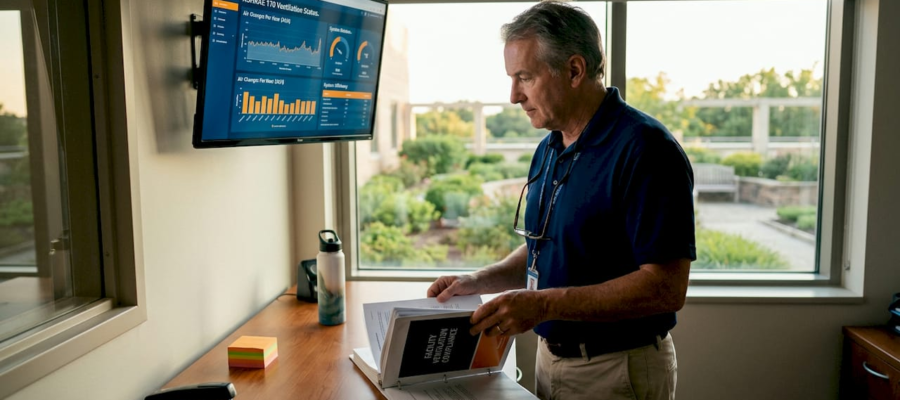
Digital continuous monitoring systems track pressure differentials, temperature, humidity, and air change rates in real time. They generate audible and visual alarms when parameters exceed set thresholds, create timestamped data logs, and in many systems, enable remote oversight by facility managers from any location. This level of documentation also satisfies the record-retention requirements that regulatory bodies require for compliance audits.
The market for these systems is growing rapidly. The hospital air purifiers and monitoring segment is projected to expand at a CAGR of 8.5% through 2030, largely driven by rising HAI rates and stricter regulatory enforcement. Facilities that invest early reduce both their compliance risk and their long-term remediation costs.
8. Air mixing effectiveness: the often-missed variable
High ACH numbers can create a false sense of security. Air change rates measure how much air moves through a room, not how well it mixes. A room with 20 ACH but poor supply/return grille placement may have dead zones where contaminated air recirculates without ever reaching a return grille.
Good mixing ensures contaminants reach return grilles for filtration. Facility managers should commission airflow studies when rooms are reconfigured or when new HVAC equipment is installed. Smoke or tracer gas testing visualizes actual airflow patterns and identifies problem areas before they become infection control failures.
This is particularly relevant in older hospital buildings where HVAC systems have been modified over decades without comprehensive airflow verification. You may be meeting ACH requirements on paper while actual air mixing in the room is compromised.
9. Practical implementation and compliance documentation
Getting protocols right on paper is one challenge. Keeping them verified and documented over time is another. Here is a structured approach that works for most facility types:
- Conduct a baseline audit. Verify current ACH, pressure differentials, and filtration grades for every critical and semi-critical space. Compare findings against ASHRAE 170 requirements for each room type.
- Install or upgrade monitoring systems. Replace manual indicators with digital continuous monitors in operating rooms, AII rooms, and procedure areas first.
- Create a maintenance schedule tied to room criticality. High-risk spaces need monthly verification; general patient rooms can operate on quarterly checks with continuous digital monitoring.
- Document everything. Regulatory bodies require multi-year retention of pressure and environmental control records. A CMMS (computerized maintenance management system) is the most reliable way to maintain this.
- Coordinate with infection control teams. Air quality protocols don’t exist in isolation. Work with your infection preventionists to align HVAC maintenance schedules with patient census patterns and outbreak response plans.
- Train staff on terminal cleaning timing. At 12 ACH, terminal cleaning in an AII room must wait 35 minutes after patient discharge to allow adequate air contaminant reduction. Environmental services staff must understand this requirement and have a reliable way to track it.
Pro Tip: Post laminated room-specific ACH wait time charts inside AII room anterooms. Environmental services teams can reference them without hunting for policy documents.
10. HVAC zone-specific maintenance as infection control
HVAC maintenance is not a facility-wide, one-size-fits-all task in a hospital setting. Failure to maintain critical pressure zones risks infection spread in ways that are difficult to trace after the fact. Filters in an operating room supply unit and filters in a general office corridor serve completely different functions and require completely different maintenance intervals.
Zone-specific maintenance plans document each zone’s criticality level, equipment components, maintenance intervals, and responsible personnel. They also connect to your alarm response protocol, so when a pressure alarm triggers in a critical zone, the response is defined and practiced rather than improvised.
Regular HVAC maintenance practices that include coil cleaning, drain pan inspection, and duct inspection are as relevant to air quality outcomes as filter changes. Biofilm in drain pans and debris in ductwork contribute to microbial contamination of supply air even when filters are up to date.
My take on what most facilities get wrong
I’ve seen hospitals invest in expensive UVGI systems and top-tier HEPA filtration while running manual magnehelic gauges as their only pressure monitoring tool. That combination doesn’t add up. The most sophisticated filtration in the world doesn’t protect you from a pressure reversal that nobody recorded.
In my experience, the protocols that hold up under inspection and during outbreak investigations share one characteristic: they treat monitoring as seriously as filtration. Digital continuous monitoring isn’t a premium add-on. It’s the mechanism that tells you whether everything else is working.
The other pattern I’ve observed repeatedly is facilities that chase ACH numbers without verifying air mixing quality. A room can check every ASHRAE box on paper and still have dead zones that harbor contaminated air. If you haven’t done a commissioned airflow study in any room that’s been reconfigured in the last five years, that’s worth putting on your priority list.
The facilities that perform best don’t rely on any single technology or standard. They layer outdoor air dilution, HEPA filtration, continuous monitoring, zone-specific maintenance, and staff training into a system where each element reinforces the others. That’s what genuine compliance looks like. It’s also what actually protects patients.
— Victor
How Amazonairpro supports your air quality compliance

Maintaining compliant air quality in a medical facility starts with clean, well-maintained duct systems. At Amazonairpro, we provide professional commercial air duct cleaning services tailored to the demands of healthcare environments in New York, New Jersey, and Connecticut. Debris buildup in HVAC ductwork undermines filtration performance regardless of filter grade. Our team works around facility schedules to minimize disruption and deliver thorough cleaning that supports ASHRAE 170 compliance goals. If you’re unsure whether your current duct condition meets the standard your protocols require, our duct cleaning assessment process helps you make that call with confidence. Contact Amazonairpro to schedule a consultation with our commercial team.
FAQ
What is the minimum ACH requirement for operating rooms?
Operating rooms require a minimum of 20 total air changes per hour under ASHRAE 170, with at least 4 of those being outdoor air, maintained under positive pressure at or above +0.01 inches of water gauge.
How long must you wait before cleaning an isolation room after patient discharge?
At 12 ACH, terminal cleaning of an AII room should wait at least 35 minutes after patient discharge to achieve 99.9% airborne contaminant reduction.
Why isn’t a single air change rate enough to ensure safe air quality?
High ACH without proper air mixing can leave dead zones where contaminated air recirculates. Commissioning airflow studies verifies that supply and return grille placement is actually moving air through the entire room volume.
What filtration stages does ASHRAE 170 require for operating rooms?
ASHRAE 170 specifies a three-stage sequence: a MERV 7 pre-filter, a MERV 14 intermediate filter, and a HEPA final filter. This protects HEPA service life and maintains consistent air quality between scheduled maintenance intervals.
Is continuous digital pressure monitoring required by ASHRAE 170?
Yes. ASHRAE 170 requires continuous pressure monitoring with visual and audible alarms in critical spaces such as operating rooms and AII rooms, along with documented records that must be retained for compliance audits.
Recommended
- OSHA Air Duct Guidelines: Your Homeowner Compliance Guide – Amazon Air Duct Cleaning
- HVAC Maintenance Guide: Boost Air Quality & Efficiency – Amazon Air Duct Cleaning
- Step-by-step guide to improving business air quality – Amazon Air Duct Cleaning
- What is HVAC cleaning? The complete guide for healthier air – Amazon Air Duct Cleaning