Ventilate 30 Minutes First: NY/NJ/CT Rodent Droppings in Ducts
Stop the furnace or air conditioner, open windows to air out the space for at least 30 minutes, and resist the urge to vacuum or sweep the droppings. Put on gloves and an N95 mask if you have one, then wait until the area is ventilated before disinfecting. If you see heavy contamination, nests, dead rodents, or smell a persistent odor, call pest control and a qualified duct-cleaning company before you do anything else.
TL;DR:
- Most rodent infestations inside ducts are indicated by multiple signs such as droppings at several vents, shredded insulation, and scratching noises that often require professional intervention.
- Ventilating the area for 30 minutes and disinfecting with a bleach solution before any cleanup is essential to reduce airborne contamination risks from dried droppings.
- DIY cleaning is limited to surface disinfecting at accessible registers; deep ductwork contamination, nests, or dead rodents demand professional duct cleaning and pest control.
- Pest control must be completed first to remove rodents and seal entry points before duct cleaning, preventing recontamination and ensuring long-term resolution.
- Full-system duct cleaning is recommended when contamination is visible or extensive, including coils and blower components, with additional measures like liner replacement if necessary.
Table of Contents
- How to Confirm Rodents Were in Your Ducts
- Immediate Safety Actions Before You Clean Anything
- What You Can Clean Yourself and What You Shouldn’t
- Why Call Pest Control First and What to Expect
- When to Hire a Duct-Cleaning Specialist
- Preventing Rodents From Coming Back
- Timeline and Cost Drivers for Full Remediation
- Who’s Behind This Guide
- Signs of Secondary Pest Problems After Rodents
- Keeping Watch After Remediation
- DIY Cleaning Steps for Small, Isolated Cases
- Disposing of Droppings and Contaminated Materials Safely
- A Measured Take on Rodent Contamination Risk
- How We Help: Rodent Duct Remediation in NY, NJ, and CT
- FAQ
- Sources
How to Confirm Rodents Were in Your Ducts
A few droppings near one register might be an isolated event, but several signs together point to an active or recent infestation inside your ductwork. Trust your senses here: sight, smell, and sound each tell a different part of the story.
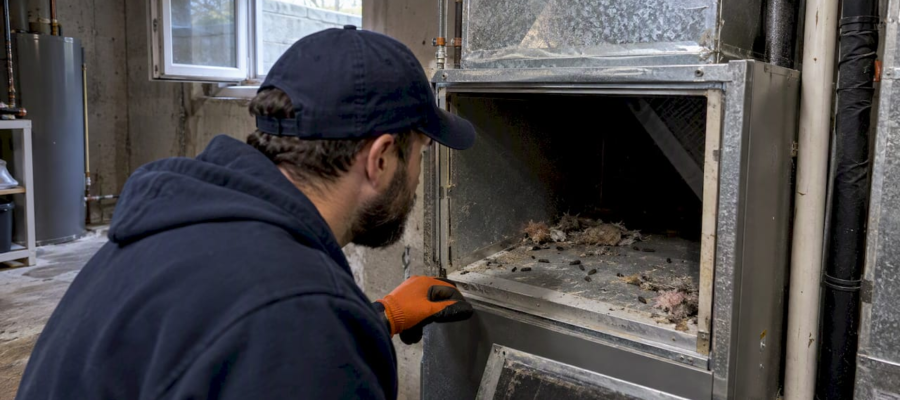
- Droppings scattered at multiple registers or visible inside the duct opening, along with shredded insulation or nesting material
- Chew marks around vent covers, duct seams, or the exterior intake and exhaust hoods
- A persistent foul or ammonia-like smell, sometimes accompanied by flies gathering near vents
- Scratching or scurrying noises inside walls or ceilings, especially at night or during cooler months when rodents seek warmth
If you notice more than one of these, treat it as an infestation rather than a one-time visitor, and plan for professional help rather than a quick wipe-down.
Immediate Safety Actions Before You Clean Anything
The CDC’s cleanup guidance exists because dry rodent droppings can release airborne particles the moment they’re disturbed, and that’s the exposure route that matters most. Follow these steps in order.
- Turn off your HVAC system and open windows to ventilate the area for at least 30 minutes.
- Put on rubber or plastic gloves, and wear an N95 respirator or similar mask if you have one on hand. Protect your eyes too.
- Do not vacuum, sweep, or dry-dust the droppings. Disturbing dry waste is exactly what spreads particles into the air you breathe.
- Spray the droppings and surrounding area with a bleach solution or an EPA-registered disinfectant until fully soaked, and let it sit for at least five minutes, per CDC guidance.
- Wipe up the waste with paper towels, double-bag it, dispose of it in an outdoor trash bin, and wash your hands thoroughly once gloves are off.
Pro Tip: Keep a dedicated spray bottle of disinfectant near your utility closet. Having it ready means you won’t be tempted to grab a broom in the moment.
What You Can Clean Yourself and What You Shouldn’t
There’s a real difference between wiping droppings off a visible register and opening up your ductwork to clean deep inside it. Knowing where that line sits protects both your health and your HVAC system.
- You can safely disinfect and remove a small, shallow amount of droppings at an accessible register using the CDC steps above
- You should not attempt to disassemble ductwork, reach into interior runs, or pull out and replace contaminated insulation yourself
- If you find a nest, a dead rodent, heavy accumulated droppings, or an odor that lingers after surface cleaning, stop and call professionals
Surface-level cleanup at a single register is a reasonable DIY task. Anything beyond that, especially inside the duct runs themselves, calls for the containment equipment and training that a qualified duct-cleaning professional brings to the job.
Why Call Pest Control First and What to Expect
Cleaning your ducts before removing the rodents is a wasted effort, because new droppings and nesting material will simply show up again. Pest control needs to go first.
- Inspection of interior access points plus attic, crawlspace, and exterior entry points where rodents are getting in
- Trapping or baiting to remove the current population, followed by exclusion work to seal the openings they used
- Written documentation of what was found and which entry points were closed off
Ask for that documentation before scheduling duct cleaning. A reputable exterminator will coordinate timing with your duct-cleaning company so the two jobs don’t overlap and undo each other’s work.
When to Hire a Duct-Cleaning Specialist
The EPA recommends professional duct cleaning when ducts are visibly contaminated with vermin, and rodent droppings qualify without question. A full-service job should cover the entire system, not just the parts you can see.
- Supply and return ducts, registers, and diffusers throughout the home
- Coils, blower components, and the air handler housing, since skipping this allows recontamination
- Removal and replacement of any insulated duct liner that’s wet, moldy, or heavily contaminated, since porous materials can’t be fully disinfected by cleaning alone
Before hiring, ask what the full scope includes, what containment practices they use during the job, whether they provide a written estimate, and whether they follow NADCA cleaning standards.
Pro Tip: Ask directly whether coil and blower cleaning is included in the quoted price. Low bids sometimes leave these components out entirely.
Preventing Rodents From Coming Back
Cleaning and extermination solve the immediate problem, but keeping rodents out for good takes ongoing exclusion work.
- Seal any gap larger than a quarter inch around the foundation, utility penetrations, and roofline.
- Screen or secure exterior vent openings so rodents can’t climb in through the duct system itself.
- Repair holes in attic framing, soffits, and foundation walls where rodents commonly enter.
- Remove attractants like bird seed, pet food left out overnight, and cluttered storage that offers shelter.
- Trim vegetation back from the foundation, since overgrown shrubs give rodents a direct path to entry points.
- Schedule a follow-up inspection with your pest control provider a few weeks after initial treatment.
Timeline and Cost Drivers for Full Remediation
Remediation typically moves through a sequence: inspection, then pest removal over days to weeks depending on infestation size, then duct cleaning and any needed repairs over one to three days, followed by a verification check.
- Extent and number of contaminated duct runs affects both time and cost
- Need for insulated liner removal and replacement adds labor and materials beyond standard cleaning
- Access difficulty for coils and blower components can add time, especially in older systems
- Regional labor rates vary, so costs differ by location even for similar jobs
Get a written scope before agreeing to any quote, and ask for references. A bid that comes in far below others often means coil and blower cleaning, or liner replacement, has been left out entirely.
Who’s Behind This Guide
This article comes from Victor at Amazon Air Duct Cleaning, where our team has spent over 10 years cleaning residential and commercial HVAC systems throughout New York, New Jersey, and Connecticut. We’ve built our process around full-system cleaning, antimicrobial and deodorizing treatments, and the kind of checklist referenced throughout this guide. When you call, ask us for our written scope so you know exactly what’s included before work begins.
Signs of Secondary Pest Problems After Rodents
Rodent droppings in ductwork rarely show up alone. The conditions that attracted rodents, easy entry points, food sources, and warm shelter, often attract other pests too, and a dead rodent inside a duct can draw scavengers on its own.
Watch for these follow-up signs after you’ve addressed the original rodent issue:
- Small flies or gnats clustering near vents, which often signal a decomposing rodent still inside the ductwork
- Fresh droppings of a different size or shape than before, which can indicate a second rodent species or an insect infestation
- Grease trails or smudge marks along baseboards near vents, a sign of ongoing rodent traffic rather than a resolved problem
- Cobwebs or insect activity increasing near areas where rodent nesting material was removed, since disturbed insulation can expose hidden pest colonies
If any of these appear after your initial cleanup, treat it as a new issue rather than a leftover from the first one, and loop your pest control provider back in.
Keeping Watch After Remediation
Once ducts are cleaned and entry points sealed, the work isn’t entirely finished. A short monitoring period catches problems while they’re still small.
Check sealed entry points monthly for the first few months after remediation, since settling foundations and weather can reopen small gaps. Keep an eye on attics and crawlspaces for fresh droppings or chewed material, particularly as seasons change and rodents search for winter shelter. A quick visual check at your return registers every few months can catch a new problem before it spreads through the whole system.

Consider scheduling a professional duct inspection annually, especially if your home sits near open fields, wooded areas, or other spots where rodents are common. Many property owners pair this with their regular HVAC maintenance visit, since a technician is already in the system and can spot early warning signs like fresh droppings or disturbed insulation.
If you’ve had one rodent intrusion, your home has at least one access point rodents found attractive, and that vulnerability doesn’t disappear just because the current problem is resolved. Staying alert for the first year after remediation matters more than any single cleaning job.
DIY Cleaning Steps for Small, Isolated Cases
If you’re dealing with a handful of droppings at one accessible register, and there’s no sign of nesting, dead animals, or a broader infestation, here’s the exact sequence to follow.
- Turn off your HVAC system completely before starting.
- Open windows nearby and let the room air out for at least 30 minutes.
- Put on rubber or plastic gloves and an N95 mask if available.
- Spray the droppings and the surrounding register area with a bleach solution or EPA-registered disinfectant until thoroughly soaked.
- Let the disinfectant sit for at least five minutes, per CDC cleanup guidance.
- Wipe the area with paper towels, working from the outside of the mess toward the center to avoid spreading it.
- Place used paper towels and gloves in a sealed plastic bag.
- Wipe down the register cover and surrounding surfaces a second time with disinfectant.
- Wash your hands thoroughly with soap and water once gloves are removed.
If, partway through, you notice the droppings extend further into the duct than you can reach, or you find insulation or nesting material, stop. That’s the point where a visible surface issue becomes an internal ductwork problem, and it’s no longer a DIY job.
Disposing of Droppings and Contaminated Materials Safely
Proper disposal matters just as much as the cleanup itself, since mishandling waste can reintroduce the same exposure risk you just worked to avoid.
Double-bag all contaminated materials, used gloves, and paper towels in plastic bags, sealing each one before placing it in an outdoor trash container. Never leave bagged waste sitting inside the house, even temporarily, and never put it in a recycling bin. If you removed any insulation, nesting material, or duct liner sections yourself, bag those separately in heavier contractor-grade bags, since torn insulation fibers combined with droppings pose added risk. Disinfect any tools or containers you used for cleanup immediately afterward, using the same bleach solution or EPA-registered disinfectant. Wash any clothing worn during cleanup separately in hot water, and clean your shoes if they contacted the affected area.

For larger quantities of contaminated material, particularly from a professional remediation job involving liner replacement, ask your duct-cleaning company how they handle disposal. A reputable provider should remove and dispose of contaminated materials as part of the service rather than leaving that to you.
A Measured Take on Rodent Contamination Risk
Hantavirus exposure is serious but rare, and most dropping discoveries resolve safely once you ventilate, avoid dry disturbance, and disinfect properly. Follow the guidance, call for help when the job exceeds a quick wipe-down, and you’ll handle this fine.
— Victor
How We Help: Rodent Duct Remediation in NY, NJ, and CT
We provide full-system cleaning, antimicrobial and deodorizing treatments, coil and blower cleaning, and insulated liner replacement services to homes and businesses in the local area. When rodent contamination reaches beyond a single register, the job should be handled by professionals with containment equipment and specialized tools.

When you book with us, here’s what the process looks like:
| Step | What happens |
|---|---|
| Inspection | We assess contamination extent across supply, return, coils, and blower |
| Written scope | You receive a clear estimate before any work starts |
| Containment | We use specialized equipment to prevent particle spread during cleaning |
| Follow-up | We recommend next steps if liner replacement or additional treatment is needed |
If you’ve confirmed rodent droppings in your ducts, schedule air duct cleaning with our team and we’ll walk you through the scope before we start.
This article is general information, not a substitute for advice from a qualified doctor. Consult a qualified healthcare professional about your own circumstances before acting on anything here.
FAQ
Is mouse poop in HVAC ducts a problem?
Yes. Rodent droppings inside ductwork can release airborne particles when disturbed, and the EPA recommends professional cleaning whenever ducts show visible vermin contamination. Leaving it untreated risks ongoing air quality issues every time the system runs.
How do I get rid of rodents in ductwork?
Contact a pest control professional first to trap, remove, and exclude rodents from entry points, since cleaning before extermination risks immediate recontamination. Once the infestation is resolved, schedule a qualified duct-cleaning service to clean all affected components and address any contaminated insulation.
How long do mouse droppings remain infectious?
Hantaviruses carried in rodent waste can remain viable for roughly two to three days at normal room temperature, with the highest exposure risk occurring when dry waste gets disturbed and becomes airborne. That’s why ventilating the area and avoiding vacuuming or sweeping matters so much before cleanup.
What should I do if there are dead mice in my ductwork?
Do not attempt to remove a dead rodent from inside ductwork yourself, since reaching into duct runs risks disturbing contaminated material and requires specialized access tools. Call pest control to confirm the extent of the issue, then arrange for a duct-cleaning professional to remove the remains and clean the affected sections safely.
Can I clean rodent droppings from air ducts myself?
You can safely clean a small amount of droppings at an accessible register by following CDC cleanup steps: ventilate, wear protection, disinfect, and dispose properly. Anything found deeper inside the duct system, or signs of nesting and heavier contamination, calls for professional remediation instead.
Sources
- Should you have the air ducts in your home cleaned? | EPA
- How to clean up after rodents | CDC
- Hantavirus pulmonary syndrome — CDC research summary
Recommended
- Shut HVAC Off First: Dead Animal Smell in Vents for NY/NJ/CT Homes
- How Can I Remove Pet Odors From My Ducts?
- Complete duct cleaning checklist: boost air quality 41%
- How to prepare for duct cleaning in NY, NJ & CT