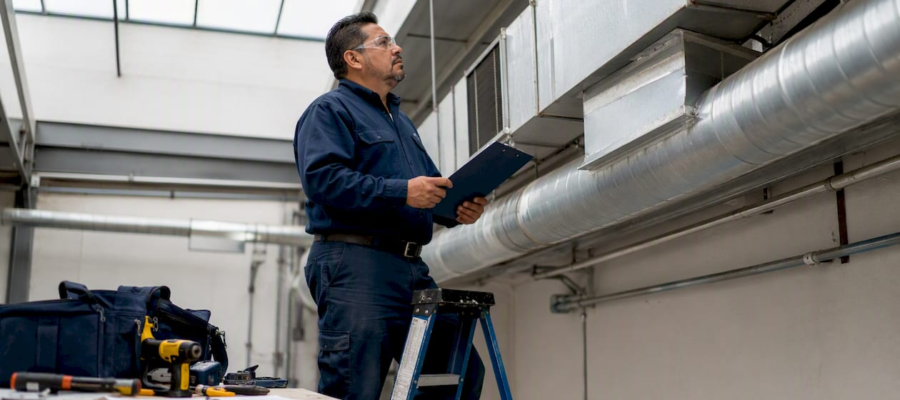
How to Reduce Workplace Dust: A Facility Manager’s Guide
TL;DR:
- Cleaning ducts alone does not eliminate workplace dust unless combined with filtration, moisture control, and source management. Professional inspections are necessary when visible dust discharges or mold signs appear, and regular preventive maintenance improves indoor air quality. Effective dust reduction requires ongoing measures, including upgrading filters, controlling humidity, and timely duct cleaning.
The most effective way to reduce workplace dust is to combine source control, filtration upgrades, and targeted professional duct cleaning when your HVAC system is the source. Surface cleaning alone won’t solve a contamination problem that lives inside your ductwork.
Three signs you need a professional now:
- Visible dust discharging from supply vents after routine cleaning
- Persistent musty odors or visible mold near registers or air handlers
- Filters clogging faster than expected, or a noticeable drop in airflow across the building
If any of these apply to your property in NY, NJ, or CT, schedule an inspection with a NADCA-aware provider before the problem compounds.
Table of Contents
- What can you do right now to cut airborne dust?
- Why surface cleaning alone won’t solve a duct-sourced dust problem
- When should you book professional duct or vent cleaning?
- What does a professional duct cleaning service actually do on-site?
- A practical month-by-month dust reduction plan for facility managers
- How do you know if your dust-control plan is working?
- Key Takeaways
- What facility managers often get wrong about workplace dust
- Amazonairpro cleans workplaces across NY, NJ, and CT
- Useful sources for facility managers
- FAQ
What can you do right now to cut airborne dust?
These actions cost little and can be completed within hours. Assign ownership clearly so nothing gets skipped.
- Place high-quality entry mats at every door (custodial staff, same day). Mats intercept tracked-in particulates before they enter the air stream.
- Switch to HEPA-filtered vacuums for all floor and surface cleaning (facilities manager, within one week). Standard vacuums exhaust fine particles back into the air.
- Establish a daily wipe-down schedule for horizontal surfaces, ledges, and equipment tops (custodial staff, ongoing). Settled dust resuspends every time someone walks past.
- Check your HVAC filter condition today (facilities manager, 30 minutes). A clogged filter bypasses filtration entirely and turns your duct system into a dust distributor.
- Relocate high-emission equipment like printers and photocopiers to a dedicated, separately ventilated space (facilities manager, within one week). Office equipment contributes meaningfully to indoor particulate levels.
Pro Tip: Schedule vacuuming and surface cleaning during HVAC off-cycles or after hours. Running the air handler while you clean resuspends particles and redistributes them through the duct system, undoing the work.

Why surface cleaning alone won’t solve a duct-sourced dust problem
Dust control works only when you address every layer of the system, not just the visible surfaces. Filtration, moisture management, and duct condition all interact. Fix one and ignore the others, and the problem returns within weeks.
Research on proactive IAQ strategies shows that combining ventilation improvements, filtration upgrades, and dampness control delivers measurable reductions in absenteeism and better cognitive performance among workers. The business case is concrete: reducing dampness and mold by 30% in U.S. office buildings could eliminate roughly 1.5 million absence days annually. That figure alone justifies a serious look at your HVAC maintenance budget.
A scientific review also found that ducts can serve as reservoirs for dust and microbials, but duct cleaning alone does not consistently improve indoor pollutant levels unless the underlying sources are controlled. Cleaning without fixing filtration or moisture issues leads to rapid recontamination.
The controls that actually work together:
- Filtration upgrades: MERV 13 filters are the practical standard for most commercial HVAC systems; HEPA filtration applies to supplemental air purifiers in high-occupancy spaces. Confirm your system can handle the static pressure before upgrading.
- Moisture and humidity control: Keep relative humidity between 30–50%. Moisture feeds mold, which feeds dust reservoirs inside ductwork.
- Intake placement: Verify outdoor air intakes are not positioned near loading docks, dumpsters, or high-traffic areas.
- Scheduled component maintenance: Coils, blower wheels, and drain pans accumulate biological growth that no filter upgrade will address. Learn more about how duct dust accumulates and why component cleaning matters.
When should you book professional duct or vent cleaning?
The NIH Office of Research Services identifies specific circumstances where duct cleaning is appropriate rather than optional: water damage inside ducts, confirmed microbial growth, debris visibly restricting airflow, dust discharging from supply diffusers, or offensive odors with no other explanation. If your property in NY, NJ, or CT shows any of these, preventive maintenance has already been missed.
What a professional inspection covers
| Component inspected | What to expect documented | Typical on-site time |
|---|---|---|
| Supply and return ducts | Before/after photos, surface dust assessment | Included in full inspection |
| Evaporator and condenser coils | Visual contamination check, photo record | Included |
| Blower wheel and motor | Debris buildup, rotation check | Included |
| Drain pan and condensate line | Standing water, mold signs | Included |
| Outdoor air intakes | Debris, pest intrusion, seal condition | Included |
Cost factors for NY/NJ/CT jobs include system size, number of zones, accessibility of ductwork, contamination type (dust vs. mold vs. post-construction debris), and whether supplemental services like coil cleaning, antimicrobial treatment, or dryer vent cleaning are added. Residential jobs typically complete in 3–5 hours; larger commercial systems run a full day or more depending on square footage.
What does a professional duct cleaning service actually do on-site?
Knowing the steps helps you evaluate proposals and spot shortcuts. NADCA’s guidance defines inspection, mechanical agitation, HEPA vacuuming, and component cleaning as the core practices for any legitimate job.
- Pre-inspection: Technicians photograph key components before touching anything. This is your baseline.
- Containment: Access panels are opened and the system is placed under negative pressure using a HEPA-filtered vacuum collection unit. This prevents dislodged debris from entering occupied spaces.
- Agitation: Rotary brushes or compressed air tools loosen settled dust from duct walls. Mechanical agitation plus HEPA vacuuming is the method with the strongest evidence base.
- Coil, blower, and drain pan cleaning: These components are cleaned separately. Skipping them leaves the primary biological growth sites untouched.
- Filter replacement recommendations: A reputable provider will note your current filter rating and recommend an upgrade if your system can support it.
- Post-cleaning verification: Before/after photos of all major components, plus airflow notes. NADCA’s objective cleanliness guideline for supply duct surfaces is 0.75 mg/100 cm² as measured by vacuum test.
Credentials to verify: proof of general liability insurance, NADCA-aligned practices (ACR standard), written scope of work before the job starts, and a documented before/after photo package. For occupant safety, the NIH DOHS recommends scheduling cleaning during off-hours and using negative-air containment throughout. Review what HVAC cleaning involves to understand the full scope before signing any proposal.
One honest caveat: professional cleaning removes the reservoir, but it is not a permanent fix if sources are not controlled. Recontamination can return within months if filtration, moisture, and intake issues remain unaddressed.
A practical month-by-month dust reduction plan for facility managers
| Timeframe | Task | Owner |
|---|---|---|
| Monthly | Inspect and replace HVAC filters per MERV rating | Facilities manager |
| Monthly | HEPA vacuum all horizontal surfaces, diffusers, and return grilles | Custodial staff |
| Monthly | Log occupant complaints and filter pressure readings | Facilities manager |
| Quarterly | Inspect drain pans, coils, and blower for visible buildup | HVAC contractor |
| Quarterly | Check outdoor air intakes for debris and seal condition | Facilities manager |
| Quarterly | Dryer vent inspection where applicable | HVAC contractor |
| Annually | Professional duct inspection and cleaning if triggers are present | Certified provider |
| Annually | Full coil and blower cleaning | Certified provider |

For a printable version of this schedule, the complete duct cleaning checklist from Amazonairpro covers the key steps in a format facilities teams can post and track.
Pro Tip: Schedule annual professional cleaning and major HVAC maintenance during low-occupancy periods, such as holiday shutdowns or summer breaks. Use containment barriers and off-hours access to avoid resuspending debris during occupied hours.
How do you know if your dust-control plan is working?
Measurement turns a maintenance plan into an accountable process. Without it, you’re guessing.
Track these indicators on a monthly basis and log them somewhere your team can reference:
- Visible dust at diffusers and return grilles after routine cleaning: if it returns within days, the duct system is still shedding.
- Filter pressure drop trends: a filter reaching its change interval faster than expected signals either a contamination spike or an undersized filtration setup.
- Occupant complaint frequency: a drop in respiratory complaints and sick-day patterns is a meaningful signal. Improving IAQ conditions can improve worker productivity by up to 20%, according to modeling research on office IEQ investments.
- Optional particle counters: portable particle counters (measuring PM2.5 and PM10) give you a before/after baseline if you want objective data for a high-stakes space.
Action triggers: if filter pressure exceeds the manufacturer’s recommended threshold, change the filter and inspect the upstream duct section immediately. If visible dust reappears at diffusers within a week of cleaning, re-evaluate duct seals, intakes, and whether a professional inspection is overdue. For ongoing tips on sustaining dust reduction after a cleaning job, Amazonairpro’s resource library covers the practical routines.
Key Takeaways
Combining source control, filtration upgrades, and professional duct cleaning when contamination is present is the most reliable strategy to reduce workplace dust and protect occupant health.
| Point | Details |
|---|---|
| Source control comes first | Relocate emission sources, use entry mats, and schedule cleaning during HVAC off-cycles before anything else. |
| Filtration upgrades matter | MERV 13 is the practical commercial standard; confirm your system’s static pressure capacity before upgrading. |
| Moisture control prevents regrowth | Keep humidity at 30–50% to stop mold from rebuilding dust reservoirs after cleaning. |
| Hire a pro when triggers appear | Visible duct discharge, rapid filter clogging, or mold signs mean professional inspection is warranted, not optional. |
| Amazonairpro serves NY, NJ, and CT | Amazonairpro provides commercial and residential duct, coil, blower, and dryer vent cleaning with before/after documentation across the tri-state area. |
What facility managers often get wrong about workplace dust
Most of the properties I see in the tri-state area have the same pattern: the custodial team is doing their job, the floors are clean, and the filters are being changed on a loose schedule. But the coils haven’t been touched in years, the drain pan has standing water, and the blower wheel is coated in a layer of debris that no filter swap will fix. The visible cleanliness is real. The IAQ problem is also real. They coexist because surface cleaning and duct-system health are separate problems.
With over 10 years of on-the-ground experience across New York, New Jersey, and Connecticut, Amazonairpro documents every job with before/after photos of all major components. That documentation matters for facility managers who need to show building owners or tenants that the work was done properly and to standard. When a client asks whether the cleaning made a difference, the photos answer the question without debate.
Amazonairpro cleans workplaces across NY, NJ, and CT
Dirty ducts are a facilities problem with a clear solution. Amazonairpro’s team handles commercial air duct cleaning, evaporator and condenser coil cleaning, blower cleaning, dryer vent cleaning, and antimicrobial duct treatment for both commercial and residential properties throughout New York, New Jersey, and Connecticut.

Every job includes a written scope of work, before/after photo documentation, and filter replacement guidance so you leave with a clear record of what was done. The team follows NADCA-aligned ACR practices and carries full liability insurance. With over 10 years of experience in the tri-state market, Amazonairpro is the local provider facility managers and property owners call when the standard maintenance schedule isn’t enough. Request an inspection or estimate directly through the air duct cleaning service page.
Useful sources for facility managers
- NIH DOHS Fact Sheet on HVAC Duct Cleaning: Defines when duct cleaning is appropriate, occupant protection steps, and preventive maintenance recommendations. Start here if you’re deciding whether a cleaning is warranted.
- NADCA: Duct Cleaning and Indoor Air Quality: Covers inspection standards, component cleaning practices, and the ACR cleanliness benchmark. Use this to evaluate any provider’s proposed scope of work.
- IAQ Evidence Review (Embry-Riddle): Summarizes the scientific evidence linking ventilation, filtration, and dampness control to reduced absenteeism and productivity gains.
- Is Ventilation Duct Cleaning Useful? (Indoor Air Journal): A peer-reviewed review of duct cleaning effectiveness across methods and building types. Useful for setting realistic expectations about outcomes.
- Homeowner’s guide to duct cleaning: A practical third-party overview for residential property managers and homeowners evaluating whether duct cleaning is the right next step.
FAQ
When does workplace dust mean you need duct cleaning?
Book a professional inspection when you see dust discharging from supply vents, filters clogging faster than normal, or signs of mold or moisture near air handlers. The NIH DOHS lists these as the clearest indicators that cleaning is warranted.
How often should commercial ducts be professionally cleaned?
Most commercial facilities benefit from a professional inspection annually and a full cleaning every 3–5 years, though higher-traffic buildings or those with recent water damage or renovation work may need more frequent service.
Does duct cleaning alone fix indoor air quality?
Not on its own. Research confirms that duct cleaning removes accumulated reservoirs but recontamination returns quickly if filtration, moisture, and source-control issues are not addressed alongside it.
What credentials should a duct cleaning provider have?
Look for proof of general liability insurance, NADCA-aligned practices (ACR standard), a written scope of work before the job starts, and before/after photo documentation. Amazonairpro provides all of these for jobs across NY, NJ, and CT.
How long does a commercial duct cleaning job take?
Residential jobs typically run 3–5 hours. Larger commercial systems with multiple zones can take a full day or more, depending on square footage, system complexity, and whether supplemental services like coil or blower cleaning are included.
Recommended
- Warehouse Dust Control Methods: A Safety Manager’s Guide – Amazon Air Duct Cleaning
- How to Reduce Dust After Duct Cleaning at Home – Amazon Air Duct Cleaning
- Understanding Dust in Ducts: Improve Your Home’s Air Quality – Amazon Air Duct Cleaning
- Improving Air Quality in Your Business (11% Productivity Boost?)