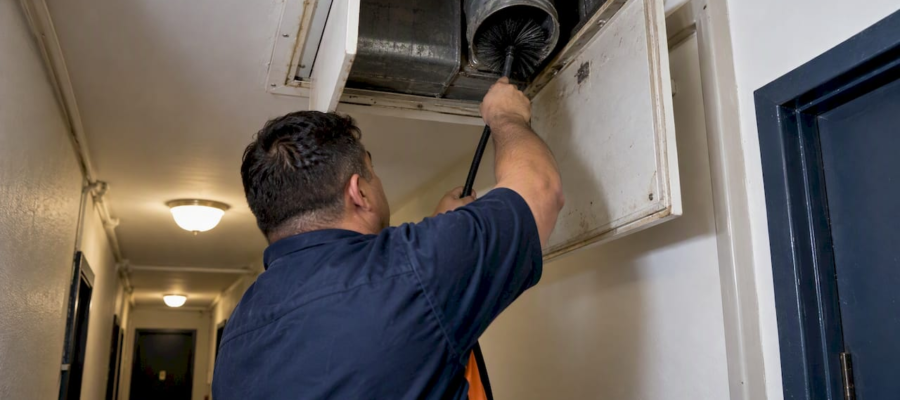
Apartment Dryer Vent Maintenance: A Guide for NY, NJ and CT
Apartment dryer vent maintenance comes down to three things: knowing whose job it is, cleaning the full duct run at least once a year, and watching for early signs of a blockage. In most managed buildings in New York, New Jersey and Connecticut, the building owner or property manager controls the vent system, so the right first step is usually a request to management, not a DIY cleaning.
This guide is for tenants, property managers, facility managers and owners of small multifamily buildings. It explains what makes apartment vents different from a single-family setup, what the fire data says, how to schedule service without tripping over building rules, and what a legitimate cleaning should include.
TL;DR
- Clean the full dryer exhaust duct at least once a year. The U.S. Consumer Product Safety Commission recommends a yearly cleaning of the vent pipe.
- In apartment buildings, ducts are often long, shared or built into fire-rated walls, so a shop vacuum at the dryer connection does not clean them. Property managers should hire professionals.
- Tenants should check the lease or resident handbook and contact management before scheduling any vendor.
- Damp clothes after a full cycle is the most common early warning. Treat it as a reason to book a cleaning, whatever the date of the last one.
- Ask any contractor what they clean, how they confirm airflow, and how they document the work.
Table of Contents
- Why apartment dryer vents are a different problem
- What the fire data says
- Who is responsible: tenant, landlord or property manager?
- What the code expects from property managers
- How often should an apartment dryer vent be cleaned?
- Warning signs to act on now
- What tenants can safely do
- What a proper apartment dryer vent cleaning includes
- A scheduling plan for property managers
- Our perspective: where apartment vent programs go wrong
- Dryer vent cleaning from Amazon Air Duct Cleaning
- Frequently asked questions
- Sources
Why apartment dryer vents are a different problem
In a house, the dryer usually sits on an exterior wall and the vent runs a few feet to the outside. Apartments rarely work that way. Vents may travel through a wall chase, across a ceiling, up through several floors or into a shared riser. Every extra foot and every elbow gives lint another place to settle.

That has two consequences. First, the vent that looks clean at the exterior hood can still hold heavy buildup deeper in the run. The U.S. Department of Energy’s dryer venting guide notes that reduced airflow is a core problem with long or restricted runs, and that blocked venting is a recognized fire cause. Second, one blocked vent in a multi-unit building is not only one household’s problem. Fire, heat and smoke can reach neighbors and common areas.
If you manage or live in an older building in the New York metro area, this matters even more. Older buildings tend to have longer, more convoluted duct paths that were never designed with cleaning access in mind.
What the fire data says
Dryer fires are common and mostly preventable. Here is what the national sources report:
- The National Fire Protection Association (NFPA) estimated that local fire departments responded to about 13,820 home structure fires per year involving dryers in 2014 to 2018.
- In the same report, failure to clean was the leading factor in 32% of home dryer fires, with an annual average of seven civilian deaths, 96 injuries and $44 million in direct property damage tied to those fires.
- The CPSC, in its 2023 release, cites an annual average of 6,400 clothes dryer fires, 180 injuries and $105 million in property damage.
The figures differ because each agency counts different incidents and years. They point the same direction: lint is the fuel, and cleaning is the cheapest control.
NFPA’s own safety tips also say that the leading cause of home dryer and washer fires is failure to clean them. The U.S. Fire Administration adds that blockages can also come from bird or animal nests or from damage to the venting system itself. In a building with rooftop or high-wall terminations, nobody may notice that for months.

Who is responsible: tenant, landlord or property manager?
The honest answer is that it depends on the building and the lease, and you should not assume. A few patterns are common:
| Situation | Who usually handles it | What you should do |
|---|---|---|
| Dryer in your unit, vent runs straight outside, tenant owns the dryer | Often shared: the lease sets the rules | Read the lease, then ask management in writing |
| Dryer provided by the landlord | Typically the landlord, as with other appliance maintenance | Report slow drying and request service |
| Shared or centralized exhaust, risers, rooftop terminations | Building owner or management | Do not touch it. Report symptoms |
| Common laundry room | Building owner or management | Report lint buildup, odors or heat |
| Condo or co-op | Depends on the declaration, bylaws or house rules | Ask the board or managing agent |
This is not legal advice. If a dispute arises over a repair obligation, a tenant attorney or your local housing agency in your state can tell you what applies to your lease. We cover maintenance, not tenancy law.
There is one practical rule that holds everywhere: do not hire your own vendor into a managed building without permission. Ducts in large buildings are often tied into the fire-rated construction, and property managers regulate access. The NYCHA resident handbook, for example, directs residents to report maintenance through the authority’s own channels. Private buildings differ, but the principle is the same: check your lease or resident handbook first.
What the code expects from property managers
Codes in this area are written in general terms. The 2024 International Fire Code, Section 610.1.2, calls for clothes dryer exhaust systems, including lint traps and ductwork, to be maintained according to the manufacturer’s instructions so debris does not restrict airflow.
What that means for your building depends on the version of the code your municipality has adopted, any local amendments, and the dryer manufacturers’ instructions. We recommend that NY, NJ and CT property managers confirm the current local requirement with their fire marshal, code enforcement office or insurance carrier, then keep dated service records. If you are working through mechanical code questions for a multi-unit portfolio, our page on multi-unit dryer vents for NY, NJ and CT property managers goes deeper on what inspectors and insurers tend to ask for.
How often should an apartment dryer vent be cleaned?
Once a year is the baseline from the CPSC. Treat it as a minimum, not a guarantee. Move to a shorter interval when:
- The duct run is long, has several bends, or rises vertically.
- Residents run dryers heavily, such as large households, or common laundry rooms with constant use.
- Previous cleanings found heavy buildup.
- Residents have pets that shed or dry lots of towels and bedding.
- The building has had complaints of slow drying.
Our article on how often to clean a dryer vent walks through these factors in more detail.
Warning signs to act on now
Don’t wait for the calendar if you see any of these:
- Clothes are damp after a normal cycle, or loads need two runs. The CPSC safety alert on overheated dryers and NFPA’s guidance both flag longer drying times as a sign something is wrong.
- The dryer or the laundry area is unusually hot.
- A burning smell while the dryer runs. Stop using it and report it.
- The exterior hood flap does not open or little air comes out.
- Lint collects around the dryer door or behind it.
- A musty odor in the laundry area or nearby rooms.
We have separate guides on clogged dryer vent symptoms and spotting blockage and preventing risks if you want a checklist to hand to residents or maintenance staff.
A burning smell is different from a slow dryer. If you smell smoke or see flames, leave, call 911 and do not try to deal with it yourself.
What tenants can safely do
Tenants cannot fix a building’s vent system, but you can reduce the load on it:
- Clean the lint screen before or after every load. NFPA’s dryer safety information says to do this each time.
- Never run the dryer without the lint filter in place.
- Do not dry items that have been soaked in flammable substances such as oils or gasoline.
- Pull the dryer slightly forward and look at the flexible connector. If it is a white vinyl accordion hose, tell management. The DOE guide describes why rigid or smooth metal ducting is preferred: ribbed plastic or foil hoses crush easily and trap lint.
- Do not run the dryer when you are out or asleep.
- Report slow drying in writing, with the date, so there is a record.
Do not disconnect ductwork in the wall or ceiling, and do not pry off a terminal on the exterior. Besides the safety question, you could violate your lease.
What a proper apartment dryer vent cleaning includes
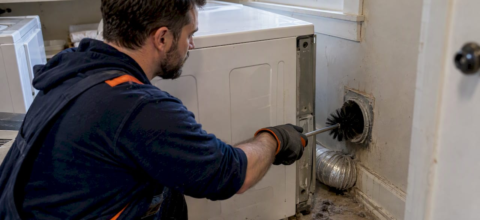
A quick brush at the dryer connection is not a maintenance service. The DOE’s venting guide points out that the clean-looking end of the vent can hide heavy lint accumulation further inside, and long or bent runs need professional tools such as rotary brushes or high-pressure air systems that a household vacuum cannot match.
When you request a quote for a building, look for these items:
- Inspection of the full run from the dryer to the termination point, including elbows and any vertical sections.
- Mechanical agitation plus negative-pressure vacuum capture, so lint is removed, not pushed around.
- Cleaning of the exterior hood or termination, and a check that the damper opens freely.
- Duct condition check: crushed or disconnected sections, vinyl or foil flex hose, and signs of animals.
- Joints sealed properly. The DOE’s guide advises against screws in dryer duct joints because their tips protrude into the airflow and catch lint. Foil tape or rivets leave a smoother interior.
- Airflow confirmation after cleaning, and a written report by unit or riser.
- Photos or a log you can file with insurance or fire inspection records.
Two red flags are worth sitting with for a moment. One is a vendor who quotes a flat figure without asking about run length, floors or access. The other is a crew that finishes a unit in a few minutes with only a household vacuum. Neither suggests a thorough job.
A scheduling plan for property managers
The hardest part of multifamily dryer vent maintenance is access. These steps make it manageable:
- Map your system. Note how many dryers there are, where each vent terminates (wall, roof, shared riser), and which units have flexible connectors.
- Set a cycle. Yearly at minimum, with high-use or long-run vents on a shorter interval.
- Give tenants notice according to your lease and state or local entry rules. Confirm the notice period for your jurisdiction with your attorney.
- Batch the work by riser or floor, so one visit covers connected units and fewer residents are disrupted.
- Plan for units that cannot be accessed and reschedule them, instead of skipping them silently.
- File the report. Keep dated records per unit for insurers, inspectors and future vendors.
- Fix what the cleaning finds. Replace plastic transition hoses, repair disconnected joints and add accessible cleanout points if the system has none.
It also helps to give residents a one-page notice with the lint-screen rule and the signs of a blockage. Residents often notice a slow dryer long before a manager does.
Our perspective: where apartment vent programs go wrong
We have cleaned vents for over 10 years across New York, New Jersey and Connecticut, for both residential and commercial customers, and the same patterns come up in multi-unit properties.
First, buildings treat the dryer vent as the tenant’s problem until something burns. A scheduled program costs far less than a fire loss, an insurance dispute or an emergency call, and it gives you records when someone asks.
Second, managers sometimes hire the lowest bidder for the entire property, then discover the crew only did the first few feet. A cleaning is only worth paying for if the whole run is cleaned and the work is documented. We think that is the legitimate standard, and we encourage customers to ask every contractor, us included, how they will prove it.
Third, the cleaning is only half the job. A well-cleaned system that still has a crushed transition hose or screwed joints will clog again fast. We would rather tell you what to repair than sell you a repeat visit.
Finally, we don’t think you should take our word for it. Check the NFPA, CPSC and DOE material above, compare what a vendor proposes against it, and make the decision that fits your building.
— Victor
Dryer vent cleaning from Amazon Air Duct Cleaning
If you manage or own a property in New York, New Jersey or Connecticut and want the vents cleaned by a certified technician, our dryer vent cleaning service covers both residential and commercial properties. If you are a property manager planning a building-wide schedule, start with our page for dryer vent and air duct services in NJ and NY, or read about our commercial air duct cleaning if the property also needs HVAC work. We don’t publish a flat price because the cost depends on the building, so request a quote and tell us the number of dryers, runs and floors.
Frequently asked questions
How do they clean dryer vents in apartments?
Technicians disconnect the dryer, run rotary brushes or compressed air through the duct, and capture lint with a high-powered vacuum. They then clean the exterior hood and check that air moves freely. In multi-unit buildings, the work is often scheduled by riser or floor.
How often should apartment building dryer vents be cleaned?
At least once a year, in line with CPSC guidance. Long runs, heavy use or earlier buildup call for a shorter interval. Slow drying or hot laundry areas mean you should schedule service sooner.
Do apartment complexes clean out dryer vents?
Many do, but not all, and it varies by building and lease. If the building owns the dryers or controls a shared exhaust system, cleaning is usually management’s job. Ask in writing and keep a copy of the answer.
Is the landlord responsible for cleaning the dryer vent?
Often, yes, particularly for landlord-provided appliances and shared or built-in ductwork, but your lease and local law decide. If you are unsure, read your lease and contact management. For a dispute, consult a tenant attorney or your local housing agency.
Sources
- NFPA: Home Dryer Fires
- NFPA: Home Fires Involving Clothes Dryers and Washing Machines
- CPSC: Save Daylight, Save Lives release (2023)
- CPSC Publication 5022: Overheated Clothes Dryers
- 2024 International Fire Code, Chapter 6
- U.S. Department of Energy: Dryer Venting
- NFPA: Clothes Dryer & Washing Machine Safety
- U.S. Fire Administration: Clothes Dryer Fires in Residential Buildings
- NYCHA Resident Handbook 2024
Recommended
- Dryer Vent Clogs: Why Roof Vents Need a Pro in NY, NJ & CT
- Dryer Vent Cleaning: When to Reserve 90 Minutes in NY, NJ & CT
- NY/NJ/CT Property Managers: Pass IMC 504.11 for Multi Unit Dryer Vents
- Dryer vent safety procedure: 5 essential steps