NY/NJ/CT Facility Managers: School Duct Cleaning RFP & Verification
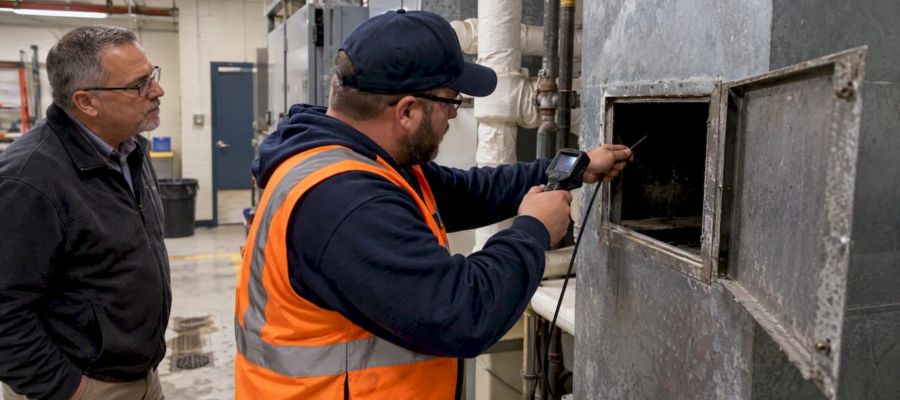
Do not schedule routine school duct cleaning on a fixed every-few-years cadence. Schedule an inspection, and clean when that inspection turns up contamination: visible mold, moisture intrusion, rodent activity, or heavy debris buildup. The triggers that call for immediate action include recent construction dust, standing water near the air handler, or droppings in the return plenum. The first real step is a borescope camera inspection with documented findings, not a calendar reminder.
TL;DR:
- Duct cleaning should be scheduled only after inspection reveals contamination like mold, moisture, rodent activity, or debris buildup, not on a fixed interval.
- A borescope inspection and documented findings are essential to accurately determine the need for cleaning and justify the scope of work.
- Typical costs vary based on project scope, duct accessibility, contamination type, and work needed on coils or air handlers, with scheduling during school breaks advised.
- The NADCA ACR Standard guides proper cleaning methods, requiring source-removal techniques, a detailed work plan, and oversight by certified professionals.
- Cleaning improves air quality by approximately 41% when done correctly but does not replace filtration upgrades, proper ventilation design, or addressing underlying moisture issues.
Table of Contents
- Benefits of professional duct cleaning for schools
- When cleaning is necessary: signs worth documenting
- Scheduling and cost factors for school projects
- What to require in the contract
- How cleaning is performed on-site
- Verifying results and keeping the gains
- How our team approaches school duct projects
- How Amazon Air Duct Cleaning can help
- FAQ
- Sources
Benefits of professional duct cleaning for schools
Clean ducts help in specific, measurable ways. Removing settled dust, pollen, dander, and biological particulates from the airstream reduces what occupants breathe during the school day, and it often cuts down on the fine grit that shows up on desks and shelves within days of a filter change.
There are operational upsides too. A thorough cleaning can lower static pressure across the system, extend the service life of filters and coils, and reduce the frequency of air handler callouts when it is paired with a regular maintenance program. Amazon Air Duct Cleaning’s own project data points to a sizable gain: complete duct cleaning can boost air quality by 41%, a figure the company tracks across its own residential and commercial jobs.
That said, cleaning has limits. It is not a substitute for proper filtration or ventilation design, and it will not fix a system that is undersized or poorly balanced.
- Removes accumulated dust, pollen, dander, and surface biological matter from ductwork
- Can reduce static pressure and extend filter and coil service life
- Does not replace filtration upgrades, ventilation design, or HVAC retrofits
When cleaning is necessary: signs worth documenting
The EPA’s Indoor Air Quality Tools for Schools guidance frames duct cleaning as a response to inspection findings, not a fixed-interval task. Routine preventive maintenance on filters, coils, and drains delivers more consistent IAQ and energy results than sporadic duct cleaning alone. The signs below are what an inspection should be looking for.
- Visible microbial growth on duct interiors, registers, or air handler components
- Moisture intrusion, standing water, or water staining near ductwork and the air handling unit
- Rodent evidence, including droppings, nesting material, or chewed insulation
- Large accumulations of debris visible through a borescope or register inspection
- Coarse dust reappearing at registers shortly after a filter change
- Strong recurring odors or occupant health complaints tied to a specific zone or classroom
Document every finding with photos, borescope video, a written log, and, where possible, filter pressure-drop readings. That record is what justifies a budget request and gives a contractor a defensible scope of work.
Scheduling and cost factors for school projects
Frequency should follow inspection results rather than a preset number of years. Some buildings go five years or longer between cleanings because filtration and moisture control hold up well; others need attention sooner because of a leak, a construction project, or a pest problem. The honest answer is that there is no single interval that fits every district, which is exactly why ASHRAE and DOE guidance on prioritizing HVAC maintenance points facility teams toward moisture control and filtration first.
Cost depends on a handful of variables that vary by building:
- Project scope, meaning how much air handling units and duct runs are involved
- Accessibility of ductwork, including ceiling height and whether liner is present
- Contamination type, since mold expands the scope to include containment and remediation
- Required work on coils, condensate pans, or other air handler components
Schedule the work during school breaks or summer recess whenever possible, and loop in custodial and maintenance staff early so access and occupant exposure stay manageable. Ask any contractor for an itemized quote tied to an inspection-based scope rather than a flat per-square-foot number.
What to require in the contract
A school duct cleaning contract should read like a technical spec, not a sales sheet. The NADCA ACR Standard is the industry benchmark for how the work should be scoped and performed, and requiring it in writing protects the district from shortcuts.
- Require source-removal mechanical cleaning methods, meaning agitation devices paired with negative-pressure vacuum collection
- Ask for a written work plan listing equipment, access openings, and protections for fire and detection systems
- Confirm the scope includes air handler coils and condensate pans, since those are common moisture sources
- Require that an ASCS-certified lead oversee the project and ask for references from prior educational work
- Specify acceptance criteria before sign-off: before-and-after borescope photos, a visual inspection checklist, and, where warranted, a NADCA surface comparison test
Pro Tip: Reject any quote that skips a site visit. A legitimate scope of work cannot be priced accurately without someone looking at your ductwork first.
How cleaning is performed on-site

Source-removal cleaning combines mechanical agitation with negative-pressure vacuum collection, pulling debris out of the ductwork rather than just stirring it. Registers, grilles, and air handler components get cleaned as part of the same visit, since skipping the AHU leaves a contamination source behind.
If an inspection turns up mold, the sequence changes. The EPA’s mold remediation guidance for schools is direct about this: fix the moisture source first, then clean, and use containment and PPE throughout. Cleaning over an active leak just means the mold comes back.
- Technicians seal openings and protect electrical and fire-alarm components before work begins
- Waste is bagged and removed according to standard handling practices
- The facility needs to provide power access, a staging area, and clear entry to mechanical rooms
- Pre-visit prep includes clearing storage near air handlers and confirming after-hours access
Verifying results and keeping the gains
Verification should happen before the crew leaves, not weeks later. Ask for before-and-after borescope photos, a signed visual inspection checklist, and, for larger or contaminated projects, a NADCA vacuum or surface comparison test.
- Move toward higher filtration where the system allows it, generally in the MERV 8 to 13 range
- Keep coil and condensate pan maintenance on a regular schedule, since that’s where moisture tends to reappear
- Track down and fix moisture sources promptly rather than cleaning around them repeatedly
- Set seasonal inspection checkpoints tied to the school calendar rather than a fixed yearly date
A seasonal maintenance checklist and a broader HVAC maintenance guide both help keep these checkpoints from falling through the cracks between cleanings.
How our team approaches school duct projects

Amazon Air Duct Cleaning has worked on residential and commercial HVAC systems across New York, New Jersey, and Connecticut for over 10 years, and school buildings follow the same inspection-first logic we apply everywhere else. A typical engagement starts with a camera inspection, moves to a written scope of work, addresses moisture remediation first if it’s present, then proceeds to NADCA-standard cleaning with documented verification at the end.
Across our own projects, complete duct cleaning has measured a 41% air quality improvement, a number we track to keep our scopes honest rather than inflated.
— Victor
How Amazon Air Duct Cleaning can help

If an inspection at your school has turned up dust, odor complaints, or early signs of moisture, you don’t need to guess at next steps — our commercial air duct cleaning services ensure a thorough and professional response. We offer commercial air duct cleaning, air handler coil and blower cleaning, antimicrobial and deodorizing treatments for ducts that have had microbial issues, and UV light installation for buildings that want ongoing microbial control between cleanings.
- Commercial air duct cleaning scoped to NADCA source-removal methods
- Evaporator coil and blower cleaning to address common moisture sources
- Antimicrobial and deodorizing treatment for ducts with prior contamination
- UV light installation for added microbial control
We serve facility managers and administrators throughout New York, New Jersey, and Connecticut, and we quote every school project after an on-site inspection, not before. Request a commercial inspection or district quote to get a scope of work specific to your building.
FAQ
Do you need to be certified to do duct cleaning?
There’s no federal license requirement for duct cleaning in most states, but reputable contractors carry NADCA certification, and commercial projects should have an ASCS-certified lead on site. Ask for proof of certification before signing a contract, especially for school facilities.
How much does it cost to clean a school?
Cost depends on the number of air handling units, duct runs, accessibility, and whether mold or heavy contamination adds containment work to the scope. Request an itemized quote based on an on-site inspection rather than a flat estimate, since published pricing isn’t available until a contractor sees the building.
How often should school ducts be cleaned?
Frequency should follow inspection findings rather than a fixed schedule. The EPA’s preventive maintenance guidance recommends cleaning when inspections reveal mold, moisture, rodent activity, or heavy debris, with regular filter and coil maintenance as the primary ongoing IAQ strategy.
Do air ducts really need to be cleaned?
Cleaning helps when an inspection shows contamination, but it isn’t a routine necessity for every building every year. The CDC’s ventilation guidance notes that filtration and ventilation, not duct cleaning, are the primary controls for airborne particulates, so treat cleaning as a response to findings rather than a standalone fix.
Sources
- Indoor Air Quality (IAQ) Tools for Schools — EPA
- ACR: The NADCA Standard for Assessment, Cleaning, and Restoration (2021 edition) — NADCA
- Prioritizing heating, ventilation, and air conditioning — U.S. Department of Energy
Recommended
- Commercial Air Duct Cleaning in NY & NJ
- 7 Air Duct Cleaning Methods: How to Verify Each in NY, NJ, CT
- Vent cleaning for businesses: essential guide for NY, NJ, CT
- Office Duct Hygiene Workflow for Facility Managers