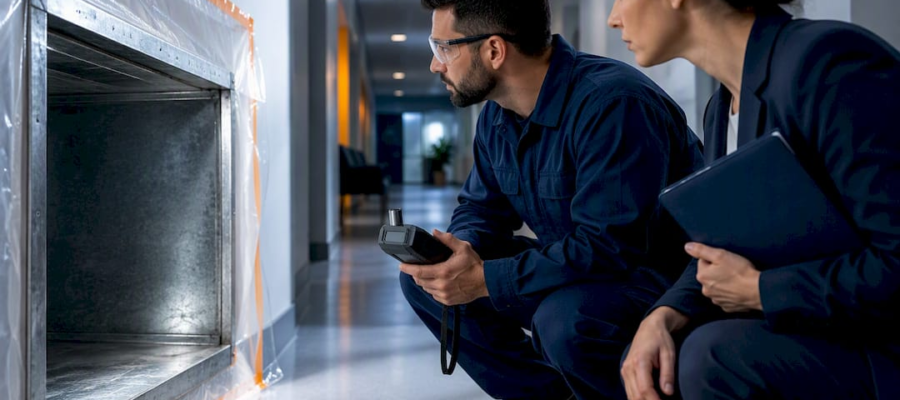
Avoid Survey Failures: NADCA ACR-2021 Duct Cleaning Specs for NY/NJ/CT
Hire only a duct cleaning provider who treats the job as an infection-control event, not a maintenance chore. That means a written work plan aligned with an Infection Control Risk Assessment, cleaning that follows the NADCA ACR-2021 standard, containment with continuous monitoring, and a documented, tested result before sign-off. One option serving the New York, New Jersey, and Connecticut area can be evaluated against this checklist.
TL;DR:
- Duct cleaning in healthcare settings must follow strict infection control protocols, including negative pressure containment and continuous monitoring, to prevent contaminant dispersal.
- Inspection, containment, cleaning, and verification should adhere to industry standards such as NADCA ACR-2021 and ASHRAE 170, with clear documentation and testing protocols.
- Costs vary based on system complexity, containment requirements, and verification testing, with higher expenses justified by the need for precise, documented results.
- Contractors must provide written work plans, verification testing, and clear certification details upfront, and avoid vague claims or unverified certifications.
- Poorly executed duct cleaning, especially without proper testing and documentation, risks contaminant spread, duct damage, and non-compliance with infection control standards.
Table of Contents
- Why healthcare duct cleaning is different from routine commercial work
- Standards and guidance to require in every bid
- What a compliant job actually looks like
- How to select and vet a contractor
- Timing, cost drivers, and logistics
- What contractors get wrong, and what to demand instead
- The company: a direct option for facility assessments
- Primary standards and guidance to consult
- Sources
- FAQ
Why healthcare duct cleaning is different from routine commercial work
A dental office and a data center do not carry the same risk when a duct cleaning crew opens an access panel. Healthcare facilities house patients whose immune systems may already be compromised, so any disturbance to airborne particulate has a direct line to patient safety. That is why the work has to be planned with clinical staff, not just facilities staff.
Coordination typically runs through an Infection Control Risk Assessment, or ICRA, the same process hospitals use before construction or renovation projects near patient care areas. The CDC’s environmental infection control recommendations frame HVAC maintenance, including duct work, as part of the broader infection-control program rather than a separate facilities task.
Get this wrong and the consequences are not cosmetic:
- Poorly contained cleaning can push dust, mold spores, or debris into occupied patient areas instead of removing them.
- Aggressive agitation without proper extraction can damage coils, dampers, or duct liner, creating a bigger repair problem than the one you started with.
- Skipping ICRA coordination can put a project in direct conflict with infection-control staff mid-job, forcing a costly stop-and-restart.
Standards and guidance to require in every bid
Three references should shape every bid specification you write, plus one caution worth including.
- NADCA ACR-2021: sets the inspection, containment, cleaning, and verification requirements a qualified contractor should follow for HVAC systems.
- ASHRAE 170: governs ventilation rates and space pressurization relationships in healthcare facilities, which matters because duct work can temporarily disrupt the pressure balance between clean and less-clean spaces.
- CDC environmental control guidance: recommends cleaning grilles when rooms are unoccupied and periodically measuring ventilation output as part of routine infection control.
NADCA’s ACR-2021 standard is the industry benchmark contractors should be measured against, since it defines minimum inspection, containment, and cleanliness verification procedures, including vacuum and visual testing, rather than leaving “clean” to subjective judgment.
The EPA’s guidance on duct cleaning is worth sitting with for a moment before you write a bid. The agency does not recommend routine duct cleaning for general buildings and notes there is little evidence that cleaning ducts alone improves system efficiency; cleaning coils and fans tends to matter more for performance. In a healthcare setting, though, the calculation changes: duct maintenance becomes one piece of an infection-control program, not a standalone efficiency play, which is why the CDC folds it into environmental control rather than energy management.
What a compliant job actually looks like
A specification that only says “clean all ductwork” invites vague results. A compliant scope of work spells out the sequence, the containment, and the proof.
- Pre-inspection and written work plan. The contractor documents existing conditions, defines containment levels, and identifies access points before any equipment is disturbed.
- Containment. Work areas run under negative pressure with continuous monitoring, sealed enclosures isolate the work zone, and HEPA-filtered extraction captures debris at the source rather than letting it recirculate.
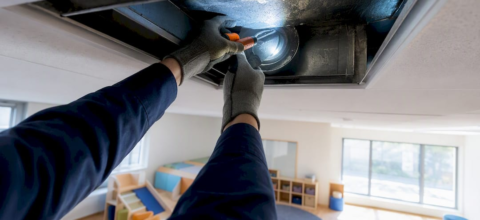
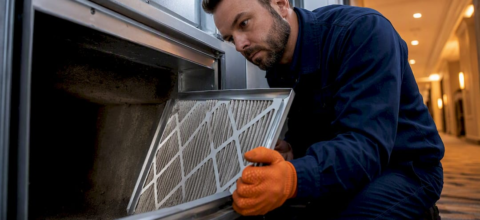
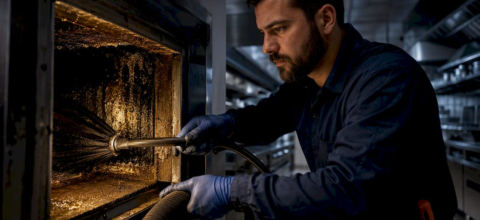
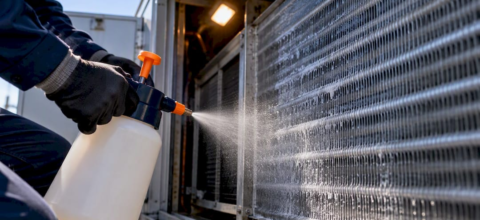
- Cleaning methods. Mechanical agitation loosens debris, HEPA vacuum collection removes it, and the scope extends to air handling units, coils, and condensate pans, not just the visible duct runs.
- Material handling. Wet or moldy porous insulation gets replaced rather than cleaned, since fibrous liner that has taken on moisture or mold typically cannot be restored to a clean baseline.
- Verification. The job closes with visual inspection photos, NADCA vacuum or surface testing, and, for higher-risk areas, particle monitoring or clearance testing before sign-off.
- Waste handling. Collected debris and any wastewater from the process follow standard disposal compliance, documented as part of the closeout package.
Details on the equipment behind steps 2 and 3, including HEPA vacuum and negative-pressure setups, are worth reviewing before you finalize a spec, since not every contractor’s containment gear meets the same standard.
Pro Tip: Ask for pre- and post-containment particle counts in writing. If a bidder cannot explain how they will measure background particulate before and after the job, they are not set up to prove the work met the standard.
How to select and vet a contractor
Standards only protect you if they show up in the contract. Before you sign anything, request these documents and ask these questions on the site walk.
- Require documentation upfront: a written statement of NADCA ACR adherence, the name of the assigned Air Systems Cleaning Specialist, a sample post-clean report, current insurance certificates, and a draft ICRA coordination plan.
- Ask on the site walk: how containment will be monitored continuously, what the HEPA extraction equipment’s specifications are, who performs the verification testing, and what happens if a test fails.
- Write acceptance criteria into the contract: tie final payment to passing verification tests, not just completed labor hours, and include a remediation clause if results fall short.
- Watch for red flags: a contractor who will not document methods in writing, who leans on vague “certified” language without naming the certification, who pushes aggressive upsells during the walk-through, or who resists coordinating around clinical schedules.
The FTC’s consumer protection guidance specifically warns about bait-and-switch pricing in duct cleaning, where a low advertised rate for a site visit turns into high-pressure sales for add-on work. Get itemized, written estimates before committing.
Timing, cost drivers, and logistics
Several conditions justify healthcare duct cleaning outside a routine schedule: visible mold growth, water intrusion into ductwork, contamination following nearby construction, or an upcoming accreditation audit that requires documented HVAC hygiene.
- System complexity drives cost more than square footage alone, since more branches and access points mean more labor and containment setup.
- Containment level required for the space (a general corridor versus an area near immunocompromised patients) changes the equipment and monitoring needed.
- Verification testing, especially particle or clearance testing, adds cost but is often the difference between a documented result and a guess.
- After-hours or phased scheduling to avoid disrupting patient care typically raises labor cost but reduces clinical risk.
Detailed cost ranges and drivers are worth reviewing when building a budget, and pairing that with guidance on cleaning intervals helps set a realistic schedule rather than reacting only after a problem appears.
What contractors get wrong, and what to demand instead

Most duct cleaning failures in healthcare settings trace back to one thing: treating the job as a one-time cleaning task instead of a documented process. A contractor who shows up, runs a vacuum through a few runs, and leaves without test results has not given you anything you can defend in an accreditation review.
The strongest jobs share a pattern: continuous negative-pressure monitoring during the work, particle baselines taken before and after, and a written report tying test results to acceptance criteria agreed on before the crew arrived. When that documentation exists, disputes over “did they actually clean it” disappear. Ask for it this week, before you sign your next contract, not after a survey flags a gap.
— Victor
The company: a direct option for facility assessments
If you manage a healthcare facility in New York, New Jersey, or Connecticut and want a documented, infection-control-aware duct cleaning process without building the specification from scratch, Commercial duct cleaning services, built around the same containment and verification approach outlined above, are available.

What that looks like in practice:
- Commercial and healthcare-capable duct cleaning covering ductwork, air handling units, and coils, scoped for your facility rather than a generic residential job.
- Antimicrobial and deodorizing duct cleaning for spaces where biological contamination or odor control is part of the goal.
- Documented reporting with every job, so you have a paper trail for accreditation or internal audit purposes.
To request a healthcare facility assessment or bid package, start with the commercial air duct cleaning page and describe your facility type, containment needs, and any accreditation deadline. A team member will scope the visit around your clinical schedule rather than asking you to work around theirs.
Primary standards and guidance to consult
For specification language, cite NADCA ACR-2021 directly and pair it with CDC environmental control guidance for infection-control planning language.
Sources
- Should You Have the Air Ducts in Your Home Cleaned? | US EPA
- ACR, The NADCA Standard for Assessment, Cleaning & Restoration of HVAC Systems (2021)
- Infection control: environmental infection control recommendations | CDC
- Federal Trade Commission: Consumer protection resources
FAQ
What is the average cost to clean air ducts?
Cost depends on system size, containment level, and whether verification testing is included, so there is no single figure that applies to every facility. A detailed breakdown of cost drivers can help you budget once you know your facility’s scope and containment requirements.
Do AC ducts really need to be cleaned?
The EPA does not recommend routine duct cleaning for general buildings, advising it on an as-needed basis when there is visible mold, debris, or vermin. In healthcare facilities, though, duct maintenance is treated as part of an ongoing infection-control program rather than an optional task.
Do you need to be certified to do duct cleaning?
There is no single license required nationwide, but reputable contractors align their work with the NADCA ACR standard and assign a qualified Air Systems Cleaning Specialist to the job. Ask any bidder to name their certification and show a sample post-clean report rather than accepting a vague claim of being “certified.”
What are the downsides of duct cleaning?
Done poorly, duct cleaning can disperse contaminants into occupied spaces instead of removing them, and aggressive methods can damage ductwork, coils, or liner material. That is why containment, HEPA extraction, and post-clean verification testing matter more in healthcare settings than in a typical home or office job.
Recommended
- How to Monitor Airflow in Ducts: NY/NJ/CT Guide
- 7 Air Duct Cleaning Methods: How to Verify Each in NY, NJ, CT
- How to prepare for duct cleaning in NY, NJ & CT
- Duct System Maintenance Checklist 2026: Frequencies and Fixes