Facility Managers: Fix the 52% Ventilation Cause of Office Air Quality
If your office has stale air, frequent headaches, or a string of similar complaints from different employees, you likely have a real indoor air quality problem, not a coincidence. The fastest next step is a short walkthrough paired with a day of CO2 monitoring, or asking your HVAC team to verify ventilation rates. OSHA, the EPA, and NIOSH all treat this kind of triage as the starting point, not a luxury.
TL;DR:
- Inadequate ventilation is the primary cause of office air quality issues in over half of the cases, often evidenced by rising CO2 levels and occupant complaints.
- Monitoring CO2 levels throughout a workday and inspecting for moisture, odors, and visible mold are essential initial steps to diagnose IAQ problems accurately.
- Increasing outdoor air intake, extending HVAC run times, and removing VOC sources can provide immediate relief, but systemic HVAC maintenance is necessary for lasting improvements.
- Regular filter replacement, coil cleaning, and verifying airflow and damper operation prevent most chronic IAQ issues, especially when combined with scheduled system maintenance.
- Professional IAQ assessments, including thorough inspections and targeted sampling, are recommended when persistent complaints or visible mold problems occur despite initial fixes.
Table of Contents
- What causes office air quality problems
- Health and productivity impacts facility managers should expect
- How to check and diagnose office air quality problems
- Immediate and low-cost fixes you can apply today
- Systems-level solutions and maintenance tasks
- When to hire a professional IAQ investigator or contractor
- What contractors see most often in the field
- How professional cleaning closes the loop on office air quality
- Sources
- FAQ
What causes office air quality problems
Most office air quality issues trace back to a handful of mechanisms, and knowing which one you’re dealing with changes the fix. Inadequate ventilation is the most common culprit: when fresh air dilution drops, CO2 climbs and so do complaints. NIOSH investigations found inadequate ventilation to be the primary issue in roughly 52% of cases they reviewed, which makes it the first thing worth checking.
Beyond ventilation, a few other sources show up again and again:
- Indoor pollutant sources, including VOCs from carpet, paint, cleaning products, and copiers or printers.
- Moisture problems: roof or plumbing leaks, clogged drain pans, and condensation on cooled coils that lead to mold growth.
- Outdoor infiltration, such as nearby exhaust, loading docks, or ongoing construction dust pulled in through intakes.
- Building envelope gaps that let unfiltered outdoor air bypass your HVAC system entirely.
High occupancy, recent renovations, and deferred maintenance tend to compound all of the above, turning a minor issue into a persistent one.
Health and productivity impacts facility managers should expect
Poor air quality shows up first as a cluster of symptoms: headaches, fatigue, eye and throat irritation, and difficulty concentrating. When these symptoms improve after people leave the building and have no confirmed cause, it’s typically labeled Sick Building Syndrome. A confirmed illness traceable to a specific contaminant, such as mold exposure, is classified separately as a building-related illness.
The cognitive effects are measurable, not just anecdotal.
A study found each interquartile increase in PM2.5 (8.8 kg/m3) was associated with a 0.82% increase in Stroop test response time in office workers, alongside related effects from lower ventilation measured via CO2. (CDC study) That’s a small percentage change per response, but it adds up across a workforce answering emails and making decisions all day.
Ventilation research also points to a practical threshold: rates below about 10 liters per second per person are linked to more Sick Building Syndrome symptoms, and pushing ventilation above that minimum, sometimes up to 20 L/s per person, has reduced complaints in some studies. Aiming above the bare minimum, not just meeting it, is worth building into your ventilation targets.

How to check and diagnose office air quality problems
Before calling in outside help, a structured walkthrough and a short monitoring window will tell you most of what you need to know. The EPA’s Building Air Quality guidance frames this as an eight-step action plan built around observation, measurement, and iteration rather than a single pass-fail test.
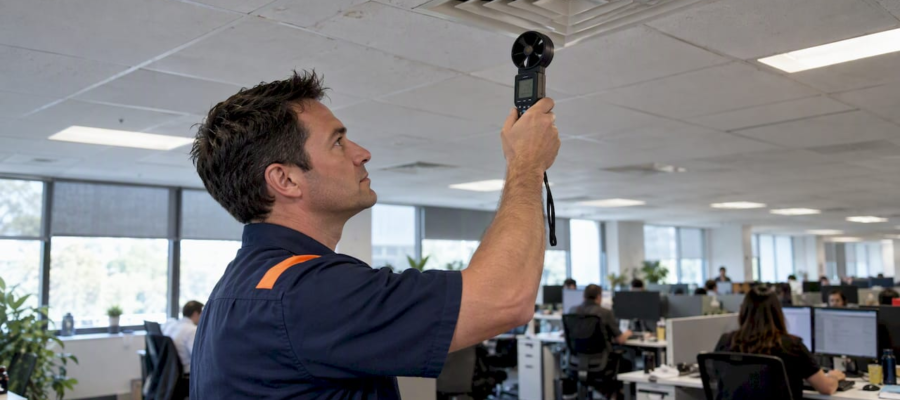
- Walk the space and note odors, water stains, blocked or dirty diffusers, and where complaints cluster geographically.
- Deploy CO2 monitors in occupied zones for a full working day to see how levels track with occupancy.
- Take PM2.5 spot readings near workstations and printer or copier areas.
- Log temperature and relative humidity alongside your air readings, since thermal discomfort often masquerades as an air quality complaint.
- Compare findings against occupant complaint patterns to see if symptoms line up with specific zones or times of day.
Pro Tip: Measure in the breathing zone, roughly three to five feet off the floor, since readings taken near the ceiling or floor can misrepresent what occupants actually inhale.
If your building uses variable air volume (VAV) systems, spot checks alone can mislead you. Compare measured airflow against the original design specification rather than assuming low readings mean a fault. When in-house checks turn up isolated, explainable issues, a fix may be all you need. Persistent, unexplained patterns across multiple zones usually call for a full building assessment.
Immediate and low-cost fixes you can apply today
While you plan any bigger repairs, several steps reduce occupant symptoms right away and cost little to implement.
- Extend HVAC run times and open outdoor-air dampers further where your system allows it, increasing dilution immediately.
- Stagger occupancy in problem zones to reduce peak CO2 buildup during meetings or shift changes.
- Place portable HEPA units in confirmed hotspots, making sure they’re sized for the room and maintained on a regular filter schedule.
- Remove or limit strong VOC sources, including harsh cleaning products and off-gassing new furniture, and reinforce basic housekeeping standards.
- Control humidity, fix any active leaks promptly, and replace filters that are visibly soiled rather than waiting for a scheduled date.
These are stopgaps, not a permanent solution, but they buy time while you address the systems behind the symptoms. Our HVAC maintenance guide walks through how these short-term steps fit into a longer maintenance schedule.
Systems-level solutions and maintenance tasks
Recurring IAQ problems usually trace back to the HVAC system itself, and fixing them means going past filters into coils, ducts, and airflow design. Upgrading filter MERV rating can meaningfully cut particle counts, but a jump that’s too aggressive for your fan capacity strains the system and raises energy use, so check your air handler’s rated static pressure before upgrading.
A handful of routine tasks prevent most chronic complaints:
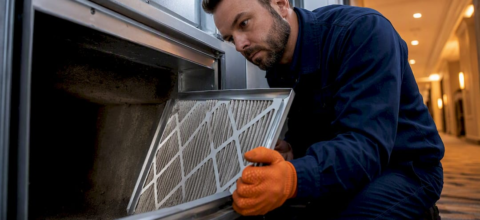
- Replace filters on a fixed schedule rather than waiting for visible dirt.
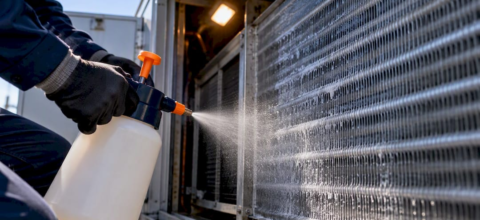
- Clean cooling coils and clear drain pans, since stuffy, persistent complaints often trace back to microbial growth in these spots.
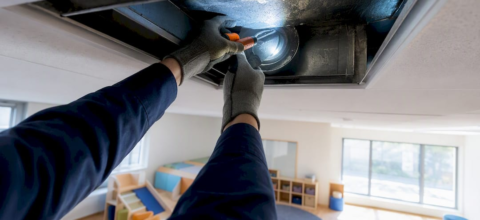
- Verify dampers are operating correctly and delivering the outdoor air ratio your system was designed for.
- Inspect fresh-air intakes for blockages, debris, or proximity to exhaust sources.
Pro Tip: Schedule coil and duct cleaning as part of your preventive calendar rather than waiting for a complaint spike. It’s cheaper to address biological buildup on a schedule than to chase it during an investigation.
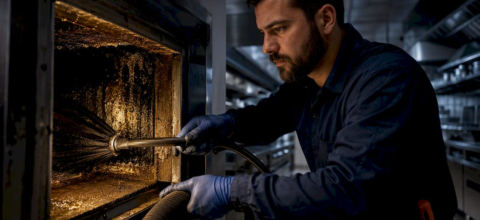
Duct cleaning, antimicrobial treatments, and UV installation are justified when moisture, dust reservoirs, or biological growth are confirmed, but they don’t substitute for correcting the airflow or ventilation problem that let those reservoirs form in the first place. When outdoor-air capacity is structurally too low, HVAC balancing or a system redesign may be the only lasting answer. Our HVAC system maintenance checklist covers the sequence in more depth.
When to hire a professional IAQ investigator or contractor
Bring in outside help when complaints persist after your fixes, when you find visible mold or water damage, when in-house monitoring can’t explain the pattern, or after any health incident tied to the building.
- Confirm the scope of work includes a walkthrough, HVAC performance measurements, targeted sampling where warranted, and a written remediation plan with a verification step after the work.
- Ask how they’ll confirm the fix worked, since a single test with no follow-up measurement is a weak investigation.
- Treat vague remediation language or a one-off test with no HVAC review as red flags.
Cost and timeline depend heavily on building access, how much sampling is needed, and whether repairs or deep cleaning follow the diagnosis.
What contractors see most often in the field
Dirty coils, blocked returns, and standing moisture in drain pans show up on the majority of commercial calls we run across New York, New Jersey, and Connecticut. Scheduled duct and coil cleaning tends to prevent these from recurring, rather than treating them as one-time emergencies.
— Victor
How professional cleaning closes the loop on office air quality
Once you’ve confirmed ventilation and moisture are under control, targeted cleaning removes what’s already built up in the system. We provide commercial air duct cleaning, evaporator coil and blower cleaning, UV light installation, and antimicrobial duct treatments across New York, New Jersey, and Connecticut, backed by over 10 years of experience and certified technicians.

A typical commercial visit includes an inspection of ductwork and coils, the cleaning itself, and before-and-after documentation so you have a record for your facility file. Follow-up recommendations are based on what our technicians actually find, not a standard upsell script.
- Commercial duct cleaning for offices with confirmed dust or biological buildup.
- Evaporator coil and blower cleaning where cooling coils are contributing to moisture and odor issues.
- UV light installation to reduce biological load on coils between cleanings.
- Antimicrobial and deodorizing treatment for ducts with confirmed microbial growth.
If your walkthrough or monitoring points to buildup in your ducts or coils, request a commercial inspection and we’ll tell you plainly what we find.
Sources
For regulatory detail and measurement protocols, see OSHA’s indoor air quality guidance, the EPA’s Building Air Quality guide, and NIOSH ventilation research linking exposure to cognitive outcomes.
This article is general information, not a substitute for advice from a qualified doctor. Consult a qualified healthcare professional about your own circumstances before acting on anything here.
- Indoor air quality – frequently asked questions | Occupational Safety and Health Administration
- A guide for building owners and facility managers | EPA
- Associations Between Acute Exposures to PM2.5 and Carbon Dioxide Indoors and Cognitive Function in Office Workers
FAQ
Is poor air quality an OSHA violation?
OSHA has no single, enforceable indoor air quality standard for offices, but employers are still covered by the General Duty Clause and any applicable ventilation or contaminant-specific standards. A persistent, unaddressed hazard can still create liability even without a dedicated IAQ rule. See OSHA’s indoor air quality FAQs for the governing framework.
Is there a way to test office air quality?
Yes, though there’s no single pass-fail test. Facility teams typically combine a walkthrough, CO2 monitoring over a working day, PM2.5 spot checks, and HVAC performance verification, then repeat measurements after any fix.
Is it illegal to work in bad air quality?
There’s no blanket law making poor office air illegal, but employers are obligated under OSHA’s General Duty Clause to keep workplaces free of recognized hazards. Whether a specific condition crosses that line depends on the contaminant, its concentration, and whether it’s a known risk, which is why persistent complaints deserve a documented investigation.
What are OSHA standards for air quality in workplaces?
OSHA does not set one universal indoor air quality standard for offices. Instead, it relies on the General Duty Clause along with specific ventilation and contaminant standards that apply depending on the hazard involved, as outlined in OSHA’s guidance.
Recommended
- Does Your Office Air Make Your Team Less Productive?
- Airflow Efficiency in Buildings: A Property Manager’s Guide
- Commercial Ductwork Troubleshooting Steps for Facility Managers
- The Role of Ventilation in Safety: A 2026 Guide