New York Dryer Vent Code: What NYC and NYS Require
New York dryer vent code comes down to a short list of rules: vent the dryer to the outdoors, use smooth-walled metal duct that is 4 inches across, keep the run within 35 feet after counting fittings, and never add a booster fan. New York State sets the baseline through its Mechanical Code, and New York City adds its own mechanical code and filing rules on top. This guide walks through both, in plain terms, so you know what an inspector, a landlord or a technician will be checking.
TL;DR
- Every dryer in New York must exhaust to the outside of the building, following the manufacturer’s instructions. Venting into an attic, crawl space or wall cavity is not an option.
- In NYC, the duct must have a smooth interior, be metal at least 0.016 inches thick, and be 4 inches nominal in diameter. A 3-inch pipe does not meet the code.
- The maximum NYC duct length is 35 feet, reduced by the equivalent length of each fitting. A 4-inch-radius mitered 90-degree elbow counts as 5 feet.
- Domestic booster fans are prohibited under New York State code, and NYC requires a licensed professional to file paperwork for certain gas dryer installations.
- Code covers installation. Lint buildup is a maintenance problem, and a code-compliant vent still needs regular cleaning.
Table of Contents
- Which code applies: New York State or New York City?
- The core rules for a residential dryer vent
- Booster fans are not allowed
- Are indoor dryer vents allowed?
- Gas dryers in NYC: the filing requirement
- Multifamily and commercial buildings
- Quick reference: NYC dryer vent requirements
- Perspective: code is the minimum, not the goal
- Signs your vent may not be up to code or is clogged
- When to call a professional
- FAQ
- Sources
Which code applies: New York State or New York City?
New York has two layers. Outside the five boroughs, the Mechanical Code of New York State (MCNYS) applies. The 2025 edition, published in July 2025, is incorporated by reference in Part 1223 of Title 19, which requires covered mechanical systems to comply with it. That covers Long Island, Westchester, the Hudson Valley, Albany, Buffalo and everywhere else that follows the state Uniform Code.
New York City writes and enforces its own codes. For dryers, the key text is Section 504 of the NYC Mechanical Code, which says dryers must be exhausted according to the manufacturer’s instructions and to the outside of the building. The numbers in this article labeled “NYC” come from that section unless noted otherwise.
If you own a home in Westchester or a co-op in Manhattan, the principles are the same. The details, especially for permits and gas dryers, differ. When in doubt, ask the local building department which edition it enforces before you hire anyone to change a vent.

The core rules for a residential dryer vent
Exhaust to the outdoors
The dryer must be independent of other systems and must carry moisture out of the building. It cannot share a duct with a bathroom fan or a kitchen hood. The reason is practical as well as legal: according to the Building America Solution Center, a typical load releases about a gallon of water, and venting into a building cavity can cause significant moisture damage while lint adds a fire hazard.
The same guide advises against terminating a dryer vent at the roof and recommends a shorter, straighter, more horizontal route outdoors.
Duct size and material
NYC code requires domestic dryer ducts to have a smooth interior, to be metal at least 0.016 inches thick, and to be 4 inches nominal in diameter unless the dryer manufacturer calls for a larger size (NYC Mechanical Code, Section 504).
Two practical consequences follow:
- A 3-inch pipe is out. It does not meet the 4-inch diameter requirement, and a narrower duct restricts airflow and collects lint faster.
- Flexible plastic or foil is a poor choice. The Building America guide recommends rigid or semi-rigid metal duct and says vinyl, nylon and foil ducts are not recommended.
The code also prohibits sheet metal screws or other fasteners that obstruct exhaust flow inside the duct. A screw tip poking into the airstream catches lint like a hook. Foil tape or clamps on the outside of joints is what a clean installation looks like.
Length and elbows
The maximum NYC dryer exhaust duct length is 35 feet, and that figure is reduced by the equivalent length of fittings. A 4-inch-radius mitered 90-degree elbow counts as 5 feet (NYC Mechanical Code, Section 504).
Here is a worked example using only those two numbers. Say your dryer sits on an interior wall and the vent goes up, across and out, with two mitered 90-degree elbows. Those elbows use 10 feet of your allowance, leaving 25 feet of straight duct. Three elbows would leave 20 feet. Every turn costs you distance, which is why a short, straight path is the best design.

Note that the manufacturer’s installation manual can set a shorter limit. The code says to follow those instructions, so the stricter of the two governs. We explain the length rule in more depth in our guide to maximum dryer vent length.
Slope and routing
The U.S. Department of Energy’s guide to venting a clothes dryer recommends a horizontal run with a slight downward slope toward the exterior, ideally 1/4 inch per foot, to limit condensation. This is guidance rather than a code number, but it is what a careful installer does. Sagging runs in a ceiling joist bay hold lint and moisture, and they are among the first things we look for when a dryer takes two cycles to dry a load.
Where the vent ends
For one- and two-family homes in NYC, there is a specific rule for gas dryers. Under 1 RCNY §101-02, these residential gas-dryer vents must terminate at least 3 feet above adjacent grade and cannot be at lot-line walls or within 3 feet of lot lines. That matters in dense neighborhoods where houses sit side by side, because the usual “shortest path” through the side wall may be illegal.
If you want to understand what you are looking at behind your dryer, our page on how your dryer vent works shows the path from the machine to the outside hood.
Booster fans are not allowed
New York State code prohibits domestic booster fans in dryer exhaust systems, per the 2025 state mechanical code, Chapter 5. Owners sometimes install one to push air through a long run. That solves the symptom and creates a new problem: the fan housing catches lint, and it can interfere with the dryer’s own airflow sensors.
If you already have one, it does not necessarily mean your building is in violation of a rule you can’t fix. It means the fix is to shorten or straighten the duct rather than add power. Our article on dryer booster fan cleaning explains what to do with an existing fan while you plan a compliant replacement.
Are indoor dryer vents allowed?
In short, no, for a standard dryer. Both the NYC code language and the guidance behind it require moisture and combustion products to go outside. The NYC code exempts one category: listed and labeled condensing (ductless) electric clothes dryers, which collect moisture internally and do not use an exhaust duct. If your dryer is not that type, an indoor vent, a lint-trap bucket or a duct ending in a basement is not compliant, and it fills the room with humidity and lint.
Gas dryers in NYC: the filing requirement
Gas dryers carry extra rules because they produce combustion gases. In NYC, domestic gas dryers in R-3 occupancies, meaning one- or two-family residences three stories or fewer, vented directly through an exterior wall require a Licensed Master Plumber to file an LAA1 with the Department of Buildings, according to 1 RCNY §101-02.
What this means for you:
- Do not have a handyman cut a new wall penetration for a gas dryer in a NYC house.
- Ask any plumber you hire whether they will file the LAA1 and who pays the filing costs.
- Keep the filing paperwork with your closing or renovation documents. Buyers and their inspectors ask for it.
Electric dryers in NYC do not trigger that particular plumbing filing, but they still must meet the duct and length rules above.
Multifamily and commercial buildings
Shared exhaust systems are where code gets technical. Under the New York State mechanical code in Chapter 5, multistory common exhaust systems require continuous fan operation, standby power and monitoring that gives an audible or visual signal if the fan fails (state code, Chapter 5). The same chapter requires common exhaust fan motors to be located outside the airstream so lint does not clog the mechanical components.
For property managers, three practical points follow:
- Know which system you have. Individual risers per unit and a common shaft with a rooftop fan are inspected differently.
- Document fan alarms. A monitoring signal that nobody can hear is a compliance problem waiting to happen.
- Schedule cleaning by building, not by complaint. Tenants notice long dry times long after the lint has built up.
We have written separate guides for managers on passing IMC 504.11 for multi-unit dryer vents, apartment dryer vent maintenance and landlord dryer vent responsibilities in NY, NJ and CT. Dryer ducts that pass through fire-rated floor or ceiling assemblies add damper and firestop questions, so involve your architect or fire protection professional before altering any of those penetrations.
Quick reference: NYC dryer vent requirements
| Item | Requirement | Applies to |
|---|---|---|
| Termination | Outside the building, per manufacturer’s instructions | All vented dryers |
| Duct diameter | 4 inches nominal, unless manufacturer requires larger | NYC domestic dryers |
| Duct material | Smooth-interior metal, at least 0.016 inches thick | NYC domestic dryers |
| Maximum length | 35 feet, minus equivalent length of fittings | NYC dryer exhaust |
| 90-degree elbow (4-inch radius, mitered) | Counts as 5 feet | NYC length calculation |
| Fasteners | No sheet metal screws that obstruct flow | NYC dryer ducts |
| Booster fans | Prohibited for domestic dryers | New York State code |
| Gas dryer through exterior wall, 1-2 family, 3 stories or fewer | LMP files LAA1; terminate 3 feet above grade, not at lot line | NYC |
Perspective: code is the minimum, not the goal
We clean dryer vents across New York, New Jersey and Connecticut, and the same thing happens again and again. A vent can satisfy every number in the code on the day it was installed and still be dangerous five years later, because code describes how a vent is built and not how clogged it is today. A legal 4-inch duct with a clean run of 20 feet will still fill up if nobody cleans it.
Our honest advice is to treat the code as your checklist for what to ask an installer, and to treat maintenance as the thing that keeps you safe. If your dryer takes more than one cycle, the laundry room feels humid, or the outside hood barely moves air, do not wait for an inspection. Our guide to how often you should clean your dryer vent gives a schedule, and the dryer vent safety procedure is what we follow on a job. If you want to see why this matters, read about dryer vent fire hazards.
We also tell people when a cleaning will not fix the problem. If the duct is 3 inches, crushed, made of foil, or longer than the code permits, cleaning only buys time and the duct needs to be replaced or rerouted. We would rather say that up front.
— Victor
Signs your vent may not be up to code or is clogged
You don’t need a tape measure to spot trouble. Look for these:
- Clothes need two cycles to dry, or the dryer shuts off hot.
- The laundry room is humid, or you smell something burning or musty.
- The outside hood flap does not open, or lint collects around it. See our note on exterior dryer vent lint.
- You see flexible foil or vinyl duct behind the dryer.
- The vent has several tight turns or a long run through floors and ceilings.
Any of these is reasonable cause to have a professional look at the whole run, not just the lint trap.
When to call a professional
Most homeowners can check the hood and the visible transition duct. Cleaning the full run, measuring length with fittings, and spotting hidden crushed sections is work for a trained technician. Rebuilding a duct, relocating a termination or installing a gas dryer in NYC is licensed work that may need a permit or filing, so ask what paperwork applies before work starts.
Our dryer vent cleaning service covers homes, apartment buildings and commercial properties in New York, New Jersey and Connecticut. Our technicians are certified, and we tell you what we find, including when a vent fails the size or length rules above, so you can decide what to do about it. You can also see our dryer vent and air duct services in NY and NJ.
FAQ
Can I use a 3-inch pipe for a dryer vent in New York?
No. NYC code calls for a 4-inch nominal diameter duct unless the dryer manufacturer requires a larger one, so 3 inches does not comply. A narrower duct also loads up with lint faster.
Where is my dryer vent located?
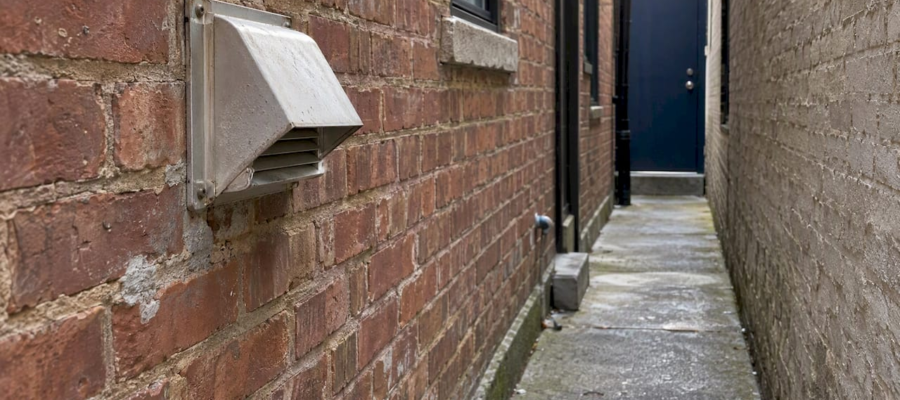
It starts at the back of the dryer, where a transition duct connects to a rigid duct in the wall, floor or ceiling. That duct runs to a hood on an exterior wall. Roof terminations are discouraged, and in NYC houses a gas dryer’s outlet must be at least 3 feet above grade.
Are indoor dryer vents up to code?
No, not for a standard vented dryer. Code requires exhaust to the outside of the building. The exception is a listed and labeled condensing (ductless) electric dryer, which collects moisture internally.
Is the NYC dryer vent code different from the rest of New York State?
Yes, in the details. NYC enforces its own Mechanical Code and filing rules, including the LAA1 requirement for some gas dryers. The rest of the state follows the state mechanical code, which, among other things, prohibits domestic booster fans.
Sources
- Title 19 Official Compilation of Codes, Rules and Regulations, Part 1223 (NY Department of State)
- Section MC 504: Clothes Dryer Exhaust, NYC Mechanical Code
- 1 RCNY §101-02, NYC Department of Buildings
- Chapter 5 Exhaust Systems, Mechanical Code of New York State
- Proper Clothes Dryer Venting, Building America Solution Center
- Vent a Clothes Dryer, U.S. Department of Energy
Recommended
- Stop Lint Fires: 35 Foot Limit and Key NJ Dryer Vent Rules
- NY/NJ/CT Property Managers: Pass IMC 504.11 for Multi Unit Dryer Vents
- Landlord Dryer Vent Responsibilities in NY, NJ and CT
- Maximum Dryer Vent Length: The 35-Foot Code Rule Explained